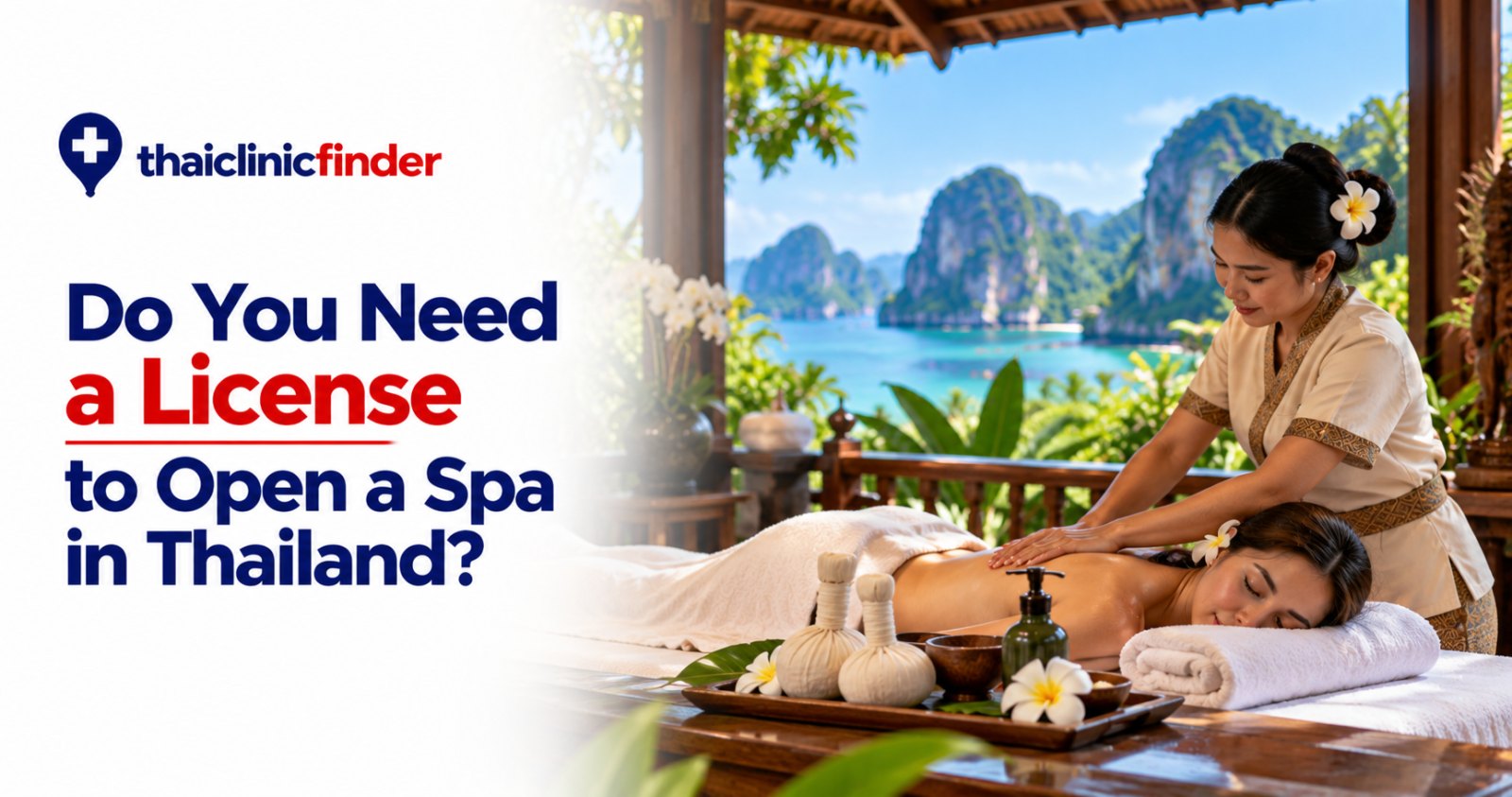
Yes. If you want to open a business that legally operates as a health spa in Thailand, you normally need a licence under Thailand's Health Establishment Act and related Ministry of Public Health regulations.
Opening the company itself is not enough. Thailand regulates the establishment, the spa operator or manager and the individual service providers separately. Foreign investors can also face additional company-ownership and Foreign Business Act requirements because spa services fall within Thailand's service-business framework.
The exact process depends on whether the business is a health spa, health massage business, beauty massage establishment or a clinic providing medical aesthetic procedures.
A spa is a regulated health establishment in Thailand
Thailand regulates spas under the Health Establishment Act B.E. 2559 (2016).
The Department of Health Service Support, part of the Ministry of Public Health, is responsible for the licensing framework for establishments such as:
- health spas
- health massage businesses
- massage for beauty businesses
A business falling within this system cannot simply register a company, rent a shop and begin operating as a spa.
It needs the appropriate health-establishment authorization.
There are several different licences and registrations
One of the most confusing aspects of opening a spa in Thailand is that there is not only one licence.
The regulatory structure can involve:
- a licence for the health establishment itself
- a licence for the person acting as spa operator or manager
- registration or certification of individual service providers
These are separate requirements.
Having a licensed massage therapist does not replace the establishment licence, and owning the licensed company does not automatically make the owner a licensed spa operator.
The establishment needs its own licence
The physical spa business must apply for permission to operate as a health establishment.
The Department of Health Service Support publishes a specific citizen guide for applications to operate a health spa establishment.
The authorities review issues such as:
- the applicant or legal entity
- the business premises
- ownership or lease documentation
- safety standards
- hygiene
- layout
- service areas
- required personnel
The premises therefore need to meet regulatory standards before the business can legally operate.
The spa must have an approved operator
Thailand also requires a spa to have a person responsible for operating the establishment.
The Department of Health Service Support states that a person performing the role of spa operator must hold the appropriate operator licence and satisfy the qualifications established under the Health Establishment Act.
The operator is not simply a receptionist or company director.
The role carries responsibility for ensuring the spa operates according to the health-establishment rules.
The spa operator may need to pass an assessment
Thailand operates an examination and competency-assessment process for people seeking a spa-operator licence.
The Department of Health Service Support continues to organize assessments for the category of spa operator, including its 2026 licensing cycle.
An applicant therefore cannot necessarily designate any employee as the licensed operator.
The person needs to satisfy the current qualification and assessment requirements.
Massage therapists and other service providers also need registration
People providing regulated services inside the spa may need to be registered as approved service providers.
The Department of Health Service Support operates a separate registration process for people working in:
- spas
- health massage establishments
- beauty massage establishments
A business should therefore check the qualifications of every therapist before allowing them to provide regulated services.
Using unregistered personnel can create problems even if the establishment itself has a licence.
The premises must meet specific standards
Thai regulations establish standards covering location, safety and service provision for spas and massage establishments.
Requirements can involve matters such as:
- appropriate treatment rooms
- cleanliness
- ventilation
- toilets
- equipment
- safe storage
- service areas
- signage
- emergency arrangements
The exact requirements depend on the type of establishment and services offered.
This means choosing a commercial unit before checking spa regulations can be an expensive mistake.
A property that works for a normal retail shop may need changes before it can be approved as a spa.
Renting a property requires supporting documents
The Department of Health Service Support lists documentation relating to the premises among the application requirements.
Where the applicant rents the location, documents can include:
- lease agreement
- proof relating to the property
- consent to use the premises for the spa business
- documents relating to the landlord
The entity applying for the establishment licence should be properly connected to the lease arrangement.
This is worth checking before signing a long commercial lease.
The company must have the correct business objective
For a corporate applicant, the Department of Health Service Support requires company-registration documentation showing that the legal entity has an appropriate objective covering the operation of a health establishment.
A Thai company registered for an unrelated business activity should not simply assume it can begin operating a spa without updating its corporate documents where necessary.
Company registration and spa licensing are different steps, but they need to be consistent with one another.
Applications can now be handled online
The Department of Health Service Support expanded its online system in 2026 for spa, health massage and beauty massage establishments.
The system supports services including:
- new establishment licence applications
- licence renewals
- licence transfers
- information changes
- annual fee payments
- service-provider registration
- spa-operator licensing
The current online platform is operated through the Department of Health Service Support's electronic health-establishment system.
Spa licences are not permanent
Thailand's current online licensing information states that establishment licences can be renewed and refers to a five-year licence period for health establishments.
Business owners should therefore plan for ongoing compliance rather than treating licensing as a one-time company-formation exercise.
Annual fees and regulatory updates may also apply.
A normal spa is different from a medical clinic
This distinction is extremely important.
A health spa can provide permitted wellness and spa services, but it does not automatically have permission to provide medical treatment.
Procedures involving medical practice can bring the business under Thailand's separate healthcare-facility and professional licensing laws.
Examples that may require a medical clinic structure rather than an ordinary spa include certain:
- injectable treatments
- medical aesthetic procedures
- prescription treatments
- physician-delivered procedures
If the business will provide Botox, fillers or other medical aesthetic treatments, it should not rely only on a spa licence.
For a broader overview of aesthetic procedures available locally, see Best Aesthetic Treatments in Thailand: Options and Costs.
Calling the business a wellness center does not necessarily avoid licensing
What matters is what the establishment actually does, not only the name on the sign.
A business called a wellness studio, beauty center or relaxation lounge can still fall within regulated health-establishment rules if it provides services covered by the legislation.
Before opening, identify every intended service and confirm which regulatory category applies.
Can a foreigner own a spa in Thailand?
This is more complicated than the health-establishment licence itself.
Foreigners can invest in businesses in Thailand, but Thailand's Foreign Business Act restricts foreign participation in many service businesses.
The Board of Investment's current business guidance explains that the category of other service businesses generally falls within List 3 of the Foreign Business Act unless a specific exemption applies.
A company considered foreign under the Act may therefore require a Foreign Business License or another qualifying route before conducting a restricted service business.
What counts as a foreign company?
Under the Foreign Business Act framework, a Thai-registered company can still be considered foreign when 50% or more of its capital is held by foreigners or foreign entities, subject to the detailed statutory definition.
This is why the company structure matters.
Simply incorporating a Thai limited company does not automatically remove foreign-business restrictions.
Foreign investors have several possible structures
The Board of Investment's current business guide explains that foreign investors wishing to own more than 49% of a business subject to Foreign Business Act restrictions can potentially use routes such as:
- Foreign Business License
- Foreign Business Certificate associated with qualifying BOI promotion
- Treaty of Amity route for eligible U.S. investors
Whether any of these routes applies to a specific spa business needs to be checked before investment.
Do not use nominee Thai shareholders to disguise foreign ownership. Ownership arrangements should reflect the real investment structure and comply with Thai law.
A foreigner owning the company and working in the spa are separate issues
Even when a foreigner can legally own or invest in the company, that does not automatically give permission to work in Thailand.
Working in the business can require appropriate immigration status and work authorization.
Professional and occupational restrictions may also affect what activities a foreign worker can personally perform.
An investor who owns shares, a managing director and a therapist can therefore face different regulatory requirements.
Can a foreigner personally provide massage services?
Foreign employment restrictions are a separate issue from spa licensing.
Before hiring a foreign therapist or personally performing services, check whether the activity is legally available to foreign workers and what professional registration is required.
Do not assume that obtaining a work permit automatically authorizes every occupation.
The establishment should verify the status of both Thai and foreign staff before they begin providing services.
What services can a licensed spa provide?
Thailand's Ministry of Public Health determines the services permitted within health-spa establishments.
A spa can typically center on wellness services such as massage and other recognized spa treatments within the regulatory framework.
However, the permitted scope should be checked against the current Ministry of Public Health list of approved spa services.
Adding a new treatment because it is popular overseas does not automatically make it legally permissible under the existing spa licence.
Selling products may create additional obligations
Many spas also sell:
- cosmetics
- skincare
- herbal products
- supplements
- essential oils
Retail activity can introduce additional legal considerations, particularly for foreign-owned businesses under the Foreign Business Act.
Products themselves may also be regulated by the Thai FDA depending on whether they are cosmetics, medicines, foods or health products.
A spa licence does not automatically authorize the sale of every wellness product.
Alcohol, food and other services can require separate permissions
Some premium spas operate cafes, restaurants or hospitality services alongside treatments.
These activities may involve additional licences or registrations.
For example, food preparation, alcohol sales and hotel operations have their own regulatory frameworks.
The safest approach is to map every revenue-generating activity before setting up the company rather than adding services after opening without checking the legal consequences.
How long does it take to obtain a spa licence?
Processing time depends on the completeness of the application, premises and authority responsible for the location.
The licensing process can involve document review and verification that the premises meet the required standards.
A business should therefore not commit to an opening date based only on the time required to incorporate the company.
Fit-out, staff registration and health-establishment approval can take additional time.
Can you open first and apply later?
That is not the correct sequence.
A regulated spa should obtain the required approval before operating the licensed activity.
Operating first and trying to regularize the business afterward can expose the owner to regulatory action and creates unnecessary risk with landlords, employees and customers.
Licensing should be part of the pre-opening plan.
How can customers check whether a spa is licensed?
The Department of Health Service Support maintains a public verification system for certified establishments.
The database covers:
- spas
- health massage establishments
- beauty massage establishments
Consumers can search for establishments that have been certified by the Department of Health Service Support.
For a business owner, appearing correctly in this system also provides useful evidence that the establishment has completed the formal regulatory process.
Basic steps to open a spa in Thailand
A simplified process looks like this:
- Decide exactly which services the spa will provide.
- Determine whether the business falls under spa, health massage, beauty massage or medical-clinic rules.
- Choose a legal business structure.
- Check foreign ownership restrictions before investing if foreign shareholders are involved.
- Select premises capable of meeting health-establishment standards.
- Ensure the lease permits the intended use.
- Prepare the required company and premises documents.
- Appoint a qualified and licensed spa operator where required.
- Register eligible service providers.
- Apply for the health-establishment licence.
- Complete any inspection or compliance requirements.
- Open only after the necessary approvals are in place.
The order can vary depending on the business and location.
Documents commonly required
The exact checklist should be confirmed with the Department of Health Service Support, but applications can involve documents such as:
- company registration certificate
- identification documents
- medical certificate for relevant applicants
- property registration information
- lease agreement
- landlord consent
- premises information
- operator documentation
- service-provider registration records
Corporate documents may need to be recent and properly certified.
Bangkok and provincial applications can follow different administrative channels
The competent office can depend on where the spa is located.
For Bangkok establishments, the Department of Health Service Support provides specific application channels and currently supports online applications.
Provincial establishments can involve the relevant provincial public-health authorities and Department of Health Service Support network.
Do not assume that a process used for a Phuket spa is identical to one used in Bangkok.
How much does a spa licence cost?
Thailand has official fees associated with health-establishment licensing, operator licensing and related transactions.
The precise amount depends on the licence and business category and can be updated by regulation.
Licence fees are generally not the largest startup expense compared with:
- rent
- renovation
- equipment
- staff
- company formation
- deposits
However, compliance costs should be included in the financial plan from the beginning.
The biggest licensing mistakes to avoid
Common planning mistakes include:
- assuming company registration is the spa licence
- signing a lease before checking whether the premises can comply
- hiring unregistered service providers
- failing to appoint a properly licensed operator
- mixing spa and medical aesthetic services without the correct facility licence
- using an unsuitable foreign-ownership structure
- adding regulated products or services without checking additional rules
Fixing these problems after the fit-out can be expensive.
Questions to answer before opening
Before committing capital, confirm:
- Which health-establishment category applies?
- Which establishment licence is required?
- Does the business need a licensed spa operator?
- Which workers require service-provider registration?
- Does the property meet spa standards?
- Does the lease permit the activity?
- Will foreigners own 50% or more of the company?
- Is a Foreign Business License or Certificate required?
- Will any foreigner work in the business?
- Will the spa provide medical procedures?
- Will products, food or alcohol also be sold?
- Which government office processes the application?
Getting these answers before fitting out the premises can prevent major restructuring later.
So, do you need a licence to open a spa in Thailand?
Yes. A health spa in Thailand normally needs a health-establishment licence before it can legally operate.
The business must also satisfy premises and safety standards, have an appropriately licensed spa operator where required and use properly registered service providers.
Foreign investors have another layer to consider. A foreign-majority spa company may also fall under Foreign Business Act restrictions on service businesses, potentially requiring a Foreign Business License, Foreign Business Certificate or another lawful structure.
The practical lesson is that opening a Thai spa involves more than registering a company. The company structure, premises, staff, spa operator and services all need to fit the correct regulatory framework before opening to customers.
Frequently Asked Questions
Do you need a licence to open a spa in Thailand?
Yes. A business operating as a regulated health spa normally requires a health-establishment licence under Thailand's Health Establishment Act and related Ministry of Public Health regulations.
Does a spa manager need a licence in Thailand?
A person acting as the regulated spa operator must meet the statutory qualifications and obtain the appropriate operator licence. The Department of Health Service Support runs a competency assessment process for spa operators.
Do massage therapists need to be registered in Thailand?
Service providers working in regulated spas, health massage establishments and beauty massage establishments can be required to register under the Department of Health Service Support system.
Can a foreigner own a spa in Thailand?
Foreign investment is possible, but service businesses can be restricted under the Foreign Business Act. A foreign-majority company may require a Foreign Business License, qualifying Foreign Business Certificate or another lawful route depending on the structure.
Can a spa provide Botox or fillers in Thailand?
A normal spa licence should not be assumed to authorize medical aesthetic procedures. Services involving medical practice can require a separately licensed healthcare facility and appropriately licensed medical professionals.
How long is a spa establishment licence valid in Thailand?
Current Department of Health Service Support information refers to a five-year licence cycle for regulated health establishments, with renewal and annual administrative requirements.
Can you apply for a spa licence online in Thailand?
Yes. The Department of Health Service Support currently provides an online system for new licences, renewals, transfers, amendments, annual fees and related spa transactions.
How can I check if a spa in Thailand is licensed?
The Department of Health Service Support operates a public database where certified spas, health massage businesses and beauty massage establishments can be checked.
Sources
- Department of Health Service Support - Health Establishment Laws and Spa Regulations
- Department of Health Service Support - Spa, Massage and Beauty Establishment Verification
- Department of Health Service Support - Health Establishment Licensing Q&A
- Thailand Board of Investment - Quick Guide to Starting a Business in Thailand
- Thailand Board of Investment - Foreign Business License and Certificate
Writer
Niran Chaiyasit
Health writer with a background in public and travel health
Niran Chaiyasit is a Thai health writer with a background in public health and a focus on travel health, disease prevention and healthcare access in Thailand.
View profile
Medical review
Sumait Premmanisakul
Medical Director (Thailand)
Dr. Sumait Premmanisakul is Medical Director (Thailand) at Global Doctor Bangkok. His work spans aviation medicine, occupational medicine and travel medicine. The clinic lists him on its medical team in Bangkok, where it serves residents and travellers from its Asoke and Silom locations.
View profile