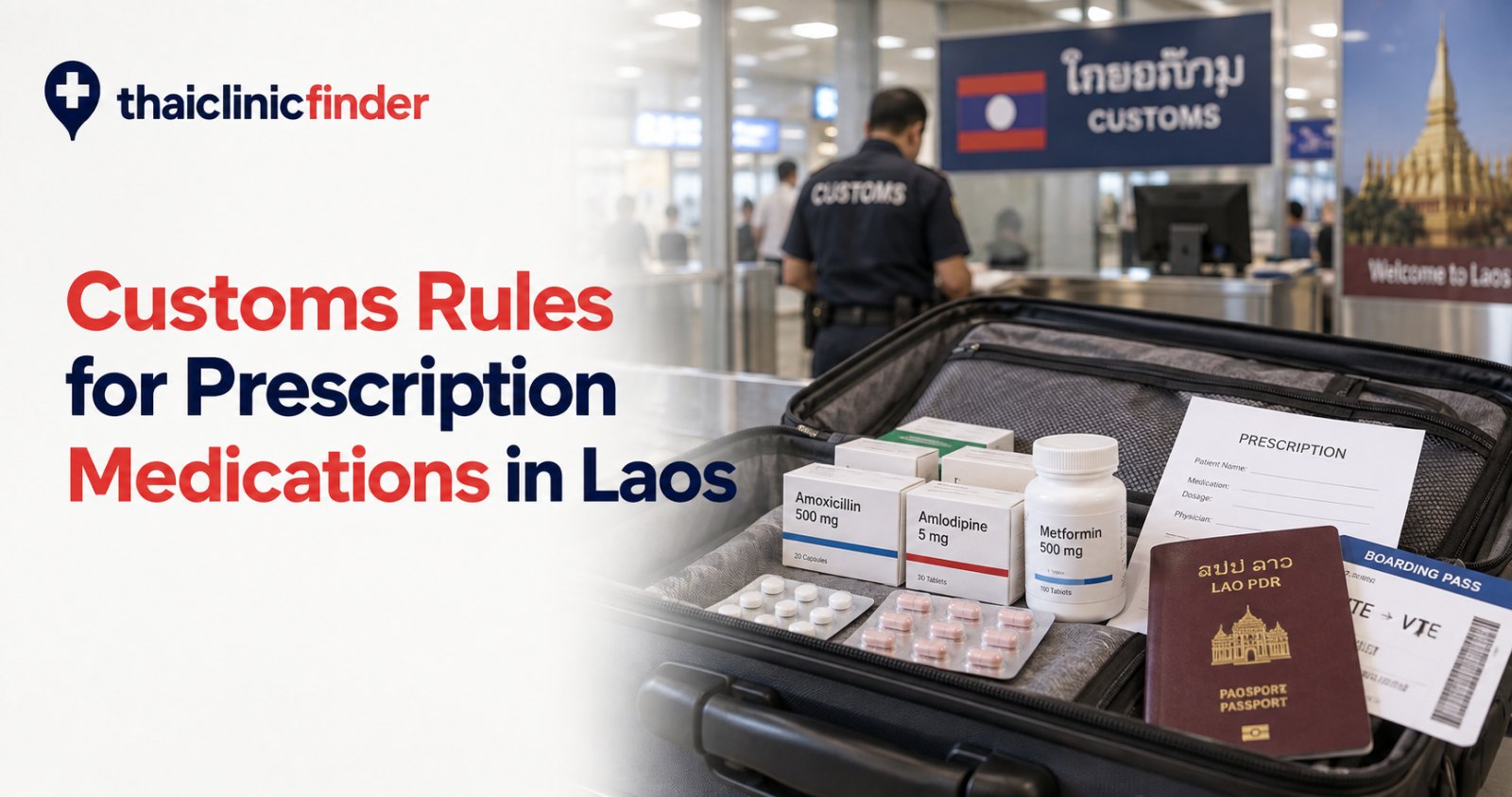
Traveling to Laos with medication requires more preparation than simply packing enough tablets for the trip. Lao law recognizes possession of medicines for individual use while traveling, but the country also regulates drug importation through the Ministry of Health.
For ordinary daily medication, the safest approach is to carry a modest personal supply in original packaging with a valid prescription. Controlled, narcotic or psychotropic medicines need closer checking because legal classifications can differ from those in your home country.
English-language traveler guidance is less detailed than in some neighboring countries, so travelers with controlled medicines should confirm requirements before departure with a Lao embassy or the Food and Drug Department.
Lao law recognizes medicine for individual travelers
The Lao Law on Drugs and Medical Products includes medicines for individual use when travelling among categories of drugs that may lawfully be possessed.
That is helpful for people bringing medication for their own treatment.
It should not be read as permission to import unlimited quantities or every controlled drug without documentation.
The broader Lao regulatory system also requires Ministry of Health oversight for drug imports.
Commercial import rules are not the same as personal luggage
The Lao Trade Portal states that an import permit from the Ministry of Health is required to import drugs commercially and that imported medical products are subject to health inspection.
A traveler carrying prescribed tablets for personal treatment is not operating as a pharmaceutical importer.
Still, this formal regulatory framework means travelers should avoid assumptions based on how easily a medicine can be bought locally.
Personal carriage and commercial import are legally different situations.
Carry your prescription and original packaging
Current U.S. travel guidance for Laos advises travelers to carry prescription medicines in their original packaging together with the doctor's prescription.
This is a sensible minimum standard.
Carry:
- original packaging
- prescription
- generic medicine name
- dosage and strength
- enough medicine for the intended stay
For medicines likely to be controlled, add a doctor's letter.
Why generic drug names matter
Brand names differ across Southeast Asia.
Customs officials and pharmacists will have a clearer understanding of an ingredient such as clonazepam, methylphenidate or morphine than of a foreign trade name.
Your doctor's documentation should ideally list both the generic and brand names.
Controlled medicines require extra caution
Lao drug legislation recognizes a separate category for toxic, narcotic and dangerous medicines determined by the Ministry of Health.
The legal status of some medicines prescribed routinely elsewhere can therefore be different in Laos.
Extra checking is sensible for:
- opioid pain medicines
- benzodiazepines
- ADHD stimulants
- sleeping medicines
- selected psychiatric medicines
Do not assume a foreign prescription automatically gives permission to import a controlled substance.
Laos does not publish a simple universal traveler allowance in the sources reviewed
There is no clear official English-language rule in the sources reviewed that gives every traveler a single fixed 30-day or 90-day allowance for all prescription medicines.
For ordinary medication, carry an amount that matches the duration of your trip and prescription.
For controlled medication, ask the Lao embassy or Food and Drug Department specifically about:
- allowed quantity
- required medical documents
- whether prior authorization is necessary
- whether the medicine should be declared
Pharmacies in Laos are not a substitute for planning
U.S. government travel guidance notes that pharmaceuticals can be easier to purchase in Laos but may be subject to fewer controls, and it warns about counterfeit medicines.
UK travel guidance similarly advises that larger pharmacies and international clinics can supply many medicines, while availability becomes more limited in remote areas.
Bring enough regular medication rather than assuming a replacement will be easy to find.
Long trips need additional preparation
A traveler staying in Laos for several months may need more medicine than feels obviously consistent with a holiday supply.
Before bringing a large quantity:
- ask whether the amount is permitted as personal use
- obtain a doctor's letter explaining the treatment period
- keep the prescription
- ask whether any additional authorization is needed
Do not solve the issue by mailing medicine later without checking the separate import rules.
Mailing medicine can trigger formal import requirements
An international parcel containing medicine is not the same as medication in a traveler's luggage.
The Lao Trade Portal states that drug imports are subject to Ministry of Health authorization and inspection.
For that reason, sending medicine by courier can be more complicated than carrying an approved personal supply.
Plan ahead if you rely on a medicine that may not be easy to obtain in Laos.
ADHD medication should be checked before travel
Stimulant medications are a category where travelers should be particularly careful.
Different countries classify amphetamines and methylphenidate differently.
Do not enter Laos with an ADHD medicine simply because it is legal in Thailand or prescribed in Europe or North America.
Send the embassy the exact active ingredient, strength, quantity and duration of treatment and request current guidance.
Sedatives and sleeping medicines can be controlled
Benzodiazepines and related sedating drugs are also subject to tighter drug-control systems in many countries.
If you take medication for anxiety, insomnia or seizures, obtain specific guidance before travel.
A doctor's letter should not merely say anxiety medicine. It should identify the actual drug and dose.
Pain medication can create border issues
Strong opioid pain medicines can be classified as narcotics.
Someone traveling with opioids after surgery or for chronic pain should have strong documentation and obtain advance confirmation when possible.
Do not carry substantially more medication than the prescribed treatment requirement without authorization.
Medical care outside Vientiane can be limited
Travel planning matters because replacing a lost medicine may be difficult outside the capital.
UK travel guidance states that medical care in Laos can be basic and that reliable emergency facilities outside Vientiane are limited.
The Australian Embassy in Laos advises travelers to bring sufficient quantities of regular prescription medicine for the entire trip.
This is especially important for medicines that should not be stopped abruptly.
Counterfeit medicine is a practical concern
Both U.S. government and CDC guidance warn about counterfeit or poor-quality medicines in Laos.
If you lose essential medication:
- contact a recognized medical provider
- provide the generic drug name
- show the prescription
- use an established pharmacy
Do not buy medicine from an informal market simply because the box resembles your usual product.
Crossing from Thailand into Laos
Many visitors reach Laos through Thailand.
The two countries have different medication rules.
A medicine legally carried into Thailand under Thai FDA traveler requirements should not automatically be assumed legal for onward entry into Laos.
If you are entering Thailand first, see Customs Rules for Prescription Medications in Thailand and check the Lao rules separately before crossing the border.
A practical checklist before entering Laos
Before traveling:
- List the generic names of your medicines.
- Keep the original labeled containers.
- Carry the doctor's prescription.
- Obtain a doctor's letter for controlled or unusual medicines.
- Check whether the ingredient is narcotic, psychotropic or otherwise controlled.
- Contact a Lao embassy when the classification is uncertain.
- Carry an amount consistent with personal treatment.
- Keep essential medicine in hand luggage.
- Avoid relying on international courier shipments.
- Keep digital copies of medical documents.
The practical answer
Lao law recognizes possession of medicines for personal use while traveling, which supports ordinary travelers carrying legitimate medication for themselves.
However, Laos also regulates drug imports through the Ministry of Health, and controlled substances require more careful checking.
Because official traveler-specific English guidance is relatively limited, anyone taking a narcotic, stimulant, benzodiazepine or other controlled medicine should confirm the exact requirements before travel rather than relying on assumptions from neighboring countries.
Frequently Asked Questions
Can I bring prescription medication into Laos?
Lao law recognizes possession of medicines for individual use while traveling. Carry original packaging and a valid prescription, and check controlled medicines separately.
How much medicine can I bring to Laos?
The official English-language sources reviewed do not provide one universal personal-use day limit for every medicine. Carry an amount appropriate to the trip and request specific guidance for controlled drugs or large quantities.
Do I need a permit for ADHD medication in Laos?
Rules depend on the active ingredient. Because stimulants can be controlled, travelers should confirm requirements with a Lao embassy or the Food and Drug Department before travel.
Can I buy replacement prescription medicine in Laos?
Many medicines are available in larger cities, but availability and quality can vary. Official travel guidance warns about counterfeit medicines, so use established medical providers and pharmacies.
Can I mail prescription medicine to Laos?
Do not assume so. Formal drug imports are subject to Ministry of Health requirements, which can make courier shipments different from personal luggage.
Sources

Writer
Niran Chaiyasit
Niran Chaiyasit is a Thai health writer with a background in public health and a focus on travel health, disease prevention and healthcare access in Thailand. His work covers topics such as common illnesses, vaccinations, mosquito-borne diseases, food safety and practical health information for travelers and expatriates.

Medical review
Justin Brooks
Daniel Brooks is an American health writer with a background in health sciences and a focus on rehabilitation, musculoskeletal health and patient education. He writes about physiotherapy, injury recovery, pain management, preventive health and practical healthcare guidance for international patients and travelers.