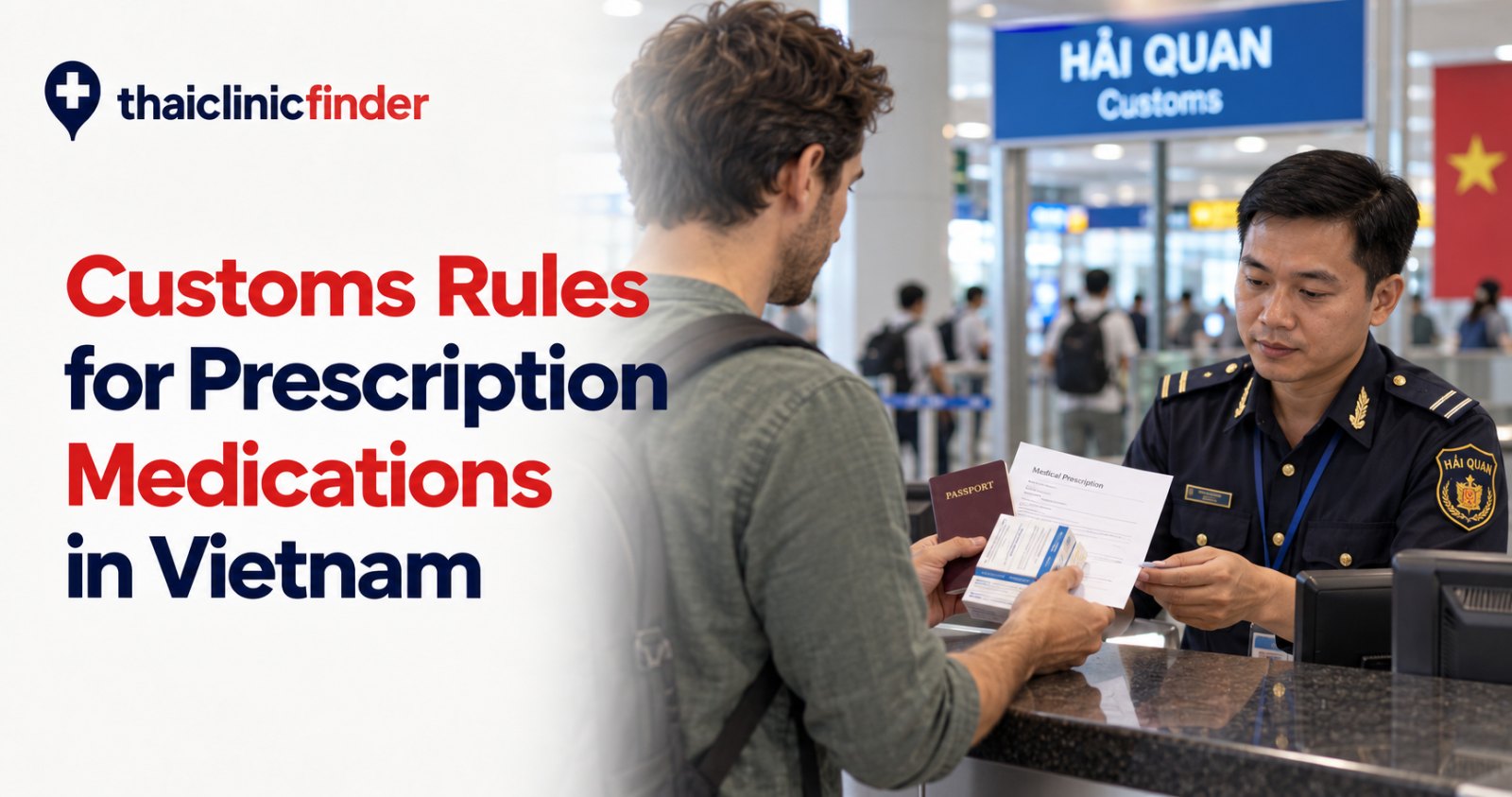
Travelers can bring prescription medication into Vietnam for their own treatment, but the rules depend on the type of medicine, quantity and customs value.
The most important distinction is between ordinary prescription medicines and medicines Vietnam classifies as addictive, narcotic, psychotropic or precursor drugs. Controlled medicines can have much shorter personal-use limits than travelers expect.
Vietnam also applies customs and non-commercial import rules to ordinary medicines, so carrying a large or expensive supply can require more preparation even when the medicine itself is not controlled.
Ordinary prescription medicine can be carried for personal treatment
Vietnamese Ministry of Health procedures recognize the non-commercial import of medicine for an individual's own treatment.
For an ordinary prescription medicine, travel with:
- the original labeled packaging
- a copy of the prescription
- the generic active ingredient
- strength and daily dose
- a doctor's letter when the treatment is important, unusual or the quantity is substantial
Current foreign-government travel guidance also recommends carrying clear medical documentation and checking that the medicine is legal in Vietnam before departure.
A prescription issued abroad is useful evidence of legitimate treatment, but it does not automatically override Vietnamese controlled-drug law.
Controlled medicines have stricter quantity limits
Vietnam applies specific thresholds to medicines classed as addictive, psychotropic or precursor drugs.
Current Ministry of Health administrative guidance states that quantities above the following limits require additional import authorization:
- addictive or narcotic medicines: more than 7 days of treatment
- psychotropic or precursor medicines: more than 10 days of treatment
These limits are calculated from the prescribed daily dose, not simply the number of tablets in the box.
That means a traveler with a 30-day prescription cannot assume the entire supply can automatically be carried into Vietnam if the medicine falls into one of these controlled categories.
The 7-day and 10-day limits are different
This distinction is easy to miss.
Vietnam does not use one single controlled-medicine allowance for every restricted drug.
The current framework distinguishes between:
- 7 days for addictive or narcotic medicines
- 10 days for psychotropic or precursor medicines
If you are unsure which category your medicine belongs to, check the active ingredient with Vietnamese authorities rather than trying to infer the answer from what the medicine is used for.
What if you need more than the normal controlled-medicine allowance?
Vietnam has a formal non-commercial import procedure for patients who need quantities above the usual traveler thresholds.
If your treatment genuinely requires more than the standard controlled-drug limit, obtain guidance before departure.
You may need to provide documents such as:
- prescription
- doctor's letter
- medicine name and active ingredient
- daily dose
- total quantity
- expected treatment duration
Do not plan to arrive with an excess controlled supply and sort out authorization at the airport.
Ordinary medicines can also be affected by value limits
For medicines that are not narcotic, addictive, psychotropic or precursor drugs, Vietnam's non-commercial import procedures can also consider the customs value of the medicine.
Current Ministry of Health administrative material refers to an ordinary non-commercial framework for medicines with a customs value not exceeding USD 200 per import under the relevant procedure.
Separately, current UK travel guidance states that prescription medicine with a total import value above USD 100 should be declared to Vietnamese customs.
These are not the same rule.
The first relates to Vietnam's medicine import procedure, while the second is a customs declaration issue.
If you carry expensive medication, keep invoices or pharmacy receipts where possible.
Keep every medicine in original packaging
Do not arrive with several weeks of tablets loose in an unmarked container.
Original packaging makes it easier to identify:
- active ingredient
- dose
- formulation
- manufacturer
- prescribing instructions
You can still use a pill organizer after entering Vietnam, but keep the original box, bottle or blister packaging while crossing the border.
Your doctor's letter should be specific
A vague letter saying the patient requires medication is less useful than one that clearly identifies the treatment.
For controlled medicines, ask your doctor to include:
- your full name
- medicine name
- generic active ingredient
- strength
- dosage
- total quantity
- treatment duration
- doctor's signature and contact details
Using the generic name is especially important because brand names can differ between Vietnam and your home country.
ADHD medication needs careful checking
Travelers taking ADHD medicine should not assume their prescription is automatically legal in Vietnam.
Some stimulant medicines can fall under strict psychotropic or controlled-drug rules, and current U.S. travel guidance specifically warns that certain ingredients used in ADHD medication may be illegal or heavily restricted.
Before travel:
- identify the exact active ingredient
- confirm whether Vietnam classifies it as controlled or prohibited
- check the permitted quantity
- carry the prescription and doctor's letter
- obtain written official confirmation if the status is unclear
Do not rely on another traveler's experience if they take a different ADHD medicine.
Benzodiazepines can fall under psychotropic-drug rules
Medicines used for anxiety, sleep disorders or seizures may be classified as psychotropic substances.
This can include some benzodiazepines and related sedatives.
If your medicine falls into this category, the 10-day psychotropic threshold may apply before additional authorization is needed.
Check the exact ingredient rather than assuming all anxiety medication follows the same rule.
Strong pain medicines can fall under the 7-day narcotic limit
Opioid pain medicines can be treated as addictive or narcotic drugs under Vietnamese law.
This is particularly relevant for people traveling after surgery or receiving treatment for chronic pain or cancer.
For these medicines, the 7-day threshold can become important.
If your treatment requires a larger supply, arrange permission before travel and carry detailed medical documentation.
High-dose codeine deserves particular attention
Current U.S. travel information for Vietnam specifically warns that high-dose codeine is among medicines that can be prohibited or tightly controlled.
Combination pain or cough medicines may contain codeine even when the brand name does not make this obvious.
Always check the ingredient list rather than assuming a common pharmacy product is unrestricted.
Pseudoephedrine can also create problems
Pseudoephedrine is another ingredient highlighted in current travel guidance for Vietnam.
It can appear in cold and sinus medicines.
This is a good example of why a product that feels routine at home can be regulated differently abroad.
Before traveling with a combination cold medicine, check every active ingredient.
Medical cannabis does not automatically transfer across borders
A prescription for cannabis issued in another country does not mean the product can legally enter Vietnam.
Current U.S. travel guidance states that marijuana and its derivatives are illegal in Vietnam.
Do not carry:
- cannabis flower
- THC oil
- cannabis edibles
- THC-containing prescription products
without explicit official confirmation that the exact product is lawful.
A foreign medical-cannabis card or prescription should not be treated as permission under Vietnamese law.
Injectable and refrigerated medicines need extra planning
Travelers carrying injectable medicines should keep appropriate documentation, especially when carrying:
- syringes
- needles
- injection pens
- refrigerated medication
Examples can include insulin, biologic medicines and fertility treatments.
Carry a medical letter explaining the need for the medicine and equipment.
For refrigerated medicines, plan how to maintain the correct storage temperature during travel without freezing the product.
Do not assume you can easily replace your medicine in Vietnam
Vietnam has a large pharmacy market, but the exact product you use at home may not be available.
Brand names differ, and some imported or specialist medicines can be difficult to source.
There is also a counterfeit and substandard medicine risk, particularly outside reputable medical channels.
If you lose an important medicine:
- contact a recognized hospital or clinic
- show your prescription and medicine list
- provide the generic ingredient and strength
- use a reputable pharmacy
Do not buy an unknown replacement simply because the packaging looks similar.
Long-term travelers need a continuity plan
A short holiday and a six-month stay create very different medication problems.
If you need regular medication for several months, plan before departure rather than assuming you can carry an unrestricted long-term supply.
Useful options can include:
- obtaining the permitted initial supply
- arranging follow-up with a doctor in Vietnam
- confirming whether the medicine is registered locally
- asking whether a Vietnamese prescription can be issued when clinically appropriate
Do not depend on repeated international shipments unless you have checked Vietnam's separate import rules.
Mailing medication is different from carrying it
The rules for medicine sent by courier or post are not necessarily the same as the rules for medication in a traveler's luggage.
Vietnam has formal non-commercial medicine import procedures, and repeated or high-value shipments can require authorization.
A personal-use exception at the airport should not be assumed to apply to an international parcel.
If you expect to run out during a long stay, investigate local medical follow-up before travel.
Buying medicine in Thailand before entering Vietnam does not change Vietnamese law
Some regional travelers purchase medicines in Thailand before continuing to Vietnam because Thai pharmacies can offer a broad range of products.
That does not change what Vietnamese customs permits.
A medicine legally purchased in Bangkok can still be restricted when you enter Vietnam.
For the Thai side, see Customs Rules for Prescription Medications in Thailand.
If you are comparing medicine costs before onward travel, our Thailand Pharmacy Price List explains how Thai reference prices and retail prices differ.
Carrying medicines through several Southeast Asian countries
Every border needs to be checked separately.
Cambodia, Laos, Malaysia, Myanmar, Thailand and Vietnam do not use one regional medication rule.
A medicine and quantity that is permitted in one country can be restricted or prohibited in the next.
This matters particularly for:
- ADHD stimulants
- benzodiazepines
- opioid pain medicines
- sleeping tablets
- cannabis products
Plan the itinerary country by country.
A practical checklist before entering Vietnam
Before departure:
- Make a list of every prescription medicine.
- Write down the generic active ingredient.
- Check whether any medicine is narcotic, addictive, psychotropic or a precursor.
- Keep medicines in original labeled packaging.
- Carry the prescription.
- Obtain a detailed doctor's letter for controlled medicines.
- Check whether the supply exceeds 7 days for addictive drugs or 10 days for psychotropic or precursor medicines.
- Check whether the medicine's value requires a customs declaration.
- Keep essential medication in hand luggage.
- Confirm Vietnamese rules before carrying cannabis, stimulants, high-dose codeine or pseudoephedrine.
The practical answer
Vietnam allows travelers to carry legitimate prescription medicine for personal treatment, but the rules become much stricter for controlled substances and larger quantities.
The most important current thresholds are 7 days for addictive or narcotic medicines and 10 days for psychotropic or precursor medicines before additional import authorization is required.
Ordinary medicines can also be affected by customs-value requirements, and current UK travel guidance says prescription medicines worth more than USD 100 should be declared.
For routine medicine, original packaging and a prescription are the minimum preparation. For stimulants, benzodiazepines, opioids, codeine, pseudoephedrine or other potentially controlled substances, verify the exact active ingredient before departure rather than relying on a foreign prescription alone.
Frequently Asked Questions
Can I bring prescription medicine into Vietnam?
Yes. Travelers can bring medicines for legitimate personal treatment, but controlled medicines and larger or high-value supplies have additional requirements.
How much narcotic medicine can I bring into Vietnam?
Current Ministry of Health guidance uses a **7-day treatment threshold** for addictive or narcotic medicines before additional authorization is required.
How much psychotropic medicine can I bring?
Current guidance uses a **10-day treatment threshold** for psychotropic or precursor medicines before additional authorization is required.
Do I need to declare prescription medication in Vietnam?
Current UK travel guidance states that prescription medicines with a total import value above **USD 100** should be declared to customs. Controlled drugs can have separate authorization requirements.
Can I bring ADHD medication into Vietnam?
It depends on the active ingredient. Some stimulant medicines can be illegal or tightly controlled, so confirm the exact medicine before travel.
Can I bring benzodiazepines into Vietnam?
Some benzodiazepines can fall under Vietnam's psychotropic-drug rules. Check the ingredient, quantity and documentation before departure.
Can I bring medical cannabis into Vietnam?
Do not assume so. Current travel guidance states that marijuana and its derivatives are illegal in Vietnam, including products legally prescribed elsewhere.
Sources

Writer
Niran Chaiyasit
Niran Chaiyasit is a Thai health writer with a background in public health and a focus on travel health, disease prevention and healthcare access in Thailand. His work covers topics such as common illnesses, vaccinations, mosquito-borne diseases, food safety and practical health information for travelers and expatriates.

Medical review
Justin Brooks
Daniel Brooks is an American health writer with a background in health sciences and a focus on rehabilitation, musculoskeletal health and patient education. He writes about physiotherapy, injury recovery, pain management, preventive health and practical healthcare guidance for international patients and travelers.