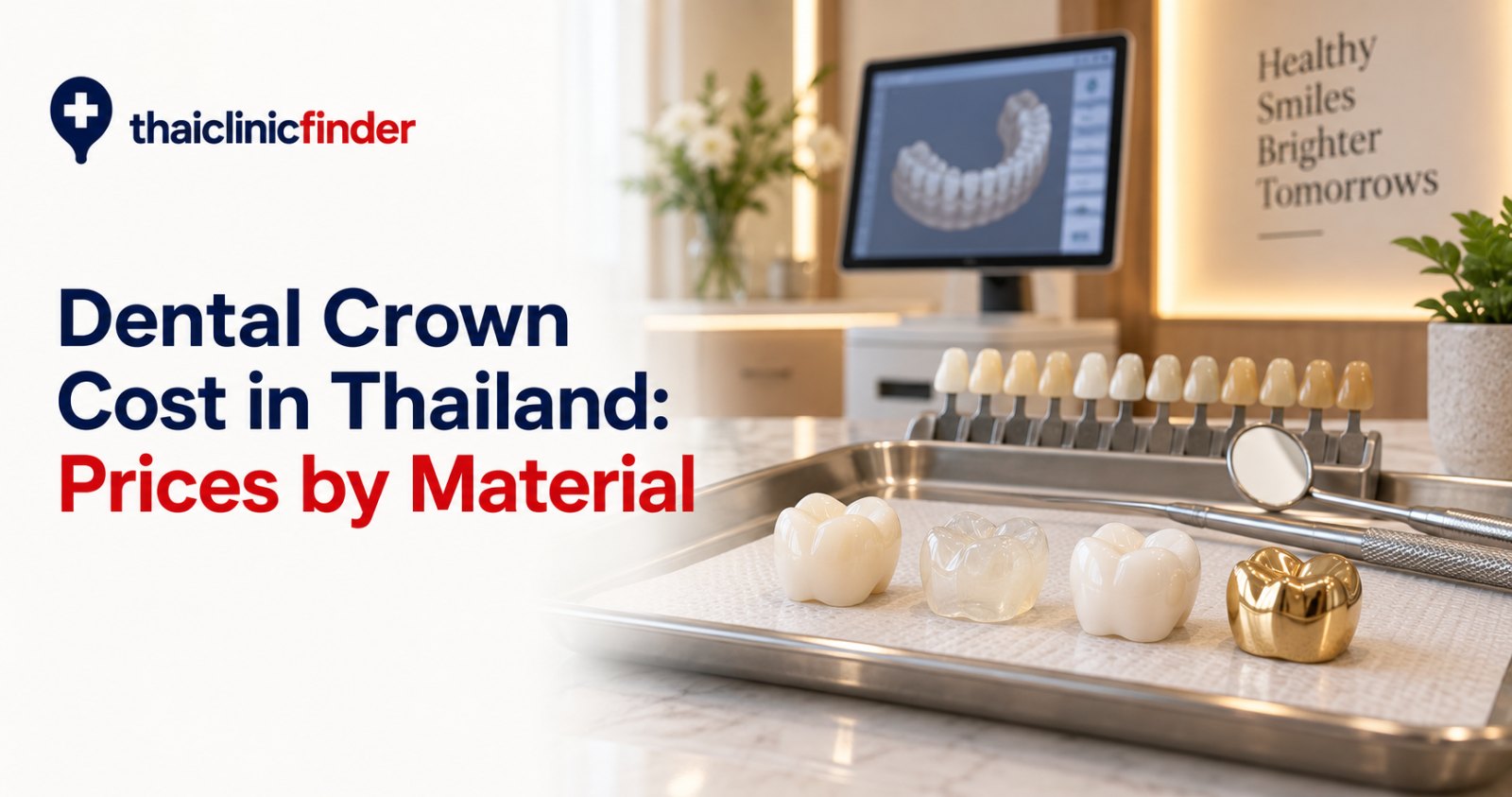
Dental crown prices in Thailand depend heavily on the crown material, the condition of the tooth, and whether additional work is required before the crown can be fitted. A crown quote should therefore be treated as one component of a restorative treatment plan rather than the complete cost of repairing a tooth.
Current private-clinic price lists show that crowns can vary by many thousands of baht per tooth depending on whether the restoration is porcelain-fused-to-metal, e.max ceramic, zirconia, gold, or an implant crown.
How much does a dental crown cost in Thailand?
Thantakit International Dental Center in Bangkok currently publishes these per-tooth prices:
- porcelain fused to metal crown: THB 18,000;
- full ceramic or porcelain e.max crown: THB 25,000;
- CAD/CAM zirconia crown with 3D scan: THB 25,000;
- full gold crown: THB 30,000 to THB 40,000 depending on size and gold type;
- zirconia crown on an existing implant: THB 35,000 to THB 40,000 depending on the implant brand.
Bangkok International Dental Center also publishes crown fees, including zirconia options around THB 20,000 to THB 21,000 per tooth for specified quantities and a one-day crown listed at THB 25,000.
These are examples from individual providers. They are not official Thailand-wide prices, and each clinic may include different steps in the quoted amount.
What is a dental crown?
A crown is a restoration that covers a prepared tooth or is attached to an implant abutment. It can be used when a tooth is extensively restored, weakened, cracked, worn, or has lost enough structure that a filling alone is not suitable.
The word "crown" does not tell you the material, whether the supporting tooth needs treatment first, or whether it is a natural-tooth crown versus an implant crown.
That distinction is important when comparing prices.
What changes the final cost?
Crown material
Porcelain-fused-to-metal, lithium disilicate ceramics such as e.max, zirconia, and gold have different laboratory and material costs. They also have different optical and mechanical properties.
There is no single material that is automatically best for every tooth. Location in the mouth, bite, remaining tooth structure, esthetic requirements, opposing teeth, and parafunctional habits can influence the recommendation.
Core build-up or post
A badly broken-down tooth may need a core build-up before the crown. A root-treated tooth may sometimes require a post depending on how much tooth structure remains. These are often separate fees.
Root canal treatment
If the tooth has irreversible pulpal disease or another indication for endodontic treatment, root canal treatment can add substantially to the total bill. A crown does not itself treat an infected pulp.
X-rays and examination
Diagnostic imaging and consultation may be charged separately. Ask whether the crown quote includes these.
Temporary crown
Many conventional crown workflows use a temporary restoration while the final crown is made. Confirm whether the temporary is included.
Same-day CAD/CAM
Some clinics offer same-day or one-day crowns using digital scanning and in-house milling. That can alter the workflow and price but does not automatically make the restoration clinically appropriate for every case.
Implant crown
A crown on an existing dental implant is a different restoration from a crown on a natural tooth. The abutment, implant connection, screw or cement retention, component compatibility, and laboratory work can increase cost.
If you are comparing implant treatment, see our guide to dental implant costs in Thailand.
How many visits does a crown take?
A conventional crown often involves at least a preparation visit and a later fitting visit. Digital workflows may allow some restorations to be made faster, including same-day crowns at clinics with suitable equipment.
Timelines can be longer if you need:
- root canal treatment;
- gum or periodontal treatment;
- healing after an extraction or implant;
- a post and core;
- laboratory shade work;
- adjustments to the bite;
- treatment of infection or a cracked tooth.
For a visitor with limited time, ask the clinic for a realistic schedule after the tooth has been examined rather than assuming a marketing timeline applies.
Is a cheap crown a good deal?
Price alone cannot establish the quality of a crown. A cheaper quote may use a different material, laboratory, warranty policy, or set of inclusions. A more expensive quote is not proof of better clinical quality either.
When comparing clinics, ask:
- what crown material and brand or system is proposed;
- whether the price is per tooth;
- whether consultation and X-rays are extra;
- whether core build-up or post is included;
- whether a temporary crown is included;
- whether root canal treatment, if needed, is separate;
- which laboratory makes the crown;
- whether adjustments and follow-up are included;
- what the clinic's repair or remake policy is;
- whether a written treatment plan is provided.
Our guide on how to compare dental clinics in Thailand explains how to evaluate providers without treating a price list as a quality ranking.
Crown versus filling, inlay or onlay
Not every damaged tooth needs a full crown. Depending on the defect and remaining tooth structure, alternatives can include a direct filling, an inlay, an onlay, or another partial-coverage restoration.
Conversely, a very compromised tooth may not be restorable and could require extraction. The decision should come from clinical and radiographic assessment.
For international patients, a second opinion can be useful before a large amount of healthy tooth structure is removed for an elective crown.
For another comparison of restorative options, see our guide to veneers in Thailand.
Crown after root canal treatment
Teeth that have had root canal treatment can be structurally weakened, but the need for a crown depends on tooth type, remaining structure, and the restorative plan. Back teeth often require cuspal coverage after endodontic treatment, while the exact approach should be individualized.
If a clinic recommends a root canal solely as a routine step before every crown, ask why it is clinically necessary for your tooth. Root canal treatment should have an indication.
Zirconia versus e.max
Both zirconia and lithium disilicate ceramics are widely used, but they are not interchangeable in every situation.
Zirconia is available in multiple formulations with varying translucency and strength. Lithium disilicate is often selected where esthetics and adhesive bonding are important. The dentist and laboratory consider thickness, tooth color, margin design, occlusal forces, and position in the mouth.
A patient should not choose only from an online material label. Ask the clinician why a particular material is appropriate for the tooth being restored.
What if the crown is for an implant?
An implant-supported crown involves an implant already integrated in bone plus an abutment and prosthetic crown. Compatibility with the exact implant system matters.
If the implant was placed in another country, bring the implant card or treatment records. A Thai dental clinic may need to identify the implant brand and connection before ordering components.
The provider's published implant-crown fee may not include any work required to repair or replace a damaged implant component.
What can go wrong with a crown?
Potential issues include sensitivity, decay at the crown margin, fracture or chipping, loss of retention, bite discomfort, gum inflammation, and in some cases pulp problems requiring later root canal treatment.
A crown also has a finite lifespan. Longevity varies with material, tooth condition, bite forces, oral hygiene, diet, grinding, and maintenance.
Seek dental review for severe pain, swelling, a loose crown, trauma, or signs of infection.
Should I get multiple crowns during a dental holiday?
Multiple elective crowns are irreversible. If you are considering extensive cosmetic or restorative work, make sure the plan addresses function and tooth preservation, not just appearance.
Ask to see the diagnosis for each tooth and understand alternatives. Large smile-makeover plans can involve more biological cost than a single restoration, and managing complications after returning home may be difficult.
If treatment is extensive, plan for follow-up and obtain copies of your X-rays, scans, material information, and laboratory details.
What about warranty claims?
Some clinics publish a warranty period for crowns, but a warranty is a commercial policy, not a guarantee that a restoration will last that long. Read exclusions carefully. Bruxism, trauma, untreated gum disease, missed maintenance, or work performed elsewhere may affect coverage.
For a traveler, also ask whether warranty work requires returning to the same Thailand location and who pays travel costs.
Bottom line
Current Bangkok provider price lists show examples from about THB 18,000 for a porcelain-fused-to-metal crown to THB 25,000 for e.max or zirconia, with gold and implant crowns potentially higher. These are provider-specific examples rather than a national price range.
Before comparing prices, confirm the crown material, whether the tooth needs a core or root canal, whether imaging and temporary restorations are included, and how follow-up will work after you leave Thailand.
What should be on a written crown quote?
A useful written estimate should identify the tooth number, crown material, laboratory or digital workflow, and every additional procedure expected before delivery. It should also separate optional work from work that is clinically necessary.
Ask whether the quote includes local anesthesia, temporary restoration, impressions or digital scans, try-in appointments, cementation, bite adjustment, and a follow-up visit. If the tooth may need root canal treatment, ask for that possible cost separately rather than accepting an unrealistically precise total before diagnosis.
What records should you keep?
After treatment, keep the invoice, treatment plan, X-rays, and the name of the crown material. For implant crowns, retain the implant brand, platform, abutment, and screw information where available.
These records are particularly useful for medical travelers. If a crown fractures or becomes loose after you leave Thailand, a dentist at home can understand what was done without relying entirely on your memory.
When should a crown be reviewed urgently?
A newly crowned tooth may feel slightly different while you adapt, but severe pain, facial swelling, fever, a crown that is clearly mobile, or a bite that prevents normal closure deserves prompt dental review. Pain on biting can have several causes and should not simply be tolerated for the remainder of a trip.
If a temporary crown comes off, contact the treating clinic. Avoid attempting to permanently cement it yourself with household adhesive.
Frequently Asked Questions
How much is a dental crown in Thailand?
Current Bangkok provider examples include THB 18,000 for a porcelain-fused-to-metal crown and THB 25,000 for e.max or zirconia at Thantakit. Other clinics and materials can differ, so request an itemized quote.
Is zirconia more expensive than a metal-ceramic crown?
It can be. In the cited Thantakit fee schedule, zirconia is THB 25,000 versus THB 18,000 for porcelain fused to metal. Prices and material options vary by provider.
Does crown cost include a root canal?
Usually you should not assume that it does. Root canal treatment, core build-up, posts, X-rays, and other procedures may be separate. Ask for the full restorative plan.
Can I get a crown in one day in Thailand?
Some clinics offer same-day CAD/CAM crowns, but suitability depends on the tooth and treatment required. A conventional laboratory crown often needs more than one visit.
Is an implant crown the same price as a tooth crown?
Not necessarily. Implant crowns require compatible implant components and an abutment, and providers often list them separately. Bring your implant system details if the implant was placed elsewhere.
Which crown material is best?
There is no universally best material. Tooth position, bite, remaining tooth structure, esthetic needs, opposing teeth, and other clinical factors affect the choice.
Sources
Writer
Niran Chaiyasit
Niran Chaiyasit is a Thai health writer with a background in public health and a focus on travel health, disease prevention and healthcare access in Thailand. His work covers topics such as common illnesses, vaccinations, mosquito-borne diseases, food safety and practical health information for travelers and expatriates.

Medical review
Justin Brooks
Daniel Brooks is an American health writer with a background in health sciences and a focus on rehabilitation, musculoskeletal health and patient education. He writes about physiotherapy, injury recovery, pain management, preventive health and practical healthcare guidance for international patients and travelers.