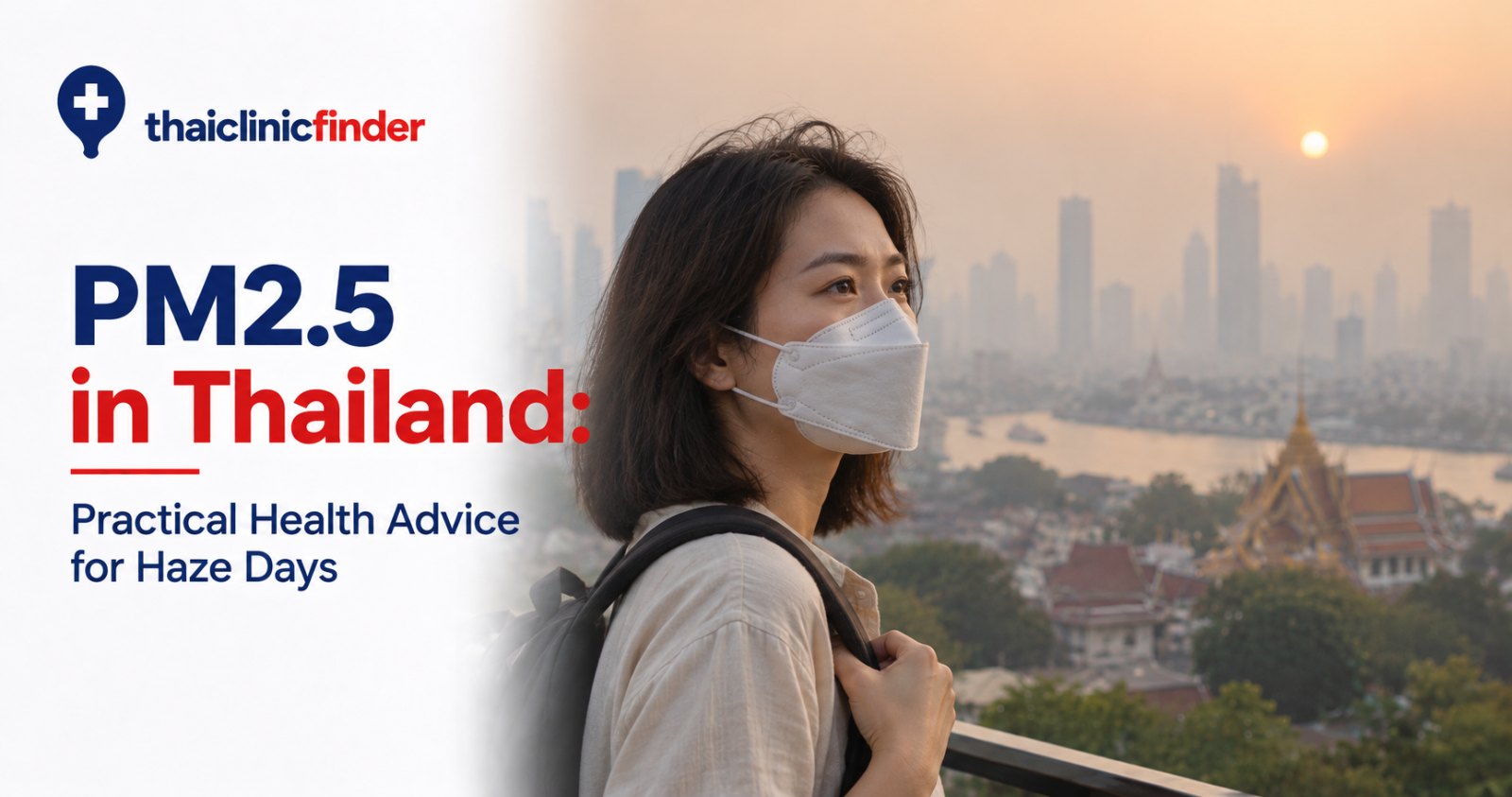
PM2.5 pollution can become a significant health issue in parts of Thailand during haze episodes. The problem is especially familiar in Bangkok and central Thailand during some dry-season periods, and in northern provinces such as Chiang Mai when regional burning and stagnant weather contribute to poor air quality.
PM2.5 refers to fine airborne particles with a diameter of 2.5 micrometres or less. These particles are small enough to penetrate deep into the lungs and can enter the bloodstream. WHO links particulate matter exposure with both respiratory and cardiovascular effects, including worsening of existing lung disease and increased risk of heart and vascular disease over time.
For most travelers and healthy adults, a single poor-air day does not mean an emergency. The practical response is to check current air quality, reduce exposure when levels rise, avoid prolonged strenuous outdoor exercise during bad episodes and use an appropriate particulate respirator such as a well-fitted N95 when necessary.
People with asthma, chronic lung disease, heart disease, older adults, children and pregnant people may need to be more cautious because they can be more susceptible to air pollution.
What exactly is PM2.5?
PM2.5 is shorthand for particulate matter measuring no more than 2.5 micrometres in aerodynamic diameter.
Sources vary by location but can include:
- traffic exhaust
- industrial emissions
- construction activity
- open burning
- agricultural fires
- forest fires
- waste burning
- secondary particles formed from gases in the atmosphere
WHO identifies PM2.5 as one of the pollutants with the strongest evidence of adverse health effects.
Because the particles are so small, they can pass deep into the lungs and some can enter the circulation.
This is why PM2.5 is treated differently from ordinary visible dust.
Why does Thailand get haze and PM2.5 episodes?
There is no single cause across the country.
In Bangkok and other major urban areas, PM2.5 can come from a mixture of traffic, industry, construction, combustion and weather conditions that trap pollutants close to the ground.
In northern Thailand, especially during the dry season, regional biomass burning, agricultural fires and forest fires can contribute substantially to haze.
Weather matters as well. Low wind, dry conditions and temperature inversions can allow fine particles to accumulate rather than disperse.
This means the same city can have relatively acceptable air one week and much worse conditions several days later.
When is PM2.5 usually worst in Thailand?
PM2.5 can rise at different times depending on region.
Bangkok and central Thailand often experience more problematic periods during the cooler and drier months when atmospheric conditions can trap pollution.
Northern Thailand, including Chiang Mai, Chiang Rai and Mae Hong Son, is particularly associated with seasonal haze during the late dry season when regional burning becomes more intense.
Exact timing and severity vary from year to year.
Do not rely only on the calendar. Check the actual air-quality reading where you are staying.
How to check PM2.5 in Thailand
Thailand's Pollution Control Department operates Air4Thai, an official national air-quality monitoring service.
It displays current pollution information by region and includes PM2.5 readings from monitoring stations around the country.
You can use Air4Thai to check conditions before:
- running outdoors
- cycling
- walking for several hours
- taking children outside
- spending a day sightseeing
- planning outdoor work
Thailand's Department of Disease Control also recommends following current PM2.5 information through Air4Thai and other official air-quality services.
Thailand's PM2.5 health levels
Thailand's current public-health communication uses PM2.5 concentrations together with color-coded health categories.
A useful simplified interpretation is:
| PM2.5, 24-hour concentration | General interpretation |
|---|---|
| Up to around 25 µg/m³ | Good to very good range |
| 25.1 to 37.5 µg/m³ | Moderate |
| 37.6 to 75 µg/m³ | Beginning to affect health |
| Above 75 µg/m³ | Affecting health |
Thailand's Department of Health describes 37.6 to 75 µg/m³ as the orange range where health effects begin to become a concern and above 75 µg/m³ as the red range with health effects.
The exact health advice also depends on whether you are in a vulnerable group.
Thailand's air-quality thresholds are not the same as WHO guideline values
This can confuse travelers who compare several apps.
WHO air-quality guidelines are health-based guideline values, while national governments can use their own regulatory standards and air-quality categories.
Different apps may therefore display different labels for the same PM2.5 concentration.
The important thing is to look at the actual PM2.5 number and follow local health advice rather than focusing only on whether an app says moderate, unhealthy or orange.
What should you do when PM2.5 is above 37.5 µg/m³?
Thailand's Department of Health and Department of Disease Control advise reducing exposure as PM2.5 enters the orange range.
For the general population, practical steps include:
- monitor symptoms
- reduce prolonged outdoor activity if you develop irritation or breathing symptoms
- consider using an appropriate particulate respirator when outdoor exposure is necessary
- avoid heavily polluted routes when possible
People who need extra health protection should be more cautious and reduce the duration of outdoor activities.
Symptoms that can indicate air pollution is affecting you include:
- coughing
- difficulty breathing
- eye irritation
- chest tightness
- headache
- palpitations
- nausea
- unusual fatigue
What should you do when PM2.5 is above 75 µg/m³?
Thailand's Department of Health classifies levels above approximately 75 µg/m³ as having health effects.
Official advice at this level is much stronger.
People should generally:
- avoid unnecessary outdoor activities
- stay away from areas with especially high pollution
- use suitable respiratory protection if outdoor exposure is necessary
- stay in cleaner indoor environments when possible
- seek medical advice if symptoms develop
Vulnerable groups should be particularly cautious.
If you are choosing between an outdoor sightseeing day and an indoor activity during a severe haze episode, moving the outdoor plan to another day is often the simplest way to reduce exposure.
Who is most vulnerable to PM2.5?
Thailand's public-health guidance identifies several groups who should take extra precautions, including:
- young children
- older adults
- pregnant people
- people with chronic medical conditions
People with cardiovascular and respiratory disease are particularly important groups to protect.
This includes people with conditions such as:
- asthma
- chronic obstructive pulmonary disease
- other chronic lung disease
- heart disease
Someone with a respiratory condition may experience symptoms at pollution levels that cause little noticeable effect in a healthy younger adult.
Does PM2.5 make asthma worse?
It can.
Fine particulate pollution can irritate and inflame the airways and can worsen respiratory symptoms in susceptible people.
Someone with asthma may notice:
- coughing
- chest tightness
- wheezing
- increased breathlessness
- reduced exercise tolerance
During haze periods, follow your prescribed asthma management plan and keep any prescribed reliever medication accessible.
Do not increase or change prescription treatment solely because an air-quality app is high without following your clinician's instructions.
Seek medical care if symptoms are significantly worse than usual or are not responding to your normal treatment plan.
Can PM2.5 affect the heart?
Yes.
WHO states that PM2.5 can enter the bloodstream and is associated with cardiovascular effects, including ischemic heart disease and stroke.
Short-term pollution exposure can also be more relevant to people who already have heart or vascular disease.
Take symptoms such as:
- chest pain
- marked shortness of breath
- fainting
- severe palpitations
seriously rather than assuming they are simply caused by haze.
Significant chest pain or acute breathing difficulty warrants urgent medical evaluation.
Can healthy people feel symptoms during haze?
Yes.
Even without chronic disease, high pollution can cause irritation such as:
- dry or sore throat
- coughing
- eye irritation
- headache
- reduced comfort during exercise
The response varies considerably between individuals.
A healthy traveler may tolerate a moderately polluted day without obvious symptoms, while another may develop irritation after an hour outdoors.
The absence of immediate symptoms does not mean PM2.5 has no health effect, but it also does not mean every brief exposure requires medical care.
Should you wear an N95 mask in Thailand during haze?
A properly fitted N95 or similar particulate respirator can reduce inhalation of fine airborne particles when worn correctly.
Thailand's Department of Disease Control specifically recommends masks capable of filtering PM2.5, including N95 respirators, when people need to be outside during high-pollution periods.
The fit matters.
Air that leaks around the edges of the mask bypasses the filter.
A respirator should fit closely around the:
- nose
- cheeks
- chin
Facial hair can make an effective seal more difficult.
Are ordinary surgical masks enough for PM2.5?
Loose surgical masks are primarily designed for droplets and splash protection and do not provide the same reliable particulate protection as a well-fitted respirator designed to filter fine particles.
For significant haze exposure, a properly fitted N95, KN95 or another reputable particulate respirator is generally more appropriate than a loose surgical mask.
However, standards and product quality vary.
Avoid counterfeit or poorly fitting masks sold solely on the basis of vague terms such as anti-pollution.
N95 versus KN95 for PM2.5
Both N95 and KN95 refer to respirator standards designed to filter high percentages of airborne particles when the product meets its standard and fits correctly.
For ordinary personal protection from PM2.5, the most important practical factors are:
- genuine product
- appropriate filtration standard
- good facial fit
- correct use
A high-quality respirator with a poor seal may provide less protection than expected.
Can you reuse an N95 mask during haze season?
Some disposable particulate respirators can be reused for a limited period if they remain clean, dry, undamaged and continue to fit properly.
Replace the respirator if it becomes:
- wet
- dirty
- visibly damaged
- difficult to breathe through
- unable to seal properly
Follow the manufacturer's instructions.
In Thailand's hot climate, sweat can make respirators uncomfortable and may shorten practical use.
Should you exercise outdoors when PM2.5 is high?
Strenuous exercise increases ventilation, meaning you breathe more air and therefore potentially inhale more pollution.
WHO guidance on personal exposure reduction supports changing the timing, location or intensity of physical activity when air pollution is elevated.
On a poor-air day, consider:
- moving a run indoors
- using a gym with good filtration
- shortening outdoor exercise
- reducing intensity
- exercising when readings are lower
- choosing routes away from heavy traffic
You do not need to stop exercising altogether. The goal is to reduce unnecessary pollutant exposure while maintaining physical activity in a cleaner environment.
Running during haze in Bangkok
A long run beside heavy traffic during a PM2.5 episode is generally a poor combination because both background pollution and direct traffic exposure can be elevated.
If you want to train, check the local reading first.
When pollution is high, consider an indoor treadmill or another indoor workout.
If conditions are only moderately elevated and you decide to run outdoors, choose a lower-traffic route and reduce duration if you develop coughing, tightness or unusual breathlessness.
Running during Chiang Mai burning season
Northern haze can become intense enough that moving exercise indoors is often the more practical option.
When PM2.5 reaches Thailand's red health category, the Department of Health recommends avoiding outdoor activity.
Do not treat a training schedule as more important than temporary air conditions.
Missing or modifying a few outdoor sessions is generally easier than exercising through a severe haze episode.
Is early morning always the best time to exercise?
No.
Air pollution levels change according to weather, traffic, wind and local emissions.
The lowest temperature of the day does not necessarily correspond to the lowest PM2.5 level.
Check current readings rather than assuming dawn is automatically cleaner.
Some haze episodes persist throughout the entire day.
Does staying indoors protect you from PM2.5?
Usually, but indoor air is not automatically clean.
Outdoor particles can enter buildings through:
- open windows
- doors
- ventilation systems
- cracks and gaps
During severe haze, reducing outdoor air entry can lower exposure.
Thailand's Department of Disease Control advises vulnerable households to close doors and windows and use air purification or a dust-free room when PM2.5 is high.
Should you close the windows during haze?
If outdoor PM2.5 is high, closing windows and doors can reduce the amount of polluted outdoor air entering the room.
This is particularly useful when:
- the building has air conditioning
- the room is relatively well sealed
- an air purifier is running
When outdoor air improves, ventilation can be resumed as appropriate.
The objective is not to permanently seal a home but to reduce infiltration during the worst pollution periods.
Do air purifiers help with PM2.5?
Portable air cleaners using HEPA filtration can reduce airborne particulate matter indoors when appropriately sized and used.
WHO includes portable and central air cleaners among personal-level measures that can reduce exposure to ambient air pollution.
Choose a purifier appropriate for the size of the room and run it long enough to clean the air effectively.
A small purifier designed for a bedroom may not adequately clean a large open-plan apartment.
What should you look for in an air purifier?
For PM2.5, focus primarily on particulate filtration and airflow rather than marketing language.
Useful factors include:
- HEPA filtration
- room-size rating
- clean air delivery rate, when provided
- availability and cost of replacement filters
- noise at the setting you will actually use
Positioning also matters. Avoid blocking the air intake or outlet.
During a bad haze episode, running an appropriately sized purifier continuously in the room where you spend most of your time can be more useful than switching it on only for a few minutes.
Does air conditioning remove PM2.5?
Air conditioning can help indirectly by allowing you to keep windows closed, but not every air-conditioning system has effective fine-particle filtration.
The filtration performance depends on the system and filter.
Do not assume that because a hotel room is air-conditioned, indoor PM2.5 must be low.
A separate HEPA air purifier can provide more predictable particle filtration in many rooms.
Hotel advice during severe haze
If you are visiting Thailand during a major haze episode, ask the hotel whether rooms have:
- windows that seal properly
- air conditioning
- air purifiers
- upgraded particulate filtration
A room facing a quieter area away from a major road may also reduce direct traffic exposure, although regional haze can affect the entire city.
If your travel plans are flexible and pollution is exceptionally severe in one region, changing destinations is another reasonable exposure-reduction strategy.
Is Chiang Mai always polluted?
No.
Chiang Mai can have very good weather and air outside significant haze episodes.
The city becomes strongly associated with PM2.5 because northern Thailand can experience severe seasonal haze, especially during parts of the dry season.
Air quality varies substantially by month, weather and year.
Someone visiting during a clear period may encounter little meaningful haze, while another traveler several weeks later may experience several consecutive poor-air days.
Check current and recent readings rather than assuming Chiang Mai is permanently polluted.
What about Bangkok?
Bangkok experiences PM2.5 episodes but also substantial day-to-day variation.
Traffic is an important urban exposure source, but regional atmospheric conditions can also influence city-wide levels.
On poor-air days:
- reduce time beside congested roads
- use enclosed public transport when practical
- move prolonged exercise indoors
- keep windows closed when outdoor readings are high
- use a suitable respirator for unavoidable prolonged outdoor exposure
What about Phuket, Pattaya and southern Thailand?
PM2.5 problems can occur outside Bangkok and northern Thailand, but southern destinations often have different pollution patterns because of weather, wind and regional geography.
Do not assume beach destinations are automatically pollution-free.
Check current Air4Thai data for your actual location.
Short-lived smoke or regional haze can still affect coastal destinations.
Motorbike riders can have particularly high exposure
Thailand's Department of Disease Control specifically notes that people who spend long periods riding motorcycles or working outdoors can be exposed continuously to fine dust.
During high-PM2.5 periods, riders should consider:
- a well-fitted particulate respirator
- eye protection
- reducing unnecessary riding time
- avoiding highly congested routes when possible
A motorcycle helmet does not necessarily filter PM2.5 unless an appropriate respirator is worn underneath and fits correctly.
Does PM2.5 cause sore throat and coughing?
It can.
Short-term exposure may irritate the respiratory tract and contribute to:
- throat irritation
- cough
- eye irritation
- breathlessness
Thailand's health authorities specifically list coughing, breathing difficulty and eye irritation among symptoms to monitor during high-pollution periods.
If symptoms improve when you move into clean indoor air, pollution may be contributing.
Persistent or severe symptoms still deserve medical assessment because infections, asthma and other conditions can produce the same symptoms.
Can PM2.5 cause headaches?
Headache is reported among symptoms that can occur during significant pollution exposure, and Thai public-health guidance includes headache among possible health complaints during elevated PM2.5.
However, headache is nonspecific.
In Thailand it can also result from:
- dehydration
- heat
- viral illness
- poor sleep
- alcohol
- migraine
Do not automatically attribute severe or unusual headache to air pollution.
When should you see a doctor?
Thailand's Department of Disease Control advises seeking medical advice when pollution exposure is associated with symptoms such as:
- significant cough
- difficulty breathing
- chest tightness
- eye inflammation
- abnormal heartbeat
- severe headache
- nausea
- unusual weakness or fatigue
Seek urgent assessment for:
- severe breathing difficulty
- chest pain
- fainting
- blue lips
- confusion
- rapidly worsening asthma
If you are unsure where to seek treatment, see Sick in Thailand? What to Do and Where to Get Medical Care.
Do you need to leave Thailand because of PM2.5?
Usually not.
Most travelers can reduce exposure effectively by modifying activities for a few days.
Leaving or changing region may become reasonable when:
- pollution is severe for an extended period
- you have a medical condition that is being aggravated
- your accommodation cannot provide reasonably clean indoor air
- the purpose of your trip involves prolonged outdoor activity
Someone with significant lung disease planning several weeks of outdoor activity in northern Thailand during a major haze episode may reasonably make a different decision from a healthy traveler staying indoors in Bangkok for one afternoon.
Are children affected more by PM2.5?
Children are among the groups Thailand's health authorities identify for extra protection during high pollution periods.
Children breathe more air relative to body size and may spend substantial time playing outdoors.
On bad haze days, consider:
- moving sports indoors
- reducing outdoor play time
- keeping bedroom air clean
- using appropriate child-specific health advice rather than simply putting an adult respirator on a small child
Mask fit can be especially difficult in young children.
Pregnancy and PM2.5
Pregnant people are also included among groups advised to take additional precautions during high PM2.5 episodes.
WHO notes associations between air pollution exposure and adverse health outcomes, including effects during pregnancy.
The practical advice is the same core strategy:
- reduce unnecessary exposure
- spend more time in cleaner indoor air
- avoid prolonged strenuous activity outdoors during poor-air periods
- discuss individual concerns with a clinician if exposure is substantial or symptoms occur
Should you take supplements for PM2.5 exposure?
No supplement has been established as a substitute for reducing exposure.
Products marketed as lung detoxes or anti-pollution supplements should not distract from measures with clearer evidence, such as:
- reducing time in polluted air
- using suitable particulate respirators
- cleaner indoor air
- appropriately timed physical activity
The lungs do not need a commercial detox after every haze day.
Do saline nasal rinses remove PM2.5 from the lungs?
No.
Saline nasal irrigation may help some people with nasal irritation or dryness, but it does not remove fine particles that have already reached the lower respiratory tract.
It should be viewed as a comfort measure rather than protection against PM2.5 exposure.
The main intervention remains reducing inhalation in the first place.
What should travelers pack during haze season?
If you are visiting a region known for seasonal PM2.5 episodes, useful items can include:
- several genuine N95 or equivalent respirators
- any prescribed respiratory medication
- a small supply of normal saline if you use it for nasal comfort
- access to an official air-quality app
Long-term visitors may also consider purchasing a HEPA air purifier locally.
There is no need to travel with elaborate anti-pollution gadgets if you can monitor conditions and adjust exposure sensibly.
A practical haze-day routine
On a day when PM2.5 is significantly elevated:
- Check Air4Thai before going outside.
- Move strenuous exercise indoors.
- Close windows if outdoor air is poor.
- Run a HEPA purifier if available.
- Use a well-fitted N95 or similar respirator when prolonged outdoor exposure is unavoidable.
- Avoid congested roads when possible.
- Keep outdoor time shorter if you are in a vulnerable group.
- Monitor for coughing, wheezing, chest tightness or unusual breathlessness.
When PM2.5 falls again, normal activities can gradually resume.
The practical health message
PM2.5 is a real health issue in Thailand, but the response does not need to be complicated.
Use official air-quality information such as Air4Thai, pay attention when PM2.5 rises above Thailand's health thresholds and reduce unnecessary exposure during severe haze.
At around 37.6 to 75 µg/m³, Thailand's Department of Health describes air quality as beginning to affect health. Above 75 µg/m³, the official category indicates health effects and everyone is advised to avoid outdoor activity where possible.
A well-fitted N95 or equivalent respirator, cleaner indoor air and moving strenuous exercise indoors are among the most practical measures.
People with asthma, cardiovascular disease, chronic lung conditions, young children, older adults and pregnant people should take extra care.
If haze is associated with significant breathing difficulty, chest tightness, abnormal heartbeat or worsening of a chronic condition, seek medical advice rather than trying to manage severe symptoms solely by staying indoors.
Frequently Asked Questions
What is PM2.5 in Thailand?
PM2.5 refers to fine airborne particles measuring 2.5 micrometres or less. They can penetrate deep into the lungs and some can enter the bloodstream, affecting respiratory and cardiovascular health.
What PM2.5 level is considered unhealthy in Thailand?
Thailand currently categorizes roughly 37.6 to 75 µg/m³ as beginning to affect health, while levels above 75 µg/m³ are categorized as affecting health. Advice becomes more restrictive as levels rise.
Where can I check PM2.5 levels in Thailand?
Air4Thai, operated by Thailand's Pollution Control Department, provides official air-quality and PM2.5 monitoring information across the country.
Should I wear an N95 mask for PM2.5 in Thailand?
A properly fitted N95 or similar particulate respirator can reduce inhalation of fine particles and is recommended by Thai health authorities when outdoor exposure is necessary during high-PM2.5 periods.
Is a surgical mask enough for PM2.5?
A loose surgical mask does not provide the same reliable fine-particle protection as a properly fitted particulate respirator such as an N95.
Should I exercise outside when PM2.5 is high?
It is sensible to reduce or relocate strenuous outdoor exercise when pollution is elevated because exercise increases the amount of air you breathe. During severe haze, move exercise indoors if possible.
Do air purifiers help with PM2.5?
Yes. Portable air cleaners with appropriate HEPA filtration can reduce indoor particulate concentrations when correctly sized and used.
Is Chiang Mai polluted all year?
No. Chiang Mai's air quality varies considerably. The city is particularly associated with seasonal haze during parts of the dry season, but cleaner periods also occur.
Can PM2.5 worsen asthma?
Yes. Fine-particle pollution can irritate the airways and aggravate asthma symptoms such as cough, wheezing, chest tightness and breathlessness.
When should I see a doctor because of PM2.5 exposure?
Seek medical advice if you develop significant breathing difficulty, chest tightness, worsening asthma, abnormal heartbeat or persistent symptoms. Severe breathing difficulty or chest pain requires urgent assessment.
Sources
Writer
Niran Chaiyasit
Niran Chaiyasit is a Thai health writer with a background in public health and a focus on travel health, disease prevention and healthcare access in Thailand. His work covers topics such as common illnesses, vaccinations, mosquito-borne diseases, food safety and practical health information for travelers and expatriates.

Medical review
Justin Brooks
Justin Brooks is an American health writer with a background in health sciences and a focus on rehabilitation, musculoskeletal health and patient education. He writes about physiotherapy, injury recovery, pain management, preventive health and practical healthcare guidance for international patients and travelers.