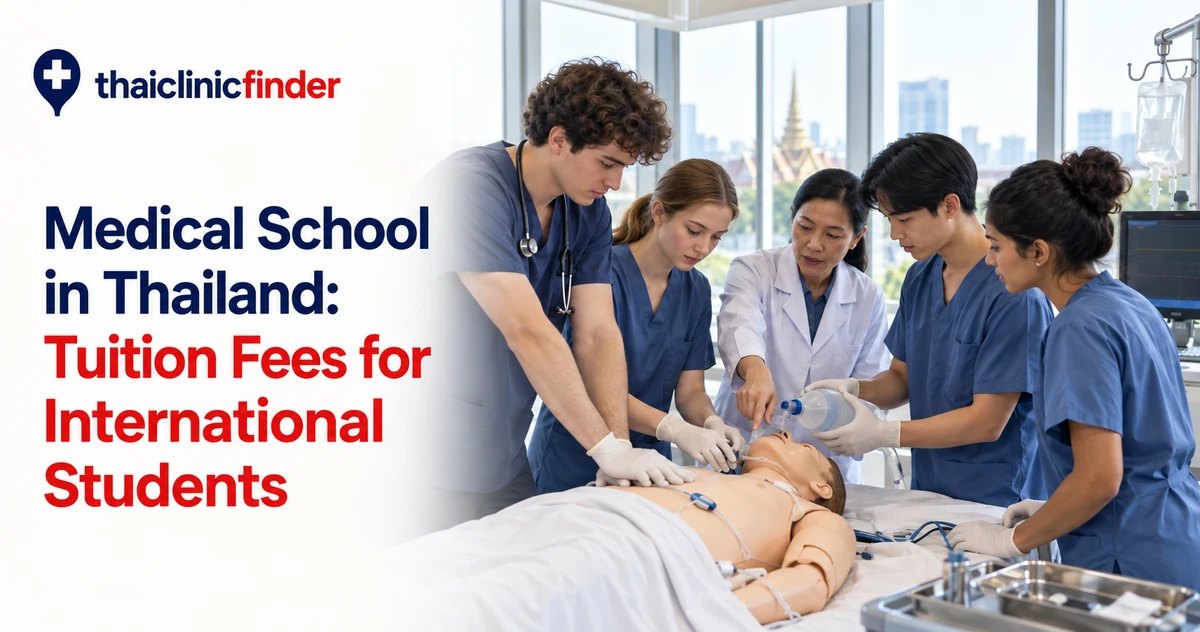
Thailand has a small number of English-taught Doctor of Medicine programs, and their tuition is much higher than the fees often quoted for ordinary Thai university degrees. International applicants also face nationality rules, academic prerequisites, English testing, aptitude tests and eventual licensing requirements that vary by program and destination country.
This guide focuses on verified program information for international students. It distinguishes six-year undergraduate-entry medicine from graduate-entry routes and from health-science degrees that do not qualify a graduate as a medical doctor.
Medical school tuition examples in Thailand
Published fees change by intake, so use the figures below as planning references and verify the admission announcement for your year.
Thammasat University CICM
The Chulabhorn International College of Medicine at Thammasat University publishes a six-year Doctor of Medicine International Program. Its 2026 admission material describes preclinical study at Thammasat's Rangsit campus and clinical training at Rayong Hospital.
The university's fee notice for admitted students states standard tuition of THB 495,000 per semester for international students and THB 475,000 per semester for Thai nationals. Over 12 standard semesters, THB 495,000 would equal THB 5.94 million before any extra charges or future fee changes. That multiplication is a planning calculation, not a guaranteed total from the university.
For the 2027 cycle, CICM's official admission page states an application fee of THB 2,000 and lists IELTS 6.5, TOEFL iBT 79 or specified TU-GET scores among accepted English evidence. It also requires a 2026 UCAT score for that cycle. Requirements can change annually.
KMITL Faculty of Medicine
King Mongkut's Institute of Technology Ladkrabang publishes a six-year Doctor of Medicine International Program taught in English. Its official curriculum page lists tuition at THB 495,000 per semester. Using 12 semesters gives a simple tuition projection of THB 5.94 million, again excluding extra costs and any changes.
Applicants should use the Faculty of Medicine's current admission notice, not only the general curriculum page, to confirm nationality eligibility, required qualifications, tests and dates.
Chulalongkorn University CU-MEDi
Chulalongkorn University's CU-MEDi is a four-year international Doctor of Medicine program for applicants who already hold a bachelor's degree. It is therefore not a direct substitute for a six-year course entered after secondary school.
Official program information has quoted an approximate program fee of THB 4.5 million for the four-year program, including local clerkship and international externship arrangements described by the program. Applicants must check the current intake documents for the operative fee and what it covers. Chulalongkorn's 2026 admission announcement also lists separate selection-process costs, including a THB 1,000 application fee and THB 4,000 for interview and psychological assessment, plus the hospital's health-check fee.
Why headline tuition is not the total cost
Tuition is the largest line, but not the only one. Build a multi-year budget that includes:
- application, aptitude-test and English-test fees;
- student registration and university charges;
- health checks, vaccinations and insurance;
- textbooks, online resources, equipment and clinical clothing;
- accommodation, utilities, food and local transport;
- visa extensions, re-entry permits and document translations;
- travel between the main campus and clinical sites;
- electives, examinations and licensing applications;
- a contingency for fee increases and delayed graduation.
Ask whether tuition remains fixed for the cohort or can change annually. Confirm whether summer terms, repeat courses, remediation, electives and overseas placements are included. A program that advertises a per-semester price may charge other university or clinical fees separately.
Do not assume you can fund a medical degree through casual work in Thailand. Student immigration status and work authorisation are separate legal issues, and the academic schedule is demanding. Obtain current advice from the university's international office and Thai authorities.
Entry routes are not interchangeable
Six-year programs after secondary school
Thammasat CICM and KMITL describe six-year international MD curricula. These routes combine general or premedical study, preclinical science and clinical training. Applicants normally present secondary-school qualifications or an accepted equivalent, but exact subject, grade and test rules differ.
For example, CICM's published 2027 information says applicants holding a GED are not eligible and sets an age rule for that cycle. It also requires English evidence and UCAT. That does not mean KMITL uses the same rules.
Four-year graduate-entry medicine
CU-MEDi is designed for degree holders. Its admission documents specify qualifying academic backgrounds and other selection requirements for each intake. A high-school applicant cannot treat it as a four-year shortcut.
Medical science is not medicine
Thailand's universities offer bachelor's, master's and doctoral programs in biomedical science, medical science, public health and related subjects. These can lead to research and health-sector careers, but they do not automatically confer an MD or licence to practise medicine.
Read the awarded degree title and licensing pathway, not just the faculty name. A program housed in a Faculty of Medicine may still be a research degree.
Language of study and clinical communication
An "international program" may teach lectures and examinations in English, but clinical training takes place with patients in Thailand. Thai language ability can therefore become essential for history-taking, consent and teamwork, even when the academic program is English-medium.
Ask the school:
- how and when Thai is taught;
- what language is used on wards and in assessments;
- whether a required Thai proficiency standard applies before clinical years;
- where clinical rotations occur;
- whether all core clerkships are available to non-Thai students.
Do not rely on an education agent's verbal assurance. Request the current curriculum and confirmation from the program itself.
Prospective students can learn about real patient-facing contexts through Thai Clinic Finder's guides to pharmacies and prescriptions in Thailand, MRI access and costs and giving birth in Thailand as a foreigner. These articles are not admissions material, but they illustrate the language, payment and coordination issues international patients encounter.
Admissions checklist for international applicants
Start at least a year before the intended intake. Admission calendars can open and close well before classes begin.
Confirm basic eligibility
Check nationality restrictions, age, previous education, science prerequisites and accepted school-leaving qualifications. Ask how the university evaluates A levels, IB, AP, national certificates or a bachelor's degree earned abroad.
If documents are not in Thai or English, confirm translation and legalisation requirements. Names must match across passport, transcripts and test reports.
Register for required tests
Programs may require English tests, UCAT or other assessments. Book early enough to receive scores before the deadline. Confirm the accepted test version, minimum component scores, validity period and whether online or retaken components are accepted.
Prepare more than grades
Admissions may include a portfolio, recommendation letters, multiple mini-interviews, health checks or psychological assessment. Follow the current official format. Reusing a generic personal statement can miss a program's exact question.
Budget for non-refundable stages
Application and assessment fees are often non-refundable. Do not pay tuition until you have an official offer and verified payment instructions from the university. Beware of agents asking for transfer to a personal account.
Accreditation and the Thai licensing pathway
Admission to a university and permission to practise medicine are separate matters. Before enrolling, verify the current accreditation status of the specific program and clinical training arrangement with Thailand's relevant official bodies.
Ask the program in writing whether an international graduate is eligible to take the Thai medical licensing examinations and what Thai-language, nationality or internship conditions apply. Do not assume that completing an English-taught MD guarantees unrestricted practice in Thailand.
Rules can change during a six-year degree. Keep copies of the curriculum, accreditation information and official correspondence from the year you enrol.
Recognition in your intended destination country
If you plan to practise outside Thailand, research the destination before paying a deposit. A foreign medical degree may be recognised for application purposes but still require examinations, credential verification, internship evidence, language testing or residency training.
Check the official medical regulator in the country where you intend to work. For the United States, applicants should review ECFMG requirements and the World Directory of Medical Schools details for the exact school and graduation years. For the United Kingdom, consult the General Medical Council. Other countries have their own authorities.
A university's statement that graduates have international opportunities is not a licensing guarantee. Ask the foreign regulator, not an education agent, whether the program meets your planned route.
Student visa and practical administration
The university normally provides documents used for a non-immigrant education visa, but the student remains responsible for maintaining lawful status. Confirm the process, reporting obligations, extension timing and whether clinical placements in another province affect administration.
International students should also ask about:
- mandatory health insurance and what it covers;
- access to student health services;
- accommodation near each campus or hospital;
- transport for early clinical shifts;
- disability support and reasonable adjustments;
- academic support and remediation policies;
- leave of absence, withdrawal and refund rules.
Read the refund policy before transferring a large first-semester payment. Visa refusal, failed health clearance or changed personal circumstances may not trigger a full refund.
Comparing programs sensibly
Tuition matters, but a medical course shapes six or more years of training and the licensing steps after graduation. Compare the curriculum and clinical exposure rather than selecting solely by the lowest projected total.
Request answers to these questions:
- What is the exact degree and program length?
- Is my nationality and qualification eligible this year?
- Which admissions tests are required?
- What is the full first-year invoice, including non-tuition fees?
- Can tuition change after enrolment?
- Where does each clinical year take place?
- What Thai proficiency is required?
- What are the program's current accreditation and licensing arrangements?
- What happens if I fail or repeat a course?
- Which official office advises international students on visas and insurance?
Compare written replies and current regulations. Marketing fairs are useful for introductions, but final decisions should rest on official documents.
A realistic application sequence
First, decide where you ultimately want to practise. Check that country's regulator and identify any school-listing or accreditation conditions. Then shortlist Thai programs for which you meet the entry route.
Next, download the current admission announcement and create a calendar for tests, documents, interviews and payments. Build a full-course budget with a contingency rather than only the first semester. Visit the campus and clinical location if possible.
Finally, ask the university to clarify any licensing, language or fee ambiguity in writing. Do not commit millions of baht on the basis of an old brochure or third-party promise. Thailand does offer genuine international MD routes, but each has distinct eligibility, structure and professional consequences.
Frequently Asked Questions
How much does medical school cost in Thailand for international students?
Two official six-year international MD examples currently list THB 495,000 per semester, while Chulalongkorn's four-year graduate-entry CU-MEDi has quoted about THB 4.5 million for the program. Fees and inclusions vary by intake, so verify the current official notice.
Can international students study medicine in English in Thailand?
Yes, a small number of universities offer international MD programs. Clinical work still involves patients in Thailand, so ask exactly what Thai-language proficiency is required before and during clerkships.
Can I enter CU-MEDi directly after high school?
CU-MEDi is a four-year graduate-entry program and requires a qualifying prior degree under its current admissions rules. High-school applicants should examine six-year entry routes and each program's current eligibility notice.
Does a Thai MD automatically let me practise in another country?
No. Every destination has its own medical regulator, examinations, credential checks, language rules and training requirements. Verify the exact school and graduation-year eligibility with the destination regulator before enrolling.
Is a medical science degree the same as an MD?
No. Biomedical, medical science and public-health degrees can support research or health careers, but they do not by themselves qualify a graduate as a physician. Check the exact awarded degree and licensing pathway.
Sources
- Thammasat CICM Doctor of Medicine International Program admissions
- Thammasat CICM tuition fees for admitted students
- Thammasat CICM 2026 admission guidelines
- KMITL Doctor of Medicine International Program curriculum
- Chulalongkorn University Doctor of Medicine International Program
- CU-MEDi 2026 admission announcement
Writer
Niran Chaiyasit
Niran Chaiyasit is a Thai health writer with a background in public health and a focus on travel health, disease prevention and healthcare access in Thailand. His work covers topics such as common illnesses, vaccinations, mosquito-borne diseases, food safety and practical health information for travelers and expatriates.
Medical review
Justin Brooks
Justin Brooks is an American health writer with a background in health sciences and a focus on rehabilitation, musculoskeletal health and patient education. He writes about physiotherapy, injury recovery, pain management, preventive health and practical healthcare guidance for international patients and travelers.