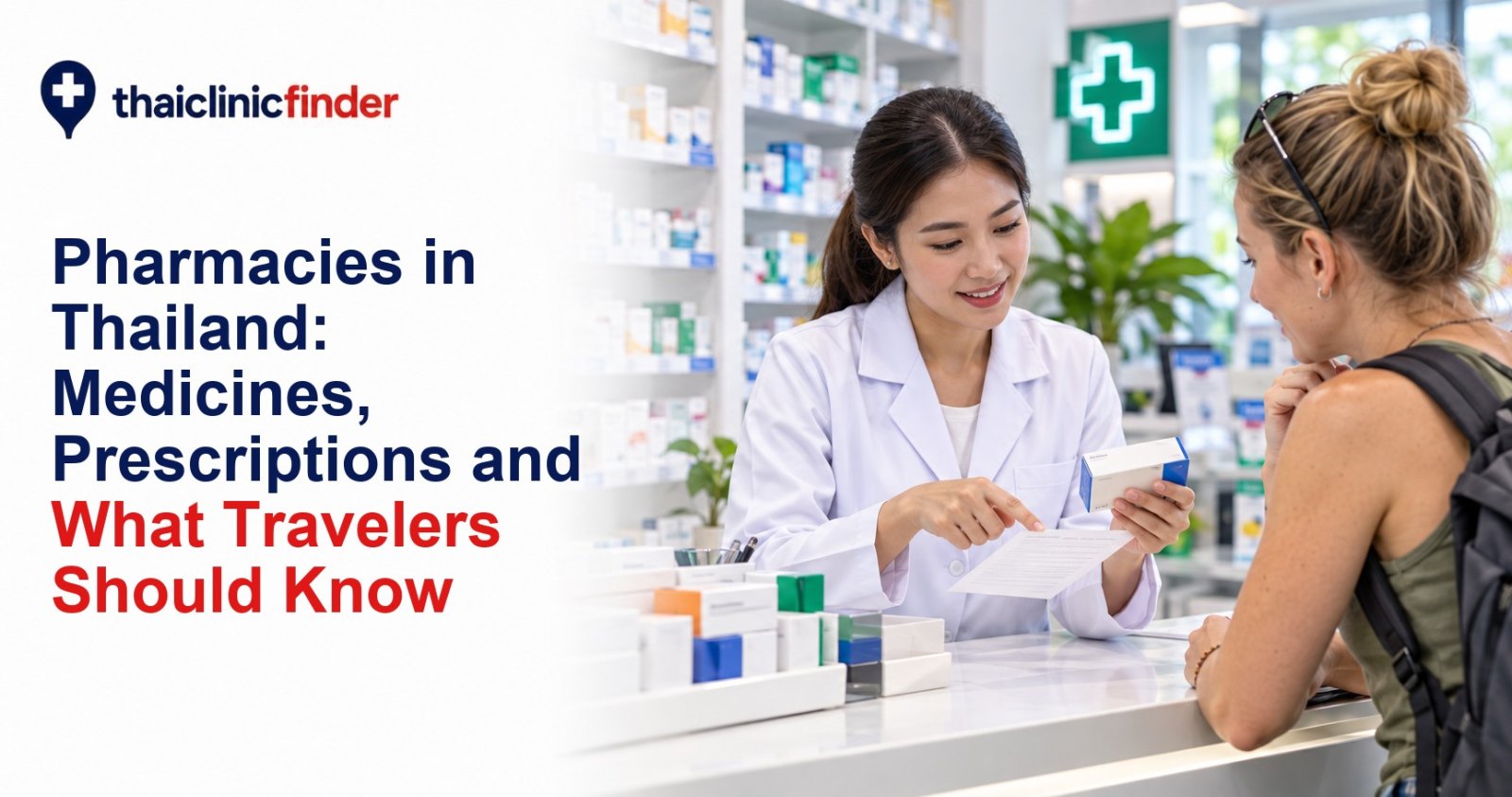
Pharmacies are easy to find in Thailand, especially in Bangkok, Chiang Mai, Phuket, Pattaya and other major cities. For travelers and new residents, the experience can feel more informal than in countries where almost every prescription medicine requires a doctor's visit.
That does not mean all medicines are over the counter. Thailand uses its own legal classifications, and the rules for a common antihistamine are very different from those for sildenafil, sleeping medicines, narcotics or psychotropic drugs.
This guide explains how to use pharmacies in Thailand safely, how to check a medicine, when a pharmacist may be enough and when you should see a doctor instead.
Thailand has several medicine categories
Thai drug law does not map perfectly onto the simple OTC-versus-prescription model used in some countries.
Medicines may fall into categories such as household remedies, ready-packed medicines, dangerous drugs and specially controlled drugs. The practical level of supervision rises with the category.
A dangerous drug can often be supplied through a licensed pharmacy under pharmacist supervision, while a specially controlled drug has stricter requirements and may require a doctor's prescription.
This is why two medicines that are both called prescription-only in another country may be handled differently in Thailand.
A licensed pharmacy is different from an informal seller
Buy medicines from a legitimate pharmacy rather than from street stalls, social media accounts or anonymous online sellers.
A pharmacy should be able to identify:
- the active ingredient
- the strength
- the manufacturer
- the Thai registration number
- how the medicine should be taken
- important warnings or interactions
If a seller cannot tell you what the active ingredient is, or sells tablets loose without clear identification, that is a reason to walk away.
Thailand's FDA maintains a National Drug Information database where registered medicines can be checked by ingredient, trade name or registration number.
Pharmacists can help with many minor problems
A pharmacist can be a useful first point of contact for uncomplicated problems such as:
- mild allergy symptoms
- minor pain or fever
- simple skin irritation
- some digestive complaints
- questions about an existing medicine
However, pharmacy advice is not a substitute for medical assessment when symptoms are severe, persistent or unclear.
Seek a doctor promptly for chest pain, breathing difficulty, neurological symptoms, severe dehydration, significant bleeding, serious allergic reactions or rapidly worsening illness. For emergencies in Thailand, call 1669.
The guide to medical emergencies in Thailand explains the main emergency contacts.
Antibiotics are not ordinary OTC products
Antibiotics are easy to encounter in Thailand, but they should not be treated as routine self-care.
Different antibiotics have different legal classifications and appropriate uses. Unnecessary treatment can cause adverse effects and contributes to antimicrobial resistance.
Do not select an antibiotic only because a previous illness felt similar. Diarrhea, sore throat and respiratory symptoms can have viral, bacterial or non-infectious causes that require different management.
For more detail, see Antibiotics in Thailand: Prescription Rules and Safe Use.
Some medicines need stricter medical supervision
Extra caution is needed with medicines such as:
- sedatives and sleeping medicines
- opioid pain medicines
- stimulant medicines
- some psychiatric medicines
- erectile dysfunction medicines
- hormone treatments
- controlled substances
Sildenafil for erectile dysfunction, for example, is classified by the Thai FDA as a specially controlled medicine. Formal dispensing rules are therefore stricter than for a simple painkiller.
A pharmacy offering a restricted medicine with no questions does not change the legal classification.
Brand names may be different from home
The same active ingredient can be sold under a completely different Thai brand.
If you take regular medication, bring a list showing:
- generic name
- strength
- formulation
- dose
- how often you take it
For example, knowing that your medicine contains amlodipine 5 mg is much more useful than knowing only a brand name used in Europe or North America.
Thai pharmacists may be able to offer a locally registered generic when the exact foreign brand is unavailable.
Generic medicines can be much cheaper
Thailand has a substantial generic pharmaceutical market.
A generic medicine should contain the same active ingredient and strength as the reference product, but the manufacturer and price can differ.
For cost-conscious patients, ask whether a registered generic is available. Do not switch formulations blindly, particularly with modified-release tablets, insulin, anticoagulants, seizure medicines or other treatments where formulation matters.
Our Thailand pharmacy price list explains how official reference prices differ from actual retail prices.
Hospital pharmacies and community pharmacies can charge different prices
Private hospital pharmacies may charge more than independent community pharmacies for the same active ingredient.
That does not necessarily mean the hospital is doing anything improper. Hospital pricing can reflect its procurement system, preferred brands, dispensing structure and facility costs.
For long-term medication, some patients ask whether they can obtain the same prescribed drug from an external pharmacy.
Before doing that, make sure the:
- active ingredient is identical
- strength is identical
- dosage form is identical
- release mechanism is identical
Ask the prescribing doctor if you are unsure.
Do not assume every product sold as a supplement is harmless
Thai FDA warnings have repeatedly involved products marketed as supplements that contain undeclared pharmaceutical ingredients.
This can be particularly concerning in products promoted for:
- weight loss
- sexual enhancement
- sleep
- bodybuilding
A product labeled natural does not guarantee that it contains only herbal ingredients.
Use Thai FDA registration information where possible and avoid products with exaggerated claims or unclear manufacturers.
Bringing your own medicines into Thailand is a separate issue
Buying a medicine inside Thailand and carrying your own medicine into Thailand are governed by different rules.
Travelers with prescription medicines should check Thai FDA traveler guidance before departure, especially for narcotic or psychotropic substances.
Quantity limits, medical certificates and advance permits can apply.
See Customs Rules for Prescription Medications in Thailand before traveling with controlled medication.
Online pharmacies require extra caution
Online ordering can be convenient, but it makes it harder to assess whether the seller is legitimate and whether the product has been stored correctly.
Avoid sellers that:
- hide the company identity
- offer controlled medicines without any medical process
- use only private messaging apps
- sell imported brands with no Thai registration information
- make cure-all claims
Counterfeit medicines can contain too much, too little or none of the stated active ingredient.
What to ask before buying a medicine
A practical pharmacy conversation can include:
- What is the active ingredient?
- What strength is this?
- Is it registered with the Thai FDA?
- Is this the original brand or a generic?
- How should it be taken?
- What side effects matter most?
- Does it interact with my current medicines?
- Does this require a doctor's prescription?
- What should make me seek medical care?
If the medicine is unfamiliar, take a photo of the box and registration details for your own records.
Language support varies
Large chain pharmacies and pharmacies in international hospital areas may have English-speaking staff, but this is not guaranteed.
Do not assume the language of a branch based on the company name. If the discussion involves a complicated treatment, ask whether an English-speaking pharmacist is available or bring a translated medication list.
When a doctor is the better first stop
Go directly to a clinic or hospital when you have:
- severe or rapidly worsening symptoms
- significant breathing difficulty
- chest pain
- high-risk pregnancy concerns
- severe abdominal pain
- neurological symptoms
- serious injury
- persistent fever
- suspected severe infection
- a condition that needs diagnostic testing
A pharmacist can help with medicine use, but cannot replace imaging, blood tests or a full medical examination.
The practical approach
Thai pharmacies can be convenient and useful, particularly for common medicines and routine refills. The safest approach is to focus on the exact active ingredient, buy from a licensed pharmacy and check unfamiliar products against Thai FDA records.
Do not use apparent availability as proof that a medicine is legally over the counter or suitable for you.
For long-term treatment, controlled medicines or symptoms that are not straightforward, use a pharmacist and doctor as complementary parts of the healthcare system rather than trying to solve everything at the pharmacy counter.
Frequently Asked Questions
Can tourists buy medicine from pharmacies in Thailand?
Yes. Tourists can buy many medicines from licensed pharmacies, but legal dispensing requirements depend on the drug. Some medicines require pharmacist supervision or a doctor's prescription.
Are antibiotics over the counter in Thailand?
Thailand uses its own drug classifications, and antibiotics should not be treated as ordinary OTC medicines. Appropriate supply depends on the medicine and pharmacy supervision.
Are Thai generic medicines safe?
Registered generics are part of Thailand's regulated medicine market. Check the exact active ingredient, strength and Thai FDA registration rather than judging a medicine by whether the brand is familiar.
Are hospital pharmacies more expensive?
They can be. Private hospitals may use different brands and pricing structures from community pharmacies.
How can I check a medicine in Thailand?
Use the Thai FDA National Drug Information database to search the active ingredient, trade name or registration number.
Should I buy medicine from street sellers?
No. Informal sellers make it much harder to verify authenticity, storage and registration.
Sources
Writer
Niran Chaiyasit
Niran Chaiyasit is a Thai health writer with a background in public health and a focus on travel health, disease prevention and healthcare access in Thailand. His work covers topics such as common illnesses, vaccinations, mosquito-borne diseases, food safety and practical health information for travelers and expatriates.

Medical review
Justin Brooks
Daniel Brooks is an American health writer with a background in health sciences and a focus on rehabilitation, musculoskeletal health and patient education. He writes about physiotherapy, injury recovery, pain management, preventive health and practical healthcare guidance for international patients and travelers.