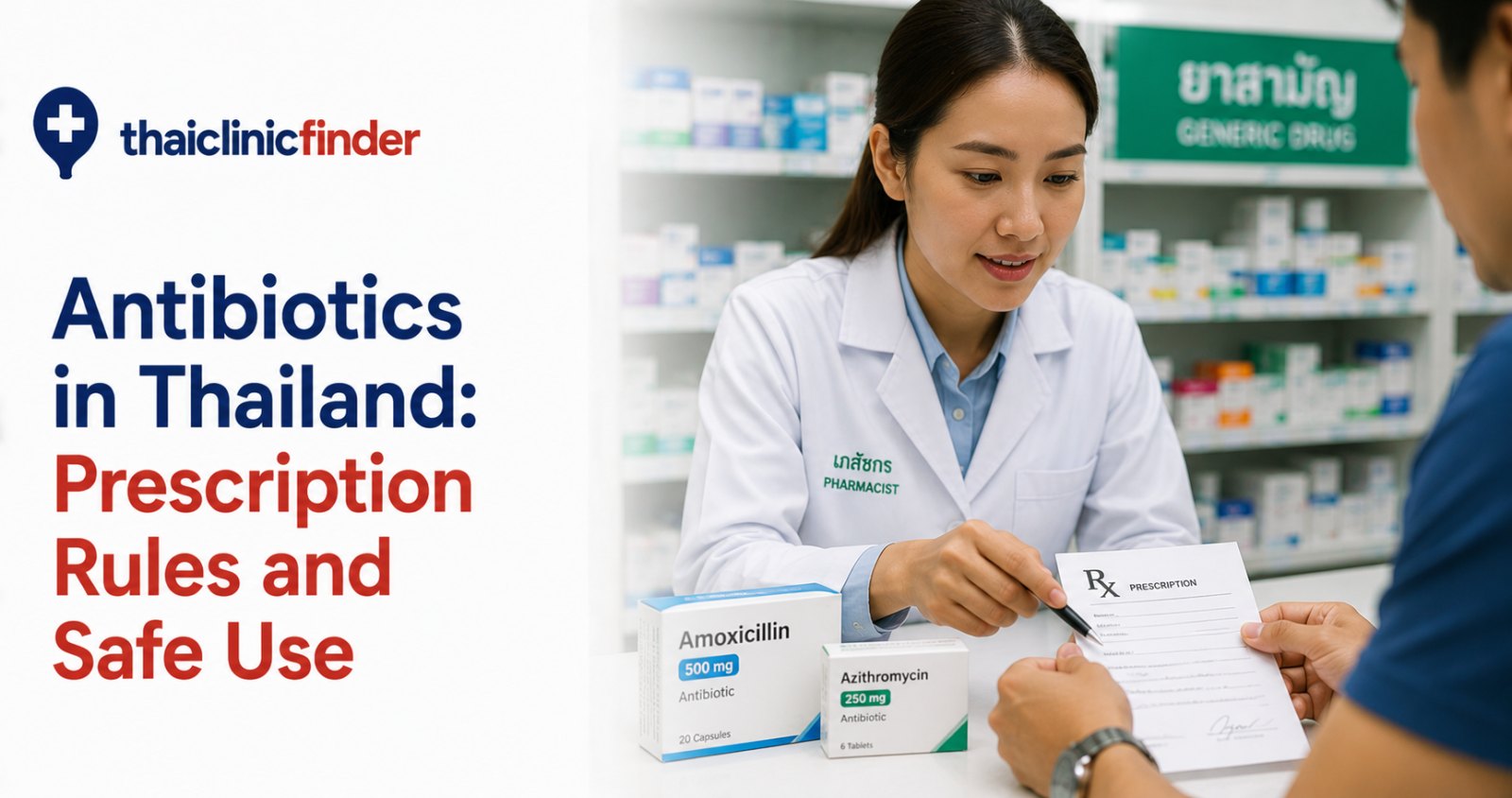
Antibiotics are widely available in Thailand, but describing them simply as over-the-counter medicines is misleading. Under Thailand's drug classification system, antibiotics are generally included in the dangerous drug category, a pharmacist-controlled class that is different from both unrestricted household remedies and specially controlled prescription medicines.
In practical terms, many antibiotics can be supplied by a licensed pharmacist without first obtaining a doctor's prescription. That does not mean they should be selected or taken casually.
Thailand also treats antimicrobial resistance as a major public-health problem. The Thai FDA maintains a national antimicrobial resistance program, and Thailand's current National Action Plan on Antimicrobial Resistance runs from 2023 to 2027.
For travelers, the useful rule is simple: easy pharmacy access does not make every cough, sore throat, stomach problem or episode of diarrhea an indication for antibiotics.
Can you buy antibiotics without a prescription in Thailand?
Many commonly used antibiotics can be obtained from a licensed pharmacy without presenting a physician's prescription because they fall under Thailand's dangerous drug category rather than the specially controlled drug category.
The Thai FDA's current dangerous-drug list specifically includes antibiotics, with certain exceptions and with some medicines potentially subject to stricter classification.
Thailand's regulatory system broadly distinguishes between:
- household remedies that can be sold more freely
- non-dangerous medicines
- dangerous drugs supplied under pharmacist supervision
- specially controlled drugs that require a doctor's prescription
Antibiotics are therefore not best described as ordinary unrestricted OTC medicines.
A more accurate description is pharmacist-controlled medicines.
Why does Thailand call antibiotics dangerous drugs?
The English translation can sound alarming.
The Thai category ยาอันตราย is commonly translated as dangerous drug, but it is a legal classification rather than a statement that every medicine in the category is exceptionally hazardous.
Thai regulatory materials describe dangerous drugs as medicines intended to be supplied through pharmacies by pharmacists.
This category includes many medicines that would require a prescription in other countries.
By contrast, specially controlled medicines are subject to stricter prescription requirements.
So when a Thai pharmacy supplies an antibiotic without a physician's written prescription, that does not necessarily mean the pharmacy is ignoring Thai law. The legal structure is different from systems used in countries such as the United States or United Kingdom.
The pharmacist still has an important role
Being able to obtain an antibiotic without first seeing a doctor does not mean walking into a pharmacy and choosing whichever antibiotic you recognize.
A pharmacist should consider factors such as:
- symptoms
- duration of illness
- allergies
- other medications
- pregnancy
- previous antibiotic use
- whether the illness is likely bacterial
- whether medical examination is needed
Different antibiotics treat different organisms.
Amoxicillin, azithromycin, doxycycline and ciprofloxacin are not interchangeable versions of the same medicine.
Can you buy amoxicillin in Thailand?
Amoxicillin is an antibiotic in the penicillin family and is used for selected bacterial infections.
Like antibiotics generally, it falls within Thailand's pharmacist-controlled framework unless a specific product or formulation is classified differently.
The important question is not simply whether amoxicillin can be obtained. It is whether amoxicillin is appropriate for the suspected infection.
It will not treat viral infections such as most common colds and many sore throats.
People with a history of serious penicillin allergy should tell the pharmacist or doctor before taking it.
What about azithromycin?
Azithromycin is a macrolide antibiotic used for several bacterial infections.
Travelers sometimes encounter it because it can be used in selected cases of severe travelers' diarrhea.
Current CDC guidance identifies azithromycin as the preferred empirical antibiotic for dysentery or febrile travelers' diarrhea and as a preferred option in Southeast Asia when fluoroquinolone-resistant organisms are suspected.
That does not mean azithromycin should be taken every time diarrhea begins.
CDC does not recommend antibiotics for mild travelers' diarrhea.
If you have simple watery diarrhea without severe symptoms, hydration and symptom management are usually the more appropriate starting point.
Ciprofloxacin is no longer the automatic Southeast Asia diarrhea antibiotic
Fluoroquinolone antibiotics such as ciprofloxacin were historically widely used for travelers' diarrhea.
That has changed because resistance has increased.
CDC states that fluoroquinolone-resistant enteric pathogens are widespread in Thailand and other parts of Southeast Asia. Resistance among Campylobacter is particularly important.
Fluoroquinolones also carry significant potential adverse effects.
This is why a traveler should not rely on old advice saying to buy ciprofloxacin as soon as gastrointestinal symptoms appear.
Antibiotic choice needs to reflect current resistance patterns as well as the severity and type of illness.
Doxycycline has several uses, but they are not interchangeable
Doxycycline is an antibiotic that can be prescribed for certain bacterial infections and is also used as malaria prevention for travelers visiting particular risk areas.
Those are completely different uses.
The dose, timing and duration depend on why it is being taken.
Do not use leftover doxycycline from malaria prevention to treat a respiratory or gastrointestinal illness without medical advice.
Likewise, taking doxycycline for an unrelated infection does not automatically provide appropriate malaria protection for a future trip.
For Thailand's geographic malaria risk, see Malaria in Thailand: Risk Areas, Prevention and What Travelers Should Know.
Antibiotics do not treat colds or most flu-like illnesses
One of the most common reasons for unnecessary antibiotic use is treating viral respiratory infections.
Antibiotics target bacteria. They do not treat viruses responsible for most cases of:
- common cold
- influenza
- many sore throats
- many episodes of acute bronchitis
Taking an antibiotic during a viral illness usually does not make recovery faster.
It can still cause side effects and contributes to antimicrobial resistance.
A doctor may consider antibiotics when examination suggests a bacterial infection or complication, but that decision is different from simply taking antibiotics because mucus has changed color or symptoms have lasted several days.
Food poisoning does not automatically need antibiotics either
Diarrhea after eating is another situation where travelers may reach for antibiotics too quickly.
Foodborne illness can be caused by:
- bacteria
- viruses
- parasites
- toxins already present in food
Antibiotics cannot treat viral illness or toxins.
CDC recommends no antibiotic treatment for mild travelers' diarrhea.
For moderate diarrhea, antibiotics can be considered in some circumstances. Severe diarrhea, particularly bloody diarrhea or dysentery, is a different situation and can justify antibiotic therapy after appropriate assessment.
For a practical first-response plan, see Food Poisoning in Thailand: Symptoms, Treatment and What to Do.
Mild travelers' diarrhea usually does not need an antibiotic
CDC classifies travelers' diarrhea according to how much it affects the traveler rather than simply counting stools.
For mild diarrhea, which is tolerable and does not interfere significantly with planned activities, antibiotics are not recommended.
Treatment can instead focus on:
- hydration
- oral rehydration salts when needed
- loperamide for suitable uncomplicated cases
- rest
For moderate diarrhea, antibiotic therapy can be considered depending on the circumstances.
For severe diarrhea, including all dysentery, antibiotic treatment is generally advised.
This approach helps avoid treating every minor gastrointestinal problem with antibiotics.
Blood in the stool changes the situation
Visible blood in diarrhea suggests dysentery and places the illness in the severe category under CDC travelers' diarrhea guidance.
Do not simply buy an antibiotic and guess the treatment yourself.
Seek medical assessment, particularly if blood is accompanied by:
- fever
- severe abdominal pain
- dehydration
- persistent vomiting
- marked weakness
CDC currently identifies azithromycin as the preferred treatment option for dysentery or febrile diarrhea in travelers, but the correct treatment still depends on the individual patient and clinical context.
See Diarrhea in Thailand: Causes, Treatment and When to See a Doctor for the broader warning signs.
Antibiotics can actually increase some travel-related risks
Antibiotics do more than target the organism causing an infection.
They also affect bacteria naturally living in the intestine.
CDC warns that antibiotic exposure while traveling can increase the likelihood of becoming colonized with extended-spectrum beta-lactamase-producing Enterobacterales, often shortened to ESBL-producing bacteria.
These organisms are resistant to several commonly used antibiotics.
The risk is one reason CDC discourages preventive antibiotics for most travelers.
Taking antibiotics just in case can therefore create a problem rather than preventing one.
Thailand has a major antimicrobial resistance challenge
Antimicrobial resistance, or AMR, occurs when microorganisms evolve in ways that make medicines less effective against them.
Thailand has maintained a national strategy to address antimicrobial resistance for years, and the Thai FDA currently publishes the country's second National Action Plan on Antimicrobial Resistance, covering 2023 to 2027.
WHO also works with Thailand on antimicrobial stewardship and appropriate antibiotic use.
Resistance matters to individual travelers because an infection caused by a resistant organism can be harder to treat and may require different or more intensive therapy.
Using antibiotics only when appropriate is therefore not an abstract public-health recommendation. It helps preserve treatment options for the individual patient as well.
WHO's Access, Watch and Reserve system explains why antibiotic choice matters
WHO groups antibiotics into its AWaRe classification:
- Access
- Watch
- Reserve
The purpose is to support appropriate antibiotic use and reduce the development of resistance.
Access antibiotics are generally preferred for common infections when clinically appropriate because they offer an appropriate balance of activity and resistance potential.
Watch antibiotics have higher resistance potential and need closer stewardship.
Reserve antibiotics are intended for selected infections caused by multidrug-resistant organisms and should generally be protected as last-resort options.
The existence of this system illustrates why choosing the strongest antibiotic is not good medicine.
The appropriate antibiotic is the narrowest suitable treatment for the actual infection, not simply the drug with the broadest spectrum.
More expensive does not mean more effective
Thai pharmacies may stock several brands and generic versions of the same antibiotic.
Price differences can reflect:
- manufacturer
- imported versus locally manufactured product
- packaging
- brand name
- pharmacy pricing
A higher price does not automatically mean that the antibiotic is more appropriate or clinically stronger.
The first question should always be whether the active ingredient is indicated for the suspected infection.
Ask for the active ingredient, not only the brand name
Brand names vary between countries.
A medicine you recognize in Europe or the United States may be sold under a different name in Thailand, and a Thai brand may contain a familiar antibiotic.
Check:
- active ingredient
- strength
- dosage form
- manufacturer
- expiry date
If a pharmacist offers a medicine you do not recognize, ask them to write down the generic name in English.
This is especially useful if you later need to see a doctor or continue treatment after leaving Thailand.
Do not combine antibiotics because one does not seem to work quickly
Antibiotics do not necessarily produce immediate symptom relief.
Starting a second antibiotic the next day because the first has not yet made you feel better can increase adverse effects and make later assessment more difficult.
Lack of rapid improvement might mean:
- the infection is viral
- the antibiotic does not cover the organism
- the organism is resistant
- the diagnosis is wrong
- a complication has developed
If symptoms are worsening despite treatment, seek medical advice instead of building your own combination regimen.
Take the antibiotic exactly as directed
If a doctor or pharmacist determines that an antibiotic is appropriate, follow the specified dose and duration.
Do not:
- double doses because symptoms are severe
- save tablets for the next illness
- give leftover medication to another traveler
- extend treatment indefinitely without advice
- stop or change treatment solely because someone online used a different regimen
Modern antibiotic stewardship does not mean that every antibiotic course must always be made longer. Some infections require shorter courses than were historically used.
The correct principle is to take the treatment for the duration prescribed for your specific infection.
Tell the pharmacist about allergies before accepting an antibiotic
Antibiotic allergies can be important.
If you have a known allergy to penicillin, cephalosporins, sulfonamides or another antibiotic, explain what actually happened during the previous reaction if you know.
There is a significant difference between:
- mild nausea
- a non-specific childhood rash
- hives
- swelling
- breathing difficulty
- anaphylaxis
- severe blistering skin reactions
A history of serious allergic reaction can substantially change which medicines are appropriate.
Antibiotics can interact with other medicines
Tell the pharmacist or doctor what else you take regularly.
Potential interactions vary by antibiotic and can involve medicines such as:
- anticoagulants
- some heart-rhythm medicines
- some seizure medicines
- certain antacids or mineral supplements
- other prescription drugs
For example, some antibiotics have absorption reduced when taken too close to products containing calcium, magnesium or iron.
Do not assume that because an antibiotic was supplied by a pharmacy without a physician prescription it cannot interact with your regular medication.
Pregnancy changes antibiotic choices
Some antibiotics are commonly used during pregnancy when clinically indicated, while others may be avoided or used only under particular circumstances.
If you are pregnant or could be pregnant, tell the pharmacist or doctor before taking an antibiotic.
The same applies to breastfeeding.
Do not select an antibiotic from a travel forum or from medication left over by another traveler during pregnancy.
Alcohol advice depends on the antibiotic
There is no universal rule that one sip of alcohol dangerously interacts with every antibiotic.
However, certain antibiotics do have important alcohol-related cautions, and being ill can make alcohol a poor choice regardless.
Ask the pharmacist about the specific antibiotic rather than assuming the same rule applies to every medicine.
If you are being treated for gastrointestinal illness, dehydration or fever, avoiding substantial alcohol until recovery is sensible even when there is no direct drug interaction.
Side effects are not always signs of an allergy
Antibiotics commonly cause adverse effects such as:
- nausea
- diarrhea
- abdominal discomfort
- headache
- altered taste
These do not necessarily indicate an allergic reaction.
More concerning features include:
- widespread hives
- swelling of the face or throat
- difficulty breathing
- collapse
- severe blistering skin rash
Breathing difficulty or severe swelling after taking an antibiotic is an emergency.
Thailand's emergency medical services number is 1669.
Antibiotic-associated diarrhea can happen after the original illness is gone
Antibiotics themselves can disrupt the intestinal microbiome and cause diarrhea.
In some cases, antibiotic exposure can contribute to infection with Clostridioides difficile, often called C. diff, which can cause substantial diarrhea and colitis.
Tell a doctor if you develop significant diarrhea during or after antibiotic treatment, particularly if symptoms are severe or persistent.
Do not assume the solution is another antibiotic chosen without assessment.
Do not use antibiotics as malaria prevention unless that is the actual prescription
Doxycycline can be used for malaria prophylaxis in certain circumstances, but this does not mean antibiotics generally prevent malaria.
Thailand's malaria risk is geographically concentrated, and CDC recommends prophylactic medicines only for specified higher-risk areas.
Taking amoxicillin or azithromycin will not protect you from malaria.
Likewise, an antibiotic used for malaria prevention should be taken according to the specific prophylaxis schedule rather than like treatment for an ordinary infection.
Antibiotics cannot treat dengue
Dengue is caused by a virus.
Antibiotics do not treat it.
Someone in Thailand with fever, headache, body aches and other systemic symptoms should not assume that an antibiotic is the appropriate first response.
Depending on symptoms and travel history, a clinician may need to consider dengue or other causes of fever.
See Dengue Fever in Thailand: Symptoms, Risk Areas and Prevention for the main warning signs.
Antibiotics cannot treat every sore throat either
Many sore throats are viral.
Bacterial infections such as group A streptococcal pharyngitis are different and can require antibiotics when appropriately diagnosed.
Symptoms alone do not always distinguish the two reliably.
If a sore throat is severe, prolonged, associated with difficulty swallowing or accompanied by other concerning symptoms, a clinical examination may be more useful than requesting amoxicillin from a pharmacy immediately.
When a Thai pharmacy is enough
A pharmacist can be useful when symptoms are mild and you need advice about whether medical treatment is appropriate.
For example, they can help review:
- minor symptoms
- medicine allergies
- an existing prescription
- dosing instructions
- drug interactions
If the pharmacist recommends that you see a doctor, take that recommendation seriously rather than moving from pharmacy to pharmacy until someone sells the antibiotic you requested.
When you should see a doctor instead
Seek medical assessment rather than relying only on pharmacy treatment if you have:
- high or persistent fever
- severe abdominal pain
- bloody diarrhea
- breathing difficulty
- confusion
- rapidly spreading skin infection
- severe throat swelling
- persistent vomiting
- significant dehydration
- symptoms worsening despite antibiotics
- recurrent infection
Certain infections require testing, drainage, imaging or other treatment that antibiotics alone cannot provide.
If English communication matters, see How to Choose an English-Speaking Clinic in Thailand.
What if you already started an antibiotic yourself?
If you have already taken one or more doses, do not hide that information when you see a doctor.
Tell them:
- the antibiotic name
- strength
- number of doses taken
- when you started
- reason you took it
- whether symptoms changed
Bring the packaging or take a photograph of it.
Previous antibiotic exposure can influence diagnostic testing and the next treatment decision.
Can you bring antibiotics into Thailand?
Travelers carrying personal medicines should follow Thai FDA import rules.
For ordinary modern medicines, the Thai FDA provides personal-use guidance, while narcotic and psychotropic medicines have separate, stricter procedures.
Keep medication in identifiable packaging and carry relevant medical documentation when appropriate.
For the wider rules, see Bringing Prescription Medicines into Thailand: A Practical Guide.
Buying antibiotics online is a different question
The fact that antibiotics can be supplied through licensed Thai pharmacies does not mean every online seller is an appropriate source.
Unverified medicines can create risks involving:
- counterfeit products
- incorrect active ingredients
- inappropriate storage
- expired medication
- absence of pharmacist assessment
For common infections, use a licensed pharmacy or healthcare provider rather than an unidentified social-media seller.
A practical approach if you think you need antibiotics in Thailand
Instead of walking into a pharmacy and requesting a specific drug by name:
- Explain your symptoms and how long you have had them.
- Tell the pharmacist about allergies and regular medication.
- Ask whether the illness appears to need an antibiotic at all.
- Ask for the generic name and strength if one is supplied.
- Confirm how it should be taken and for how long.
- Ask about important food, alcohol or medicine interactions.
- Seek medical assessment if symptoms are severe or the diagnosis is uncertain.
- Do not save leftovers for another illness.
This approach uses Thailand's relatively accessible pharmacy system without treating antibiotics as ordinary travel supplies.
The key distinction travelers should remember
Can you buy antibiotics without a doctor's prescription in Thailand? Many antibiotics can be dispensed by a licensed pharmacist without a physician prescription because Thai law classifies antibiotics broadly as dangerous drugs rather than ordinary unrestricted medicines.
That is different from saying antibiotics are freely available and suitable for self-treatment.
Thailand is actively addressing antimicrobial resistance, and current CDC guidance also highlights important resistance among enteric pathogens in Southeast Asia.
Use antibiotics for a clear clinical reason, not simply because they are easy to obtain. For colds, mild diarrhea and many short-lived infections, antibiotics may provide no benefit at all. When symptoms are severe, persistent or unclear, seeing a doctor is safer than choosing an antibiotic from a pharmacy shelf.
Frequently Asked Questions
Can you buy antibiotics without a prescription in Thailand?
Many antibiotics are classified as dangerous drugs in Thailand and can generally be supplied by a licensed pharmacist without the physician prescription required for specially controlled medicines. They are better described as pharmacist-controlled rather than ordinary unrestricted OTC medicines.
Are antibiotics over the counter in Thailand?
Not in the usual unrestricted sense of OTC. Thai FDA classifies antibiotics broadly as dangerous drugs, which are intended to be supplied under pharmacist supervision.
Can you buy amoxicillin in Thailand?
Amoxicillin and other antibiotics are available through Thai pharmacies, subject to their regulatory classification and pharmacist supervision. Whether amoxicillin is appropriate depends on the infection, allergies and other medical factors.
Can I buy azithromycin in Thailand?
Azithromycin is available in Thailand, but it should be used for an appropriate bacterial indication. CDC recommends it for selected severe travelers' diarrhea scenarios, including dysentery or febrile diarrhea, but antibiotics are not recommended for mild travelers' diarrhea.
Should I take antibiotics for food poisoning in Thailand?
Usually not for mild illness. Foodborne illness can be viral, bacterial, parasitic or toxin-mediated. CDC does not recommend antibiotics for mild travelers' diarrhea, while selected severe bacterial illness may require them.
Is ciprofloxacin good for travelers' diarrhea in Thailand?
Fluoroquinolone resistance is widespread among enteric pathogens in Thailand and Southeast Asia, particularly Campylobacter. CDC therefore identifies azithromycin as a preferred empirical option in Southeast Asia when resistant organisms are suspected.
Do antibiotics treat dengue?
No. Dengue is a viral infection, so antibiotics do not treat it. Fever in Thailand can have many causes and significant illness should be properly assessed.
Why should I avoid taking antibiotics unnecessarily?
Unnecessary antibiotics can cause side effects, disrupt normal intestinal bacteria and contribute to antimicrobial resistance. CDC also notes that antibiotic exposure while traveling increases the risk of acquiring resistant intestinal bacteria.
When should I see a doctor instead of buying antibiotics from a pharmacy?
Seek medical assessment for high or persistent fever, bloody diarrhea, severe abdominal pain, breathing difficulty, serious skin infections, dehydration, confusion, worsening symptoms or illness that does not improve as expected.
Sources

Writer
Niran Chaiyasit
Niran Chaiyasit is a Thai health writer with a background in public health and a focus on travel health, disease prevention and healthcare access in Thailand. His work covers topics such as common illnesses, vaccinations, mosquito-borne diseases, food safety and practical health information for travelers and expatriates.

Medical review
Justin Brooks
Justin Brooks is an American health writer with a background in health sciences and a focus on rehabilitation, musculoskeletal health and patient education. He writes about physiotherapy, injury recovery, pain management, preventive health and practical healthcare guidance for international patients and travelers.