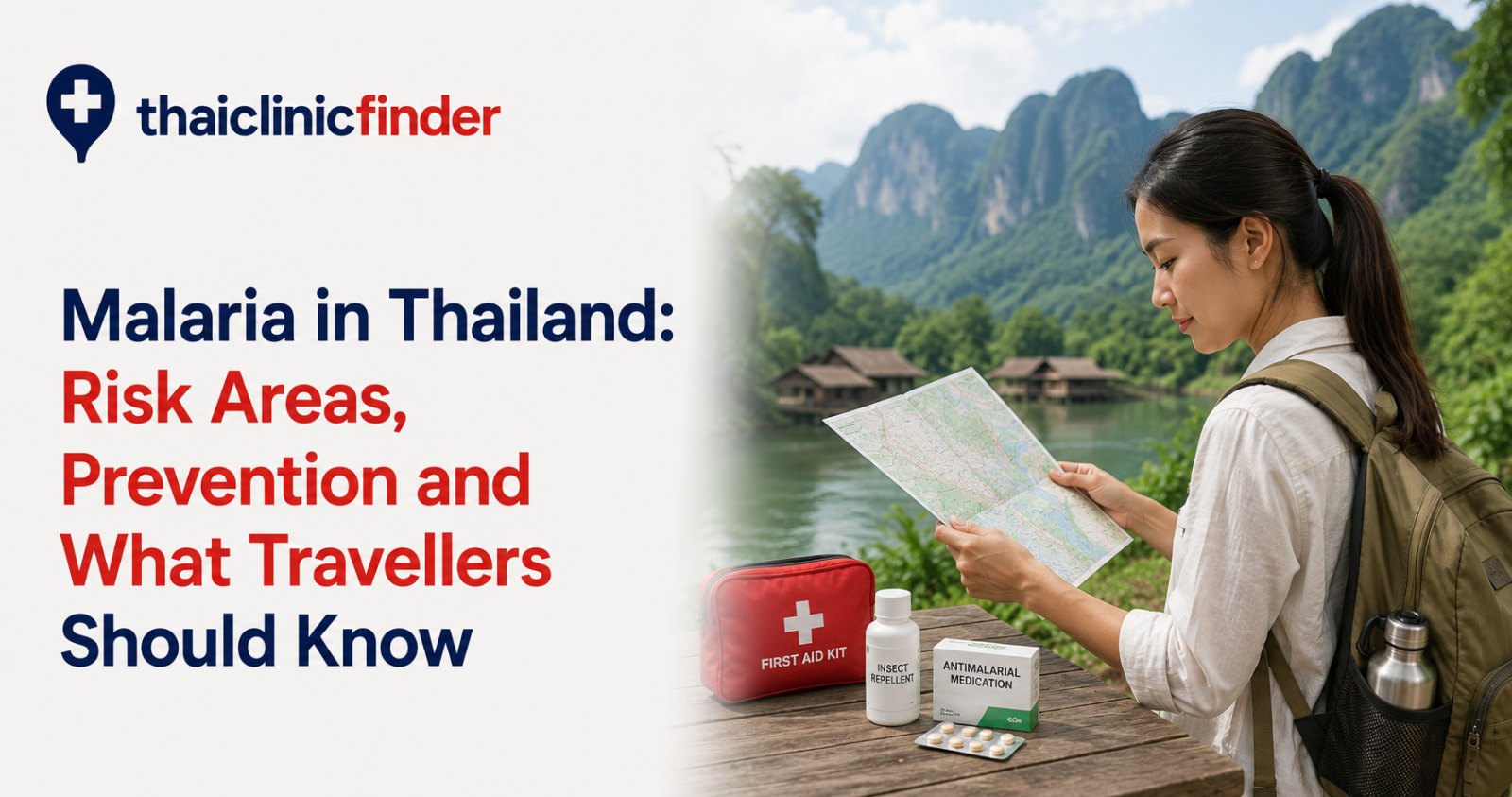
Malaria still occurs in Thailand, but the risk is concentrated in particular parts of the country rather than across every tourist destination. For most travellers following standard itineraries through Bangkok, Pattaya, Phuket or the main islands, malaria is not one of the main day-to-day risks. The situation is different in some rural and forested areas near Thailand's international borders.
Current CDC guidance places the main malaria transmission areas along borders with Myanmar, Cambodia and Malaysia, particularly in rural forest and forest-fringe locations. WHO also continues to classify Thailand as a malaria-endemic country while documenting the country's progress towards elimination.
Whether you need malaria prevention medicine therefore depends on your exact itinerary. A city break in Bangkok and a trekking trip near the Myanmar border should not receive the same travel-health advice.
Is there malaria in Thailand?
Yes. Malaria has not yet been eliminated from Thailand.
WHO's Thailand malaria country profile continues to include the country among malaria-endemic countries reporting to the Global Malaria Programme. Thailand has substantially reduced malaria over previous decades, but transmission persists in some areas.
CDC describes malaria as endemic in specific parts of Thailand, particularly rural and forested areas bordering Myanmar, rural forested areas near Cambodia and provinces in the far south near Malaysia.
This geographical concentration is important for travellers. The fact that malaria exists in Thailand does not mean that someone spending a week in central Bangkok faces the same risk as someone staying in a remote border village.
Where is malaria found in Thailand?
Current CDC guidance says transmission occurs primarily in provinces bordering Myanmar, Cambodia and Malaysia, especially rural forest and forest-fringe areas.
Its current malaria prevention map identifies areas along much of Thailand's western border, parts of the eastern border with Cambodia and parts of the far south where both mosquito precautions and preventive medication may be recommended.
These include areas within provinces such as:
- Mae Hong Son
- Chiang Mai
- Chiang Rai
- Tak
- Kanchanaburi
- Ratchaburi
- Phetchaburi
- Prachuap Khiri Khan
- Chumphon
- Ranong
- Trat
- Chanthaburi
- Sa Kaeo
- Surin
- Si Sa Ket
- Ubon Ratchathani
- Satun
- Songkhla
- Yala
- Narathiwat
The risk is not necessarily uniform across an entire province. A provincial capital and a remote forested border district can have very different transmission patterns.
For that reason, travellers should provide a travel-health professional with the actual places they will visit rather than simply naming the province.
Is malaria common in Bangkok?
Malaria is not considered a significant risk for the typical visitor to Bangkok.
CDC describes only rare to few cases in Bangkok and recommends mosquito avoidance rather than routine malaria chemoprophylaxis for areas where transmission is rare.
This means someone staying in central Bangkok would not normally take malaria tablets solely because they are visiting the city.
Mosquito protection is still important. Dengue, chikungunya and other mosquito-borne infections can occur in Thailand even where malaria risk is very low.
Is there malaria in Pattaya?
CDC currently states that there is no malaria transmission in Pattaya City.
A traveller staying only in Pattaya would therefore not normally require malaria preventive medication because of the city itself.
This does not mean that the same advice applies everywhere in eastern Thailand. Areas closer to the Cambodian border can have malaria transmission, so anyone travelling onward into rural or forested parts of the region should check the specific destination.
Is there malaria in Phuket?
CDC reports rare to few malaria cases on Phuket and currently recommends mosquito avoidance rather than routine chemoprophylaxis for destinations with this low level of transmission.
For a standard tourist stay in Phuket, malaria tablets are therefore generally not recommended solely because of the island stay.
Mosquito precautions remain worthwhile because dengue and other mosquito-borne diseases occur in Thailand and have a different geographical pattern from malaria.
Is there malaria in Chiang Mai?
The answer depends on whether you mean Chiang Mai city or the wider province.
CDC reports only rare to few cases in Chiang Mai city, and mosquito avoidance rather than routine malaria medication is recommended for areas with this level of transmission.
However, parts of Chiang Mai Province lie close to the Myanmar border and include rural and forested environments where malaria risk can be different.
A traveller staying in the city and someone trekking or staying in remote border districts should therefore not assume that the same recommendation applies to both itineraries.
Is there malaria in Chiang Rai?
CDC similarly reports rare to few cases in Chiang Rai city, but parts of Chiang Rai Province are close to international borders and appear within the broader malaria-risk zone.
For an urban stay, mosquito precautions may be sufficient. For rural travel, forest activities or trips close to the Myanmar border, obtain itinerary-specific advice before departure.
What about Koh Samui and Koh Pha Ngan?
CDC currently reports rare to few malaria cases on Koh Samui and Koh Pha Ngan.
For typical visits to these islands, mosquito avoidance rather than routine malaria chemoprophylaxis is recommended under current CDC guidance.
Again, malaria is only one reason to prevent mosquito bites. Dengue and other mosquito-borne diseases remain relevant in Thailand.
Is there malaria on the islands of Krabi Province?
CDC currently states that there is no malaria transmission on several major islands of Krabi Province, including:
- Koh Lanta
- Koh Phi Phi
- Koh Yao Noi
- Koh Yao Yai
Travellers visiting these islands do not normally require malaria preventive medication solely because of the island stay.
If your itinerary also includes rural mainland areas or forest travel elsewhere in Thailand, that part of the trip should be assessed separately.
Where is malaria risk most relevant for travellers?
For international visitors, malaria becomes more relevant when an itinerary includes rural forest or forest-fringe areas close to Thailand's borders.
WHO has highlighted ongoing malaria-control challenges in Mae Hong Son along the Thai-Myanmar border, where remote villages, forest exposure, cross-border movement and difficult access to healthcare continue to complicate malaria elimination.
Travel activities that may increase exposure include:
- trekking in forested border areas
- camping in malaria transmission zones
- staying in remote rural villages
- working in forests or agricultural areas
- spending extended periods close to the Myanmar, Cambodian or Malaysian borders
- sleeping in accommodation with limited mosquito protection
The duration of exposure also matters. One afternoon excursion and several weeks living in a remote forest area are not equivalent risks.
Do you need malaria tablets for Thailand?
Not every traveller to Thailand needs malaria prevention medicine.
CDC currently recommends prescription malaria chemoprophylaxis for travellers visiting the main endemic border areas with Myanmar, Cambodia and Malaysia. For those areas, the recommended options are atovaquone-proguanil, doxycycline or tafenoquine.
For other areas where malaria cases are rare to few, including Bangkok, Chiang Mai, Chiang Rai, Phuket, Koh Samui and Koh Pha Ngan, CDC currently recommends mosquito precautions without routine chemoprophylaxis.
Pattaya City and the specified islands of Krabi Province are listed as having no malaria transmission.
Do not choose an antimalarial drug yourself from an online list. The appropriate medicine depends on the itinerary and individual factors such as medical history, other medicines, pregnancy where relevant and the time available before departure.
Why is mefloquine not recommended in the main risk areas?
Drug resistance affects malaria prevention recommendations in Thailand.
CDC currently reports resistance to both chloroquine and mefloquine. For the main endemic areas along the borders with Myanmar, Cambodia and Malaysia, CDC recommends atovaquone-proguanil, doxycycline or tafenoquine rather than mefloquine.
This is one reason old travel advice can be unreliable. Malaria recommendations should be checked against current guidance rather than copied from an itinerary or travel forum published several years ago.
The prescribing clinician should select the appropriate medication when chemoprophylaxis is indicated.
What type of malaria occurs in Thailand?
CDC currently estimates that approximately 80 percent of malaria infections in Thailand are caused by Plasmodium vivax, while less than 20 percent are caused by Plasmodium falciparum.
Other species, including Plasmodium knowlesi, Plasmodium malariae and Plasmodium ovale, are reported rarely.
Travellers do not need to determine the parasite species themselves. Diagnosis requires appropriate testing, and treatment depends on the species and clinical circumstances.
Is malaria seasonal in Thailand?
Malaria transmission in Thailand can occur throughout the year in endemic areas.
The CDC Yellow Book states that transmission peaks during the rainy season, with a smaller second peak in December.
Seasonality does not make a known transmission area risk-free outside the peak. Anyone travelling to an endemic rural border area should use current destination-specific recommendations regardless of the month.
Thailand's rainy season also varies somewhat by region, so a simple national wet-season rule is not sufficient for individual malaria decisions.
How can travellers prevent malaria?
Where malaria transmission occurs, preventing mosquito bites is important whether or not preventive medication is prescribed.
Practical measures include:
- using an appropriate insect repellent
- wearing long sleeves and trousers when practical
- sleeping in screened or air-conditioned accommodation
- using an appropriate bed net when sleeping somewhere exposed to mosquitoes
- following any prescribed malaria prevention regimen correctly
Malaria-carrying Anopheles mosquitoes commonly bite between dusk and dawn, making evening and nighttime precautions particularly important.
Taking malaria medication does not remove the need for mosquito protection. No preventive medicine is completely effective, and mosquito precautions also help reduce exposure to other infections.
Dengue is a separate mosquito risk
Travellers sometimes focus on malaria while overlooking dengue.
The geographical patterns are different. Malaria in Thailand is concentrated mainly in selected rural and forested border areas, while dengue can occur much more widely, including major urban and tourist destinations.
Someone staying only in Bangkok, Pattaya or Phuket may have little or no reason for malaria medication but should still take mosquito precautions because of dengue and other mosquito-borne infections.
This distinction is useful when planning prevention. No malaria tablets does not mean no mosquito risk.
What are the symptoms of malaria?
Malaria commonly causes fever and can also cause chills, headache, sweating, fatigue, muscle aches, nausea or vomiting.
These symptoms overlap with dengue, influenza and several other infections found in or around Thailand. You cannot reliably diagnose malaria from symptoms alone.
Malaria can become serious if diagnosis and treatment are delayed. A fever during or after travel in a malaria-risk area requires prompt medical assessment.
Tell the healthcare professional where you travelled, particularly if you visited rural or forested border areas. Saying only that you were in Thailand may not provide enough information to assess malaria risk.
Can malaria appear after leaving Thailand?
Yes. Malaria can develop after you have left the area where you were exposed.
If you develop a fever after returning from a malaria-risk area in Thailand, tell the doctor about your travel history and the specific places you visited.
Do this even if you took malaria preventive medication. Chemoprophylaxis reduces risk but does not provide complete protection.
If a clinician prescribed preventive medication that needs to be continued after leaving the risk area, complete the course according to the instructions provided.
What if you develop a fever while travelling in Thailand?
Seek medical assessment promptly if you develop a significant fever during or after travel to an area where malaria occurs.
Tell the healthcare provider:
- where in Thailand you stayed
- whether you visited rural or forested areas
- whether you were close to an international border
- when you entered and left the risk area
- whether you took preventive malaria medicine
- which medicine you took
- whether any doses were missed
- when your symptoms started
Testing is required to determine whether malaria is responsible. Do not try to distinguish malaria from dengue or another infection based only on symptoms.
For severe illness, altered consciousness, breathing difficulty or another potentially life-threatening condition, seek emergency medical care. Thailand's emergency medical services number is 1669. See medical emergencies in Thailand for practical emergency information.
How to plan a trip that includes a malaria-risk area
If your itinerary includes border regions, forests or remote rural areas, review malaria prevention before departure.
Useful information for a travel-health appointment includes:
- the provinces you will visit
- the towns, villages or parks on your route
- how close you will be to an international border
- whether you will trek or camp
- how many nights you will spend in rural areas
- the type of accommodation
- your regular medicines
- relevant medical conditions
- your departure date
The province name alone may not be enough because malaria transmission can be concentrated in particular districts or environments.
If preventive medication is prescribed, obtain enough for the entire required course and follow the instructions about when to begin and when to stop it.
Conclusion
Malaria is still present in Thailand, but the risk is concentrated mainly in rural forest and forest-fringe areas near the borders with Myanmar, Cambodia and Malaysia. Most standard tourist stays in Bangkok, Pattaya, Phuket, Chiang Mai city and the major islands do not require routine malaria medication under current CDC guidance.
The key is to assess the actual itinerary. Travellers heading into rural border areas may need prescription chemoprophylaxis, while people visiting low-risk destinations generally need mosquito precautions rather than malaria tablets.
If you develop a fever during or after travel to a malaria-risk part of Thailand, seek medical assessment promptly and tell the clinician exactly where you travelled.
Frequently Asked Questions
Is malaria common in Thailand?
Malaria still occurs in Thailand, but transmission is concentrated mainly in rural forested border areas. The risk is low or absent in many of the country's main tourist destinations.
Do I need malaria tablets for Thailand?
Not for every itinerary. CDC recommends preventive medication for the main endemic areas along borders with Myanmar, Cambodia and Malaysia, while mosquito avoidance alone is recommended for many low-risk tourist destinations.
Is there malaria in Bangkok?
CDC reports rare to few malaria cases in Bangkok and recommends mosquito precautions rather than routine chemoprophylaxis. Dengue and other mosquito-borne diseases remain relevant in the city.
Is there malaria in Phuket?
CDC reports rare to few malaria cases in Phuket and currently recommends mosquito avoidance rather than routine malaria preventive medication for typical stays on the island.
Is there malaria in Pattaya?
CDC currently states that there is no malaria transmission in Pattaya City. Travellers going onward to rural areas near Thailand's borders should assess those destinations separately.
Is there malaria in Chiang Mai?
CDC reports rare to few cases in Chiang Mai city, where mosquito avoidance rather than routine chemoprophylaxis is recommended. Rural and forested parts of Chiang Mai Province near the Myanmar border can have a different risk.
Which parts of Thailand have the highest malaria risk?
The main risk areas are rural forest and forest-fringe locations near the borders with Myanmar and Cambodia and in the far south near Malaysia. The exact risk varies within provinces.
Can I get malaria after returning from Thailand?
Yes. Malaria symptoms can develop after leaving the transmission area. Seek prompt medical assessment for fever after relevant travel and tell the clinician exactly where in Thailand you stayed.
Sources

Writer
Thai Clinic Finder Editorial Team
The editorial team checks public healthcare information against official provider and institutional sources. It does not provide medical advice.