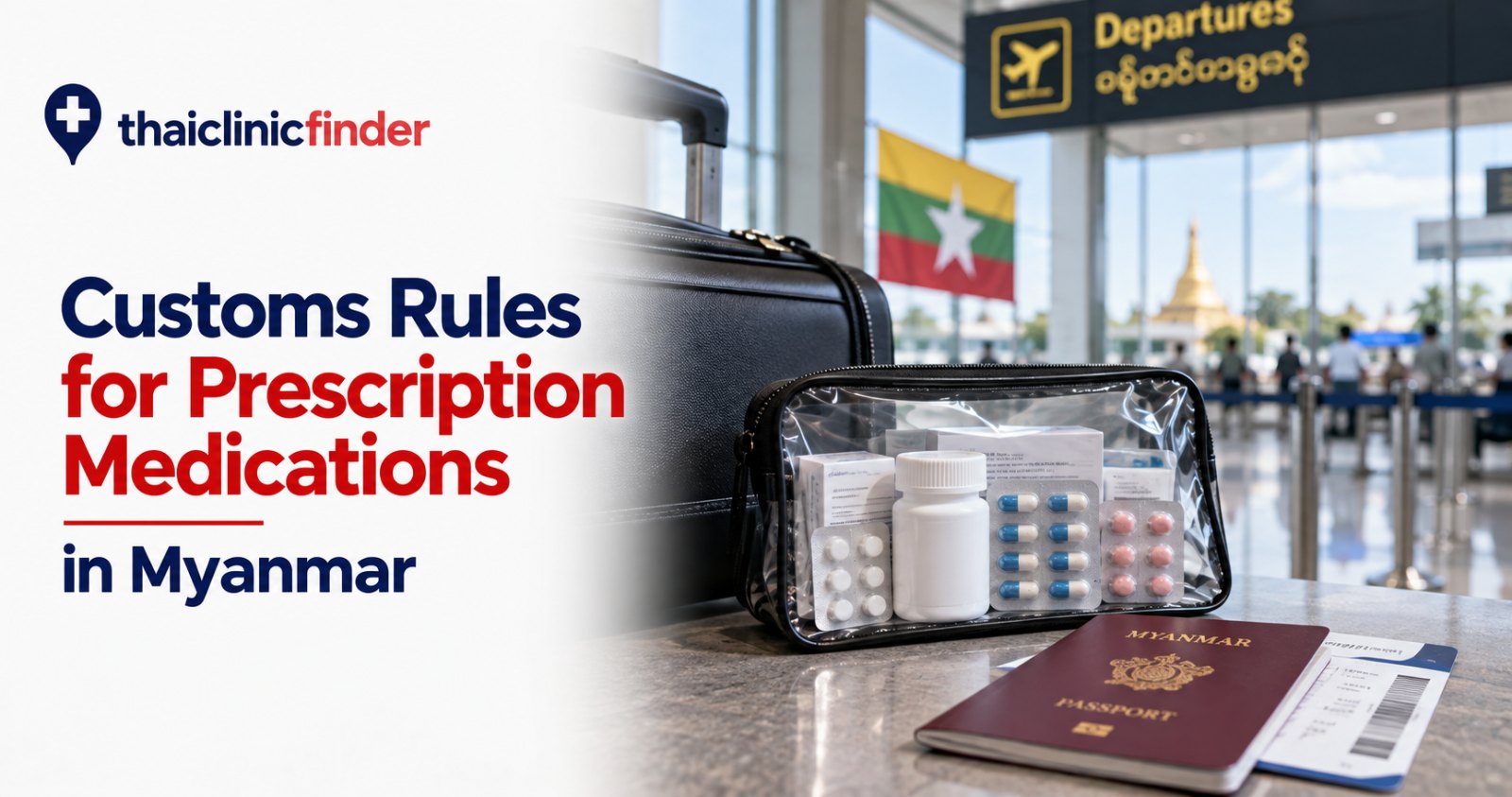
Travelers entering Myanmar with prescription medicine should distinguish ordinary personal medication from medicines containing narcotic or psychotropic substances.
Myanmar's current country information submitted to the International Narcotics Control Board gives a 14-day limit for narcotic drugs and a 14-day limit for psychotropic substances carried by travelers for medical treatment. It also identifies several substances as prohibited.
For ordinary prescription medicines, carry clearly labeled packaging and medical documentation. For any medicine that could be controlled, check the active ingredient before departure and confirm current requirements with the competent authority.
Myanmar has a specific 14-day rule for controlled medicines
Myanmar's official INCB traveler submission, dated March 2024, states:
- narcotic drugs: 14 days
- psychotropic substances: 14 days
This is much shorter than the 30-day controlled-medicine framework used by some other countries in the region.
Do not assume that a one-month prescription can automatically be carried into Myanmar in full.
Some substances are specifically listed as prohibited
Myanmar's INCB submission identifies the following among prohibited substances:
- ketamine
- tramadol
- Mitragyna speciosa, commonly known as kratom
This is particularly important because tramadol is legally prescribed in many countries and may be viewed by travelers simply as a pain medicine.
A prescription issued abroad does not automatically make a prohibited substance acceptable at the border.
Check the active ingredient before packing
Do not rely only on the medicine's brand name.
Prepare a list containing:
- generic active ingredient
- strength
- dosage form
- prescribed daily dose
- total quantity
- reason for treatment
This is essential for combination medicines, where a controlled ingredient may not be obvious from the trade name.
Carry strong medical documentation
For controlled medication, travel with documentation that clearly connects the medicine to your treatment.
Useful documents include:
- original prescription
- doctor's letter
- original medicine packaging
- copy of your passport details
The doctor's letter should use the generic drug name and state the dose and required treatment period.
The letter should be recent, signed and preferably written in English. It should identify you by the same name shown in your passport and explain why the quantity matches the trip. Keep a paper copy with the medicine and a separate digital copy in case the original is lost.
Documentation supports your explanation but does not cancel a restriction. A foreign doctor's letter cannot convert a prohibited substance into an ordinary personal import.
Do not exceed the 14-day controlled-drug allowance without confirmation
If your prescription normally provides 30 or 90 days of a narcotic or psychotropic medicine, do not simply pack the entire supply.
Myanmar's current INCB submission specifies 14 days for these categories.
If you need more than this amount, contact the national competent authority before traveling and ask what authorization is required.
Myanmar's drug-import system is highly regulated
Myanmar Customs states that formal drug imports require a Drug Registration Certificate among the supporting documents.
Myanmar FDA guidance for drug importers likewise requires registration details for commercial import applications.
Those rules are aimed at formal pharmaceutical importation rather than an ordinary traveler carrying a personal supply.
They still demonstrate that medicines are a regulated import category and should not be mailed or imported commercially without checking the rules.
Tramadol is a particularly important exception
Tramadol deserves special mention because travelers may not think of it as an especially restricted medicine.
Myanmar's official INCB submission includes tramadol in its prohibited-substance list for travelers.
Do not carry tramadol into Myanmar based solely on a foreign prescription without obtaining specific official guidance.
Ketamine should not be treated as ordinary prescription medication
Ketamine is also listed among prohibited substances in Myanmar's current traveler information.
This is relevant to people receiving ketamine for:
- chronic pain
- depression treatment
- anesthesia-related medical care
A legitimate prescription or clinic program abroad does not automatically create permission to import it into Myanmar.
Kratom is also listed as prohibited
Kratom, or Mitragyna speciosa, is legally available or differently regulated in some Southeast Asian countries.
Myanmar's INCB traveler submission specifically lists it as prohibited.
Do not assume rules in Thailand apply across the Myanmar border.
Psychotropic medication requires ingredient-level checking
Psychotropic medicines can include selected treatments for:
- anxiety
- sleep disorders
- ADHD
- psychiatric conditions
Myanmar's 14-day limit applies to the psychotropic category in its official traveler submission.
If your medicine could fall into this group, confirm the classification before travel.
This can affect stimulants, sedatives and some medicines used for anxiety, sleep or psychiatric treatment, but the brand name alone is not enough to decide. Ask the prescriber or pharmacist for the generic ingredient, then compare that ingredient with current official information. If the answer remains unclear, contact the competent authority or a Myanmar embassy before departure.
Do not stop a psychiatric medicine abruptly merely to simplify travel. Sudden interruption can cause withdrawal symptoms or a return of the treated condition. Speak with the prescriber early enough to discuss a lawful quantity, a documented alternative or a revised itinerary.
Opioid and narcotic medicines require particular care
Narcotic medicines are also limited to 14 days under the official INCB information.
People traveling for chronic pain or cancer treatment should contact the competent authority in advance when their therapy requires a longer supply.
Carry precise medical documentation rather than a generic note saying pain medication.
Ordinary medicines should still remain in original packaging
Even when a medicine is not controlled, keep it identifiable.
Original packaging helps demonstrate:
- drug name
- dose
- manufacturer
- legitimate medical use
Loose tablets can create unnecessary confusion at customs.
Do not depend on buying replacements informally
Myanmar FDA has warned the public against medicines purchased from street vendors and online sellers because products can be counterfeit, adulterated or withdrawn from the market.
If essential medication is lost:
- seek help from a legitimate medical provider
- show your prescription and medicine list
- use a recognized pharmacy
- verify the exact replacement product
Do not substitute a tablet based only on color or packaging.
Mailing medicine can create a different customs process
A traveler's personal medication allowance should not be assumed to apply to international parcels.
Myanmar Customs requires drug registration documentation for formal imports.
If you will run out during a long stay, plan with a doctor and authorities before departure rather than relying on a family member to courier more medicine later.
Regional travel creates different rules at each border
Thailand and Myanmar have very different controlled-drug traveler frameworks.
A medicine that Thailand permits for 30 or 90 days under a specific Thai FDA route may face Myanmar's 14-day controlled-substance limit or a prohibition.
If your trip includes Thailand as well, read Bringing Prescription Medicines into Thailand separately.
Rules are applied at each entry, including overland crossings and a return journey. A medicine accepted when you entered Thailand may still face a different quantity limit or prohibition when you continue to Myanmar. The same issue arises when leaving Myanmar for Malaysia, Laos, Cambodia or Vietnam.
Review each country's official rules using the generic ingredient and total quantity. Our separate guides cover prescription medicines in Malaysia, Laos, Cambodia and Vietnam, but official confirmation remains important for controlled drugs.
At the airport or land border
Keep medicine in hand luggage when possible, subject to airline security rules, so that it remains available if checked baggage is delayed. Carry only the quantity supported by the prescription and trip, plus the documents that identify it. Do not combine several medicines in an unlabelled pill organiser for border inspection.
If an arrival form or officer asks about medicines, answer accurately. Present the prescription and letter without arguing that the product is legal in your home country. Customs and drug-control rules apply in Myanmar, and officers may need time to check an unfamiliar active ingredient.
If authorities detain a medicine, ask for a written record and contact your embassy or consular service if you need help understanding the process. Do not conceal, mislabel or transfer medicine to another traveller. Those actions can turn a documentation problem into a more serious legal issue.
Planning for a stay longer than the permitted supply
Travellers who need ongoing treatment should solve the supply question before departure. Ask the prescriber whether the medicine can be lawfully replaced, whether the travel dates can fit the permitted quantity, and what would happen clinically if access were interrupted. A longer trip does not itself create a larger personal allowance.
Do not assume that the same brand, strength or formulation will be available locally. Product registration, stock and prescribing practice differ. If local continuation may be possible, arrange contact with a legitimate clinic and verify the exact appointment, language and documentation requirements rather than depending on an informal seller.
Travel insurance may help with an unexpected consultation but does not guarantee replacement of routine medicine. Check exclusions and keep receipts.
Who is the competent authority?
Myanmar's INCB submission names the Central Committee for Drug Abuse Control, Office of Drug Enforcement Division as the national competent authority for traveler questions about controlled medicines.
For complicated cases, contacting the authority or a Myanmar embassy before travel is safer than trying to resolve a controlled-drug issue on arrival.
A practical pre-travel checklist
Before entering Myanmar:
- Identify every generic medicine ingredient.
- Determine whether any medicine is narcotic or psychotropic.
- Check whether the substance appears on Myanmar's prohibited list.
- For controlled medicine, plan around the current 14-day limit.
- Carry the prescription.
- Obtain a doctor's letter.
- Keep original packaging.
- Contact the competent authority if you need more than the permitted quantity.
- Do not mail medicine without checking separate import rules.
- Keep essential medicine in hand luggage.
What to confirm before travelling with medicine to Myanmar
Start with the generic active ingredient, not the brand. Myanmar's current INCB traveler submission states a 14-day limit for narcotic drugs and 14 days for psychotropic substances, while identifying ketamine, tramadol and kratom as prohibited. Confirm the current classification and rule with the named competent authority or a Myanmar embassy when any medicine may be controlled.
Carry the permitted supply in original labelled packaging with the prescription and a signed medical letter. Keep the quantity consistent with the documented dose and travel period, and do not assume a foreign prescription overrides a prohibition. For ordinary medicines, the same preparation reduces confusion even when a special permit is not indicated.
Longer stays need planning rather than tablets hidden in luggage or sent later by post. Discuss continuity with the prescriber and check every border on a multi-country trip; the separate guide to customs rules for prescription medicines in Thailand shows why a nearby country's allowance cannot be applied to Myanmar.
Frequently Asked Questions
How much controlled medicine can I bring into Myanmar?
Myanmar's current INCB traveler submission states a 14-day limit for narcotic drugs and a 14-day limit for psychotropic substances.
Can I bring tramadol into Myanmar?
Myanmar's official INCB submission lists tramadol among prohibited substances. Do not carry it without obtaining specific official guidance.
Can I bring ketamine into Myanmar with a prescription?
Ketamine is listed as prohibited in Myanmar's current traveler submission. A foreign prescription should not be assumed to override that restriction.
Is kratom legal to bring into Myanmar?
Mitragyna speciosa, or kratom, is listed among prohibited substances in Myanmar's current INCB traveler information.
Should prescription medicine stay in original packaging?
Yes. Original packaging and a prescription make the medicine easier to identify and document as personal treatment.
Sources

Writer
Niran Chaiyasit
Niran Chaiyasit is a Thai health writer with a background in public health and a focus on travel health, disease prevention and healthcare access in Thailand. His work covers topics such as common illnesses, vaccinations, mosquito-borne diseases, food safety and practical health information for travelers and expatriates.

Medical review
Justin Brooks
Daniel Brooks is an American health writer with a background in health sciences and a focus on rehabilitation, musculoskeletal health and patient education. He writes about physiotherapy, injury recovery, pain management, preventive health and practical healthcare guidance for international patients and travelers.