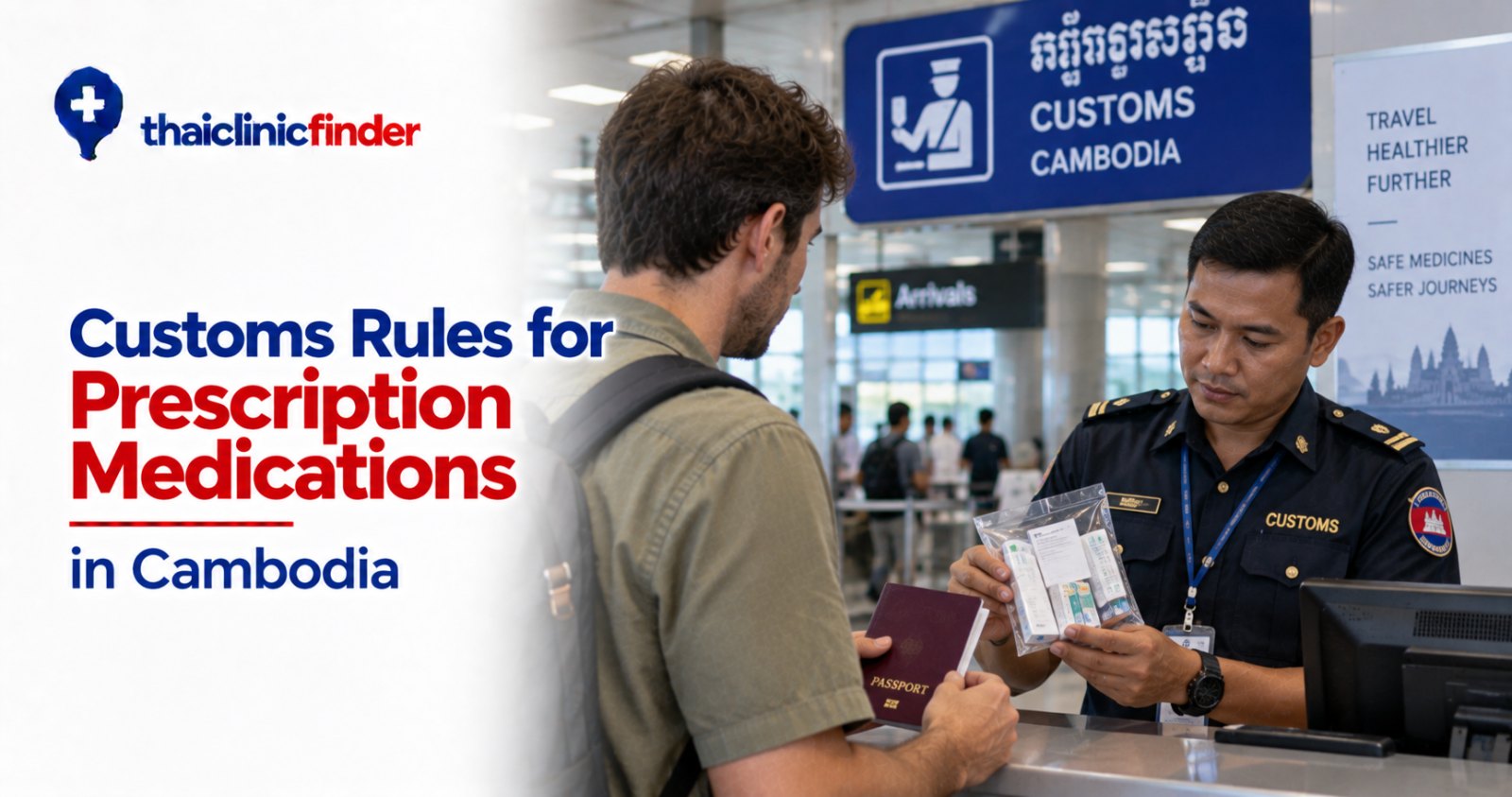
Travelers can usually enter Cambodia with prescription medication needed for their own treatment, but the rules become more important when a medicine contains a narcotic, stimulant, sedative or other psychotropic substance.
Cambodian pharmaceutical law places medicine imports under Ministry of Health oversight, while official travel guidance specifically advises visitors to keep medicines in their original packaging and carry the doctor's prescription. Medicines containing narcotic or psychotropic substances can require prior authorization.
There is no reliable single rule saying that every medicine is automatically permitted for 30 or 90 days. The safest approach is to check the generic active ingredient, travel with an amount consistent with personal treatment and obtain specific advice before carrying a controlled drug.
Ordinary prescription medicine is different from controlled medicine
For routine prescription medicines, the main practical issues are identification and proof that the medicine is for your own treatment.
Useful documents include:
- original pharmacy or manufacturer packaging
- a copy of the prescription
- a doctor's letter
- the generic name of the medicine
- strength and daily dose
- total quantity carried
The U.S. Department of State currently advises travelers to Cambodia to keep prescription medicine in its original packaging with the doctor's prescription and to verify with a Cambodian embassy that the medicine is legal in the country.
A prescription issued abroad does not automatically override Cambodian drug-control law.
Controlled drugs need more preparation
Cambodia applies stricter rules to medicines containing narcotic or psychotropic substances.
UK government guidance for people living in or traveling to Cambodia states that a permit is required to bring medicines containing psychotropic or narcotic substances into the country.
Cambodia's pharmaceutical law also requires Ministry of Health authorization for the importation of addictive drugs and medicines affecting the nervous system where they fall under controlled-drug legislation.
This can be relevant to medicines used for:
- ADHD
- anxiety
- insomnia
- severe pain
- seizure disorders
- psychiatric conditions
Do not assume that a medicine is unrestricted simply because it is routinely prescribed in your home country.
Check the generic ingredient, not only the brand
Customs and health authorities regulate substances rather than marketing names.
For example, it is more useful to ask whether diazepam is permitted than to ask only about Valium.
Before contacting an embassy or authority, prepare:
- generic active ingredient
- brand name
- strength
- formulation
- daily dose
- total quantity
- duration of stay
This makes it easier to obtain a clear answer.
Some common medicines may attract additional scrutiny
Cambodian restricted-goods documentation includes a range of narcotic and psychotropic substances.
Examples appearing in official customs material include medicines or substances such as:
- alprazolam
- clonazepam
- diazepam
- fentanyl
- lorazepam
- methylphenidate
- midazolam
- nitrazepam
- oxazepam
- phenobarbital
- temazepam
- triazolam
This is not a complete traveler medication list.
The presence of an ingredient in controlled-substance documentation does not tell you by itself what personal-traveler permit process applies to your exact prescription. Confirm before departure.
ADHD medicines deserve particular attention
Travelers taking stimulant medication should check Cambodia's rules before flying.
Methylphenidate appears in Cambodian restricted-goods documentation.
If you take medication for ADHD, do not rely on the fact that it is legal in Thailand, Europe, Australia or North America.
Contact a Cambodian embassy or the relevant Cambodian authority with the exact generic name and quantity.
If your regional itinerary also includes Thailand, the rules are different. See Customs Rules for Prescription Medications in Thailand.
Benzodiazepines should be checked individually
Several benzodiazepines appear in Cambodia's controlled or restricted goods documentation.
These include familiar medicines such as diazepam, clonazepam, lorazepam and alprazolam.
A doctor's prescription is useful documentation, but travelers should not assume that the prescription alone replaces a Cambodian permit when authorization is required.
Contact the embassy before travel rather than trying to resolve the issue at the airport.
Strong pain medicines can fall under narcotics rules
Opioid medicines can be subject to additional controls.
If you use a strong opioid for chronic pain, cancer treatment or postoperative care, obtain written confirmation of the import requirements.
A doctor's letter should ideally state:
- your full name
- diagnosis or treatment need
- active ingredient
- dose
- formulation
- total quantity required
- duration of treatment
Keep the medicine in the original labeled container.
There is no universal personal-use day limit to rely on
One common mistake is assuming Cambodia automatically permits a fixed 30-day or 90-day supply of every prescription medicine.
The official sources reviewed do not establish one universal allowance covering all ordinary and controlled medicines.
Carry a quantity that reasonably matches the trip and prescription, and obtain specific guidance when:
- the medicine is controlled
- the supply is unusually large
- you will remain in Cambodia for several months
- you use injectable medication
- you carry several restricted medicines
Keep medicines in original packaging
Loose tablets in an unmarked plastic bag are difficult for customs officers to identify.
Original packaging helps show:
- drug name
- active ingredient
- strength
- manufacturer
- prescribing instructions
A weekly pill organizer can still be useful during the trip, but keep the labeled medicine boxes or bottles available while crossing the border.
A doctor's letter can prevent confusion
For routine medication, a prescription may be enough to explain what you are carrying.
A doctor's letter is especially useful when carrying:
- controlled medicines
- injections or syringes
- refrigerated medicines
- a large quantity
- several prescription products
The letter should use generic drug names because brand names vary between countries.
Do you need to declare medicine at Cambodian customs?
There is no indication that every traveler carrying an ordinary personal prescription must complete a special declaration solely because medicine is in the luggage.
Controlled or restricted drugs are different.
If an authority or permit process instructs you to declare the medicine, follow that instruction. If you are unsure whether the ingredient is restricted, obtain clarification before travel.
Commercial pharmaceutical import rules should not be confused with personal luggage, but medicines remain part of Cambodia's regulated import system.
Mailing medication to Cambodia is not the same as carrying it
Do not assume that medicine can be mailed or couriered to Cambodia under the same rules that apply to a traveler carrying a personal supply.
Cambodia requires authorization for pharmaceutical importation, and postal shipments can trigger formal customs and Ministry of Health requirements.
If you are staying long term, plan medication continuity before arrival instead of depending on international parcels.
Buying replacement medicine in Cambodia
Official U.S. and CDC travel guidance warns that counterfeit and substandard medicines can occur in Cambodia.
If you lose an important prescription medicine:
- contact a reputable clinic or hospital
- show your prescription or doctor's letter
- provide the generic ingredient and strength
- ask the clinician about an appropriate local replacement
- use an established pharmacy
Do not purchase an unknown substitute because the packaging resembles your usual medicine.
Medical cannabis needs specific confirmation
Do not assume that a cannabis prescription issued in another country allows you to enter Cambodia with THC-containing medicine.
Controlled-drug law can apply regardless of whether a product was legally prescribed abroad.
Obtain explicit confirmation from Cambodian authorities before carrying cannabis-derived medication.
Traveling onward to Thailand
If Cambodia is one stop on a wider Southeast Asian trip, remember that each border applies its own rules.
A medicine permitted in Cambodia may require different documentation or a permit in Thailand.
Our guide to bringing prescription medicines into Thailand explains the Thai framework for ordinary and controlled medicines.
A practical pre-travel checklist
Before flying to Cambodia:
- Make a list of every prescription medicine.
- Record each generic active ingredient.
- Check whether any medicine is narcotic or psychotropic.
- Keep medicines in their original packaging.
- Carry the prescription.
- Ask your doctor for a letter if the medicine is controlled or unusual.
- Contact the Cambodian embassy when restrictions are unclear.
- Obtain any required permit before departure.
- Carry only a quantity consistent with personal treatment unless otherwise authorized.
- Keep essential medicine in hand luggage.
The practical answer
Most travelers carrying ordinary prescription medicine for genuine personal treatment can reduce problems by using original packaging and carrying a prescription and medical documentation.
The situation changes when the medicine contains a controlled narcotic or psychotropic substance. Cambodian law places these substances under additional Ministry of Health control, and current UK government guidance states that a permit is required for narcotic or psychotropic medicines.
Do not use a blanket 30-day or 90-day rule. Check the exact active ingredient, quantity and current Cambodian requirements before departure, especially for ADHD stimulants, benzodiazepines and opioid pain medicines.
Frequently Asked Questions
Can I bring prescription medicine into Cambodia?
Many ordinary prescription medicines can be carried for personal treatment. Keep them in original packaging and carry the doctor's prescription, while checking the exact ingredient is legal in Cambodia.
Do I need a permit for controlled medicine in Cambodia?
Potentially yes. Current UK government guidance states that a permit is required for medicines containing narcotic or psychotropic substances.
Can I bring diazepam or alprazolam to Cambodia?
Both appear in Cambodian restricted-goods documentation. Travelers should confirm the permit and documentation requirements before departure.
Can I bring methylphenidate to Cambodia?
Methylphenidate appears in Cambodian restricted-goods documentation. Contact a Cambodian embassy or competent authority before traveling with it.
How much prescription medicine can I carry?
The official sources reviewed do not establish one universal 30-day or 90-day allowance for every medicine. Carry a reasonable personal supply and obtain specific advice for controlled drugs or large quantities.
Should medicines stay in their original packaging?
Yes. Original labeled packaging makes the active ingredient, dose and product easier to identify at customs.
Sources

Writer
Niran Chaiyasit
Niran Chaiyasit is a Thai health writer with a background in public health and a focus on travel health, disease prevention and healthcare access in Thailand. His work covers topics such as common illnesses, vaccinations, mosquito-borne diseases, food safety and practical health information for travelers and expatriates.

Medical review
Justin Brooks
Daniel Brooks is an American health writer with a background in health sciences and a focus on rehabilitation, musculoskeletal health and patient education. He writes about physiotherapy, injury recovery, pain management, preventive health and practical healthcare guidance for international patients and travelers.