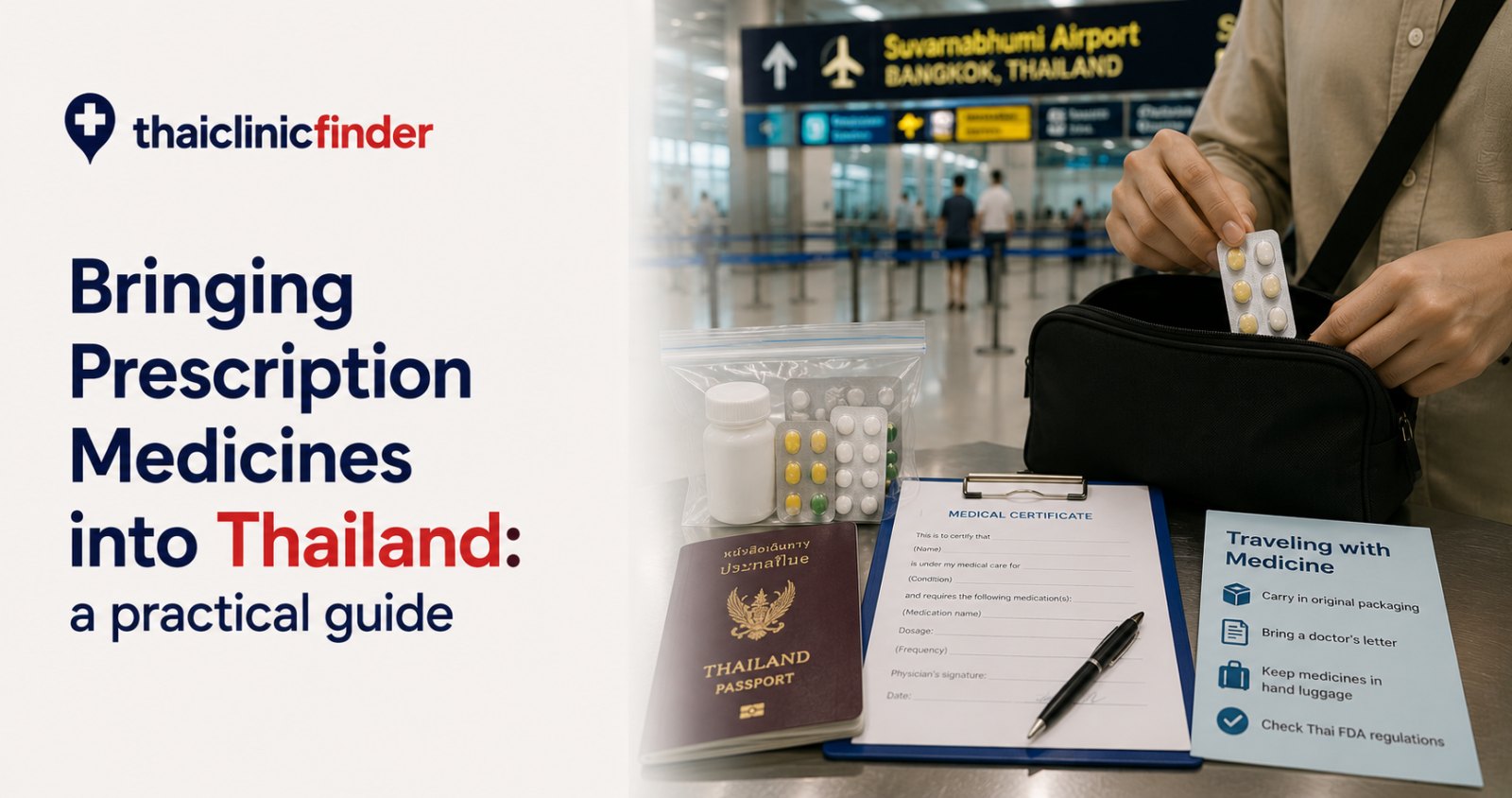
Travelling to Thailand with prescription medicine is usually manageable, but the rules depend on what the medicine contains. An ordinary prescription medicine and a medicine classified in Thailand as a narcotic or psychotropic substance can have very different import requirements.
The Thai Food and Drug Administration, or Thai FDA, advises travellers to check the classification of their medication before entering Thailand. For ordinary modern medicines brought for personal use, the general allowance is a supply for no more than 30 days, kept in its original container and accompanied by a doctor's prescription. Controlled medicines require separate checks and, in some cases, advance permission from the Thai FDA.
This guide explains the main rules for bringing prescription medicines into Thailand and the practical steps to take before travelling. Drug classifications and legal requirements can change, so check your exact active ingredient with the Thai FDA before departure if there is any uncertainty.
Start with the generic name of your medicine
Do not check only the brand name printed on the box. The same medicine may be sold under different brands in different countries, while Thai controls are based on the active substance and its legal classification.
Before travelling, write down:
- the generic or active ingredient
- the brand name
- the strength
- the dose you take
- how often you take it
- how many days of treatment you are carrying
You can then use the Thai FDA Narcotics Control Division's official Check the Drug tool to search by generic name.
The tool distinguishes medicines that are not classified as narcotics or psychotropic substances from substances that are subject to additional restrictions. If your medicine does not appear in the controlled-substance search or you are unsure about the result, the Thai FDA provides contact details for its Medicines Regulation Division and Narcotics Control Division.
Do not assume that a medicine is unrestricted in Thailand because it is commonly prescribed or easily obtained in your home country.
Ordinary prescription medicines: the general 30-day rule
The Thai FDA states that a traveller entering Thailand may bring a modern medicine for personal use for no longer than 30 days under the Drugs Act.
The medicine should be kept in its original container and accompanied by a prescription from the doctor.
For a typical traveller carrying an ordinary prescription medicine that is not classified as a narcotic or psychotropic substance, this means preparing a quantity consistent with up to 30 days of prescribed use rather than bringing a large reserve supply.
The Thai FDA's Check the Drug system also states that medicines outside the narcotic and psychotropic classifications can be carried for personal use in a quantity not exceeding 30 days of prescribed use and do not require a Thai FDA traveller permit.
Keep the medication for your own treatment. The personal-use exemption should not be treated as permission to import medicines for another person, resale or commercial distribution.
Keep medicines in their original packaging
The Thai FDA specifically advises travellers to keep ordinary medicines in their original container.
This also makes it easier for customs officials or healthcare professionals to identify what you are carrying. Avoid transferring an entire trip's supply into an unlabelled pill box before entering Thailand.
You can still use a daily pill organiser during your trip if that is part of your normal routine, but keep the original labelled packaging and supporting medical documentation with you when travelling internationally.
For each prescription medicine, the packaging should ideally make the drug name and strength identifiable.
Carry a prescription or medical document
For ordinary modern medicines, the Thai FDA advises carrying the doctor's prescription. Controlled medicines have more specific documentation requirements.
A useful medical document should clearly connect you with the treatment and identify the medicine. Depending on the drug category and Thai FDA requirements, relevant information may include:
- your name
- the medicine or active ingredient
- the prescribed dose
- instructions for use
- the prescribing doctor's details
- the doctor's signature where required
For controlled medicines, follow the documentation instructions shown by the Thai FDA rather than relying on a general travel letter.
If your prescription or medical certificate is not in English, check with the Thai FDA whether additional documentation is advisable before travel.
Controlled medicines need an extra check
Thailand applies separate rules to narcotic drugs and psychotropic substances. You should therefore check any medicine that may fall into one of these groups before travelling.
The Thai FDA's traveller portal provides an official Check the Drug function. Search using the generic active ingredient, not only the commercial brand name.
The result can indicate whether the medicine is:
- not classified as a narcotic or psychotropic substance
- an allowable psychotropic substance
- a narcotic that requires a permit
- a substance whose import for personal treatment is prohibited
Do this well before departure. Some controlled medicines require an application at least 15 days before travelling to Thailand.
Psychotropic medicines
The Thai FDA states that travellers receiving treatment with psychotropic substances in Schedules II, III and IV may bring up to 30 days of prescribed use into Thailand when accompanied by a certificate or medical prescription from the prescribing physician.
For this quantity, the Thai FDA traveller system states that an advance permit is not required.
The rules change when the quantity represents more than 30 days of treatment. For a prescribed supply covering 31 to 90 days, the Thai FDA states that the traveller must obtain a permit, Form IC-2, before travelling to Thailand.
The Thai FDA instructs travellers in this situation to apply at least 15 days before travel and submit documents including a passport copy and a signed medical prescription or medical document containing information about the medication and instructions for use.
Psychotropic substances in Schedule I are prohibited from being imported by travellers for personal treatment under the Thai FDA guidance.
Because classifications can change, use the official Thai FDA drug checker for the exact active ingredient rather than trying to determine the category from an old online list.
Narcotic medicines
Narcotic medicines are subject to stricter rules.
The Thai FDA's current guidance covers narcotic medicines in Schedules II and III together. Travellers under treatment may carry a personal supply not exceeding 90 days, as prescribed, provided they comply with the applicable rules; they must obtain a permit from the Thai FDA at least 15 days before arriving in Thailand.
The traveller must apply through the Thai FDA permit system and provide the required documents. The Check the Drug service identifies the permit as Form IC-2 and lists a passport copy and a signed medical prescription or medical document among the required documents.
Other narcotic classifications may be prohibited or subject to different rules. Do not assume that all medicines described as controlled drugs follow the same 90-day provision.
The safest approach is to enter the exact generic ingredient into the Thai FDA Check the Drug tool and follow the result provided for that substance.
Some medicines cannot be brought in for personal use
A valid prescription from another country does not automatically make a medicine legal to import into Thailand.
The Thai FDA traveller system identifies some narcotic and psychotropic classifications as prohibited for travellers, including Schedule I psychotropic substances. The system also identifies prohibited narcotic categories depending on the substance classification.
If the official checker states that your medicine is prohibited, do not pack it on the assumption that a doctor's letter will override the restriction.
Contact the Thai FDA before travel to confirm your options. You may also need to speak with the doctor managing your treatment about whether an appropriate alternative is available.
Do not change or stop an important prescription medicine solely on the basis of travel information without appropriate medical advice.
How to apply for a Thai FDA permit
When a permit is required, applications are handled through the Thai FDA Narcotics Control Division's traveller portal.
The exact requirements depend on the medicine classification. The Thai FDA's controlled-drug checker states that applications for qualifying controlled medicines require documents including:
- a copy of the traveller's passport
- a signed medical prescription or medical document showing relevant medication and usage information
When the permit is approved, the Thai FDA issues the traveller permit, Form IC-2, by email. The current Thai FDA guidance says that a completed online application is processed and issued in approximately three working days. Submit the application at least 15 days before arrival, as required by the current guidance.
For psychotropic substances where the quantity is 31 to 90 days of prescribed treatment, the Thai FDA specifies that the permit should be obtained before travel and that travellers should apply at least 15 days in advance.
Do not leave the classification check until the day before departure. If a permit is necessary, you need enough time to prepare documents and complete the application.
What if you are staying for more than 30 days?
A long stay in Thailand does not automatically allow you to bring a correspondingly large supply of ordinary prescription medicine.
The Thai FDA's general traveller exemption for ordinary modern medicines is a supply for no longer than 30 days. Controlled substances have their own rules, and certain categories can permit larger quantities when the required Thai FDA authorisation has been obtained.
If you need treatment for several months, check whether your medicine is available legally in Thailand and whether you will need to see a doctor locally to continue treatment.
The Thai FDA states that travellers who need a medicine after arrival can check whether a particular drug trade name is available in Thailand through its Health Products Search. If the desired medicine is not available, the Thai FDA advises consulting a hospital doctor about an alternative.
Before a planned consultation, Thai Clinic Finder's guide to what to check before a medical appointment in Thailand explains how to prepare your records, medicine list and insurance information.
Do not assume you can mail more medicine later
Travellers sometimes plan to enter Thailand with a small supply and have additional prescription medicine sent from home later.
The Thai FDA distinguishes carrying medicine personally as a traveller from importing or ordering medicine into Thailand. Its official medicines FAQ states that bringing drugs or ordering drugs to be shipped into Thailand by post is not allowed under the ordinary traveller exemption.
If you will need more medication during a long stay, arrange a legally appropriate plan before your supply runs out. This may involve consulting a doctor in Thailand and obtaining an available local medicine rather than having prescription medication posted from another country.
Carrying medicine through airport customs
The Thai FDA Check the Drug tool gives specific instructions based on a medicine's classification.
For ordinary medicines that are not classified as narcotics or psychotropic substances, it states that a patient may carry up to 30 days of prescribed use without a Thai FDA permit. If the traveller has nothing else to declare, the tool states that the medication is treated as personal belongings for Green Channel purposes.
Similar instructions are provided for qualifying psychotropic medicines carried within the permitted quantity with the required medical documentation.
Controlled medicines requiring a Thai FDA permit should be handled according to the conditions attached to that permit and the current instructions from the authorities.
If you are uncertain about customs procedure for your particular medicine, contact the Thai FDA or Thai Customs before travelling instead of deciding at the airport based on unofficial advice.
Keep medicines in your hand luggage where appropriate
From a practical perspective, travellers may prefer to keep essential medication and its documents accessible during the journey rather than placing the entire supply somewhere difficult to reach.
Check your airline's rules as well, particularly for liquids, injectable medicines, needles, refrigeration equipment or other medical items that may have separate aviation requirements.
Airline cabin rules and Thai medicine import rules are separate. Approval to carry an item on an aircraft does not establish that the medicine can legally be imported into Thailand.
Travelling with injectable or refrigerated medicine
If your treatment involves syringes, injection devices or medicine that must remain within a particular temperature range, speak with your prescribing healthcare professional and airline before departure.
Ask how the medicine should be transported and what documentation is appropriate for the injection equipment. Do not improvise storage conditions for a temperature-sensitive medicine.
You still need to check the active ingredient under Thai import rules. The fact that a medicine is injectable or needs refrigeration does not determine whether it is classified as an ordinary medicine, narcotic or psychotropic substance.
If you need a new prescription in Thailand
A foreign prescription should not be treated as a guarantee that a Thai pharmacy can supply the same medicine.
The Thai FDA advises people who need medicines after arrival to check whether the product is available in Thailand. If the drug is unavailable, it recommends consulting a hospital doctor about possible alternatives.
If you need ongoing treatment, bring your medication history and supporting records to the appointment. The generic drug name is particularly useful because brands may differ between countries.
For a broader explanation of hospitals, clinics, payment and insurance, see how healthcare access works in Thailand for visitors and residents.
Check every country on your route
Thailand's rules apply to entry into Thailand. If you change planes or enter another country during your journey, that country may apply different controls to the same medicine.
Check the rules of any destination or transit country that requires you to clear immigration or customs. Do not assume that a Thai FDA permit authorises you to possess or import the medicine elsewhere.
The same applies when leaving Thailand with medication obtained locally. Check the rules of your next destination before travelling.
A checklist before travelling with prescription medicine
Before departure, check:
- the generic active ingredient of every prescription medicine
- whether it appears in the Thai FDA controlled-drug checker
- how many days of prescribed treatment you are carrying
- whether a Thai FDA permit is required
- whether your medicine is prohibited from import
- whether you have the required prescription or medical document
- whether the medicine is in its original labelled container
- whether any airline requirements apply to liquids, injections or medical equipment
- how you will obtain further medication if staying longer than your permitted supply
For a controlled medicine, complete these checks well before travel because an advance permit may be required.
Conclusion
For ordinary prescription medicines that are not classified as narcotic or psychotropic substances, the Thai FDA generally allows travellers to bring up to 30 days of personal treatment, with the medicine in its original container and accompanied by a doctor's prescription.
Controlled medicines require more careful checking. Some psychotropic medicines can be carried for up to 30 days with medical documentation, while larger quantities require advance permission. Narcotic medicines in Schedules II and III require a Thai FDA permit even when prescribed, and some substances cannot be brought into Thailand for personal treatment at all.
Before packing a controlled or uncertain medicine, search the exact generic ingredient using the Thai FDA's official Check the Drug tool. If the result is unclear, contact the Thai FDA directly before travelling rather than relying on general travel advice.
Frequently Asked Questions
Can I bring prescription medicine into Thailand?
Generally, yes, for many ordinary medicines. The Thai FDA states that travellers may bring modern medicines for personal use for no longer than 30 days, kept in the original container and accompanied by the doctor's prescription. Different rules apply to narcotic and psychotropic substances.
How much prescription medicine can I bring into Thailand?
For ordinary medicines that are not controlled as narcotic or psychotropic substances, the Thai FDA generally permits up to 30 days of prescribed use. Controlled medicines can have different limits and permit requirements, so check the exact active ingredient.
Do I need a doctor's letter to bring medication into Thailand?
The Thai FDA advises travellers carrying ordinary modern medicines to have the doctor's prescription and keep the medicine in its original container. Controlled medicines may require more specific medical documentation and, in some cases, an advance Thai FDA permit.
How do I check whether my medicine is controlled in Thailand?
Use the Thai FDA Narcotics Control Division's official Check the Drug service and search by the generic active ingredient. If you cannot determine the classification, contact the Thai FDA directly before travelling.
Can I bring more than 30 days of medication into Thailand?
Do not assume that you can. The general traveller allowance for ordinary modern medicines is up to 30 days. Certain controlled medicines have separate rules that can permit quantities of up to 90 days when the required conditions and Thai FDA permits are met.
When do I need a Thai FDA permit?
It depends on the medicine's legal classification and quantity. For example, narcotic medicines in Schedules II and III require a Thai FDA permit, while psychotropic substances in Schedules II, III and IV require one when carrying 31 to 90 days of prescribed use.
How early should I apply for a Thai FDA medication permit?
For psychotropic medicines requiring permission for 31 to 90 days of prescribed use, the Thai FDA instructs travellers to apply at least 15 days before travelling. Check the current instructions for your exact substance before departure.
Can someone mail my prescription medicine to Thailand after I arrive?
Do not rely on the traveller exemption for mailed medication. The Thai FDA states that ordering drugs to be shipped into Thailand by post is not allowed under the ordinary personal traveller provision. For longer-term treatment, check legal local supply options with the Thai FDA and a healthcare provider.
Sources
- Thai Food and Drug Administration - Medicines FAQs
- Thai FDA Narcotics Control Division - Check the Drug
- Thai Customs Care Center - Bringing health products into Thailand
- Thai Food and Drug Administration - Guidance for travelers carrying personal medicines containing narcotic drugs and psychotropic substances
- Thai FDA. Guidance for travellers carrying personal medicines

Writer
Thai Clinic Finder Editorial Team
The editorial team checks public healthcare information against official provider and institutional sources. It does not provide medical advice.