A medical appointment in Thailand is usually easier when you confirm a few practical details beforehand. International residents and visitors may need to think about identification, previous medical records, insurance, language support and payment arrangements in addition to the medical reason for the visit.
The preparation required depends on the appointment. A routine consultation may need little more than identification and a medication list, while a specialist visit, health screening or planned procedure can require previous test results, imaging or specific instructions from the provider.
This guide explains what to check before attending a medical appointment in Thailand and which details are worth confirming directly with the exact hospital, clinic or department.
Confirm the exact facility and branch
Start by checking where the appointment will actually take place. Hospital groups and clinic networks can operate several branches, and the same specialty may not be available at every location.
Confirm:
- the full name of the hospital or clinic
- the exact branch
- the street address
- the department or clinic you need
- the appointment date and time
- the name of the doctor when available
- whether you should arrive before the scheduled consultation time
Do not rely only on a search result or map listing if the provider has several locations. Use the provider's current first-party information and confirm directly when anything is unclear.
For private healthcare facilities, Thailand's Department of Health Service Support operates an official system for checking licensed private healthcare establishments. Search for the exact facility rather than assuming that information about one branch applies to another.
Check who you are seeing
For a planned appointment, ask which doctor or other healthcare professional will see you. This is particularly useful for specialist consultations, procedures and ongoing treatment.
The Medical Council of Thailand provides an official English-language doctor verification service. It allows users to search for active physicians licensed to practise using the doctor's name and, when known, medical licence number.
A hospital's reputation, size or appearance does not replace checking the practitioner when that information is important to your decision. A hospital, clinic, department and individual doctor are separate parts of the healthcare service.
If you are unsure what type of doctor you need, contact the provider and describe the reason for the appointment rather than choosing a specialist solely from an online profile.
Check what identification you need
Thailand.go.th guidance for foreign patients lists a passport among the documents to prepare when arranging medical treatment in Thailand.
For an international patient, the provider may ask for your passport or another accepted identification document during registration. If you have attended the same hospital before, bring your patient card or patient number if the facility has issued one.
Requirements can vary, so ask the exact provider if you are unsure what identification is accepted.
If someone else is arranging treatment on your behalf, ask whether additional documentation is required rather than assuming that your passport details alone will be sufficient.
Bring relevant medical records
Previous medical information can make a consultation more useful, particularly when you are seeing a new doctor or receiving specialist care.
Thai government guidance for foreign patients advises preparing relevant documents such as previous medical history or referral letters, blood test results and X-rays when available, and surgical history or pathology reports when relevant.
You do not necessarily need to bring your complete lifetime medical record. Focus on information connected to the reason for the appointment.
Useful records may include:
- a recent medical summary
- previous diagnoses relevant to the current problem
- laboratory results
- imaging reports and images when requested
- previous operation reports
- pathology results
- hospital discharge summaries
- specialist letters
- previous treatment plans
If your records are in another language, ask the provider beforehand whether an English translation is needed. Do not assume that the doctor will be able to read records in your home language.
Prepare a current medication list
Bring an accurate list of medicines you currently use. Include prescription medicines, relevant over-the-counter medicines and any other products that the clinician needs to know about.
For each regular medicine, it is useful to record:
- the generic drug name when known
- the brand name if relevant
- the dose
- how often you take it
- why it was prescribed
Bringing the original packaging can also help, particularly if the medicine was prescribed outside Thailand.
Tell the clinician about known medication allergies or significant previous reactions.
Do not stop a regular prescription medicine before an appointment unless the treating provider has specifically instructed you to do so. Some tests and procedures have medication restrictions, but these depend on the exact examination and your medical circumstances.
Ask whether you need to prepare for tests
Do not assume that every blood test, health check or medical examination requires fasting. Preparation depends on the tests being performed.
Some hospital health screening programmes provide specific instructions about eating, drinking or medications before particular tests. These instructions apply to the specific programme rather than to every medical appointment in Thailand.
If tests are planned, ask:
- whether fasting is required
- how long any fasting period should be
- whether water is permitted
- whether you should take your usual medication
- whether you need to bring a urine or other sample
- whether there are clothing or preparation requirements
Follow the instructions given by the provider for your actual appointment. If the instructions conflict with how you normally take an important medication, contact the facility for clarification rather than making your own adjustment.
Confirm English-language support
An English-language website does not guarantee that the doctor assigned to your appointment will conduct the consultation in English.
If English is important to you, ask whether the exact doctor or healthcare professional can communicate with you in English. For more complex care, it may also be useful to confirm language support for consent discussions, nursing instructions, medication information and follow-up.
Some Thai hospitals publish international patient and language assistance services, but availability can depend on the branch, department and appointment.
Thai Clinic Finder's guide on how to choose an English-speaking clinic in Thailand explains these checks in more detail.
If you need another language, ask whether a qualified interpreter or other language assistance is available and whether there is a charge.
Check the expected cost
For non-urgent care, ask about fees before the appointment when practical. A consultation price may not include everything that happens during the visit.
Possible additional charges can include:
- hospital or facility fees
- laboratory tests
- imaging
- medication
- medical supplies
- procedures
- specialist fees
- medical reports or certificates
If you are attending for a planned procedure or expensive investigation, ask whether the provider can give you a written estimate.
An estimate may change if the doctor recommends additional tests or treatment after examining you. Ask what is included rather than comparing only the first number quoted.
Do not delay urgent or emergency medical care solely to obtain several price estimates.
Confirm your insurance arrangements
If you intend to use travel, private or employer health insurance, check the administrative requirements before planned care.
Hospitals may have arrangements with particular insurers, but this does not mean that your specific policy covers every service. Direct billing can depend on the insurer, hospital, treatment and prior approval.
Ask your insurer:
- whether the provider is covered
- whether the appointment requires pre-authorisation
- whether outpatient treatment is included
- whether you have a deductible or co-payment
- whether direct billing is possible
- which documents are needed for reimbursement
Ask the hospital separately what it needs to verify your coverage. Bangkok Hospital, for example, advises patients using insurance to prepare identification or insurance information and notes that patients can remain responsible for expenses outside their policy coverage.
Bring your insurance card, policy details or approval documents when required.
For a broader explanation of payment and healthcare pathways, see how healthcare access works in Thailand for visitors and residents.
Write down the main reason for your visit
Medical appointments can move quickly, especially when you are explaining symptoms in a second language. A short note can help you give the clinician the information that matters.
Consider recording:
- your main symptom or concern
- when it started
- whether it has changed
- treatments you have already tried
- relevant previous episodes
- questions you want to ask
Do not try to construct your own diagnosis. Describe what you are experiencing and let the clinician assess it.
For a chronic condition, bring a concise summary of previous treatment and any recent changes. This is usually more useful than presenting a large collection of unrelated records.
Be clear about allergies and previous medical problems
Tell the clinician about relevant allergies, particularly allergies to medicines. Distinguish a confirmed allergy from a side effect or a medicine that simply did not work, if you know the difference from your previous medical care.
Relevant medical history can include previous surgery, chronic conditions, pregnancy when applicable and important previous reactions to treatment or anaesthesia.
You do not need to decide yourself which details affect the current treatment. When in doubt, mention significant medical information and allow the clinician to determine its relevance.
Ask questions before agreeing to treatment
If a doctor recommends a test, procedure or new medication, make sure you understand the practical information you need before proceeding.
Depending on the treatment, useful questions can include:
- What is the purpose of the test or treatment?
- Are there reasonable alternatives?
- What preparation is required?
- What should I expect afterwards?
- When should I seek further medical help?
- When will results be available?
- Do I need another appointment?
- What is the expected cost?
For a procedure, make sure important consent information is explained in a language you understand. Ask for clarification when something is unclear rather than relying on an online description of the procedure.
Check how you will receive results
Before leaving the appointment, ask how laboratory, imaging or pathology results will be communicated.
Depending on the provider, results may be discussed at another appointment, made available through a patient system or communicated through another approved channel.
Ask whether you need to book the follow-up yourself. Do not assume that no contact means that a test result was normal.
If you are leaving Thailand soon, tell the clinician. Ask whether the expected result will be available before departure and how you can obtain a copy for another healthcare provider if necessary.
Ask for the records you may need later
International residents and visitors often receive healthcare in more than one country. Keeping your own important records can make later treatment easier.
After significant treatment, consider asking for:
- a medical summary
- laboratory results
- imaging reports
- prescriptions
- a list of newly prescribed medicines
- procedure or operation reports when relevant
- discharge instructions
Ask whether these documents can be provided in English if that is important for future care.
Keep invoices and receipts separately if you need them for insurance reimbursement.
Know when not to wait for an appointment
A scheduled outpatient appointment is not appropriate for every medical problem. Severe breathing difficulty, loss of consciousness, major trauma, uncontrolled bleeding or another potentially life-threatening condition requires urgent assessment.
Thailand's National Institute for Emergency Medicine lists 1669 as the emergency medical services number.
If symptoms become seriously worse while you are waiting for a routine appointment, seek urgent medical help rather than waiting for the scheduled time. Thai Clinic Finder's guide to medical emergencies in Thailand explains the main emergency contacts and practical steps.
A checklist before leaving for your appointment
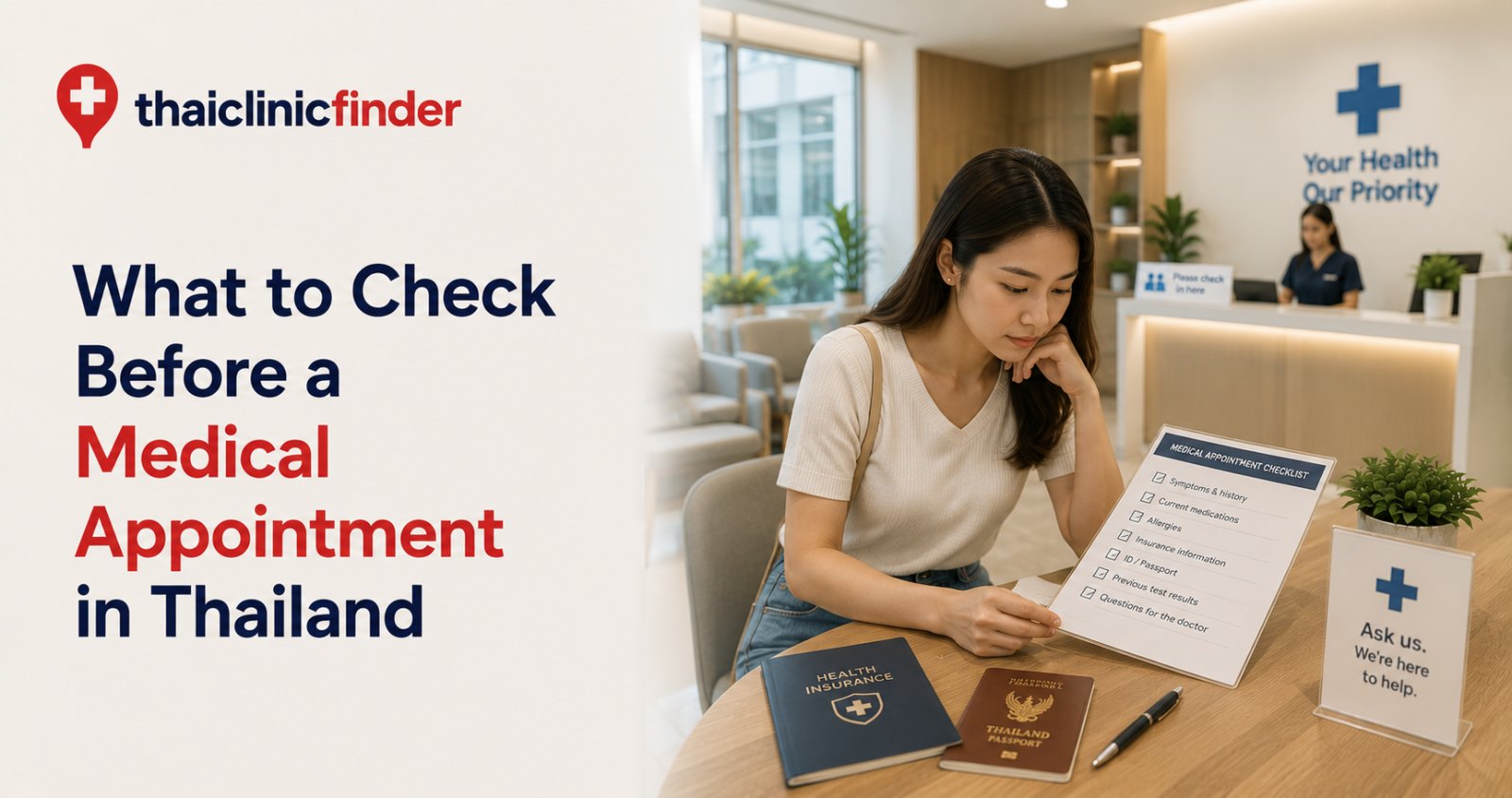
Before a planned medical appointment in Thailand, check that you have what is relevant to your visit:
- confirmed hospital or clinic branch
- department and appointment time
- doctor's name when available
- passport or accepted identification
- insurance details
- relevant medical reports
- test results or imaging requested by the provider
- current medication list
- allergy information
- referral letter when required
- any preparation instructions from the provider
- a short list of symptoms and questions
Also confirm how you will travel to the facility and allow enough time to find the correct department and complete any registration required by the provider.
Conclusion
Before a medical appointment in Thailand, confirm the exact facility, department and clinician, then prepare the identification and medical information relevant to your visit. Bring an accurate medication list, check any test instructions and confirm English-language support if you need it.
For planned care, it is also worth clarifying insurance, expected fees and how results or follow-up will be handled. A few checks before the appointment can reduce administrative problems and help the clinician work with accurate information.
Frequently Asked Questions
What should I bring to a medical appointment in Thailand?
International patients should generally bring accepted identification such as a passport and any relevant medical records. A current medication list, allergy information, insurance details and previous test results can also be useful depending on the appointment.
Do I need my passport to see a doctor in Thailand?
Thai government guidance for foreign patients lists a passport among the documents to prepare for medical treatment. Individual registration requirements can vary, so confirm with the exact hospital or clinic if you are unsure.
Should I fast before a medical appointment in Thailand?
Only when the provider gives you instructions to fast for a particular test or examination. Do not assume that every blood test or health check requires the same preparation, and ask before changing how you take regular medication.
How can I check whether a doctor in Thailand is licensed?
The Medical Council of Thailand provides an official English-language verification tool for active physicians licensed to practise. Search using the doctor's full name or medical licence number when available.
Will my health insurance pay for the appointment?
Coverage depends on your policy, provider and treatment. Confirm coverage, pre-authorisation and direct billing with your insurer and check separately what documentation the hospital requires.
Can I ask for my medical records in English?
You can ask whether the hospital or clinic can provide medical summaries, results or other records in English. Availability, format, preparation time and any fee should be confirmed directly with the provider.
What if my symptoms become severe before my appointment?
Do not wait for a routine appointment if you develop a potentially life-threatening condition. Thailand's National Institute for Emergency Medicine lists 1669 as the emergency medical services number.
Sources
- Thailand.go.th - Medical Treatment in Thailand: What Foreigners Need to Prepare
- The Medical Council of Thailand - Doctor verification
- Department of Health Service Support - Licensed private healthcare establishment verification
- Bangkok Hospital - Required documents for patients
- National Institute for Emergency Medicine, Thailand

Writer
Thai Clinic Finder Editorial Team
The editorial team checks public healthcare information against official provider and institutional sources. It does not provide medical advice.