A medical emergency in Thailand can be difficult to manage when you are unfamiliar with the healthcare system, do not speak Thai or are unsure which number to call. Knowing the main emergency contacts before you need them can save valuable time.
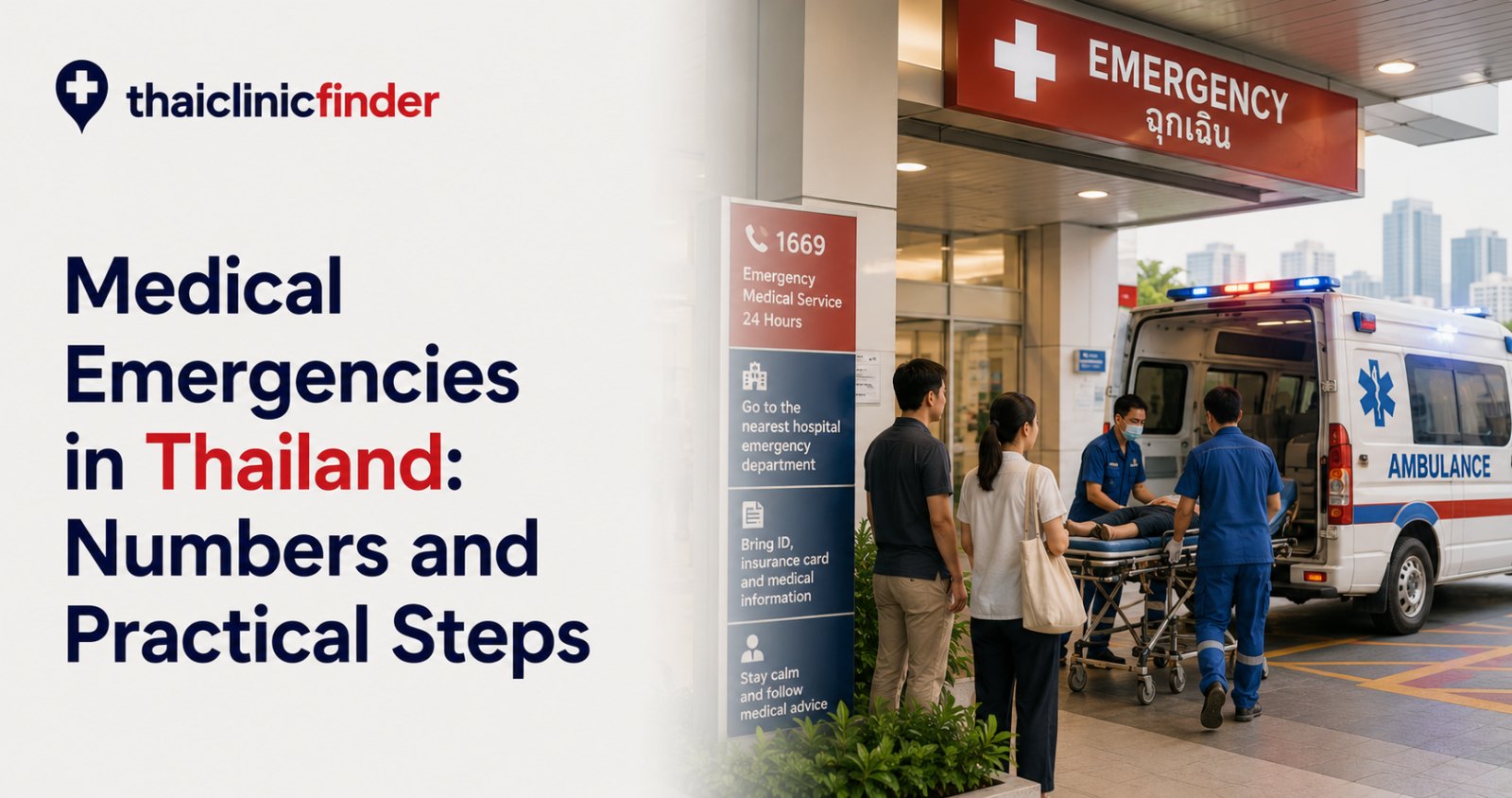
For a serious illness or injury requiring emergency medical assistance, the main number to know is 1669. Thailand's National Institute for Emergency Medicine identifies 1669 as the emergency medical services number, and the Tourism Authority of Thailand also lists it as the country's ambulance number.
This guide covers the main emergency numbers in Thailand, what to do when calling for help, what information to prepare and how international visitors can handle practical issues such as language, identification, insurance and follow-up.
Emergency numbers in Thailand
For most visitors and international residents, these are the main numbers worth saving:
- 1669: Emergency medical services and ambulance
- 191: General police emergency
- 199: Fire emergency
- 1155: Tourist Police
- 1367: Ramathibodi Poison Center
Thailand's official government and Tourism Authority of Thailand resources list 1669 for emergency medical assistance, 191 for police emergencies and 199 for fire emergencies.
The correct number depends on what is happening. If someone is seriously ill or injured and needs medical assistance, 1669 is the most relevant first call.
Call 1669 for a medical emergency
The National Institute for Emergency Medicine operates Thailand's emergency medical system and publishes 1669 as the number for emergency illness and injury.
Situations that can justify urgent emergency assessment include severe breathing difficulty, loss of consciousness, major trauma, uncontrolled bleeding, suspected stroke, severe chest symptoms, seizures that are prolonged or unusual for the person, severe allergic reactions and other rapidly deteriorating conditions.
This is not an exhaustive diagnostic list. If a person's condition appears immediately dangerous or is worsening quickly, call emergency medical services rather than trying to determine the diagnosis yourself.
When calling 1669, be ready to explain what has happened and where the patient is located. Follow the operator's instructions and answer questions as clearly as possible.
Give a precise location
Location can be one of the most important practical details during an emergency, particularly for visitors staying in hotels, condominiums or unfamiliar neighbourhoods.
Be ready to provide:
- the hotel, condominium, business or building name
- the street or soi when known
- the district or neighbourhood
- the city or province
- a nearby landmark
- the floor and room number if relevant
- a phone number where you can be reached
If you are using a map application, keep the location open so you can describe it accurately. If another person is present, they can wait at the building entrance or another visible point to help emergency personnel find the patient.
Do not leave a seriously ill or injured person alone simply to meet an ambulance unless it is safe and necessary to do so.
Explain what is happening clearly
You do not need to identify the medical condition yourself. Describe what you can see and what you know.
Useful information can include:
- whether the person is conscious
- whether they are breathing normally
- the main symptom or injury
- when the problem started
- whether there has been an accident or fall
- whether there is significant bleeding
- whether more than one person is injured
- the person's approximate age if known
- important known medical conditions or allergies
- medications or substances involved when relevant
Stay on the call as instructed. The emergency operator may ask additional questions to determine what response is appropriate.
What to do while emergency help is coming
Follow instructions from the emergency medical dispatcher. Do not give food, drink or medication to an unconscious or severely impaired person unless a qualified healthcare professional specifically instructs you to do so.
If you have formal first-aid or CPR training and it is appropriate to use it, follow your training and the instructions provided by emergency personnel.
Avoid moving a person with a potentially serious injury unnecessarily unless remaining where they are creates an immediate danger, such as fire or another active hazard.
If possible, prepare the patient's identification, medication list and relevant medical information while waiting. Keep access routes clear so emergency personnel can reach the patient quickly.
When to call 191
191 is Thailand's general police emergency number. The Royal Thai Police and official Thai government resources identify it for urgent incidents requiring police assistance.
Police involvement may be relevant when a medical emergency results from violence, a serious road incident, a crime or another situation where the scene itself remains unsafe.
If someone needs urgent medical assistance as well, call 1669. Do not assume that contacting the police automatically replaces the need to request emergency medical services.
When to call 199
199 is the fire emergency number listed by the Tourism Authority of Thailand and Thai government emergency information.
Use it for fires and situations requiring fire and rescue services. If someone has also been injured or is experiencing a medical emergency, emergency medical assistance may also be required through 1669.
Do not enter or remain in a dangerous building simply to retrieve belongings or documents.
Tourist Police 1155
The Tourist Police hotline is 1155. The Tourist Police Bureau states that the hotline can provide assistance to tourists, and an official January 2026 Tourist Police notice described the service as available 24 hours a day in eight languages.
This can be useful when an international visitor needs tourist assistance or help with communication around an incident. It should not replace calling 1669 when someone requires emergency medical treatment.
If there is a serious medical emergency, contact the appropriate medical emergency service first. Tourist Police assistance can be useful alongside that response when there are language, safety or practical problems.
Poisoning and medication overdoses
For suspected poisoning, chemical exposure or medication overdose, Thailand's Ramathibodi Poison Center operates the 1367 hotline. The centre, part of the Faculty of Medicine Ramathibodi Hospital at Mahidol University, states that the service operates 24 hours a day.
If the person is unconscious, having difficulty breathing, having seizures or otherwise critically unwell, call 1669 for emergency medical assistance rather than relying only on telephone toxicology advice.
When possible, keep the medicine packet, chemical label, product container or other information about the substance involved. Do not deliberately induce vomiting or give a home remedy unless a qualified medical or poison-control professional specifically advises it.
Going directly to a hospital
In some situations, people choose to travel directly to a hospital emergency department. Whether this is appropriate depends on the patient's condition, distance and whether safe transport is available.
If someone is critically ill, unconscious, severely injured or may deteriorate during transport, calling 1669 allows the emergency medical system to assess the situation and organise an appropriate response.
Do not spend time comparing hospitals online during an immediately life-threatening emergency. The priority is reaching appropriate emergency care.
For non-emergency medical problems, you have more time to confirm the facility, department and language available. Thai Clinic Finder's guide on how to choose an English-speaking clinic in Thailand covers those checks in more detail.
Language during an emergency
Do not assume that every emergency dispatcher, ambulance team or hospital staff member will be able to communicate fluently in English. Language availability can vary.
Keep your explanation simple. State the location first, followed by the main problem. A hotel receptionist, building employee, local colleague or Thai-speaking person nearby may be able to assist with communication if this can be arranged without delaying the emergency call.
Tourist Police 1155 may also provide multilingual assistance for international visitors, but it is not a replacement for 1669 when emergency medical care is required.
It can be useful to keep your accommodation address written in Thai on your phone, particularly when travelling outside areas you know well.
What to bring to the hospital if possible
Emergency treatment should not be delayed because documents are unavailable. If another person can gather them without slowing access to care, useful items may include:
- passport or other identification
- health or travel insurance information
- list of regular medications
- information about significant allergies
- relevant medical records
- contact details for a family member or emergency contact
- the patient's phone and charger
For a suspected poisoning or medication problem, bring the original container or packaging if it can be done safely.
If the patient takes an important regular medication, knowing the generic name and dose can be useful to the treating team.
Insurance and emergency treatment
Travel and private health insurance policies differ in how they handle emergency care in Thailand. Some insurers have preferred hospitals, direct billing agreements or requirements for notification after emergency treatment.
In an immediately dangerous situation, do not delay necessary emergency care while trying to obtain insurance authorisation.
Once the patient is stable, contact the insurer and ask what documentation it requires. Keep invoices, receipts, medical reports, prescriptions and discharge documents.
If the patient is admitted to hospital, the provider or insurer may ask for identification and policy details. Coverage, deposits and direct billing should be confirmed directly because they vary between hospitals and insurance plans.
Road accidents
Road accidents can involve both medical and police services. If someone is seriously injured, request emergency medical assistance through 1669. Police emergencies can be reported through 191.
Do not move into active traffic or create additional risk while trying to assist someone. If the scene is unsafe, protect your own safety and follow instructions from emergency services.
If you are the patient and are able to do so, keep details of the hospital you are taken to and any documentation provided after treatment. Insurance companies may later request medical and accident records.
Animal bites are time-sensitive even when they are not dramatic emergencies
A dog, cat, monkey or other mammal bite may not require an ambulance if the person is otherwise stable, but potential rabies exposure should not be ignored.
Wash the wound thoroughly and arrange prompt medical assessment. Thai Clinic Finder's guide to animal bites and rabies care in Thailand explains the practical steps and when rabies post-exposure treatment may be considered.
Call 1669 if the injury itself is severe, there is uncontrolled bleeding, major trauma or another immediate medical emergency.
Mental health emergencies
A mental health crisis can also become a medical emergency. If someone is in immediate danger, has seriously harmed themselves, is threatening imminent serious harm or has another acute condition that cannot be managed safely, seek emergency medical assistance.
For broader information about psychiatric care, psychological support and mental health services, see finding mental health support in Thailand.
Do not leave a person who is at immediate risk alone while trying to arrange a routine appointment.
Prepare before you need emergency care
A few practical preparations can make an unexpected situation easier to manage.
Save 1669, 191, 199 and 1155 in your phone. If you have a significant medical condition, keep a brief medication and allergy list that can be accessed quickly.
International visitors may also want to keep:
- their insurer's emergency contact number
- their passport details
- their accommodation address in English and Thai
- an emergency contact at home
- the generic names and doses of regular medicines
- details of significant medical conditions or allergies
If you live in Thailand, learn the name and location of an appropriate hospital near your home. This does not mean that you should insist on a particular hospital during every emergency, but knowing your local healthcare options can help with non-urgent and follow-up care.
After emergency treatment
Before leaving a hospital, make sure you understand any discharge instructions, medications, follow-up appointments and warning signs that should lead you to seek further care.
Ask for documents you may need for your insurer or another doctor. If you are travelling soon, tell the treating team so that follow-up plans can take your itinerary into account.
If you do not understand an instruction because of language difficulties, ask for clarification before leaving. Do not guess how to use a new medication or manage an important follow-up issue.
Conclusion
For a serious medical emergency in Thailand, 1669 is the main emergency medical services number. Police emergencies can be reported through 191, fire emergencies through 199, and international visitors can contact Tourist Police through 1155 for tourist assistance. Ramathibodi Poison Center operates the 1367 poison hotline.
Save the numbers before you need them. During an emergency, give a clear location, describe what is happening and follow the instructions of emergency personnel. Do not delay urgent care while comparing hospitals, checking insurance or searching for an English-speaking provider.
Frequently Asked Questions
What is the ambulance number in Thailand?
The emergency medical services number in Thailand is 1669. It is published by the National Institute for Emergency Medicine and the Tourism Authority of Thailand for emergency illness and injury.
What are the main emergency numbers in Thailand?
The main numbers include 1669 for emergency medical services, 191 for police emergencies, 199 for fire emergencies and 1155 for Tourist Police. The correct service depends on the type of emergency.
What should I tell the ambulance service in Thailand?
Start with a precise location and describe the main medical problem or injury. Be ready to say whether the person is conscious and breathing normally, and follow the operator's instructions.
Is there a poison hotline in Thailand?
Yes. Ramathibodi Poison Center lists 1367 as its 24-hour consultation hotline. A critically ill person still requires emergency medical assistance through 1669.
Can Tourist Police help during a medical emergency?
Tourist Police 1155 can provide assistance to international visitors and publishes multilingual support. It does not replace 1669 when someone requires emergency medical treatment.
Should I call my insurance company before going to hospital?
Not if delaying the call could put the patient at risk. In an immediate medical emergency, seek appropriate care first and contact the insurer once the situation allows.
Should I choose a private or public hospital during an emergency?
In an immediately life-threatening situation, the priority is obtaining appropriate emergency care rather than comparing facilities. Once the patient is stable, practical issues such as insurance, transfer and follow-up can be discussed with the treating team and insurer.
Sources

Writer
Thai Clinic Finder Editorial Team
The editorial team checks public healthcare information against official provider and institutional sources. It does not provide medical advice.