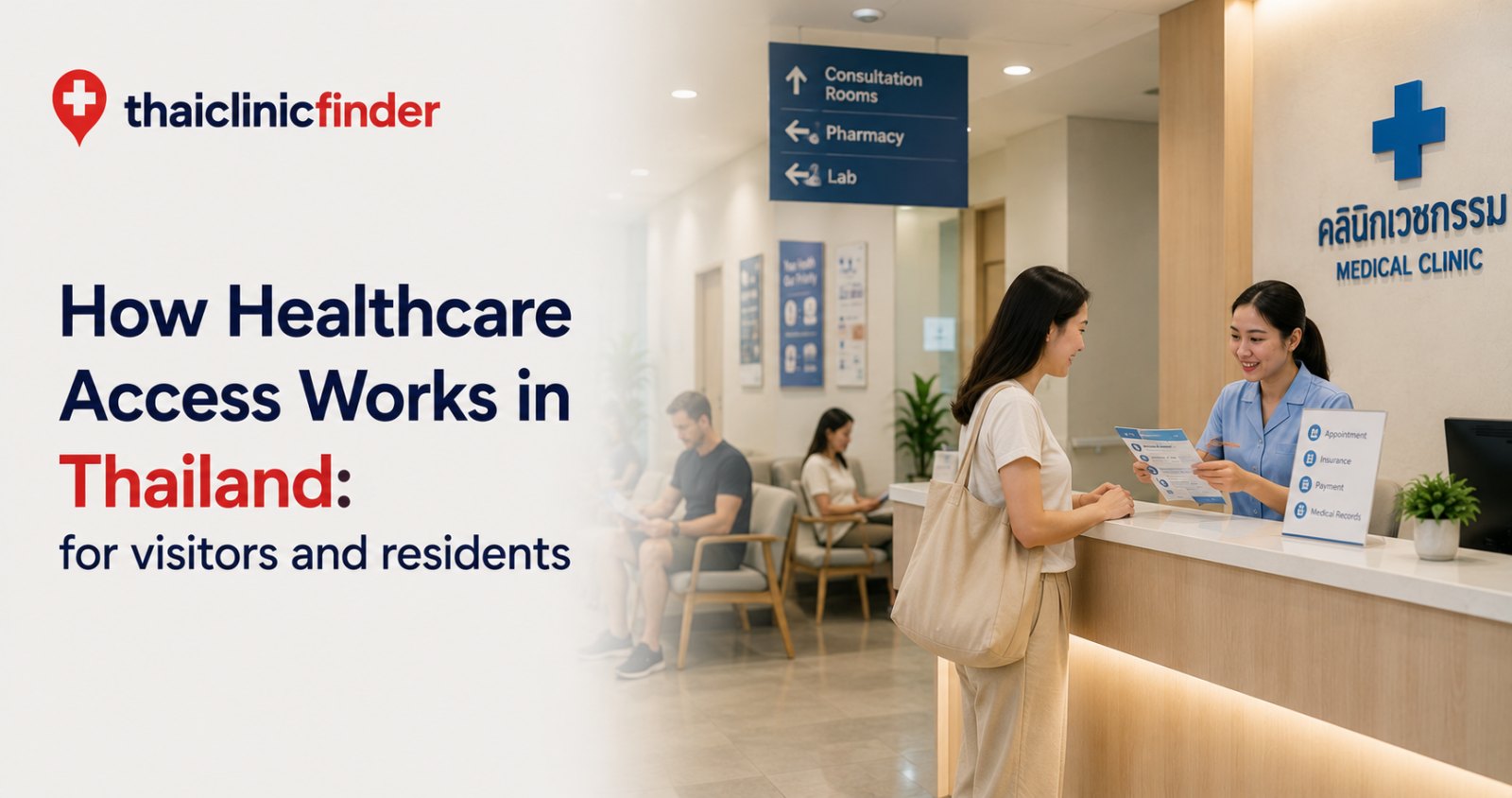
Healthcare access in Thailand depends partly on why you are in the country and how your medical expenses are covered. A tourist paying privately, an expatriate with international insurance and a foreign worker enrolled in a Thai health scheme may use the same hospital but follow different administrative and payment processes.
Thailand has public hospitals, private hospitals, specialist centres and outpatient clinics. International patients can arrange care directly with many facilities, but being resident in Thailand does not by itself mean that every healthcare service is covered by a Thai public scheme.
This guide explains how healthcare access in Thailand generally works for visitors and international residents, what to prepare before an appointment and what changes when the situation is an emergency.
Public and private healthcare in Thailand
Thailand's healthcare system includes a large public sector alongside private hospitals and clinics. Thai universal health coverage operates through several public schemes, including the Universal Coverage Scheme, Social Security and the Civil Servant Medical Benefit Scheme.
These national coverage arrangements should not be confused with simply being physically resident in Thailand. Eligibility depends on the particular scheme and the person's status.
Foreign visitors commonly access healthcare as self-paying patients or through travel or international health insurance. Some foreign workers are covered through employment-related Social Security arrangements or specific health insurance systems for foreign workers. The rules depend on the individual's employment, nationality, registration and insurance status.
If you live in Thailand, find out which system actually covers you before you need treatment. Your employer, insurer or the relevant Thai authority should be able to confirm your eligibility and any designated healthcare facility.
Visitors can contact hospitals directly
For planned medical treatment, the Thai government's guidance for foreign patients advises contacting the hospital by telephone or email before attending.
The government guidance lists a passport among the documents foreign patients should prepare. Previous medical information can also be useful, including referral letters, blood test results, imaging, surgical history or pathology reports when relevant to the treatment.
At the hospital, a new patient may first need to register before seeing a doctor. The exact process varies between facilities, so confirm appointment requirements directly with the hospital or clinic.
For a minor health problem, an outpatient clinic may be sufficient. More complex investigation, surgery or specialist treatment may require a hospital or specialist department.
You often do not need to start at a general practitioner
Healthcare pathways in Thailand may differ from systems where a family doctor acts as the compulsory gateway to most specialist care.
Many private hospitals and clinics allow patients to contact specialist departments directly. Whether this is possible depends on the provider and the type of care. Some services may still ask for a referral or previous records.
If you already know the specialty you need, ask the facility whether you can make a direct appointment. If you are unsure what type of doctor is appropriate, starting with general medicine or another primary-care service can help direct you to the correct department.
Do not try to choose a specialty yourself when symptoms are severe or potentially life-threatening. Emergency symptoms require urgent assessment rather than a routine specialist booking.
Check the exact facility and doctor
Hospital groups can operate several branches, and services can differ between them. Before travelling to an appointment, confirm the exact hospital or clinic, address, department and appointment time.
For private healthcare establishments, Thailand's Department of Health Service Support operates a system for checking licensed facilities. When using it, look for the exact branch rather than assuming information about one location applies to the whole hospital or clinic group.
Individual physicians can be checked separately. The Medical Council of Thailand provides an English-language search tool for active doctors licensed to practise medicine.
This distinction is useful when researching healthcare online. A hospital, an outpatient clinic, a hospital department and an individual doctor are not interchangeable, and each may require a different type of verification.
Confirm English-language care before the appointment
English is available in some Thai healthcare settings, particularly services that regularly see international patients, but availability varies considerably.
An English-language hospital website does not guarantee that every doctor, nurse, pharmacist or receptionist speaks English. If communication in English is important, ask whether the specific clinician for your appointment can conduct the consultation in English.
For significant treatment, also consider whether you can discuss consent, medication instructions, test results and follow-up in a language you understand.
Thai Clinic Finder's guide on how to choose an English-speaking clinic in Thailand explains what to verify before booking.
How payment usually works for visitors
Visitors who are not covered by a Thai healthcare scheme should be prepared for the possibility of paying the provider directly and then seeking reimbursement from their insurer.
Payment arrangements vary by hospital and insurance company. Some facilities may have direct billing agreements with particular insurers, while others require payment before discharge or treatment.
Before planned care, ask:
- what the consultation is expected to cost
- whether hospital or facility fees are charged separately
- whether tests, imaging and medication are additional
- whether a deposit is required
- whether the hospital works directly with your insurer
- whether pre-authorisation is required
For expensive procedures, request a written estimate where possible. An estimate is not necessarily a final bill because the treatment required can change after examination or testing.
Health insurance can change how you access care
Travel insurance, international health insurance, employer insurance and Thai health schemes can have different rules.
Your policy may specify:
- which hospitals you can use
- whether outpatient care is covered
- whether you need pre-authorisation
- whether direct billing is available
- what deductible or co-payment applies
- whether dental or mental health care is covered
- whether medication is reimbursed
- whether emergency evacuation is covered
Contact your insurer before non-urgent treatment when the policy requires approval. Keep receipts, invoices, medical reports and prescriptions if you expect to make a reimbursement claim.
During an immediate medical emergency, do not delay necessary care solely to resolve insurance administration.
Healthcare access for foreign residents
There is no single healthcare pathway that applies to everyone who lives in Thailand without Thai citizenship.
A foreign resident might use private insurance, employer-provided insurance, Social Security, a specific foreign-worker health insurance arrangement or personal payment. Some people use a combination of these depending on the type of treatment.
Thai government guidance for foreign workers describes a health insurance system under which eligible workers and dependants use the hospital specified by their health insurance arrangement for normal services. Identification and proof of insurance may be required.
That system should not be assumed to apply to every expatriate or foreign resident. If you work in Thailand, ask your employer which healthcare scheme you are registered under, which hospital is assigned to you if relevant and what services are covered.
If you are retired, self-employed, a digital nomad, a dependent or living in Thailand under another immigration status, check your own insurance arrangements rather than assuming that residence gives automatic access to a public coverage scheme.
What to bring to a medical appointment
The exact requirements vary, but international patients may find it useful to bring:
- passport or other accepted identification
- insurance card or policy details
- previous medical reports relevant to the problem
- recent test or imaging results
- a list of current medicines and doses
- information about allergies
- referral documentation if requested
The Thai government's guidance for foreign patients specifically identifies a passport and relevant medical history among documents that may be needed when arranging treatment.
For ongoing or complex conditions, a concise English-language medical summary can be particularly useful if your previous records are extensive.
Prescriptions and medication
Do not assume that a medicine prescribed in another country will be sold under the same brand name or be available under the same prescribing rules in Thailand.
For ongoing medication, keep a record of the generic drug name, dose and reason it was prescribed. Bring the original packaging and previous prescription or medical documentation when practical.
Some medicines require a medical consultation or have specific controls. If you are running low on an important regular prescription, arrange care before the supply is exhausted.
Do not stop or substantially alter an established prescription treatment without appropriate medical advice simply because you are travelling or living abroad.
Accessing mental health care
Mental health services can be provided through psychiatric hospitals, hospital departments, private clinics and psychological or counselling services.
The type of professional matters. A psychiatrist is a medical doctor and may assess psychiatric conditions and prescribe medication where appropriate. Psychologists, counsellors and therapists have different professional roles and training.
For details on checking providers, English-language care, medication and urgent support, see finding mental health support in Thailand.
Dental care works separately from general medical care
Dental services are available through public and private facilities, including dedicated dental clinics and hospital dental departments.
For planned private dental treatment, you can usually contact a clinic directly. For more extensive work, compare the treating dentist, proposed treatment plan, total expected fees and follow-up arrangements rather than relying only on advertised prices.
If your insurance includes dental benefits, check whether the particular treatment is covered. Routine dental care and treatment following an accident may be treated differently by the same policy.
What happens during a medical emergency?
For a serious medical emergency in Thailand, the National Institute for Emergency Medicine lists 1669 as the emergency medical services number.
If someone has severe breathing difficulty, is unconscious, has major trauma, uncontrolled bleeding or another potentially life-threatening condition, seek emergency help rather than trying to arrange an ordinary clinic appointment.
Visitors should not delay urgent treatment while comparing hospital prices or waiting for routine insurance approval.
Thai Clinic Finder's guide to medical emergencies in Thailand covers the main emergency numbers and practical steps in more detail.
Medical care outside Bangkok
Healthcare availability varies across Thailand. Large cities and provincial centres generally have a broader range of specialist services than smaller towns or islands, while some locations may have clinics that manage routine problems and refer patients elsewhere for more complex care.
If you have a chronic condition or need specialist treatment while staying outside a major city, check what is available locally before travelling. You may need to attend a larger hospital for some investigations, procedures or specialist follow-up.
If you are choosing accommodation for an extended stay and have significant medical needs, proximity to appropriate healthcare may be more useful than simply knowing that a clinic is nearby.
Referrals and follow-up
Ask what happens after the initial consultation. Depending on the problem, the doctor may recommend tests, medication, another specialist or a follow-up appointment.
If you are travelling around Thailand, tell the doctor if returning to the same facility will be difficult. Ask for copies of relevant results and a treatment summary when appropriate.
If you are leaving Thailand, ask what information another doctor will need to continue your care. Keep important test results, imaging reports, prescriptions and discharge instructions rather than relying on being able to retrieve everything later.
Questions to ask before planned care
Before a non-urgent appointment, it can help to confirm:
- Is this the correct branch and department for my problem?
- Do I need an appointment or referral?
- Which clinician will see me?
- Can the appointment be conducted in English if needed?
- What identification should I bring?
- What previous medical records are useful?
- What is the estimated consultation fee?
- Are tests and medicines charged separately?
- Can the hospital bill my insurer directly?
- Do I need pre-authorisation?
- How will I receive test results?
- How is follow-up arranged?
These questions are more useful for planned care than trying to judge a provider from marketing claims or third-party ratings.
Conclusion
Healthcare access in Thailand is relatively straightforward once you know how you will pay for care and what type of facility you need. Visitors can contact hospitals and clinics directly for many forms of planned treatment, while international residents should check whether they are using private insurance, employer coverage or a Thai healthcare scheme.
Before a routine appointment, confirm the exact facility, doctor, language support, expected costs and insurance arrangements. Keep your passport details, medication list and important medical records accessible. If the situation is a genuine medical emergency, seek urgent care first and deal with routine administrative questions once the patient is safe.
Frequently Asked Questions
Can tourists use hospitals in Thailand?
Yes. Foreign visitors can arrange treatment with Thai hospitals and clinics, although payment and insurance arrangements vary. For planned care, contact the exact provider beforehand and ask what identification, medical records and payment information it requires.
Do foreign residents get free healthcare in Thailand?
Living in Thailand does not by itself establish entitlement to every public healthcare scheme. Coverage depends on factors such as employment and registration, and some foreign workers have specific Social Security or health insurance arrangements. Other residents use private insurance or pay directly.
Do I need a referral to see a specialist in Thailand?
Not always. Many private providers allow patients to contact specialist departments directly, but individual hospitals and services can set their own appointment requirements. Confirm with the exact department before booking.
Should I use a public or private hospital in Thailand?
The appropriate choice depends on your medical needs, location, coverage, language requirements and whether the situation is urgent. Check the exact facility and service rather than assuming that either public or private care is automatically preferable.
What documents should a visitor take to a hospital in Thailand?
A passport or other accepted identification is commonly important. Relevant medical history, referral letters, test results, imaging, medication information and insurance details may also be useful depending on the reason for treatment.
Can hospitals in Thailand bill international insurance directly?
Some hospitals have direct billing arrangements with some insurers, but this depends on the provider, insurer, policy and treatment. Confirm direct billing and any pre-authorisation requirements with both the hospital and your insurer.
What number should I call for a medical emergency in Thailand?
Thailand's National Institute for Emergency Medicine lists 1669 as the emergency medical services number. For a potentially life-threatening illness or injury, seek emergency help rather than delaying care to compare providers or resolve routine insurance questions.
Sources
- Thailand.go.th - Medical Treatment in Thailand: What Foreigners Need to Prepare
- National Health Security Office - Pathways to Sustainable UHC
- The Medical Council of Thailand - Doctor verification
- Department of Health Service Support - Licensed private healthcare establishment verification
- National Institute for Emergency Medicine, Thailand

Writer
Thai Clinic Finder Editorial Team
The editorial team checks public healthcare information against official provider and institutional sources. It does not provide medical advice.