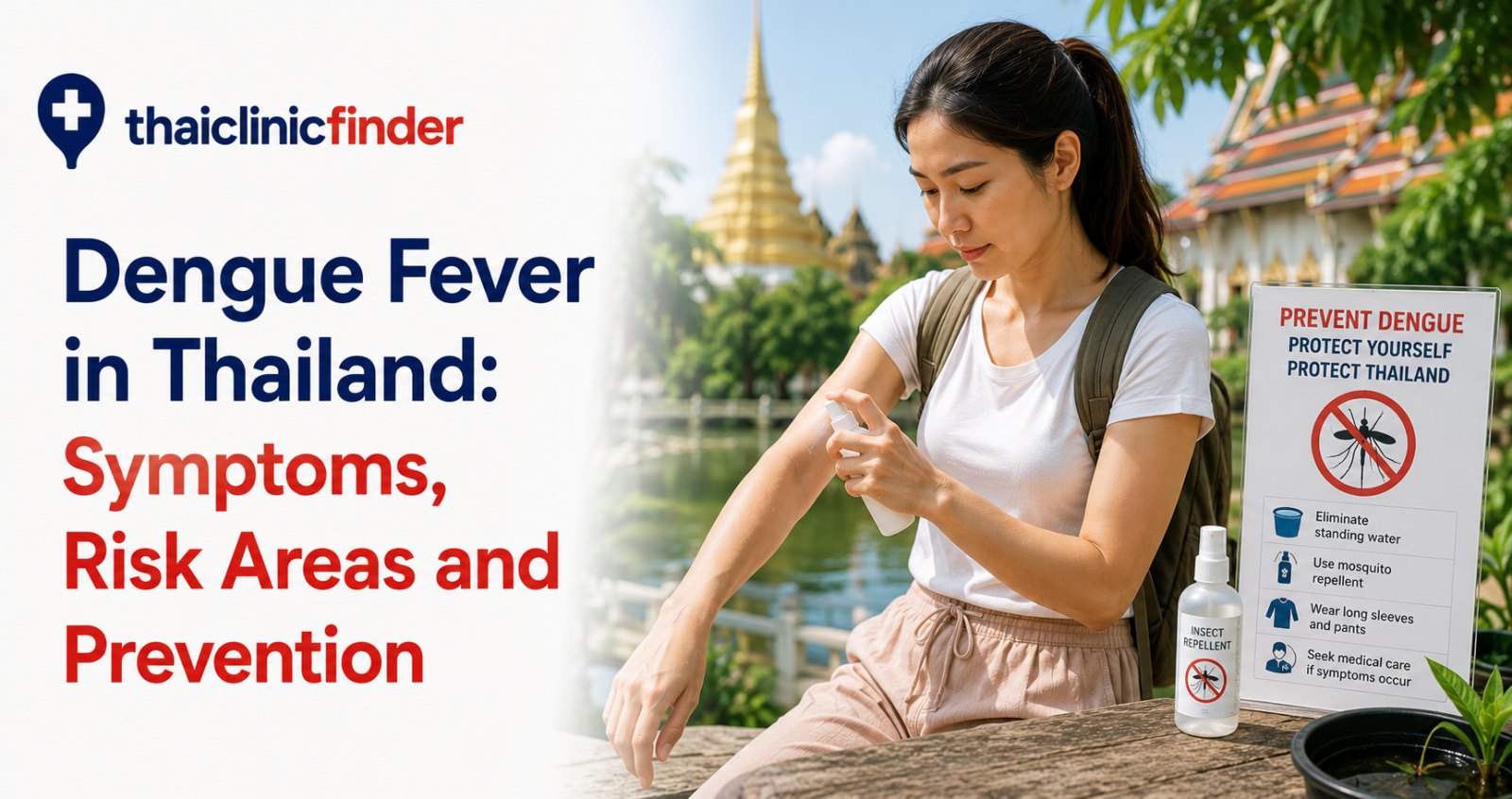
Dengue fever is one of the main mosquito-borne infections travellers and residents should understand in Thailand. Unlike malaria, which is concentrated mainly in selected rural and forested areas, dengue can occur in cities, tourist destinations and residential neighbourhoods across the country.
Thailand remains a dengue-endemic country. WHO lists Thailand among the world's 30 most highly dengue-endemic countries and describes South-East Asia as a high-burden region. The Thai Department of Disease Control reported 21,620 cumulative cases and 31 deaths nationwide between 1 January and 19 August 2026 in a release dated 26 August 2026. The release also cited Bangkok health data showing 1,785 cases and four deaths. It said the dengue situation was still trending upward as the seasonal outbreak period began, although the total remained below the previous year's level and the 2026 case forecast. These surveillance totals are cumulative and do not estimate an individual traveller's probability of infection.
Most dengue infections cause no symptoms or a relatively mild illness, but some cases progress to severe dengue. Knowing the warning signs matters because deterioration can occur around the time the fever begins to fall.
Dengue is not limited to remote parts of Thailand
Dengue differs from malaria in an important way: you do not need to travel to a forest or border area to be exposed.
The mosquitoes that transmit dengue, particularly Aedes aegypti, are well adapted to living around people. Thailand's Department of Disease Control states that these mosquitoes breed in standing water around homes and buildings, including containers, plant-pot trays and other places where water collects.
Dengue transmission can therefore occur in urban, suburban and rural environments.
For travellers, this means mosquito precautions remain relevant in destinations such as Bangkok, Phuket, Pattaya, Chiang Mai and the Thai islands even when malaria medication is not recommended for the itinerary.
How common is dengue in Thailand?
Dengue is endemic in Thailand, meaning transmission occurs regularly rather than only during isolated imported outbreaks.
WHO lists Thailand among the 30 countries with a high dengue burden globally. The number of reported cases varies significantly from year to year and across seasons.
On 26 August 2026, Thailand's Department of Disease Control reported 21,620 cumulative dengue cases and 31 deaths nationwide between 1 January and 19 August 2026. It also reported 1,785 cases and four deaths in Bangkok, and said the dengue situation was still trending upward as the seasonal outbreak period began while remaining below the previous year's level and the 2026 case forecast.
These are cumulative surveillance totals, not an estimate of an individual traveller's probability of infection. Risk varies with mosquito exposure, location, season, length of stay and preventive measures.
They do show that dengue remains an active public-health issue in Thailand rather than a historical travel risk.
Which mosquitoes spread dengue?
Dengue is transmitted primarily by infected Aedes aegypti mosquitoes. Aedes albopictus can also transmit the virus.
Thailand's Department of Disease Control identifies Aedes aegypti as the principal dengue vector and Aedes albopictus as a secondary vector.
These mosquitoes also matter because they can transmit other infections, including chikungunya and Zika.
A mosquito becomes infected after biting a person carrying dengue virus and can later transmit the virus when biting another person.
Dengue is not normally transmitted directly from one traveller to another through ordinary social contact.
Dengue mosquitoes bite during the day
This is one of the most important points for travellers to remember.
Aedes mosquitoes are daytime biters. Thailand's Department of Disease Control states that they bite during the day and are particularly active around the first hours after sunrise, although biting can continue throughout daylight hours.
WHO similarly advises preventing mosquito bites particularly during the day.
That means mosquito repellent is relevant while:
- sightseeing
- eating outdoors
- walking around cities
- visiting temples or parks
- sitting near hotel gardens or swimming pools
- hiking during daylight hours
Using repellent only after sunset leaves a substantial part of dengue exposure unaddressed.
What are the symptoms of dengue fever?
Many dengue infections cause no noticeable symptoms. When symptoms occur, WHO states that they commonly begin 4 to 10 days after infection and usually last for around 2 to 7 days.
Possible symptoms include:
- high fever
- severe headache
- pain behind the eyes
- muscle pain
- joint pain
- nausea
- vomiting
- swollen glands
- rash
These symptoms are not specific to dengue. Influenza, COVID-19, chikungunya, malaria in relevant areas and several other infections can produce overlapping symptoms.
Do not assume that fever in Thailand is dengue solely because you have mosquito bites.
The fever going down does not always mean recovery
One of the more important features of dengue is that severe symptoms can appear after the fever begins to settle.
WHO states that warning signs of severe dengue often develop after the fever has gone away, commonly during the critical phase of illness.
Warning signs include:
- severe abdominal pain
- persistent vomiting
- rapid breathing
- bleeding from the gums or nose
- blood in vomit or stool
- marked fatigue or restlessness
- intense thirst
- pale or cold skin
- significant weakness
These symptoms require prompt medical assessment.
A person with dengue who feels worse when the temperature starts falling should not assume that the illness is ending.
What is severe dengue?
A small proportion of dengue infections develop into severe dengue.
WHO states that severe dengue can involve plasma leakage leading to shock or fluid accumulation, severe bleeding or serious organ impairment.
Hospital care is often required when severe dengue develops.
People infected with dengue for a second time have a greater risk of severe disease, although a previous infection does not mean that severe dengue will necessarily occur.
There are four recognised dengue virus serotypes. Previous infection with one serotype produces long-term immunity mainly to that serotype rather than complete protection against the others.
When should you see a doctor?
Seek medical advice if you develop a significant fever while in Thailand, particularly if you also have severe headache, muscle or joint pain, rash, vomiting or marked weakness.
Prompt assessment becomes more important when symptoms are severe, persistent or worsening.
Seek urgent medical care for warning signs such as:
- severe abdominal pain
- persistent vomiting
- unusual bleeding
- blood in vomit or stool
- breathing difficulty
- fainting or confusion
- marked weakness
- pale or cold skin
For an immediately life-threatening condition, Thailand's emergency medical services number is 1669. Thai Clinic Finder's guide to medical emergencies in Thailand explains the main emergency contacts.
How is dengue diagnosed?
A doctor considers symptoms, examination findings, timing of illness and local exposure. Blood tests can be used to help confirm dengue, with the appropriate test depending partly on how long the person has been ill.
Laboratory tests may also be used to monitor changes such as platelet counts, haematocrit and other findings when clinically appropriate.
Do not try to diagnose dengue from a rash, mosquito bite or home symptom checklist alone.
If you are travelling, tell the doctor when your symptoms started and where in Thailand you have been staying.
There is no specific antiviral treatment for ordinary dengue
WHO states that there is currently no specific medicine that cures dengue infection itself.
Management focuses on monitoring, hydration and treating symptoms appropriately. People with severe dengue may require hospital treatment and close fluid management.
The correct level of care depends on symptoms, examination findings and clinical test results.
Do not self-treat severe or worsening dengue symptoms at a hotel or apartment rather than seeking appropriate assessment.
Avoid aspirin and ibuprofen if dengue is suspected
WHO specifically advises avoiding aspirin and ibuprofen in dengue because these medicines can increase the risk of bleeding.
Paracetamol, also called acetaminophen, is generally used for fever and pain under dengue guidance when medically appropriate.
This is particularly relevant for travellers because ibuprofen is commonly used for ordinary fever and muscle pain.
If you have an unexplained fever in Thailand and dengue is possible, seek medical advice rather than repeatedly taking anti-inflammatory medicines while waiting for the illness to resolve.
Hydration matters
Fever, vomiting and reduced food or fluid intake can contribute to dehydration.
WHO advises people with dengue to rest and drink adequate fluids. However, fluid management becomes more complicated in severe dengue, where medical supervision can be important.
Persistent vomiting, inability to keep fluids down, dizziness, very limited urination or marked weakness are reasons to seek medical assessment rather than relying on oral fluids alone.
Is there a dengue season in Thailand?
Dengue can occur throughout the year, but transmission often rises during and after rainy periods.
WHO notes that dengue outbreaks commonly show seasonal patterns linked to rainfall, temperature and humidity. These conditions affect mosquito breeding and virus transmission.
Thailand does not have one identical rainy season across every region. Bangkok and much of central and northern Thailand generally experience wetter conditions during the southwest monsoon, while parts of the Gulf coast have a different rainfall pattern.
For travellers, the practical approach is to use mosquito precautions year-round and be particularly consistent during wetter periods rather than treating dengue as a risk confined to a few months.
Is dengue a risk in Bangkok?
Yes. Dengue can occur in Bangkok.
Unlike malaria, dengue is well adapted to urban environments. Aedes mosquitoes can breed in small collections of water around houses, apartments and commercial areas.
A traveller staying only in central Bangkok does not need to visit a rural area to have potential dengue exposure.
This does not mean that every mosquito bite in Bangkok is dangerous. Most bites do not result in dengue, but routine mosquito precautions are appropriate.
What about Phuket and Pattaya?
Dengue prevention also matters in major resort destinations such as Phuket and Pattaya.
These are urban and tourist environments where Aedes mosquitoes can occur. Low malaria risk in these destinations should not be confused with low mosquito-borne disease risk overall.
Travellers who have been told that malaria tablets are unnecessary sometimes incorrectly conclude that they do not need insect repellent. Dengue is one reason that conclusion is wrong.
Is dengue a concern on Thai islands?
Yes. Being on an island does not remove dengue risk.
Aedes mosquitoes can live around hotels, houses and populated areas wherever suitable breeding sites and human hosts are present.
Use repellent around accommodation, beach towns, restaurants and gardens, particularly during daylight hours.
Hotel quality alone does not guarantee an absence of mosquitoes.
How to prevent dengue in Thailand
There is no single method that prevents every mosquito bite, so combining several measures is useful.
WHO and CDC recommend measures such as:
- using an effective mosquito repellent
- covering exposed skin with clothing when practical
- staying in screened or air-conditioned rooms
- using mosquito nets where appropriate
- reducing standing water around accommodation
Repellent is particularly important because dengue mosquitoes bite during daylight hours.
For a broader prevention guide, see mosquito bites in Thailand: risks and prevention.
Which mosquito repellents work?
CDC recommends repellents containing recognised active ingredients such as:
- DEET
- picaridin or icaridin
- IR3535
- oil of lemon eucalyptus or PMD
- 2-undecanone
Follow the product label and reapply as directed.
A higher concentration can generally increase the duration of protection, but more product should not be applied than the label recommends.
Do not assume that an untested herbal spray provides equivalent protection simply because it is marketed as natural mosquito repellent.
Remove standing water if you live in Thailand
Long-term residents can reduce mosquito breeding around the home by paying attention to water containers.
Thailand's Department of Disease Control notes that Aedes mosquitoes commonly lay eggs around standing water in places such as flower vases, plant-pot trays and discarded tyres.
Check balconies, gardens and outdoor areas for containers collecting rainwater. Cover or empty water storage containers when appropriate.
For short-stay hotel guests, structural mosquito control is largely the responsibility of the property, but travellers can still keep balcony doors closed and report obvious mosquito problems.
Can you catch dengue twice?
Yes.
There are four main dengue virus serotypes. Infection with one serotype does not provide lifelong protection against all of the others.
WHO states that people infected for a second time have a greater risk of severe dengue.
A previous dengue infection should therefore not be used as a reason to stop mosquito precautions during later trips to Thailand.
What if you get dengue while travelling?
If dengue is diagnosed or strongly suspected, ask the healthcare provider what symptoms should trigger reassessment and when follow-up testing is needed.
Do not plan strenuous travel simply because the fever has improved. The period around defervescence can be clinically important in dengue.
If you are due to fly or move to another part of Thailand, tell the doctor. Depending on your condition, continued monitoring may be more important than maintaining the original itinerary.
Keep copies of relevant blood tests, prescriptions and medical reports if you need to continue care elsewhere.
For preparation before attending a provider, see what to check before a medical appointment in Thailand.
Can dengue symptoms appear after leaving Thailand?
Yes. Because symptoms do not necessarily begin immediately after an infected mosquito bite, a traveller can become ill after leaving Thailand.
If you develop fever within days of returning home, tell the healthcare professional that you recently travelled to Thailand.
Mention the dates and destinations of your trip. Travel history can help clinicians consider dengue alongside other possible causes of fever.
If you also visited a malaria transmission area, make that clear because malaria can require urgent testing and treatment.
Dengue and malaria are not the same risk
Both infections are transmitted by mosquitoes, but the epidemiology is quite different in Thailand.
Dengue can occur widely, including cities and tourist areas. Malaria is concentrated mainly in rural forest and border regions.
Dengue mosquitoes mainly bite during the day. Malaria-carrying Anopheles mosquitoes are more relevant from dusk through the night.
For detailed malaria guidance, see Malaria in Thailand: Risk Areas, Prevention and What Travellers Should Know.
The key point is that being somewhere with little or no malaria risk does not mean mosquito prevention is unnecessary.
A practical dengue checklist for travellers
During a trip to Thailand:
- use mosquito repellent during the day
- reapply according to the product instructions
- reduce exposed skin where practical
- use screened or air-conditioned accommodation when possible
- avoid allowing standing water to collect around long-term accommodation
- seek medical advice for significant fever
- avoid aspirin and ibuprofen when dengue is suspected unless a clinician advises otherwise
- watch carefully for severe abdominal pain, persistent vomiting, bleeding or marked weakness
- tell the doctor about your travel history
Dengue prevention does not require avoiding Thailand's cities, islands or outdoor activities. It means treating mosquito protection as a routine part of travel rather than something needed only in remote areas.
Conclusion
Dengue fever remains endemic in Thailand and can occur in major cities, resort destinations and rural areas. The Thai Department of Disease Control reported 21,620 cumulative cases and 31 deaths nationwide between 1 January and 19 August 2026, with 1,785 cases and four deaths reported in Bangkok. The release said the dengue situation was still trending upward as the seasonal outbreak period began while remaining below the previous year's level and the 2026 case forecast.
Most infections are mild or asymptomatic, but severe dengue can develop and may become dangerous. Watch particularly for worsening symptoms around the time the fever begins to fall.
Use mosquito repellent during daylight hours, reduce mosquito exposure around accommodation and seek medical assessment for significant fever or warning signs. Avoid assuming that a destination is low risk simply because malaria is uncommon there.
Frequently Asked Questions
Is dengue common in Thailand?
Dengue is endemic in Thailand and cases are reported every year. In a release dated 26 August 2026, Thailand's Department of Disease Control reported 21,620 cumulative cases and 31 deaths nationwide between 1 January and 19 August 2026. It also reported 1,785 cases and four deaths in Bangkok. Reported totals vary by season and location and do not estimate an individual traveller's probability of infection.
What are the symptoms of dengue fever?
Symptoms can include high fever, headache, pain behind the eyes, muscle and joint pain, nausea, vomiting and rash. Many infections cause mild or no symptoms, while a smaller number progress to severe dengue.
When should I go to hospital with suspected dengue?
Seek prompt care for severe abdominal pain, persistent vomiting, unusual bleeding, blood in vomit or stool, rapid breathing, marked weakness, pale or cold skin or other serious deterioration. Warning signs can develop as the fever starts to fall.
Can I take ibuprofen if I think I have dengue?
WHO advises against ibuprofen and aspirin when dengue is suspected because they can increase bleeding risk. Seek medical advice for a significant fever and use medication only as appropriate for your situation.
Is dengue a risk in Bangkok?
Yes. Dengue can be transmitted in urban areas, including Bangkok, because Aedes mosquitoes live and breed around populated environments. Mosquito precautions are relevant even if you do not visit rural areas.
Is dengue a risk in Phuket and Pattaya?
Yes. Dengue prevention remains relevant in major Thai tourist destinations, including Phuket and Pattaya. Low malaria risk in these locations does not mean mosquito-borne disease risk is absent.
Do dengue mosquitoes bite at night?
Aedes mosquitoes that transmit dengue are primarily daytime biters, although mosquito exposure can occur across the day. Repellent should therefore be used during daytime activities rather than only after sunset.
Can I get dengue more than once?
Yes. There are four main dengue virus serotypes, and infection with one does not provide complete lifelong protection against the others. WHO states that a second infection is associated with a greater risk of severe dengue.
Sources

Writer
Thai Clinic Finder Editorial Team
The editorial team checks public healthcare information against official provider and institutional sources. It does not provide medical advice.