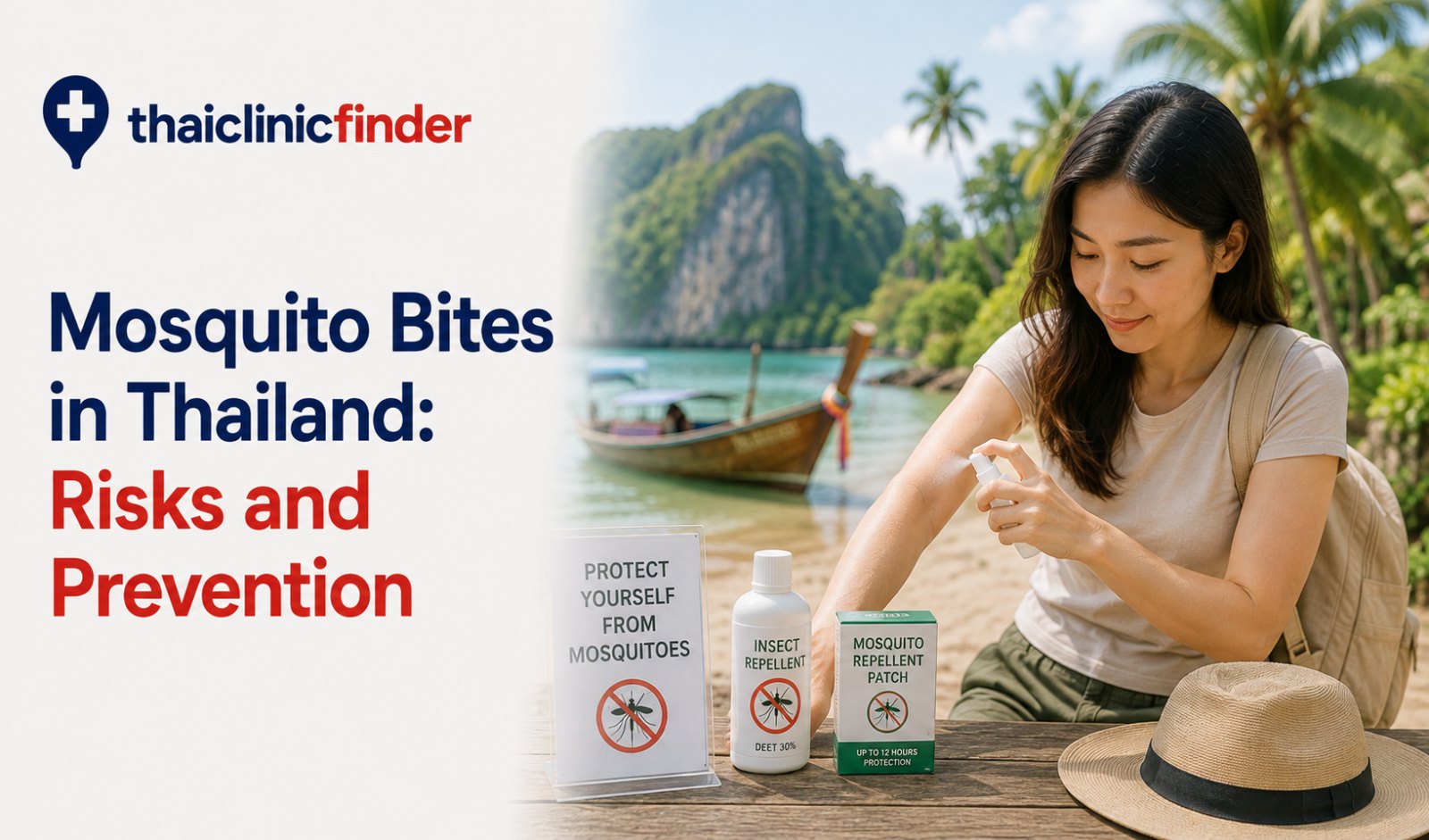
Mosquito bites are common in Thailand, particularly in warm, humid conditions and around areas where mosquitoes can breed. Most bites cause little more than temporary itching or swelling, but mosquitoes in Thailand can also transmit infections including dengue and, in certain parts of the country, malaria.
The important point for travellers is that mosquito risk is not the same everywhere or at every time of day. Dengue can occur in cities and tourist destinations, while malaria transmission is concentrated mainly in selected rural and forested border areas. Different mosquitoes also tend to bite at different times.
This guide explains the main risks associated with mosquito bites in Thailand, how to reduce your exposure and when a bite or later illness should prompt medical attention.
Are mosquito bites common in Thailand?
Yes. Thailand's tropical climate supports several mosquito species, and bites can occur in cities, islands, rural areas and forest environments.
The number of mosquitoes varies with location, rainfall, season, standing water and local conditions. WHO notes that dengue transmission often increases during and after rainy periods because temperature, rainfall and humidity affect mosquito populations and virus transmission.
You do not need to be in a jungle to be bitten. Aedes mosquitoes, which transmit dengue, often live around homes and other populated areas and can breed in relatively small collections of standing water.
For travellers, regular mosquito precautions are more useful than assuming that a particular hotel, city or season will be mosquito-free.
What diseases can mosquito bites transmit in Thailand?
Several mosquito-borne infections are relevant in Thailand, but their importance varies substantially by location and type of exposure.
The main diseases travellers may hear about include:
- dengue
- malaria
- chikungunya
- Zika
- Japanese encephalitis
- lymphatic filariasis
This does not mean that every mosquito bite carries a meaningful risk of disease. Most bites do not result in a mosquito-borne infection.
The practical approach is to prevent bites consistently and understand which symptoms should lead to medical assessment.
Dengue is the main mosquito-borne concern in many tourist areas
Dengue is endemic in Thailand. WHO lists Thailand among the countries with a high dengue burden in South-East Asia.
Dengue is transmitted primarily by Aedes mosquitoes. These mosquitoes are active during the day, so using repellent only in the evening is not enough.
WHO advises protecting against dengue by:
- wearing clothing that covers exposed skin when practical
- using mosquito repellents containing ingredients such as DEET, picaridin or IR3535
- using window and door screens
- staying in air-conditioned accommodation when available
- using mosquito nets where appropriate
- reducing standing water where mosquitoes can breed
Dengue can occur in urban and semi-urban environments. This means travellers in Bangkok, Phuket, Pattaya, Chiang Mai and other well-developed destinations should still use mosquito precautions even when malaria risk is low.
Malaria risk is much more location-specific
Malaria also occurs in Thailand, but the geographical pattern is very different from dengue.
Current CDC guidance places the main malaria transmission areas in rural forest and forest-fringe locations near Thailand's borders with Myanmar, Cambodia and Malaysia.
For destinations such as Pattaya City, CDC currently reports no malaria transmission. For Bangkok, Phuket, Chiang Mai city, Chiang Rai city, Koh Samui and Koh Pha Ngan, malaria cases are described as rare to few and routine preventive malaria medication is not generally recommended solely for a typical stay in those locations.
Travellers going into rural border areas may receive different advice, including prescription malaria prevention medicine.
For a detailed breakdown, see Malaria in Thailand: Risk Areas, Prevention and What Travellers Should Know.
Mosquitoes that spread dengue can bite during the day
One of the most common misunderstandings about mosquito prevention is that bites matter mainly after sunset.
The Aedes mosquitoes responsible for most dengue transmission are primarily daytime biters. WHO notes that they are particularly active during daylight hours.
This means mosquito repellent can be useful during activities such as:
- sightseeing
- eating outdoors
- walking around cities
- visiting temples or parks
- spending time around swimming pools or gardens
- hiking during the day
Do not remove repellent from your routine simply because it is morning or afternoon.
Malaria mosquitoes are more relevant from dusk to dawn
The mosquitoes responsible for malaria belong mainly to the Anopheles group and are generally more active from evening through the night.
In malaria-risk areas, nighttime precautions become particularly important. These may include sleeping in screened or air-conditioned rooms and using an appropriate bed net when accommodation is exposed to mosquitoes.
This difference between mosquito species explains why travellers should think about protection throughout the day rather than focusing on one particular time.
What mosquito repellent should you use in Thailand?
CDC recommends using an appropriate insect repellent and lists several active ingredients that can protect against mosquito bites.
These include:
- DEET
- picaridin, also called icaridin
- IR3535
- oil of lemon eucalyptus or PMD
- 2-undecanone
For DEET products, CDC notes that concentrations of 20 percent or more can provide protection lasting several hours.
Follow the instructions on the product rather than applying more than recommended. Higher concentrations generally affect how long protection lasts rather than making a repellent proportionally more powerful against each mosquito.
Reapply according to the label, particularly after swimming, heavy sweating or washing.
Can you use DEET in Thailand?
DEET is widely used internationally as an insect repellent and is included in CDC and WHO mosquito-prevention guidance.
Use it according to the product instructions and avoid unnecessary contact with the eyes, mouth or damaged skin.
If you prefer a non-DEET option, picaridin or another recognised repellent ingredient may also provide effective mosquito protection when used correctly.
Do not assume that a product described only as natural or herbal provides the same duration or level of protection as a recognised repellent formulation.
Clothing can reduce mosquito exposure
Repellent is more effective when combined with sensible clothing where conditions allow.
Long trousers, socks and long-sleeved shirts reduce the amount of exposed skin available to mosquitoes. Lightweight fabrics may be more comfortable in Thailand's heat.
CDC also recommends permethrin-treated clothing and equipment for some travellers. Permethrin can be used on clothing, footwear, mosquito nets and certain travel gear according to product instructions, but CDC specifically advises not to apply permethrin directly to the skin.
For ordinary city travel, full coverage may not always be practical. Use a combination of repellent, clothing and accommodation protection that fits the setting.
Does air conditioning help prevent mosquito bites?
Staying in an air-conditioned or well-screened room can reduce mosquito exposure.
CDC recommends staying and sleeping in air-conditioned or screened rooms when possible. WHO likewise identifies window and door screens as useful protection against dengue mosquitoes.
Check that windows and balcony doors close properly. If mosquitoes are entering the room, ask the accommodation to address the problem rather than relying only on indoor sprays.
A mosquito net can be useful when sleeping somewhere that is exposed to the outdoors or lacks effective screens.
Standing water matters
Aedes mosquitoes can breed in containers holding relatively small amounts of water.
WHO recommends removing or managing potential breeding sites around homes, including containers that collect standing water. Water storage containers should be covered, emptied or cleaned appropriately.
For a short-term hotel guest, mosquito control is mainly the responsibility of the property. Long-term residents can also check balconies, plant containers, buckets and other places where rainwater may collect.
After heavy rain, mosquito numbers can increase when breeding conditions improve.
Are mosquitoes worse during Thailand's rainy season?
Mosquito abundance and mosquito-borne disease transmission can increase during rainy periods, but there is no single Thailand-wide mosquito season that makes bites irrelevant during the rest of the year.
WHO notes that dengue epidemics often show seasonal patterns, with transmission frequently increasing during and after rainy seasons.
Thailand's rainfall patterns also vary by region. The Gulf islands, Bangkok, northern Thailand and the Andaman coast do not all experience their wettest months at exactly the same time.
Use mosquito precautions throughout the year rather than stopping protection outside the period usually described as rainy season.
What does a normal mosquito bite look like?
An ordinary mosquito bite commonly causes a small itchy raised area of skin. Some people develop more noticeable local redness or swelling than others.
The reaction itself does not tell you whether the mosquito carried dengue, malaria or another infection. Mosquito-borne illnesses generally cause systemic symptoms later rather than producing a distinctive infected-looking mosquito bite at the moment of exposure.
Try not to scratch bites excessively because broken skin can become irritated or secondarily infected.
CDC advises avoiding scratching and notes that hydrocortisone cream or calamine lotion can help reduce itching from insect bites.
If you have significant swelling, severe pain, spreading redness, pus or another unusual local reaction, seek appropriate medical advice.
Do you need to see a doctor after every mosquito bite?
No. An isolated mosquito bite without concerning symptoms normally does not require medical assessment.
Seek care based on the symptoms that develop rather than simply because you noticed a bite.
Important symptoms during or after travel can include:
- significant fever
- severe headache
- marked muscle or joint pain
- persistent vomiting
- severe abdominal pain
- unusual bleeding
- confusion
- breathing difficulty
- severe weakness
- symptoms that are rapidly worsening
Tell the clinician where in Thailand you have travelled. Location matters particularly when malaria is being considered.
What are the symptoms of dengue?
WHO states that many dengue infections cause no symptoms or only mild illness. When symptoms occur, they can include:
- high fever
- headache
- pain behind the eyes
- muscle and joint pain
- nausea
- vomiting
- swollen glands
- rash
Most symptomatic cases improve, but some develop severe dengue.
WHO identifies warning symptoms including severe abdominal pain, persistent vomiting, rapid breathing, bleeding, marked weakness and other signs of deterioration.
Seek medical care promptly if you develop severe or worsening symptoms. Severe dengue can become dangerous and requires appropriate clinical management.
Avoid ibuprofen and aspirin if dengue is suspected
WHO advises people with dengue to avoid non-steroidal anti-inflammatory drugs such as ibuprofen and aspirin because of the risk of bleeding.
Paracetamol, also called acetaminophen, is generally used for fever and pain in dengue guidance, but the appropriate treatment for an individual should be confirmed with a healthcare professional.
If you develop fever in Thailand and dengue is possible, do not automatically treat yourself with aspirin or ibuprofen while waiting several days to see what happens.
Arrange medical assessment if the fever is significant, persistent or accompanied by concerning symptoms.
What about chikungunya?
Chikungunya is another mosquito-borne viral infection transmitted mainly by Aedes mosquitoes.
It can cause fever and prominent joint pain, sometimes with headache, muscle pain, joint swelling or rash.
Because dengue and chikungunya can initially look similar, travellers should not try to distinguish them from symptoms alone when they are significantly unwell.
The same daytime mosquito precautions used for dengue also help reduce chikungunya exposure.
What about Zika?
Zika virus can also be spread by Aedes mosquitoes. CDC continues to include Zika among mosquito-borne diseases relevant to travellers in Thailand.
Most Zika infections are mild or cause no symptoms, but infection during pregnancy is particularly important because of the risk to the developing fetus.
Pregnant travellers or people planning pregnancy should check current destination-specific Zika guidance before travelling and obtain appropriate medical advice.
Mosquito-bite prevention remains a central part of reducing exposure.
Japanese encephalitis is a different type of risk
Japanese encephalitis is also transmitted by mosquitoes but is generally associated with a different exposure pattern from dengue.
The risk is usually more relevant for people spending extended periods in rural agricultural areas, particularly where mosquitoes, pigs and rice-growing environments support transmission.
Vaccination may be considered for some travellers depending on trip duration, destination and activities. It is not required for every visitor to Thailand.
Discuss vaccination with a travel-health professional rather than making the decision from the presence of mosquitoes alone.
Mosquito prevention in Bangkok, Phuket and Pattaya
Visitors sometimes assume mosquito precautions are unnecessary in major tourist areas because malaria risk is low.
That is incorrect. Dengue remains the more relevant mosquito-borne concern in many urban and tourist settings.
In Bangkok, Phuket and Pattaya:
- use mosquito repellent during the day
- use it again in the evening when mosquitoes are present
- consider clothing that reduces exposed skin
- keep accommodation screened or air-conditioned where possible
- avoid allowing standing water to accumulate around longer-term accommodation
You generally do not need malaria tablets solely because you are staying in these standard tourist destinations under current CDC guidance, but mosquito protection still matters.
Mosquito prevention for trekking and rural travel
Travellers heading into forests, border areas or rural environments may need more extensive preparation.
Depending on the itinerary, this can include:
- regular repellent use
- long clothing
- treated clothing or gear
- bed nets
- accommodation with screens
- prescription malaria chemoprophylaxis for selected risk areas
Review the actual route before departure, particularly if travelling near borders with Myanmar, Cambodia or Malaysia.
Do not wait until you are already in a remote area to determine whether malaria medication should have been started before arrival.
What if you develop fever after leaving Thailand?
Tell the healthcare professional about your recent travel.
Some mosquito-borne infections become symptomatic after the trip has ended. This is particularly important for malaria because a fever after travel to a malaria transmission area requires prompt assessment.
Give the doctor specific locations rather than saying only that you visited Thailand. Mention rural or forest travel, border provinces and whether you took malaria preventive medicine.
The same information can help clinicians consider dengue and other travel-related infections.
A practical mosquito protection checklist
For most travellers in Thailand:
- carry a recognised mosquito repellent
- apply it according to the label
- remember that dengue mosquitoes bite during the day
- cover exposed skin when practical
- choose screened or air-conditioned accommodation where possible
- use a bed net when sleeping somewhere exposed to mosquitoes
- avoid standing water around longer-term accommodation
- check malaria recommendations before visiting rural border areas
- seek medical care for significant fever or severe symptoms
Mosquito precautions are useful even when malaria medication is not recommended because dengue and other mosquito-borne infections have a much wider distribution in Thailand.
Conclusion
Most mosquito bites in Thailand cause only temporary itching, but mosquitoes can transmit dengue, malaria and several other infections. Dengue is relevant in cities and tourist areas and is spread by mosquitoes that commonly bite during the day. Malaria risk is much more concentrated in rural and forested border regions.
Use an effective repellent, reduce exposed skin where practical and choose accommodation that limits mosquito exposure. If you develop significant fever or other concerning symptoms during or after your trip, seek medical assessment and tell the clinician exactly where in Thailand you travelled.
Frequently Asked Questions
Are mosquito bites dangerous in Thailand?
Most mosquito bites are harmless apart from itching and local irritation. However, mosquitoes in Thailand can transmit infections including dengue, malaria, chikungunya and Zika, so preventing bites is worthwhile.
What is the main mosquito-borne disease in Thailand?
Dengue is one of the main mosquito-borne risks for travellers because it is endemic in Thailand and can occur in urban as well as rural areas. Malaria is much more geographically concentrated.
Do mosquitoes bite during the day in Thailand?
Yes. Aedes mosquitoes that transmit dengue are primarily active during the day. Travellers should therefore use mosquito protection during daytime activities as well as when mosquitoes are active in the evening.
What mosquito repellent should I use in Thailand?
CDC recommends recognised repellent ingredients including DEET, picaridin, IR3535, oil of lemon eucalyptus or PMD, and 2-undecanone. Follow the product instructions and reapply as directed.
Do I need malaria tablets for mosquito bites in Thailand?
Not for most standard tourist itineraries. Malaria medication is mainly recommended for selected rural forest and border areas, while mosquito avoidance is sufficient for many major tourist destinations under current CDC guidance.
Should I see a doctor after a mosquito bite in Thailand?
An ordinary itchy bite does not usually require medical care. Seek assessment if you later develop significant fever, severe abdominal pain, persistent vomiting, unusual bleeding, severe weakness or other concerning symptoms.
Can I take ibuprofen for a fever after mosquito bites in Thailand?
If dengue is possible, WHO advises avoiding ibuprofen and aspirin because of bleeding risk. Seek medical advice for a significant fever rather than assuming it is an ordinary viral illness.
Are mosquitoes worse during Thailand's rainy season?
Mosquito numbers and dengue transmission can increase during and after rainy periods, but mosquitoes and mosquito-borne infections can occur throughout the year. Thailand's rainfall patterns also vary by region.
Sources

Writer
Thai Clinic Finder Editorial Team
The editorial team checks public healthcare information against official provider and institutional sources. It does not provide medical advice.