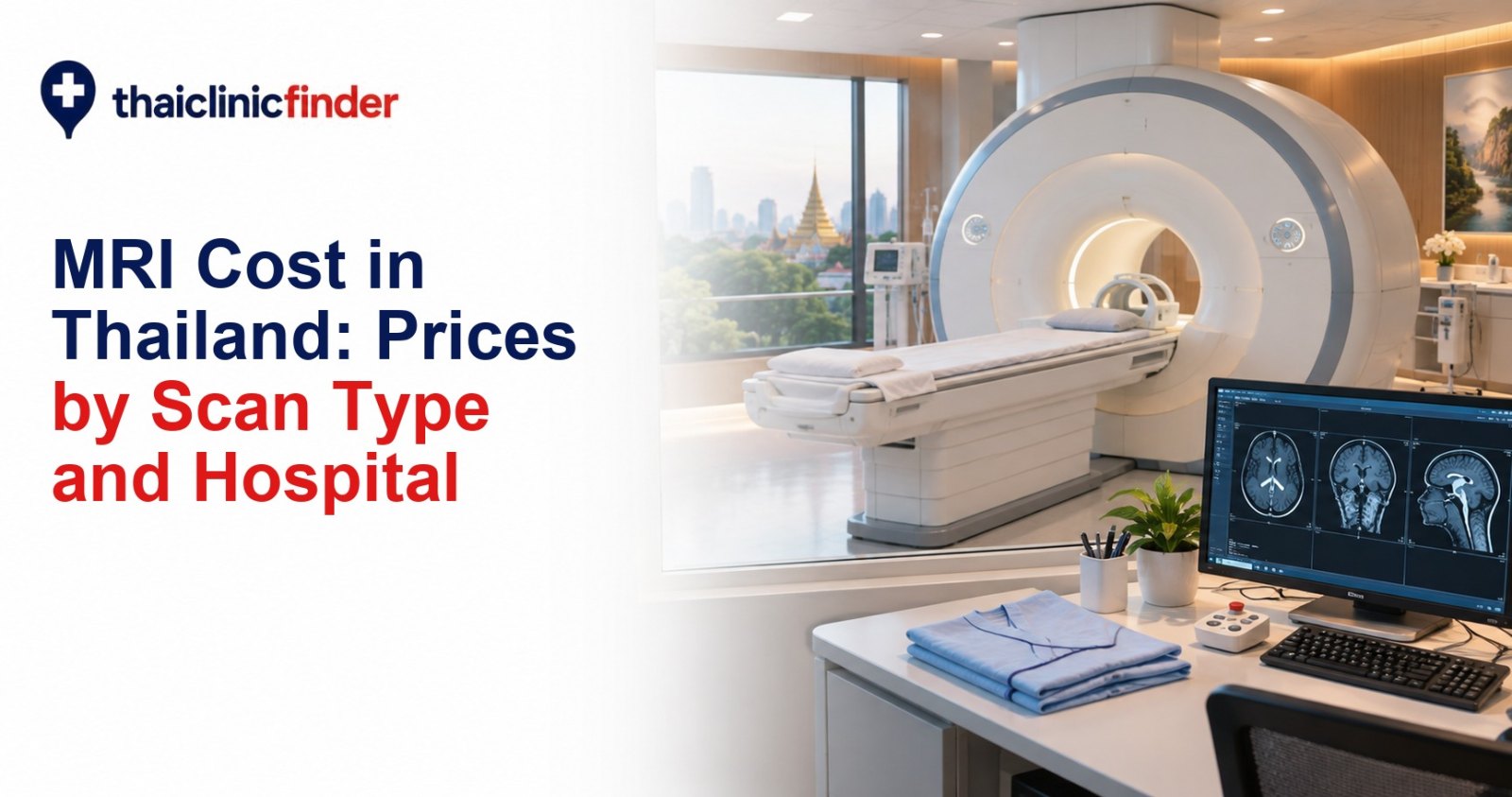
MRI scans in Thailand can cost from around the low tens of thousands of baht for selected promotional scans to substantially more for complex imaging, contrast studies or multiple body regions.
A current Bangkok International Hospital promotion lists selected MRI examinations from THB 12,000, including shoulder and knee MRI. Spine MRI is listed from THB 13,500 to THB 15,900.
These prices are useful examples, but they are not a national fixed tariff.
Current MRI price examples
Bangkok International Hospital currently publishes:
- shoulder MRI, one side: THB 12,000
- knee MRI, one side: THB 12,000
- foot MRI, one side: THB 13,500
- spine MRI: THB 13,500 to THB 15,900
The hospital states that these prices include the radiologist's interpretation fee.
Additional investigations are not included.
Why MRI prices vary
The cost can change according to:
- body part
- one side versus both sides
- scan duration
- use of contrast
- specialized sequences
- sedation
- hospital
- emergency versus scheduled imaging
A simple knee MRI should not be compared with a brain MRI requiring contrast and angiographic sequences.
Contrast can increase the cost
Some MRI studies use gadolinium-based contrast.
The radiologist or referring doctor determines whether contrast is useful.
Contrast can add:
- medication cost
- injection supplies
- additional scan time
- possible kidney-function testing
Do not insist on contrast because you assume it makes the scan better. Some conditions are best evaluated without it.
A doctor's referral may be required
Hospitals commonly want a clinical indication and an appropriate imaging request.
This helps the radiology team choose the correct protocol.
If you arrive with an overseas referral, ask whether the Thai facility accepts it or requires a local doctor to review the case first.
A separate consultation can add to the total cost.
Radiologist interpretation matters
The scan itself is only part of the service.
A radiologist reviews the images and issues a report.
Bangkok International Hospital's current promotion explicitly states that the radiologist interpretation fee is included.
When comparing cheaper imaging centers, ask whether the report is included and whether images are provided digitally.
Orthopedic MRI is one of the easiest to price
Hospitals often publish package prices for:
- knee
- shoulder
- ankle
- spine
These are common outpatient investigations and can fit standardized protocols.
More specialized MRI examinations are more likely to require an individual quote.
Brain MRI can have different protocols
A brain MRI can be ordered for many different questions.
Examples include:
- stroke evaluation
- tumor assessment
- pituitary imaging
- seizure investigation
- multiple sclerosis
- vascular imaging
The appropriate protocol affects scan time and price.
Ask the hospital for a quote based on the exact doctor's request rather than searching only for brain MRI price.
MRI and CT are not interchangeable
MRI uses magnetic fields and radiofrequency energy.
CT uses X-rays.
One is not automatically better than the other.
The choice depends on the clinical question.
For some emergencies, CT may be faster and more appropriate. For certain soft-tissue, neurological and musculoskeletal problems, MRI can provide additional detail.
Safety screening is essential
MRI staff will ask about:
- pacemakers
- implanted devices
- metal fragments
- previous surgery
- pregnancy
- kidney disease when contrast is considered
Do not omit an implant because you assume it is MRI-safe.
The radiology department needs the exact device information when possible.
Claustrophobia
Some people struggle with the enclosed scanner.
Tell the hospital before the appointment if you have severe claustrophobia.
Possible options depend on the facility and medical situation.
Sedation, when used, can add cost and may require fasting and a companion.
MRI for international patients
If you are arranging imaging in Thailand from abroad, ask whether the hospital can provide:
- English report
- digital image files
- online access
- CD or USB copy
- transfer to your overseas doctor
Do not assume the written report alone is enough if another specialist needs to review the images.
Public versus private pricing
Public hospitals may offer lower self-pay imaging costs than premium private hospitals, but appointment access can be slower.
Private hospitals often provide faster scheduling and English-language coordination.
The clinical quality of the scan also depends on the equipment, protocol and radiologist expertise.
Insurance
MRI may be covered when medically necessary.
However, outpatient imaging can be subject to:
- deductible
- pre-authorization
- outpatient benefit limits
- network rules
Check approval requirements before a scheduled scan.
What to bring
Bring:
- referral
- previous imaging
- prior reports
- implant information
- medication list
- passport or hospital ID
- insurance authorization
Previous images can prevent unnecessary repeat scans.
When not to delay imaging
If a doctor recommends urgent imaging for severe neurological symptoms, major trauma or another emergency condition, do not delay care to compare prices.
For an emergency in Thailand, call 1669 or go to an emergency department.
Questions before booking
Ask:
- Is the radiologist report included?
- Is contrast expected?
- Is kidney testing required?
- Is a doctor consultation extra?
- Can I receive images digitally?
- Is sedation available if needed?
- Does the price apply to foreigners?
- Is pre-authorization required?
What a written quote should show
Ask for more than a single headline price. A useful MRI quote identifies the body region, whether the scan is for one side or both, whether contrast is planned, and whether the radiologist's report is included. It should also say whether a consultation, blood test, sedation, extra sequences or copies of the images are charged separately. The referral wording matters because two examinations described casually as a "back MRI" may use different protocols.
If you are comparing hospitals, send each one the same referral or clinical question. That produces a fairer comparison than asking for a generic MRI price. Confirm how long the quotation remains valid, since packages and promotions can change. For a broader sense of private hospital charges, our guide to medical costs in Thailand explains why the advertised package and the final bill are not always identical.
Booking an MRI as an international patient
Start with the hospital's radiology or international patient team and attach the referral, a brief medical history and any previous imaging report. If the hospital requires a local consultation first, ask for that fee and the earliest available appointment. Give the exact name shown on your passport so the report and image files match your other medical records.
Tell the booking team in advance if you need language assistance, use a wheelchair, cannot lie flat, or feel severely claustrophobic. Do not assume that an English-speaking coordinator means the radiographer and radiologist for your appointment will communicate in English. Ask about the language of the appointment and report directly.
On the day, bring identification, the referral, previous relevant scans and a list of medicines and implants. Arrive early enough for safety screening. MRI suites have strict rules about metal objects, and staff may need extra time to check an implanted device. If you have a device card, bring it rather than relying on memory.
Insurance, payment and documents
For planned outpatient imaging, many hospitals ask for payment on the day unless they have approved direct billing. An insurer may require pre-authorisation, a doctor's referral and a medical report before agreeing to cover the scan. A hospital confirming that it accepts your insurer is not the same as confirmation that your individual examination is covered.
Ask the insurer whether contrast, consultation fees and follow-up are included. If you pay yourself and claim later, request an itemised invoice, receipt, medical certificate if required, referral and radiology report. Keep the image-access link or disc as well. These records are especially useful if your doctor is outside Thailand.
When the cheapest scan is not the best comparison
A lower price can be perfectly reasonable, but first establish what you are buying. Scanner strength alone does not determine quality. The chosen protocol, staff experience, motion during the scan and the radiologist's interpretation all affect how useful the result is. A scan that must be repeated is neither cheap nor convenient.
For a complex neurological, cancer or post-operative question, ask whether the facility routinely handles that type of examination and whether a subspecialist radiologist will report it. This is a practical question, not a request for a quality guarantee. The hospital should be able to explain its process without promising a diagnosis before the scan.
Results and follow-up
Before leaving, confirm when the report will be ready, how you will receive it and who will explain it. The images may be provided through a portal, on a disc or by another digital method. If you are travelling soon, tell the hospital and ask whether both the report and images can be accessed from abroad.
An MRI report is not a treatment plan. Arrange follow-up with the clinician who requested the examination, particularly when symptoms are worsening. New weakness, loss of bladder or bowel control, severe sudden headache, major trauma or other urgent symptoms should be assessed promptly rather than waiting for a routine imaging appointment.
If imaging is part of a larger diagnostic plan, ask which tests answer different questions rather than assuming that one replaces another. Our guide to endoscopy costs in Thailand, for example, shows how procedure pricing and preparation differ from imaging even when both are used during the same investigation.
Planning your MRI in Thailand
Published Bangkok prices make about THB 12,000 a useful starting point for selected one-sided shoulder and knee scans, but they do not predict the price of every MRI. The body area, protocol, contrast and extra services can change the total, so request a written quotation against the exact referral.
Compare what is included, not just the first number on the page. Confirm the radiologist's report, contrast, kidney testing, consultation and image delivery, then check any insurance pre-authorisation before the appointment. If you are comparing this scan with other treatment costs, the medical costs in Thailand guide provides useful context.
Finally, take implant information and earlier imaging with you, complete the safety screening carefully and arrange a clinician to review the result. That small amount of preparation makes the appointment smoother and gives you a clearer idea of the true cost before you commit.
Frequently Asked Questions
How much does an MRI cost in Thailand?
Selected promotional MRI scans in Bangkok currently start around THB 12,000. Complex scans, contrast studies and other hospitals can cost more.
How much is a knee MRI in Bangkok?
Bangkok International Hospital currently lists one-sided knee MRI at THB 12,000 under its 2026 promotion.
Does an MRI price include the radiologist report?
The current Bangkok International Hospital promotion says the radiologist interpretation fee is included. Confirm this with other providers.
Does contrast cost extra?
It can. Contrast, kidney testing and additional sequences may increase the final bill.
Can foreigners get an MRI in Thailand?
Yes. Private and public hospitals provide MRI services, though referral and registration requirements vary.
Sources
Writer
Niran Chaiyasit
Niran Chaiyasit is a Thai health writer with a background in public health and a focus on travel health, disease prevention and healthcare access in Thailand. His work covers topics such as common illnesses, vaccinations, mosquito-borne diseases, food safety and practical health information for travelers and expatriates.

Medical review
Justin Brooks
Daniel Brooks is an American health writer with a background in health sciences and a focus on rehabilitation, musculoskeletal health and patient education. He writes about physiotherapy, injury recovery, pain management, preventive health and practical healthcare guidance for international patients and travelers.