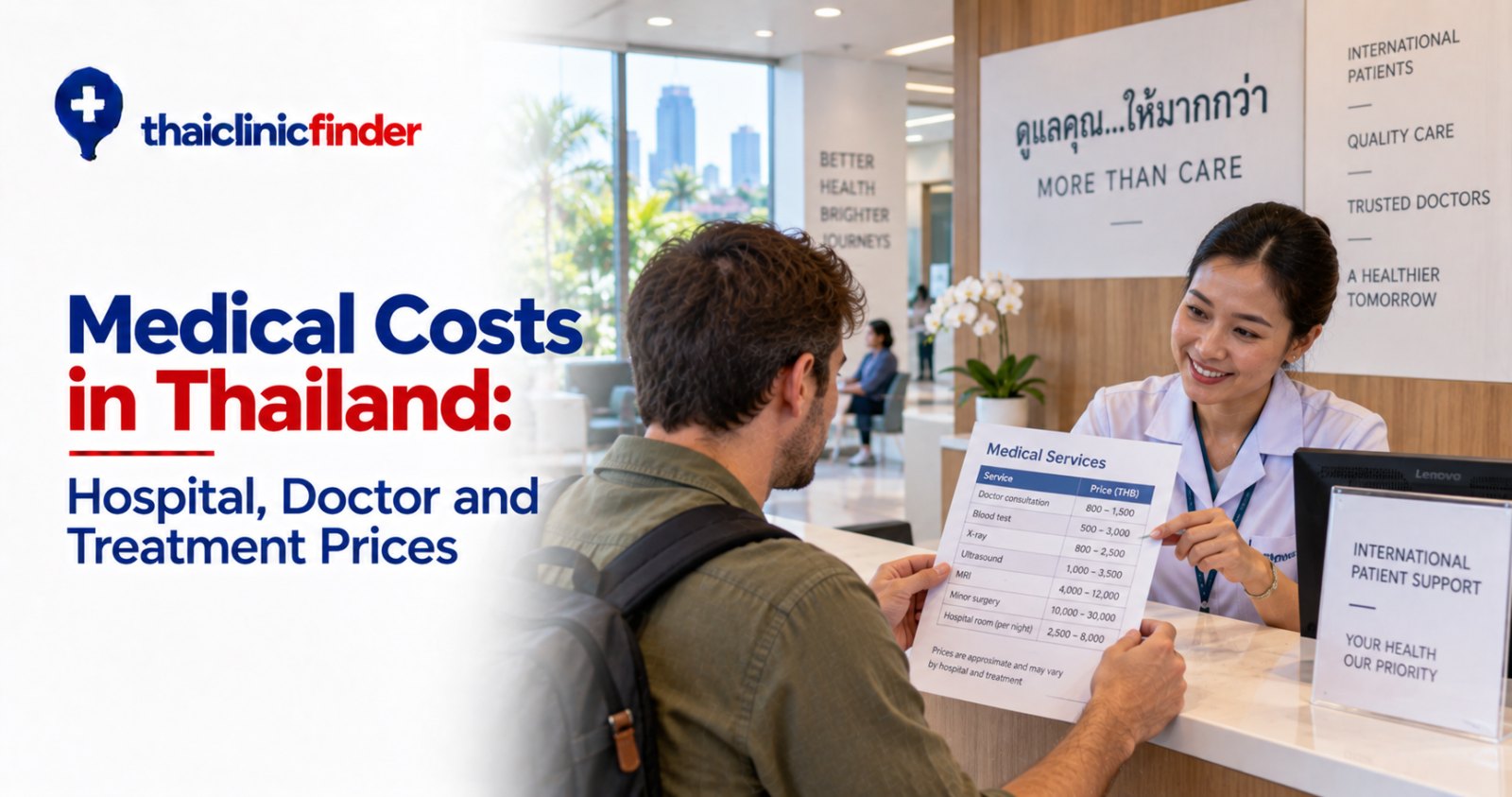
Medical costs in Thailand can be much lower than in countries such as the United States, but there is no single Thai healthcare price level. A consultation at a provincial government hospital, a specialist visit at a premium Bangkok private hospital and an elective surgical package are completely different markets.
For foreigners paying themselves, the biggest factor is usually where you receive treatment. Thailand has a large public hospital network alongside private hospitals ranging from local facilities to major international medical centers.
The Ministry of Public Health publishes a dedicated schedule of healthcare service rates for foreign patients treated at facilities under the Ministry, while private hospitals generally set their own fees and package prices.
Current 2026 private-hospital examples show the range clearly. Bangkok Hospital Headquarter advertises health-check packages from THB 5,500, more extensive screening programs costing tens of thousands of baht, and procedures such as colonoscopy at THB 30,000. Major surgery can easily move into six figures.
The useful question is therefore not simply, "Is healthcare cheap in Thailand?" It is what type of care do you need, at which hospital, and what exactly is included in the quotation?
Thailand does not have one medical price list
Thailand's healthcare market is divided into several systems.
A patient might receive care through:
- a Ministry of Public Health hospital
- a university hospital
- another government hospital
- a local private hospital
- a premium private hospital
- a specialist clinic
- a dental clinic
Prices can be very different even within the same city.
Government hospitals generally operate at lower price levels, but waiting times can be longer and English-language coordination may be more limited.
Private hospitals generally offer easier appointments, shorter waits, international patient departments and more English-language services, but the patient pays considerably more for that convenience.
For an explanation of the two systems, see How Healthcare Access Works in Thailand for Visitors and Residents.
Public hospitals have official rates for foreign patients
The Ministry of Public Health maintains a specific healthcare service fee manual for foreign patients at facilities under its authority.
The latest published manual is the B.E. 2568 schedule, released in 2026.
This is important because foreigners should not automatically assume that the price paid by a Thai citizen under a public healthcare entitlement is the price they will pay as a self-paying foreigner.
Public hospitals can still be substantially less expensive than high-end private hospitals, but billing depends on:
- the service provided
- patient eligibility
- hospital type
- medicines
- laboratory tests
- imaging
- inpatient care
Foreign residents covered through an eligible Thai insurance or employment scheme may follow different payment arrangements from tourists paying entirely out of pocket.
Private hospital prices can vary enormously
Private healthcare is not one homogeneous category either.
A neighborhood private hospital can be much less expensive than a flagship international hospital in central Bangkok.
At the upper end, major private hospitals offer:
- multilingual coordinators
- international insurance billing
- premium rooms
- advanced imaging
- specialist centers
- complex surgery
- executive health screening
These services make Thailand attractive for medical tourism, but they also mean that someone expecting universally low Asian healthcare prices can receive a surprisingly large bill.
Always ask for an estimate before non-emergency treatment.
How much is a medical check-up in Thailand?
Health screening provides one of the easiest ways to see current Thai private hospital pricing because many hospitals publish complete packages.
Bangkok Hospital Headquarter's 2026 health-check programs currently include:
| Health check | Published 2026 price |
|---|---|
| Essence package for people under 30 | THB 5,500 |
| Mid-range age-based programs | Around THB 13,500 to THB 35,000 |
| Ultimate male check-up | THB 40,000 |
| Ultimate female check-up | THB 43,000 |
| CEO-level programs | Up to approximately THB 129,000 to THB 135,000 |
The THB 40,000 and THB 43,000 Ultimate packages include extensive laboratory testing, imaging and specialist screening rather than a simple doctor consultation.
This illustrates why comparing a basic check-up with a premium executive screening package is not meaningful unless you compare what tests are included.
Diagnostic procedures can quickly increase the bill
Laboratory tests and imaging are often relatively affordable individually, but a specialist investigation involving multiple procedures can become expensive.
One current Bangkok Hospital example is gastrointestinal endoscopy.
Its 2026 fly-in patient prices include:
| Procedure | Published price |
|---|---|
| Sigmoidoscopy | THB 20,000 |
| Gastroscopy | THB 22,500 |
| Colonoscopy | THB 30,000 |
| Gastroscopy + sigmoidoscopy | THB 41,000 |
| Gastroscopy + colonoscopy | THB 44,000 |
Those packages include the doctor fee for performing the procedure, but the hospital states that some costs such as anesthesiology, biopsy, additional laboratory work and medication can be extra.
This is a useful example of why the words package price do not necessarily mean final bill.
Cancer screening can cost tens of thousands of baht
Advanced screening is considerably more expensive than a routine blood test.
Current programs at Bangkok Cancer Hospital Wattanosoth range from approximately THB 46,200 to THB 82,800, depending on the package and tests included.
Higher-level packages can incorporate investigations such as:
- tumor markers
- ultrasound
- mammography
- low-dose CT
- gastroscopy and colonoscopy
- PET/CT in selected packages
These are screening packages rather than cancer-treatment prices.
Once surgery, chemotherapy, radiation or targeted medicines are involved, costs can be far higher and need an individualized treatment quotation.
For that subject, see Cancer Treatment in Thailand.
Surgery often moves into six figures
Elective private surgery is where costs commonly exceed THB 100,000.
Published Thai hospital prices from our procedure-specific guides provide several useful examples:
- full tummy tuck at Yanhee for a patient under 70 kg: around THB 126,000
- rhinoplasty procedures: from relatively simple augmentation to well above THB 100,000 for more complex structural surgery
- gynecomastia surgery: approximately THB 71,000 to THB 106,000 in current Yanhee packages
- combined upper and lower blepharoplasty at Bangkok Hospital: approximately THB 98,000
The important point is that surgery prices depend on much more than the name of the operation.
Costs can change according to:
- surgeon
- anesthesia
- operating room
- implant or device
- complexity
- hospital nights
- pathology
- medication
- postoperative care
For elective procedures, see Plastic Surgery Cost in Thailand for more detailed examples.
Emergency care is harder to price in advance
Emergency medical costs cannot be reduced to a simple tariff because the bill depends on what happens after arrival.
A minor wound requiring cleaning and medication is very different from:
- CT imaging after a motorbike crash
- emergency surgery
- intensive care
- cardiac treatment
- ambulance transfer
Thailand's emergency medical number is 1669 for situations requiring urgent ambulance and emergency medical assistance.
Private hospitals may also operate their own ambulances. One current Bangkok Hospital promotion, for example, lists an emergency ambulance transport fee of THB 500 per trip, while explicitly stating that this covers transport only and does not include treatment or other medical expenses.
That promotional price should not be treated as a nationwide ambulance tariff.
For emergencies, treatment needs come before price comparison. See Medical Emergencies in Thailand: Numbers and Practical Steps.
Hospital admission can change the cost very quickly
Being admitted overnight introduces several possible charges beyond the doctor's fee.
A private hospital bill can include:
- room
- nursing
- specialist visits
- medication
- laboratory testing
- imaging
- medical supplies
- operating room
- anesthesia
- intensive care when required
Room choice can also matter. Private hospitals may offer anything from conventional rooms to premium suites.
For planned surgery, ask whether the package includes a fixed number of hospital nights and what happens if the doctor keeps you admitted longer.
For unplanned hospitalization, insurance becomes much more important because costs can escalate quickly.
Dental care follows its own market
Dental treatment is often one of the reasons foreigners actively seek healthcare in Thailand.
Prices vary according to procedure, materials and whether treatment is performed in a dental hospital, private clinic or specialist center.
A basic cleaning cannot be compared with:
- root canal treatment
- dental implants
- crowns
- veneers
- full-mouth rehabilitation
For major work, request a treatment plan showing each stage separately.
Our guide to How to Compare Dental Clinics in Thailand explains how to compare qualifications, materials and quotations rather than choosing solely by headline price.
Medication is a separate cost category
Medicine prices in Thailand also vary substantially.
The amount you pay can depend on:
- original brand versus generic
- hospital pharmacy versus community pharmacy
- imported versus locally manufactured medicine
- pack size
- regulated medicine category
Hospital medication can be only one part of a larger outpatient bill, while common generic medicines purchased through legitimate pharmacies may be considerably cheaper.
Medication pricing deserves its own comparison because it can otherwise distort a general healthcare-cost guide. This article therefore focuses on the broader medical system rather than attempting to reproduce a pharmacy price list.
Maternity costs depend heavily on the hospital
Pregnancy care can involve separate charges for:
- prenatal consultations
- ultrasound
- laboratory testing
- genetic screening
- delivery
- anesthesia
- hospital accommodation
- neonatal care
Normal delivery and cesarean packages at private hospitals can differ substantially according to hospital and room category.
High-risk pregnancy or neonatal intensive care can increase costs far beyond the standard delivery package.
When comparing maternity hospitals, look at clinical capability as well as price, especially access to obstetrics specialists and neonatal intensive care when needed.
Foreigners should distinguish self-pay from insured prices
A traveler paying directly and an expat with international insurance may receive the same clinical service but have very different financial experiences.
Private hospitals commonly work with international insurers, but direct billing is not guaranteed.
Before treatment, determine whether:
- the hospital is in your insurer's network
- pre-authorization is required
- you need to pay first and claim later
- outpatient care is included
- there is a deductible
- there is a co-payment
- pre-existing conditions are excluded
For long-term residents, see How to Choose Health Insurance in Thailand.
Public care is cheaper, but private care can be easier for travelers
For a tourist with a non-urgent problem, choosing between a government and private hospital often involves a trade-off.
A government hospital may offer:
- lower self-pay costs
- strong clinical expertise
- extensive specialist departments
A large private hospital may offer:
- easier English communication
- shorter waiting times
- international patient coordination
- clearer package pricing
- easier insurance administration
Neither option is automatically better in every situation.
For a minor illness, a local clinic may be sufficient. For complicated care, the relevant specialist department matters much more than lobby design or hospital brand.
Bangkok tends to have the widest price range
Bangkok contains everything from major public teaching hospitals to some of Southeast Asia's most internationally oriented private hospitals.
As a result, both relatively inexpensive and very expensive care can be found in the same city.
Phuket, Pattaya and Chiang Mai also have substantial private healthcare markets catering to foreign residents and travelers.
On islands and in smaller provinces, the initial cost may be modest at a local clinic, but a serious condition can require transfer to a larger hospital.
This is one reason travel insurance should include appropriate medical transport and evacuation provisions when traveling to remote areas.
Why two hospitals can quote very different prices
A cheaper quote is not necessarily for the same product.
Before comparing two estimates, check whether both include:
- doctor fees
- hospital fees
- anesthesia
- laboratory tests
- imaging
- implants or devices
- medication
- pathology
- hospital accommodation
- postoperative appointments
One hospital may advertise a procedure-only fee while another quotes an all-inclusive package.
Without comparing inclusions, the lower headline number can be misleading.
Ask for a written estimate before planned treatment
For non-emergency care, request a written quotation.
Useful questions include:
- What is included?
- What is excluded?
- Are doctor fees separate?
- Are medications included?
- Is anesthesia included?
- How many hospital nights are covered?
- What happens if complications require a longer stay?
- Are follow-up appointments included?
For expensive treatment, ask whether the estimate is fixed or only indicative.
Unexpected medical findings can change the final cost even when the original estimate was accurate.
Do foreigners pay more in Thailand?
There is no simple nationwide rule that every foreigner pays the same percentage more than a Thai patient.
However, foreigners can encounter different financial arrangements because:
- Thai citizens may have public healthcare entitlements
- foreigners may be self-paying
- government facilities maintain specific foreign-patient service rates
- private hospitals set their own pricing
- some promotions are limited to Thai nationals
For example, Bangkok Hospital's 2026 Thai-language health-check page explicitly notes that certain promotional prices apply only to Thai customers, while it provides separate international-customer contact arrangements.
Always confirm whether an advertised package is available to foreign patients before relying on the price.
How much money should a traveler budget for healthcare?
There is no sensible single emergency budget because severe illness can generate bills far beyond what most travelers would want to self-finance.
For routine outpatient care, many travelers can comfortably self-pay.
For scenarios involving:
- surgery
- hospitalization
- intensive care
- cancer treatment
- major trauma
- medical evacuation
insurance becomes much more important.
The financially sensible approach is not to carry enough cash for every possible medical problem. It is to have appropriate insurance and access to a payment method for deductibles or initial deposits.
Thailand can be affordable without being universally cheap
Thailand's reputation for affordable healthcare is justified in many contexts, particularly compared with high-cost healthcare markets.
But the phrase cheap healthcare in Thailand can create the wrong expectation.
Premium private hospitals can charge substantial amounts, and complex treatment remains expensive even when it is cheaper than an equivalent procedure elsewhere.
A better way to think about the market is:
- public hospitals: generally lower-cost
- conventional private hospitals: moderate to high cost
- premium international hospitals: higher cost but greater convenience and international services
- elective packages: often transparent, but check exclusions
- major or unpredictable illness: potentially expensive anywhere
The practical answer
Medical costs in Thailand vary dramatically according to hospital type and treatment complexity.
At a major Bangkok private hospital, current 2026 published examples range from THB 5,500 for an entry-level health screening package to THB 30,000 for a colonoscopy and THB 40,000 or more for extensive executive screening. Elective operations commonly move above THB 100,000, while major hospitalization and complex treatment can cost substantially more.
Public hospitals generally operate at lower cost and the Ministry of Public Health maintains an official service-fee schedule specifically for foreign patients.
For foreigners, the safest approach is to decide first whether you need public or private care, obtain a written quotation for planned treatment, check exactly what a package includes and use adequate insurance for costs that would be difficult to pay out of pocket.
Frequently Asked Questions
Is healthcare expensive in Thailand?
Healthcare can be relatively affordable in Thailand, particularly in government hospitals, but premium private hospitals and complex treatment can be expensive. The final cost depends heavily on the facility and type of care.
How much does a medical check-up cost in Thailand?
Current 2026 Bangkok Hospital packages start around THB 5,500 for a basic age-based screening program and rise to THB 40,000 or more for extensive health checks. Executive programs can cost considerably more.
How much does a colonoscopy cost in Thailand?
Bangkok Hospital Headquarter currently lists a 2026 colonoscopy package at THB 30,000 for fly-in patients. Additional anesthesiology, biopsy, laboratory work or medication can be charged separately.
Are public hospitals cheaper than private hospitals in Thailand?
Generally yes. Government hospitals usually operate at lower prices, while private hospitals charge more for convenience, shorter waits, international services and premium facilities.
Do foreigners pay more for healthcare in Thailand?
Foreign patients can face different rates because Thai citizens may use public healthcare entitlements and the Ministry of Public Health publishes specific foreign-patient service rates. Private hospital promotions can also have nationality-specific conditions.
How much does surgery cost in Thailand?
It varies by procedure. Many elective private surgeries cost more than THB 100,000, although simpler procedures can cost less. Surgeon fees, anesthesia, hospital stay, implants and procedure complexity all affect the total.
Do I need health insurance in Thailand?
Insurance is particularly valuable for hospitalization, surgery, serious illness, trauma and medical evacuation. Routine outpatient visits may be affordable to self-pay, but major hospital bills can be substantial.
Are hospital package prices the final price?
Not always. Packages may exclude specialist consultations, anesthesia, medication, pathology, additional tests or extra hospital nights. Check the inclusions and exclusions before treatment.
Is medical treatment cheaper in Bangkok or outside Bangkok?
Location alone does not determine price. Bangkok has both low-cost public hospitals and premium international hospitals, giving it the widest price range. Smaller cities can be cheaper, but specialist services may be more limited.
Sources
Writer
Niran Chaiyasit
Niran Chaiyasit is a Thai health writer with a background in public health and a focus on travel health, disease prevention and healthcare access in Thailand. His work covers topics such as common illnesses, vaccinations, mosquito-borne diseases, food safety and practical health information for travelers and expatriates.

Medical review
Justin Brooks
Daniel Brooks is an American health writer with a background in health sciences and a focus on rehabilitation, musculoskeletal health and patient education. He writes about physiotherapy, injury recovery, pain management, preventive health and practical healthcare guidance for international patients and travelers.