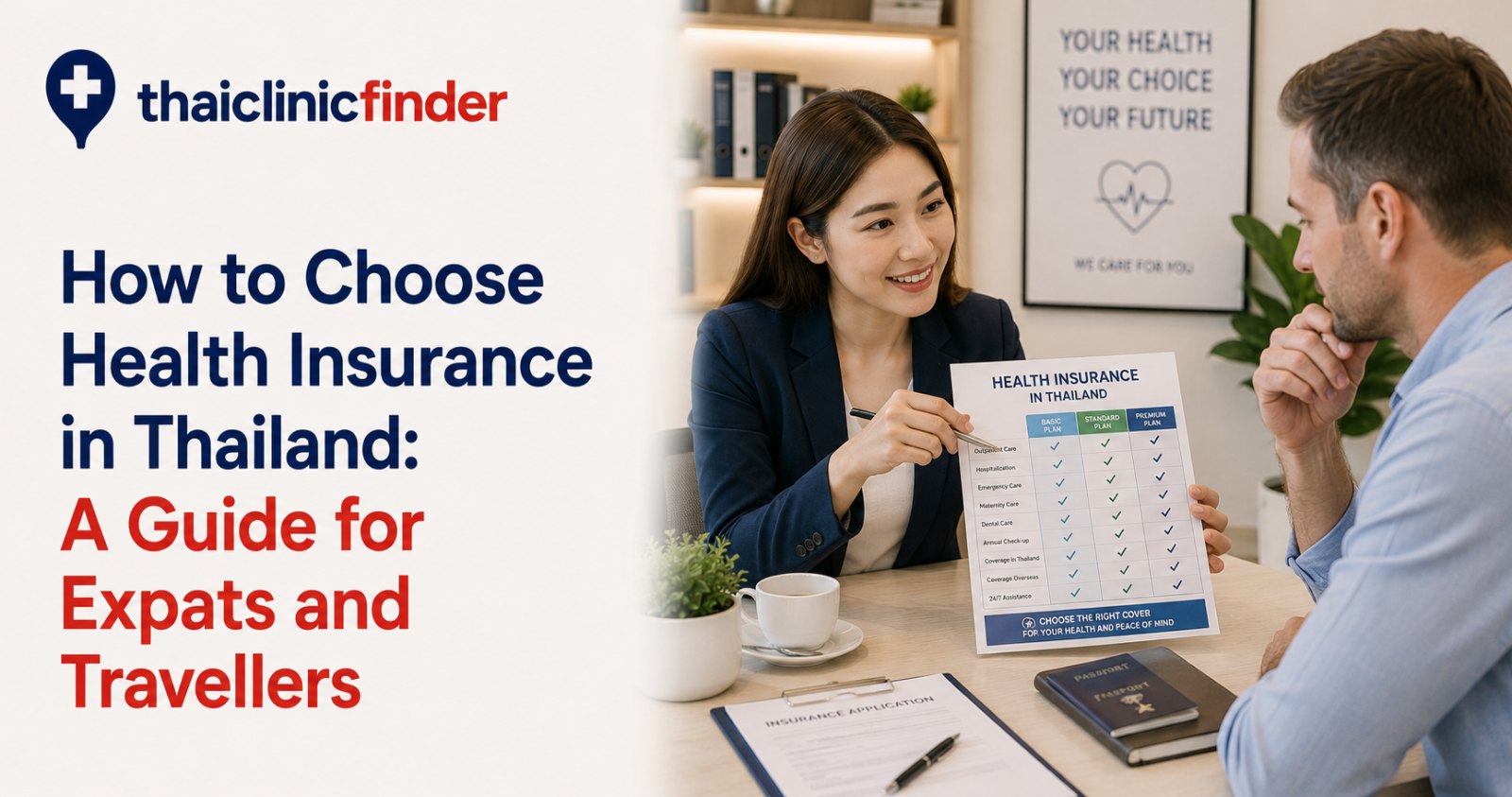
Health insurance in Thailand can range from short-term travel policies to comprehensive international medical plans designed for people who live in the country for years. The right policy depends on how long you will stay, where you expect to receive treatment and how much financial risk you are comfortable carrying yourself.
For international residents, the cheapest premium is rarely enough information to compare plans properly. Two policies with similar prices can have very different annual limits, hospital networks, deductibles, exclusions and rules for pre-existing conditions.
This guide explains what to check when choosing health insurance in Thailand and how to compare policies without assuming that one type of plan is suitable for everyone.
Start with your status in Thailand
Your insurance needs depend partly on why you are in Thailand.
A tourist visiting for two weeks may only need travel insurance with emergency medical cover. Someone living in Bangkok or Phuket for most of the year may need a broader policy that covers routine outpatient care, specialist treatment and hospital admission. A foreign employee may also have access to employment-related healthcare coverage through Thailand's Social Security system or an employer plan.
Being resident in Thailand does not automatically mean that every public healthcare service is available to you without charge. Coverage depends on your employment, registration and insurance status.
Before buying a private policy, check whether you already have employer coverage, Social Security benefits or another health plan that could overlap with what you are considering.
Local insurance versus international health insurance
One of the first decisions is whether to choose a Thailand-based insurance policy or an international health insurance plan.
A local policy is generally designed primarily for treatment in Thailand. It may offer access to a network of Thai hospitals and can be more focused on domestic healthcare costs.
International policies may cover treatment in several countries and can be more suitable for people who move regularly, divide their time between countries or want access to treatment outside Thailand.
Neither model is automatically better. Compare the geographical area of cover carefully.
Ask:
- Is treatment covered only in Thailand?
- Is Southeast Asia included?
- Is worldwide treatment covered?
- Is the United States included or excluded?
- Is emergency treatment abroad covered?
- What happens if I permanently move to another country?
Worldwide coverage can substantially affect the premium, particularly when the United States is included.
Check the annual coverage limit
The annual maximum is one of the most important figures in a health insurance policy.
This is the maximum amount the insurer will normally pay for covered treatment during the policy year, subject to the terms and sub-limits of the plan.
A policy with a high headline annual limit can still have much lower limits for particular services. Look for sub-limits on areas such as:
- hospital room charges
- intensive care
- cancer treatment
- kidney dialysis
- outpatient consultations
- diagnostic imaging
- rehabilitation
- mental health care
- dental treatment
- maternity care
Do not compare policies using the annual maximum alone. Read the benefit schedule and exclusions together.
Understand inpatient and outpatient cover
Inpatient cover generally applies when you are formally admitted to hospital. It can include hospital accommodation, surgery, medical fees, diagnostic tests and other treatment associated with the admission, depending on the policy.
Outpatient cover usually applies to consultations and treatment where you are not admitted overnight.
Outpatient cover can increase the premium, so some residents choose comprehensive inpatient insurance and pay for routine doctor visits themselves.
Whether that makes sense depends on your health, budget and expected use of healthcare.
Ask whether outpatient benefits have:
- an annual maximum
- a per-visit limit
- a co-payment
- a deductible
- restrictions on specialist consultations
- prescription medication limits
If you expect regular follow-up for a chronic condition, outpatient restrictions can make a significant difference to the practical value of the policy.
Check the hospital network
An insurance policy can be generous on paper but inconvenient if the hospitals you want to use are outside its network.
Before buying, ask the insurer for its current hospital network in Thailand. Check the exact hospitals and branches that matter to you rather than relying on a statement such as extensive nationwide network.
If you live in Bangkok, check hospitals near your home and workplace. If you live in Phuket, Pattaya, Chiang Mai, Koh Samui or another city, make sure the plan has practical options there too.
Also ask what happens if you use a hospital outside the network. You may still be covered but have to pay first and request reimbursement, or different benefit limits may apply.
Hospital networks can change, so confirm important providers directly with the insurer before buying or renewing the policy.
Direct billing can make a major difference
Direct billing means the hospital coordinates payment with the insurer rather than requiring you to pay the entire medical bill yourself and claim reimbursement later.
Some major Thai hospitals have international insurance departments and direct billing arrangements with multiple insurers. However, a hospital having a relationship with an insurer does not guarantee that your specific policy or treatment qualifies for direct billing.
For planned treatment, the hospital may need a guarantee of payment or pre-authorisation before the insurer agrees to pay directly.
Ask both the insurer and hospital:
- Is direct billing available for my policy?
- Is it available for outpatient treatment?
- Is it limited to hospital admissions?
- Is pre-authorisation required?
- Do I need to pay a deposit?
- What expenses remain my responsibility?
For a major admission, direct billing can reduce the amount of money you need to provide upfront.
Understand deductibles
A deductible is an amount you pay yourself before the insurer begins paying eligible expenses according to the policy terms.
For example, a policy with a substantial annual deductible can have a much lower premium because you are agreeing to cover smaller medical expenses yourself.
This structure can make sense for someone who mainly wants protection against major hospital bills and is comfortable paying routine healthcare costs directly.
Check whether the deductible applies:
- once per year
- per medical condition
- per hospital admission
- separately to outpatient and inpatient treatment
Do not assume that all policies calculate deductibles in the same way.
Check co-payments as well
A co-payment means you pay a percentage or fixed part of a covered medical expense even after the insurer accepts the claim.
A policy might, for example, cover a percentage of outpatient care while requiring you to pay the remainder. The exact arrangement varies by insurer and plan.
Co-payments can keep premiums lower, but they also mean that a high-cost hospital admission may still leave you with a significant personal bill.
When comparing policies, look at the maximum amount you might realistically need to pay yourself in a serious medical year, not only the monthly premium.
Pre-existing conditions are critical
Pre-existing conditions are one of the most important areas to clarify before buying health insurance.
Insurers may exclude an existing condition, charge a higher premium, impose a waiting period, limit related benefits or decline coverage depending on their underwriting rules.
Complete medical declarations accurately. Failing to disclose relevant information can create problems when you later make a claim.
Ask the insurer to confirm any exclusions in writing. Do not rely only on a salesperson saying that a condition should be fine.
If a condition is excluded, ask what the exclusion actually covers. A broad exclusion may include complications, tests or treatment related to the underlying condition, not just the original diagnosis itself.
Check waiting periods
Some benefits do not start immediately when the policy begins.
Waiting periods can apply to services such as:
- maternity care
- some chronic conditions
- particular surgeries
- dental treatment
- health screening
- certain pre-existing conditions accepted under special terms
Read the policy wording before assuming that a benefit listed in the brochure is immediately available.
A waiting period is particularly important if you are buying insurance because you already expect to need treatment soon.
Emergency medical cover
Every traveller and international resident should understand how their policy handles medical emergencies.
Check whether emergency treatment is covered both inside and outside the insurer's normal hospital network. Also ask what happens if you are unconscious or otherwise unable to contact the insurer before treatment begins.
For a life-threatening emergency in Thailand, do not delay necessary medical care while trying to obtain routine insurance authorisation. Thailand's National Institute for Emergency Medicine lists 1669 as the emergency medical services number.
Thai Clinic Finder's guide to medical emergencies in Thailand explains the main emergency numbers and practical steps.
After emergency treatment begins, contact the insurer as soon as reasonably possible and keep all medical and payment documentation.
Emergency evacuation and repatriation
Emergency evacuation can be important if you spend time on islands, in remote areas or in countries where the required medical treatment is not available locally.
Check whether the policy covers medically necessary transfer to another hospital, another city or another country.
Also distinguish medical evacuation from repatriation. These terms can refer to different benefits and conditions under the policy.
Ask who decides whether evacuation is medically necessary. Insurance policies commonly require the insurer or its medical assistance service to approve and coordinate an evacuation rather than allowing the patient to choose an international transfer independently.
Cancer and other high-cost treatment
Long-term treatment for cancer, kidney disease or another serious condition can produce costs very different from a routine hospital admission.
Check whether the policy has specific sub-limits for:
- chemotherapy
- radiotherapy
- targeted cancer medicines
- dialysis
- organ transplantation
- rehabilitation
- home nursing
Do not assume that a large annual maximum means every treatment is covered up to that amount.
Policy exclusions and sub-limits become particularly important for treatments that continue for months or years.
Mental health coverage
Mental health benefits vary widely between insurers.
Some policies include psychiatric inpatient treatment but little or no outpatient psychotherapy. Others place annual limits on counselling, psychology or psychiatric consultations.
If mental health care matters to you, check specifically for:
- psychiatry consultations
- psychology
- psychotherapy or counselling
- psychiatric medication
- inpatient psychiatric treatment
- annual session or monetary limits
Do not assume that mental health treatment is included simply because the policy describes itself as comprehensive.
For healthcare options, see finding mental health support in Thailand.
Dental and optical benefits
Routine dental and optical care is often separate from the main medical policy or available only as an optional benefit.
Dental coverage may have low annual limits compared with the cost of major restorative treatment. Check whether it covers only routine care or includes treatment such as fillings, root canal therapy, crowns or emergency dental treatment.
Optical benefits may be limited to eye examinations or provide a fixed allowance for glasses or contact lenses.
If dental or optical cover adds significantly to the premium, compare the annual benefit with what you would realistically pay directly in Thailand.
Maternity coverage
Maternity is usually a specific benefit rather than something to assume is included in ordinary medical insurance.
Policies can have waiting periods, separate limits and conditions for routine pregnancy, delivery and complications.
If maternity coverage matters to you, check it before conception rather than waiting until pregnancy begins. A policy purchased after pregnancy starts may exclude the pregnancy entirely.
Ask separately about newborn coverage because the rules for adding a child to the policy can be time-sensitive.
Prescription medicines
Check whether outpatient prescription medication is covered and whether there are annual limits.
Some inpatient policies cover medicine provided during a hospital admission but do not cover regular outpatient prescriptions.
This distinction matters for people using long-term medication for conditions such as hypertension, diabetes, asthma or psychiatric disorders.
If you are travelling to Thailand with medication from abroad, insurance coverage is a separate issue from Thai import rules. Thai Clinic Finder's guide to bringing prescription medicines into Thailand explains what to check with the Thai FDA.
Travel insurance versus expat health insurance
Travel insurance and international medical insurance are designed for different situations.
Travel insurance usually focuses on unexpected events during a trip, such as emergency medical treatment, cancellation, lost luggage or evacuation. It may not be designed for routine healthcare, long-term treatment or chronic conditions.
Expat or international health insurance is generally designed for ongoing healthcare while living abroad and may include regular consultations, planned hospital treatment and long-term follow-up depending on the plan.
A traveller staying for two weeks and an expatriate living in Thailand for three years therefore have different insurance needs.
Check maximum trip duration carefully. Some travel policies stop covering you once a trip exceeds a specified length even if the overall policy remains active.
Insurance requirements for Thai visas
Do not assume that every Thai visa requires health insurance or that one insurance requirement applies to every immigration category.
Some visa types and long-stay arrangements have specific insurance requirements, while others do not. Rules can also change.
If insurance is required for your immigration status, check the current requirements with the relevant Thai government authority or official visa information before buying a policy specifically for that purpose.
A policy that provides good medical coverage does not automatically satisfy a particular immigration requirement, and a policy that satisfies a visa requirement is not automatically the best health insurance for your personal needs.
Check the renewal rules
For long-term residents, renewal conditions can matter more than the first-year premium.
Ask whether the policy is guaranteed renewable and under what circumstances premiums can change. Age-related increases are common in health insurance, and insurers may also adjust pricing across a product portfolio.
Check the maximum entry age and whether there is an age at which coverage ends.
A low-priced policy today may become significantly more expensive later, so long-term residents should look beyond the first-year quote.
Understand exclusions before buying
Every health insurance policy contains exclusions.
Common areas that may be excluded or restricted include elective cosmetic treatment, routine dental care, fertility treatment, some pre-existing conditions and treatment that the insurer considers medically unnecessary. The exact exclusions differ between policies.
Do not rely on summaries alone. Read the full policy wording before buying, particularly sections covering exclusions, waiting periods, claim requirements and definitions.
If something important is unclear, ask the insurer to explain it in writing.
How to compare two health insurance policies
When comparing policies, use the same criteria for each one.
A practical comparison can include:
- annual coverage maximum
- geographic area of cover
- inpatient benefits
- outpatient benefits
- deductible
- co-payment
- hospital network in Thailand
- direct billing
- pre-existing condition exclusions
- waiting periods
- cancer and chronic disease limits
- mental health benefits
- dental and optical cover
- maternity benefits if relevant
- emergency evacuation
- renewal conditions
- maximum coverage age
- monthly or annual premium
This provides a much clearer comparison than choosing from premium alone.
Questions to ask before buying health insurance in Thailand
Before accepting a policy, ask:
- Which hospitals in Thailand are in the network?
- Can I use direct billing at those hospitals?
- What is the annual maximum?
- Are there treatment-specific sub-limits?
- What deductible applies?
- Is there a co-payment?
- Are my existing medical conditions covered or excluded?
- What waiting periods apply?
- Is outpatient treatment included?
- Are prescription medicines covered?
- Is mental health treatment covered?
- Is emergency evacuation included?
- What happens when I travel outside Thailand?
- Is the policy guaranteed renewable?
- How does the premium change with age?
- What documents are required when making a claim?
Ask for the policy wording and benefit schedule before paying rather than relying only on a sales summary.
Using insurance at a hospital in Thailand
Before planned treatment, contact both the insurer and the hospital if you intend to use direct billing.
Bring your insurance card or policy information and identification. Some treatment requires pre-authorisation or a guarantee of payment before the hospital can bill the insurer directly.
You can still be responsible for deductibles, co-payments, excluded treatment or expenses above policy limits.
For more detail on appointments and hospital access, see how healthcare access works in Thailand for visitors and residents and what to check before a medical appointment in Thailand.
Conclusion
Choosing health insurance in Thailand is mainly about understanding what financial risks you want the insurer to cover. Start with the annual limit, hospital network, inpatient and outpatient benefits, deductible and exclusions, then look at direct billing, emergency evacuation and long-term renewal conditions.
Travellers should check that the policy remains valid for the full trip and provides adequate emergency medical cover. Long-term residents should pay particular attention to pre-existing conditions, chronic treatment, age-related premium increases and whether the policy remains suitable if they later move outside Thailand.
Before buying, obtain the full policy wording and confirm any important coverage point directly with the insurer. Hospital networks, policy terms and immigration-related insurance requirements can change.
Frequently Asked Questions
Do expats need health insurance in Thailand?
The answer depends on the person's immigration, employment and healthcare status. Many international residents use private or international health insurance, while some foreign employees may have access to Thai Social Security or employer-provided benefits.
Is travel insurance enough for living in Thailand?
Travel insurance is generally designed for temporary trips and unexpected events rather than long-term routine healthcare. Check maximum trip duration, chronic-condition exclusions and whether planned outpatient care is covered before relying on it for an extended stay.
How much health insurance coverage should I have in Thailand?
There is no single appropriate amount for everyone. Compare the annual maximum with sub-limits, deductibles and the types of hospitals you expect to use rather than selecting a policy from one headline coverage figure.
Can hospitals in Thailand bill my insurer directly?
Some hospitals have direct billing arrangements with insurers, but availability depends on the hospital, insurer, policy and treatment. Planned admissions may also require pre-authorisation or a guarantee of payment.
Are pre-existing conditions covered by health insurance in Thailand?
They may be covered, excluded or accepted under special conditions depending on the insurer and underwriting decision. Disclose relevant medical history accurately and obtain any exclusion or special terms in writing.
Does expat health insurance cover outpatient visits in Thailand?
Some plans include outpatient treatment while others offer it as an optional benefit or exclude it. Check annual or per-visit limits, co-payments and prescription medicine coverage.
Does health insurance in Thailand cover mental health treatment?
Coverage varies considerably. Check separately for psychiatric consultations, psychotherapy, medication and inpatient mental health treatment because these services can have their own limits.
Should I choose a local Thai policy or international health insurance?
A local plan may suit someone who expects to receive most care in Thailand, while international coverage can be more appropriate for people who travel or move between countries regularly. Compare geographical coverage, hospital networks, exclusions and renewal conditions.
Sources

Writer
Thai Clinic Finder Editorial Team
The editorial team checks public healthcare information against official provider and institutional sources. It does not provide medical advice.