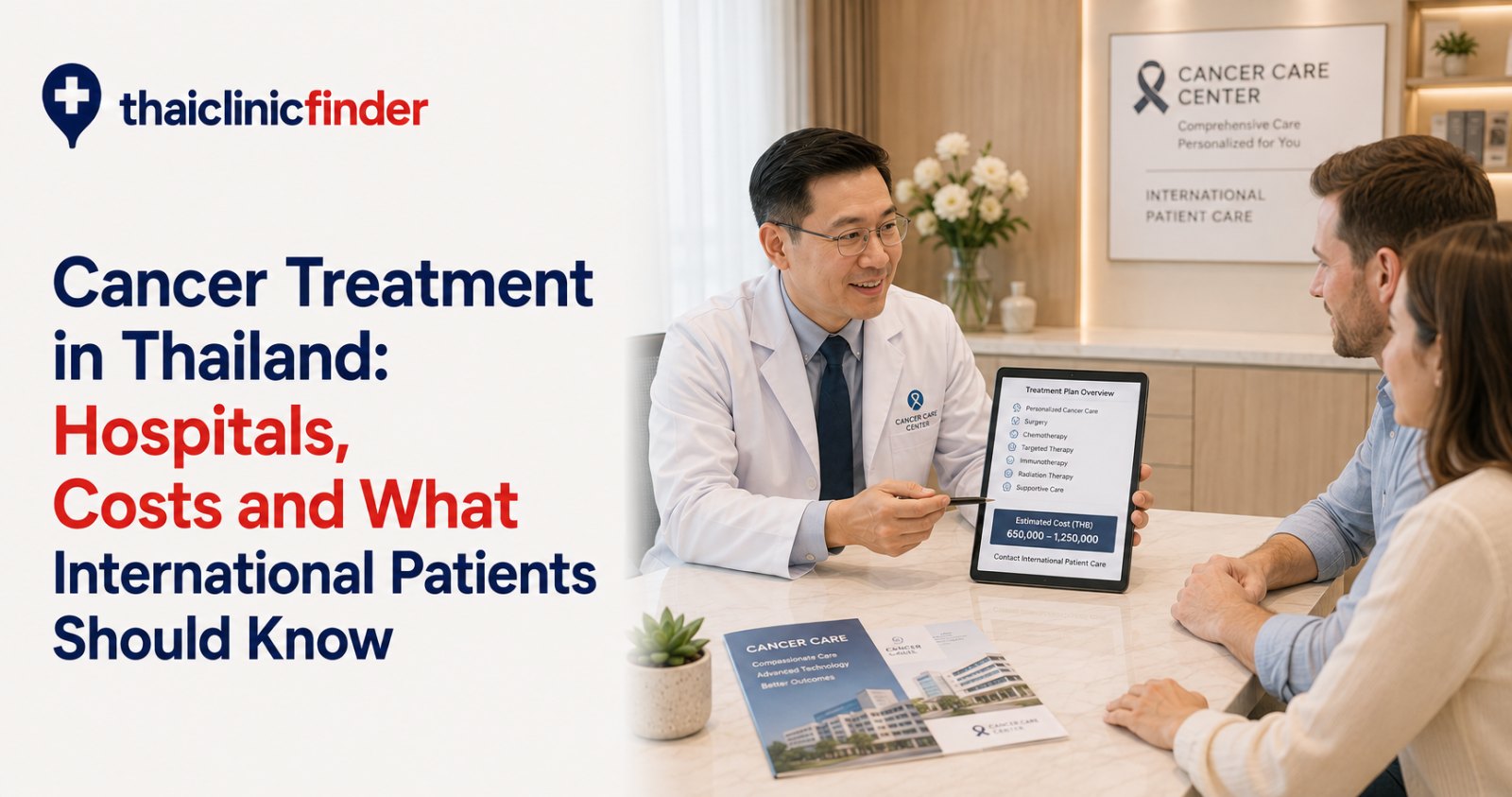
Cancer treatment in Thailand is available through dedicated cancer hospitals, oncology departments within general hospitals and specialist centres offering surgery, chemotherapy, radiotherapy and newer systemic treatments. Bangkok has the greatest concentration of comprehensive oncology services, although cancer care is also available in other parts of the country.
For international patients, the difficult part is rarely finding a hospital that treats cancer. It is working out whether the exact hospital can manage your type and stage of cancer, whether several specialties can coordinate treatment, what the complete treatment pathway may cost and how follow-up will work if you later leave Thailand.
This guide explains the practical side of cancer treatment in Thailand without ranking individual hospitals. The appropriate provider depends on the diagnosis, pathology, stage, previous treatment and services required.
The first question is not which hospital is biggest
Cancer is a broad group of diseases rather than one condition, so the relevant expertise can vary substantially.
A patient with early breast cancer may need breast imaging, pathology, surgery and possibly systemic treatment or radiotherapy. Someone with lymphoma may need haematology, specialised laboratory testing and systemic treatment. A patient with a liver tumour may require hepatobiliary surgery, interventional radiology, systemic treatment or another combination of services.
Before comparing hospitals, collect what is already known about the diagnosis:
- cancer type or suspected cancer type
- pathology report
- stage when known
- CT, MRI, PET or other imaging
- previous surgery
- chemotherapy or radiotherapy already received
- molecular, receptor or biomarker results when relevant
- current medications
- important medical conditions
Bangkok Hospital Udon, for example, specifically asks new oncology patients previously diagnosed elsewhere to prepare their pathology report and receptor or other special test results when available.
Look for a treatment pathway, not a single procedure
Cancer care often involves several specialties. The patient may move between medical oncology, surgical oncology, radiation oncology, pathology, radiology and supportive care during the same course of treatment.
Bangkok Cancer Hospital Wattanosoth describes its cancer care as multidisciplinary, and its Medical Oncology Center states that treatment plans are developed by specialist oncologists working with a multidisciplinary medical team. The hospital also publishes information about tumour board conferences used to discuss treatment choices.
Samitivej Sukhumvit's Oncology Clinic likewise publishes services across chemotherapy, targeted therapy, immunotherapy, radiotherapy, surgery, bone marrow transplantation and palliative care.
For an international patient, ask whether your case will be discussed by a multidisciplinary team when more than one treatment modality may be relevant.
Surgery can be the beginning rather than the end
Surgery remains central to treatment for many solid tumours, but the operation is often only one part of the plan.
Bangkok Cancer Hospital Wattanosoth's Specific Cancer Center states that surgery may be used together with treatments such as radiotherapy, chemotherapy and hormonal therapy.
Before agreeing to cancer surgery, ask:
- what operation is proposed
- whether surgery is intended to remove all visible disease or has another objective
- whether treatment is recommended before the operation
- what pathology will be performed afterwards
- whether lymph nodes or margins will be assessed
- whether chemotherapy, radiotherapy or another treatment is likely afterwards
- how long hospital admission is expected to last
A quotation for the operation alone may therefore underestimate the eventual cost of treatment.
Chemotherapy is no longer the only form of drug treatment
Medical oncology can involve several categories of systemic treatment.
Bangkok Cancer Hospital Wattanosoth currently publishes chemotherapy, hormone therapy, immunotherapy and molecular targeted therapy among its medical oncology services. Samitivej Sukhumvit also lists chemotherapy, targeted cancer therapy and cancer immunotherapy.
Which treatment is appropriate depends on the cancer type, stage, pathology and, in some cancers, molecular or receptor testing.
The cost can vary dramatically because some treatments involve relatively established chemotherapy medicines while targeted therapies and immunotherapies can be considerably more expensive.
If systemic treatment is recommended, ask for the exact drug names and expected number of cycles or treatment duration rather than requesting only a general chemotherapy price.
Radiotherapy deserves its own comparison
Radiotherapy is not one standard treatment delivered identically at every facility.
Different cancers can require different techniques, doses and numbers of treatment sessions. Treatment may be combined with chemotherapy or used before or after surgery.
Bangkok Cancer Hospital Wattanosoth publishes radiation therapy among its oncology services and operates oncology imaging and nuclear medicine services. Samitivej Sukhumvit also lists radiation among the treatment methods available through its oncology programme.
If radiotherapy is proposed, ask:
- which radiation technique is recommended
- where the treatment will physically be delivered
- how many sessions are expected
- whether planning scans are included
- whether chemotherapy will be given at the same time
- how side effects will be monitored
- whether treatment can continue elsewhere if you leave Thailand
The number of sessions is particularly important for medical travellers because treatment may require staying in Bangkok or another city for several weeks.
Proton therapy is not yet a routine option in Thailand
Patients researching advanced radiotherapy may encounter information about proton treatment in Thailand.
Bangkok Cancer Hospital announced the Bangkok Proton Center as a future service and states that it is expected to be ready for Thai and international patients by 2029.
That means it should not currently be presented as an available treatment option in Thailand in 2026.
If a particular technology is important to your treatment decision, confirm that it is operational and clinically available now rather than relying on announcements about future facilities.
Pathology can change everything that follows
A cancer treatment plan depends heavily on confirming what tumour is present.
If the diagnosis was made outside Thailand, the receiving hospital may ask to review the pathology report and sometimes the original slides or tissue blocks.
Additional pathology can include immunohistochemistry, receptor testing or molecular testing when relevant. These results can affect whether surgery, chemotherapy, targeted treatment, immunotherapy or another approach is considered.
Before travelling, ask whether the Thai oncology team wants:
- the pathology report
- pathology slides
- paraffin tissue blocks
- imaging discs or digital files
- molecular test reports
- operative records
Do not assume that sending a photograph of a translated pathology summary will be sufficient for major treatment decisions.
Where can international patients seek cancer treatment in Thailand?
Thailand has both public and private cancer services. For international patients seeking private care, several hospitals publish detailed English-language oncology information.
Bangkok Cancer Hospital Wattanosoth
Bangkok Cancer Hospital Wattanosoth is a dedicated cancer hospital within the Bangkok Hospital network. Its official address is 2 Soi Soonvijai 7, New Petchburi Road, Huaykwang, Bangkok 10310, Thailand.
The hospital publishes medical oncology, surgical oncology, diagnostic imaging, nuclear medicine, chemotherapy, targeted treatment, immunotherapy and haematology services.
This is a hospital, not simply an outpatient cancer clinic.
Samitivej Sukhumvit Oncology Clinic
Samitivej Sukhumvit operates an Oncology Clinic in Building 1 of Samitivej Sukhumvit Hospital in Bangkok.
Its official oncology page publishes chemotherapy, targeted treatment, immunotherapy, diagnostic imaging, biopsy, pain management, palliative care and other cancer-related services.
The page also states that the hospital has a multilingual team. International patients should still confirm the language of the exact oncologist and appointment rather than assuming that every staff member provides care in English.
These providers are included as verifiable examples of cancer services in Thailand. They are not a Thai Clinic Finder ranking or recommendation.
Bangkok has the broadest choice, but treatment exists beyond Bangkok
Cancer care is not limited to the capital.
Bangkok Hospital Udon, for example, publishes an oncology department treating adult solid tumours and haematological cancers with surgery, chemotherapy and targeted therapy. It states that radiotherapy is arranged through specialised partner networks rather than delivered entirely within the department.
In July 2026, Bangkok Hospital Group also announced the opening of the Bangkok-Phuket Cancer Institute, integrating cancer services within its Phuket network.
These examples show why patients should check where every part of their treatment will actually occur. A hospital may provide chemotherapy locally while referring radiotherapy to another facility.
For someone needing several months of treatment, that logistical difference can be important.
Cancer treatment costs in Thailand are rarely one number
There is no meaningful national average for cancer treatment in Thailand.
The cost of a consultation and diagnostic work-up is fundamentally different from the cost of major cancer surgery, several weeks of radiotherapy or months of immunotherapy.
A complete budget may include:
- oncology consultations
- pathology review
- blood tests
- biopsy
- CT, MRI or PET imaging
- genetic or molecular testing
- surgery
- anaesthesia
- hospital admission
- chemotherapy
- radiotherapy planning and treatment
- targeted medicines
- immunotherapy
- supportive medication
- blood products when required
- rehabilitation
- follow-up scans
- palliative or supportive care
Hospitals do publish prices for some cancer screening services. Bangkok Cancer Hospital, for example, currently lists individual screening packages such as mammography and cervical screening. These prices should not be used as proxies for the cost of treating established cancer.
Why quoting an average chemotherapy price can mislead
Even two people with the same broad cancer diagnosis may receive very different drug treatments.
Costs can depend on:
- the exact medicines
- dose
- patient weight or body surface area where relevant
- treatment frequency
- number of cycles
- whether treatment is oral or intravenous
- day-care or inpatient administration
- laboratory monitoring
- supportive medicines
- molecular testing
- complications or dose changes
If a hospital gives you a chemotherapy quote, ask whether it covers one cycle or the expected complete course.
The same principle applies to targeted therapy and immunotherapy, where the medicine itself may account for a substantial proportion of the total expense.
Ask for a staged estimate rather than a package price
Cancer treatment plans can change when new pathology, imaging or treatment-response information becomes available.
Instead of expecting one guaranteed total, ask the hospital to estimate the likely cost by phase:
- diagnostic review and staging
- surgery if required
- pathology after surgery
- systemic treatment
- radiotherapy if required
- follow-up and surveillance
Ask which parts of the plan are already known and which depend on future results.
This creates a more realistic financial picture than comparing a single headline price from two hospitals.
International patients should send records before booking flights
If you are travelling to Thailand specifically for cancer treatment, contact the oncology service before making non-refundable travel arrangements.
Useful records can include:
- pathology report
- imaging reports
- CT, MRI or PET files
- biopsy results
- operation reports
- discharge summaries
- previous chemotherapy regimen and dates
- radiotherapy treatment summary
- molecular or genetic testing
- recent laboratory results
- current medication list
The hospital can then determine which specialist should review the case and whether additional testing is likely to be required.
For general appointment preparation, see what to check before a medical appointment in Thailand.
A second opinion can prevent expensive assumptions
A second oncology opinion can be useful before committing to major or irreversible treatment.
It may be particularly reasonable when:
- the pathology is uncertain
- major surgery is proposed
- two teams recommend different treatment sequences
- an expensive targeted medicine is being considered
- the cancer has progressed despite previous treatment
- treatment would significantly affect organ function
- you are planning international travel specifically for treatment
A second opinion does not mean the first team is wrong. It can help confirm the diagnosis, stage and treatment sequence.
Ask whether the second hospital wants to review the original pathology material rather than only the written report.
Do not assume an English website means an English oncology pathway
Cancer care involves repeated communication with many people, often over months.
Even when a hospital publishes extensive information in English, confirm language support for the specific services you will use.
Ask whether English is available for:
- the oncology consultation
- informed consent
- surgery discussions
- chemotherapy education
- radiotherapy planning
- pharmacy instructions
- pathology results
- financial counselling
- discharge instructions
- follow-up
Thai Clinic Finder's guide to choosing an English-speaking clinic in Thailand explains how to verify language support more carefully.
Insurance becomes more important as treatment gets longer
Cancer treatment can generate repeated high-cost claims, and insurance policies may apply conditions that are less noticeable during routine outpatient care.
Before planned treatment, ask your insurer:
- whether cancer treatment in Thailand is covered
- whether the hospital is within its network
- whether pre-authorisation is required
- whether direct billing is available
- whether chemotherapy or radiotherapy has a sub-limit
- whether targeted therapy or immunotherapy is covered
- whether there are limits for outpatient cancer treatment
- whether a previous cancer diagnosis is excluded as a pre-existing condition
Do not rely only on the hospital saying it works with your insurer. Coverage depends on your individual policy.
See how to choose health insurance in Thailand for a broader explanation of networks, exclusions, deductibles and direct billing.
Staying in Thailand for treatment changes the budget
Medical travellers should budget for more than hospital invoices.
Depending on the treatment, additional costs can include:
- accommodation near the hospital
- local transport
- meals
- a companion or caregiver
- visa extensions
- repeat trips to Thailand
- changes to flights
- longer accommodation if recovery is slower than expected
Conventional radiotherapy and repeated chemotherapy can make location particularly important because patients may need to visit the hospital frequently.
Ask how long the oncology team expects you to remain in Thailand before booking accommodation or flights.
Moving your cancer care between countries requires detailed records
Some international patients begin treatment in Thailand and later continue it at home. Others arrive in Thailand after treatment has already begun elsewhere.
Ask for records detailed enough for another oncology team to reconstruct what has happened.
These may include:
- final pathology diagnosis
- cancer stage
- operative reports
- chemotherapy drugs and doses
- dates of each cycle
- adverse reactions
- targeted or immunotherapy medicines
- radiotherapy site, technique and dose
- current medications
- follow-up plan
A short discharge summary may not contain enough information for complex oncology care.
Palliative care can be introduced before the final stage of illness
Palliative care is sometimes misunderstood as treatment used only when cancer therapy stops.
In practice, supportive and palliative services can be used alongside cancer treatment to manage pain, nausea, nutrition problems and other symptoms.
Samitivej Sukhumvit explicitly lists pain management and palliative care within its oncology services. Bangkok Cancer Hospital also describes cancer care extending from diagnosis and treatment through rehabilitation and survivorship.
If symptoms are affecting daily life, ask about supportive care rather than waiting until anticancer treatment has ended.
Thailand's cancer burden in context
The International Agency for Research on Cancer estimated 183,541 new cancer cases in Thailand in 2022, with 118,829 cancer deaths during the same year.
Across both sexes, the most frequently diagnosed cancers were liver cancer, lung cancer, breast cancer, colorectal cancer and cervical cancer. Liver, lung and colorectal cancers were the three leading causes of cancer death in the GLOBOCAN estimate.
These are population estimates and should not be used to assess an individual's symptoms or prognosis. They do show why oncology represents a substantial part of Thailand's healthcare system.
Questions that reveal more than a hospital brochure
Before starting treatment, ask the oncology team:
- Has my pathology been reviewed?
- What is the confirmed stage?
- Which doctor will coordinate my care?
- Will the case be discussed by a multidisciplinary team?
- What is the goal of treatment?
- Which treatments are expected and in what order?
- Which parts of the plan could change after further tests?
- Does this hospital provide every part of the treatment itself?
- If not, where will I be referred?
- What is the estimated cost of each treatment phase?
- Which medicines are included in the estimate?
- How frequently will I need to attend?
- Can the entire treatment discussion be conducted in English if required?
- Who should I contact if symptoms worsen between appointments?
- What records will I receive if I continue treatment elsewhere?
These questions usually tell you more about whether a hospital fits your situation than a general claim about technology or international standards.
Build the plan around months, not the first consultation
Cancer treatment in Thailand can include surgery, chemotherapy, targeted therapy, immunotherapy, radiotherapy and supportive care, but the combination depends on the individual diagnosis.
For international patients, the most useful first step is to send the oncology department your existing pathology and imaging and ask what further review is required. Then establish where each part of treatment will take place, how long you may need to remain in Thailand and what the expected costs are by treatment phase.
A hospital that is convenient for the first consultation is not automatically the most practical option for several months of treatment, so continuity, communication and follow-up should be part of the comparison from the beginning.
Frequently Asked Questions
Can foreigners get cancer treatment in Thailand?
Yes. International patients can access cancer treatment through private hospitals and other oncology services in Thailand. Confirm the exact hospital, oncology department, appointment process, language support, costs and insurance arrangements before travelling.
What cancer treatments are available in Thailand?
Depending on the hospital and diagnosis, services can include cancer surgery, chemotherapy, radiotherapy, hormone therapy, targeted therapy, immunotherapy, haematology treatment and palliative care. Not every facility provides every treatment.
How much does cancer treatment cost in Thailand?
There is no useful single average because costs vary enormously according to cancer type, stage, surgery, medication, radiotherapy and duration of treatment. Ask for itemised estimates for each stage of the proposed treatment pathway.
Where can international patients receive cancer treatment in Bangkok?
Private examples with publicly documented oncology services include Bangkok Cancer Hospital Wattanosoth and the Oncology Clinic at Samitivej Sukhumvit Hospital. Their inclusion here is informational and is not a ranking or endorsement.
Does Thailand offer chemotherapy and immunotherapy?
Yes. Major oncology providers in Thailand publish chemotherapy, targeted therapy and immunotherapy among their services. Whether one of these treatments is appropriate depends on the cancer diagnosis, stage and relevant pathology or biomarker results.
Is proton therapy available in Thailand?
Bangkok Cancer Hospital has announced a Bangkok Proton Center, but its official information states that the service is expected to be ready for Thai and international patients in 2029. It should therefore not be treated as a currently available treatment in 2026.
Should I send my pathology report before travelling to Thailand?
Yes, when possible. Oncology services may also request pathology slides, tissue blocks, imaging and previous treatment records so the team can review the diagnosis and decide what additional tests are needed.
Can I continue cancer treatment outside Thailand later?
Often, but continuity requires detailed medical records. Ask for pathology, surgery, chemotherapy and radiotherapy documentation, including drug names, doses and treatment dates, before transferring care.
Sources

Writer
Thai Clinic Finder Editorial Team
The editorial team checks public healthcare information against official provider and institutional sources. It does not provide medical advice.