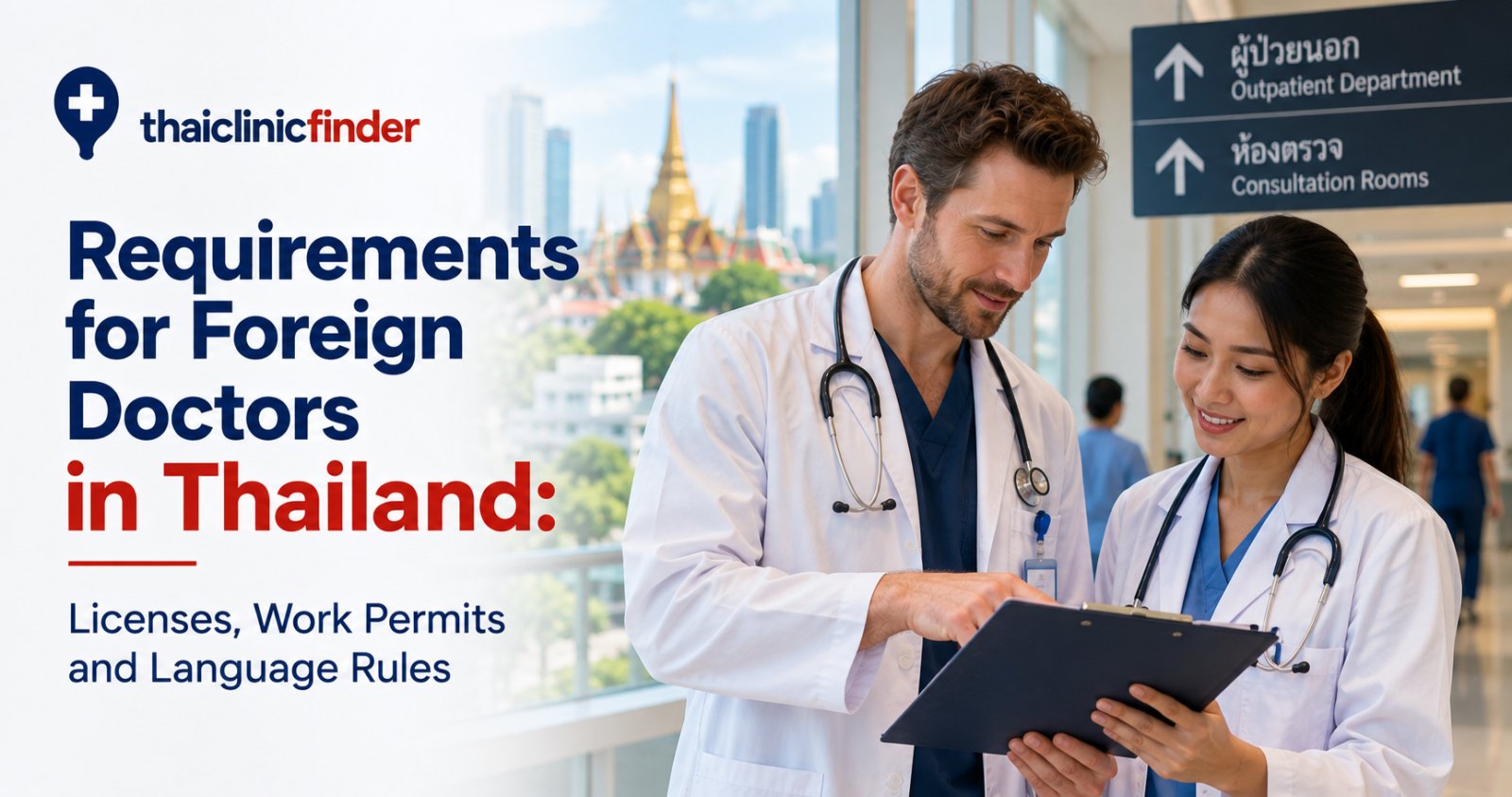
A medical degree and licence from another country do not automatically give a doctor the right to treat patients in Thailand. Clinical practice is regulated by the Medical Council of Thailand, and foreign nationals also need to comply separately with immigration and employment rules.
There are important differences between obtaining full registration as a medical practitioner and receiving limited temporary permission for a specific government project. The rules for foreign physicians seeking full registration were updated in 2025, so older summaries found online may no longer reflect the current eligibility criteria.
This guide is aimed at non-Thai doctors who qualified and practise abroad and are considering clinical work in Thailand. Thai nationals who study medicine overseas are subject to a related but different registration process.
Can a foreign doctor practise medicine in Thailand?
Yes, but only after obtaining the appropriate authorization.
Section 26 of Thailand's Medical Profession Act B.E. 2525 states that a person may not practise medicine or represent themselves as ready to practise medicine unless they are a medical practitioner under the Act, apart from specific statutory exceptions.
For a foreign physician, the two routes most relevant to this discussion are:
- obtaining full registration and a licence from the Medical Council of Thailand;
- receiving specific temporary permission to practise as a foreign consultant or specialist under the conditions set by the Medical Council.
These are not interchangeable. Temporary permission is limited to the approved project, institution, location and period. It should not be interpreted as a general licence to work independently at any clinic or hospital in Thailand.
A medical licence is also separate from permission to work as a foreign national. A doctor may therefore have to satisfy the Medical Council, immigration authorities and the Department of Employment before starting work.
Full medical registration for foreign doctors
In 2025, the Medical Council issued Announcement 104/2568 setting out criteria for foreign physicians seeking recognition of an overseas medical curriculum and institution so that they can enter the Thai licensing process. The announcement specifically concerns full registration rather than temporary permission.
The current criteria are considerably more demanding than some older English-language guidance still available online.
Experience requirements
Under Announcement 104/2568, a foreign physician applying through this route must have held a valid licence to practise medicine abroad continuously for at least 10 years, and that licence must remain valid.
The applicant must also be a specialist or subspecialist and have held the relevant specialist qualification continuously for at least five years, with the qualification still valid.
These requirements are important because older Medical Council material previously referred to shorter periods. Anyone relying on an older guide should check the current Thai-language announcement and confirm eligibility directly with the Medical Council before paying fees or making employment plans.
Recognition of the overseas medical school and curriculum
An overseas medical qualification is not accepted solely because the university is recognised in the doctor's home country.
The Medical Council must consider recognition of the medical curriculum and medical school for the foreign doctor's application. Under the 2025 procedure, the physician submits a request for the Medical Council to consider the overseas medical degree program and institution.
The announcement lists an administrative fee of THB 200,000 for this process and states that fees already collected for the administrative work are not refundable. Because fee schedules can change, applicants should confirm the current amount directly with the Medical Council before making a payment.
Where the institution has not already been recognised, the Medical Council may obtain detailed curriculum information directly from the overseas medical school before deciding whether it meets the required standard.
Recognition of an overseas degree is only one part of the process. It does not itself create a licence to practise medicine in Thailand.
Foreign doctors must pass the Thai medical licensing assessment
The 2025 rules require eligible foreign doctors seeking full registration to complete the medical competency assessment required for a Thai medical licence.
The assessment is administered through the Center for Medical Competency Assessment and Accreditation of the Medical Council of Thailand, commonly referred to as CMA or CMATHAI.
The process includes three main stages:
- Basic Medical Sciences.
- Clinical Sciences.
- Clinical skills assessment.
The third stage includes components such as the Objective Structured Clinical Examination, or OSCE, Modified Essay Question assessment, Long Case Examination and Manual Skill assessment according to the applicable examination rules and schedules.
The CMA publishes examination schedules and registration notices separately. Dates, eligibility rules, examination locations and administrative requirements should therefore be checked with CMA for the year in which the doctor intends to apply.
Passing the examinations does not necessarily mean registration is automatic. The 2025 announcement also provides for further Medical Council consideration before the doctor proceeds to registration and licensing.
Specialist qualifications may also be assessed
A foreign specialist should not assume that an overseas specialist title will automatically be recognised as an equivalent Thai specialist qualification.
Under the current procedure, the Medical Council may send the case to the relevant Thai Royal College or another expert body appointed by the Council to consider whether the applicant's specialist expertise is appropriate. The foreign physician may be required to undergo additional assessment of specialist knowledge.
This distinction matters for doctors applying for consultant-level positions. A foreign licence to practise medicine, an overseas specialist certificate and Thai recognition of specialist competence are related but separate questions.
Before accepting an employment offer based on a particular specialist title, the doctor and employer should confirm exactly what recognition will be required in Thailand.
Do foreign doctors need to speak Thai?
Thai-language ability is one of the most significant practical issues for doctors considering the full licensing route.
The Medical Council's English guidance for foreign physicians states that Parts 1 and 2 of the licensing examination are conducted in English, while Part 3 is conducted in Thai. The same guidance states that applicants need Thai-language ability for the application process.
However, that English guidance is currently displayed by the Medical Council with a notice indicating that the regulation is being revised, while the 2025 announcement introduced updated eligibility criteria. Applicants should therefore confirm the current language format of every examination component directly with CMA before applying.
There is a practical reason Thai matters beyond an examination requirement. Clinical work involves obtaining a history, explaining risks and treatment, obtaining informed consent, documenting care and communicating with Thai healthcare colleagues and patients. Working at a hospital that serves international patients does not eliminate these responsibilities.
Foreign doctors should therefore not interpret an English-speaking workplace as meaning that Thai proficiency is irrelevant to professional registration or safe clinical practice.
Is there a separate Thai-language test?
The current 2025 announcement does not simply describe the full-registration requirement as passing a standalone general Thai-language examination.
Instead, language is closely connected to the clinical licensing process. The Medical Council's published foreign-doctor guidance states that the clinical Part 3 examination is conducted in Thai.
For that reason, asking only whether there is a Thai-language certificate requirement can be misleading. A physician may need sufficient medical Thai to function in examinations and clinical situations even if the applicable process does not require a general language certificate such as those used for university admissions.
Contact CMA and the Medical Council directly for the current examination-language rules that apply to your application year.
Temporary permission for foreign medical consultants and specialists
Thailand also has a narrower route allowing certain foreign doctors to practise temporarily without going through ordinary full registration first.
Medical Council Announcement 60/2023 covers foreign physicians working as consultants or specialists for qualifying government bodies. It replaced previous Medical Council announcements governing this particular type of permission.
This route is designed around a defined project or government need rather than ordinary independent employment.
Eligible bodies that can submit the application include the Ministry of Public Health, other governmental health institutions and government bodies or state enterprises at central, regional or local level.
The application is made by the responsible institution, not simply by an individual foreign doctor seeking permission to practise wherever they choose.
Conditions attached to temporary permission
The government institution applying for temporary permission must provide information about the project, where it will take place and how long the foreign consultant or specialist will participate.
The application must also identify a Thai physician authorised to practise in Thailand who will supervise the foreign doctor during the project.
Documents listed in Announcement 60/2023 include evidence of the foreign doctor's medical degree, a valid overseas medical licence, passport, education and work record and professional liability coverage required for the arrangement.
The resulting permission identifies matters such as:
- the foreign consultant or specialist;
- the approved project;
- the supervising physician;
- the responsible institution;
- the place where medical practice is permitted;
- the period of authorization;
- any additional conditions imposed by the Medical Council.
The announcement explicitly states that the physician cannot practise outside the location covered by the permission.
Temporary permission is issued for no more than one year and cannot extend beyond the validity of the foreign physician's overseas medical licence.
The 2023 announcement lists an application fee of THB 2,000 per person per application, but it also notes that fees may be changed by the Medical Council. Verify the current amount before applying.
Can a foreign doctor use temporary permission to work at a private clinic?
The temporary consultant and specialist route described in Announcement 60/2023 should not be treated as a shortcut for ordinary private practice.
The announcement identifies government and state entities as the bodies entitled to file applications. The Medical Council's ASEAN mobility information likewise describes Thailand's limited-practice route as government-based, supervised and restricted to the approved place, specialty and period.
A doctor who wants ongoing employment treating patients at a private hospital or clinic should therefore ask the employer to establish the exact legal pathway before accepting the role. For ordinary unrestricted clinical practice, full Thai registration may be required unless another specific legal exception applies.
A private clinic simply employing a doctor who holds a licence in the United States, United Kingdom, Australia, another ASEAN state or elsewhere does not by itself create authority to practise medicine in Thailand.
Medical registration and a work permit are different
Professional authorization from the Medical Council is only one part of legally working in Thailand.
Foreign employment is administered separately through the Ministry of Labour and Department of Employment. When the proposed job is a profession that legally requires professional certification, Department of Employment work-permit documentation calls for evidence of the relevant professional licence or certificate.
For standard employment by a foreign national admitted under an appropriate non-immigrant status, work-permit applications are now handled through the Department of Employment's e-WorkPermit system. The nationwide electronic system was launched in October 2025 and allows applications and status tracking online.
The Ministry of Labour states that a foreigner admitted as a tourist or transit traveller is not eligible to follow the normal first-time work-permit route for non-immigrant workers.
The exact immigration and work authorization route can differ for government appointments, investment-promoted employers and other special categories. Doctors should therefore have the prospective employer confirm the correct immigration status and Department of Employment procedure for the specific job.
Does a work permit allow someone to practise medicine?
No.
A work permit deals with employment authorization. It does not replace a Thai medical licence or specific Medical Council permission.
Likewise, professional authorization from the Medical Council does not automatically settle every immigration and employment requirement.
A foreign doctor planning clinical work should therefore think of the process as separate layers:
- professional authorization: Medical Council of Thailand;
- immigration status: permission to remain in Thailand for the relevant purpose;
- employment authorization: Department of Employment work permit or other applicable authorization;
- employer and facility requirements: credentialing and any other rules applicable to the hospital, clinic or government institution.
The order and documentation can depend on the exact employment arrangement, so the employer should coordinate the process rather than asking the doctor to assume that one approval covers everything.
Does being an ASEAN doctor make the process automatic?
No. Regional professional mobility arrangements should not be interpreted as an automatic licence to treat patients in Thailand.
The Medical Council's ASEAN policy material shows that Thailand continues to impose domestic requirements for limited medical practice, including supervision, restrictions on the approved place and specialty, and authorization for the particular period of work.
A doctor licensed in another ASEAN country should therefore still confirm the Thai Medical Council requirements applying to the intended role.
Can foreign doctors train in Thailand without full registration?
Training has its own rules and should be distinguished from independent clinical practice.
The Medical Council has published requirements for professional training of foreign doctors. These include recognition of the medical degree, a valid licence from the country of origin, good-standing documentation and assessment of professional ability and Thai communication skills by the relevant Royal College and training institution.
The permitted activities of a trainee depend on the approved training arrangement. A foreign doctor should not assume that joining an observership, fellowship or training program gives permission to independently diagnose, prescribe or perform procedures outside that program.
Ask the Thai training institution which Medical Council authorization applies before beginning any patient-facing activity.
What documents should foreign doctors prepare?
Requirements differ between full registration, temporary permission and training, but doctors may need documents such as:
- passport;
- medical degree and academic records;
- valid medical licence from the country of practice;
- evidence showing how long the licence has been continuously held;
- specialist or subspecialist certification;
- evidence of specialist experience;
- certificate of good standing where required;
- employment or appointment documents;
- curriculum information from the medical school;
- certified translations or authenticated copies when requested;
- professional liability insurance for certain temporary arrangements;
- documents required for immigration and the work permit.
Do not obtain expensive legalisation or translation services based solely on an unofficial checklist. Ask the Medical Council and prospective employer which documents, certifications and translations are currently required for the specific application route.
How can patients check whether a doctor is licensed in Thailand?
The Medical Council operates an online doctor verification service that allows the public to search for practitioners and medical licence information. The system also provides information relating to temporary medical permission.
For patients, this is more useful than relying solely on a clinic biography stating that a doctor trained overseas or belongs to a foreign professional organisation.
A foreign qualification can be relevant to a doctor's background, but the key question for clinical practice in Thailand is whether that person has the Thai authorization required for the work they are performing.
If you are comparing medical facilities as a patient rather than applying to work as a doctor, how healthcare access works in Thailand for visitors and residents explains the main options for arranging care. International patients who need a consultation in a particular language can also see how to choose an English-speaking clinic in Thailand.
What should a foreign doctor confirm before accepting a job?
Before signing a contract or relocating, ask the employer to explain precisely what clinical activities you will perform and under which Thai authorization.
Confirm:
- whether the position requires full Thai medical registration or qualifies for a specific temporary exception;
- whether your years of licensing and specialist certification meet the current Medical Council criteria;
- whether your overseas medical school and curriculum require individual recognition;
- which licensing examinations you must complete;
- the current language used for each examination component;
- whether your specialist qualification requires Royal College assessment;
- who is responsible for the Medical Council application;
- which immigration status will be used;
- who will arrange the work permit;
- which hospital, clinic or project locations you will legally be permitted to work at;
- whether your permission allows independent practice or requires supervision.
Get these answers from the relevant authority or employer in writing where possible. Regulatory requirements can change, and a recruitment advertisement should never be treated as evidence that a doctor is legally eligible to practise.
Bottom line
Foreign doctors can practise medicine in Thailand, but an overseas medical licence alone is not sufficient.
Under the Medical Council's 2025 rules for foreign physicians seeking full registration, applicants must meet substantial prior-experience requirements, including at least 10 continuous years holding a valid foreign medical licence and at least five continuous years holding a valid specialist or subspecialist qualification. Their overseas medical education must be considered by the Medical Council, and they must complete the required Thai medical competency assessment before registration can be considered.
Thai-language ability is also practically important. The Medical Council's published foreign-doctor guidance states that the first two licensing examination stages are in English and the clinical third stage is in Thai, although applicants should verify the latest language arrangements with CMA because the Council is revising its English guidance and newer regulations have been issued.
A separate temporary route exists for foreign consultants and specialists working on qualifying government projects, but that permission is limited to the approved institution, project, location, supervision arrangements and period. It is not a general private-practice licence.
Finally, medical authorization and employment authorization are separate. Before starting clinical work, foreign doctors should confirm both their Medical Council status and the immigration and work-permit requirements applying to the exact position.
Licensing, immigration and employment requirements can change. Before applying, accepting a position or arranging patient care, confirm the current requirements with the Medical Council of Thailand and the Department of Employment for the specific role.
Frequently Asked Questions
Can a foreign doctor work as a doctor in Thailand?
Yes, but an overseas medical licence does not automatically permit clinical practice in Thailand. The doctor needs the appropriate authorization from the Medical Council of Thailand and must separately comply with applicable immigration and work authorization requirements.
How many years of experience does a foreign doctor need for a Thai medical licence?
Under Medical Council Announcement 104/2568, the full-registration route for foreign physicians requires a valid overseas medical licence held continuously for at least 10 years and a valid specialist or subspecialist qualification held continuously for at least five years. Applicants should confirm that these criteria still apply when they file their application.
Do foreign doctors have to take the Thai medical licensing exam?
Foreign physicians following the full-registration route must complete the competency assessment required by the Medical Council. It includes Basic Medical Sciences, Clinical Sciences and clinical assessment components including OSCE and other practical or written examinations.
Do foreign doctors need to speak Thai to practise in Thailand?
Thai is highly relevant to the full licensing process and clinical work. The Medical Council's published English guidance states that Parts 1 and 2 of the licensing examination are in English and Part 3 is in Thai, but applicants should verify the current examination-language rules directly with CMA because regulations have subsequently been updated.
Can a foreign specialist get a temporary medical licence in Thailand?
Thailand has a temporary permission route for certain foreign consultants and specialists working through qualifying government or state institutions. The authorization is tied to a specified project, supervising doctor, location and period and is not a general licence for unrestricted private practice.
Does a Thai work permit allow a foreign doctor to treat patients?
No. A work permit concerns employment authorization and does not replace professional authorization from the Medical Council of Thailand. A foreign doctor may need both the appropriate medical authorization and separate permission to work.
Can a private hospital hire a foreign doctor who only has an overseas licence?
An overseas licence by itself does not authorize ordinary clinical practice in Thailand. The temporary consultant route described by the Medical Council is designed for qualifying government and state projects, so a private employer should establish the doctor's applicable Thai licensing and work authorization before any patient care begins.
How can I check whether a foreign doctor is licensed in Thailand?
The Medical Council of Thailand operates an online doctor verification system where the public can search medical practitioners and licence details. Patients should verify Thai authorization rather than relying only on an overseas qualification listed in a clinic biography.
Sources
- Medical Council of Thailand - Announcement 104/2568 on Foreign Physicians Seeking Full Registration
- Medical Council of Thailand - Doctor Licence Verification
- Center for Medical Competency Assessment and Accreditation - Examination Information
- Ministry of Labour Thailand - e-WorkPermit System
- Department of Employment Thailand - e-WorkPermit
- Ministry of Labour Thailand - Eligibility to Apply for a Work Permit
- Medical Council of Thailand. Foreign doctor guidance
- Medical Council of Thailand. Announcement 104/2568
Writer
Niran Chaiyasit
Niran Chaiyasit is a Thai health writer with a background in public health and a focus on travel health, disease prevention and healthcare access in Thailand. His work covers topics such as common illnesses, vaccinations, mosquito-borne diseases, food safety and practical health information for travelers and expatriates.

Medical review
Justin Brooks
Justin Brooks is an American health writer with a background in health sciences and a focus on rehabilitation, musculoskeletal health and patient education. He writes about physiotherapy, injury recovery, pain management, preventive health and practical healthcare guidance for international patients and travelers.