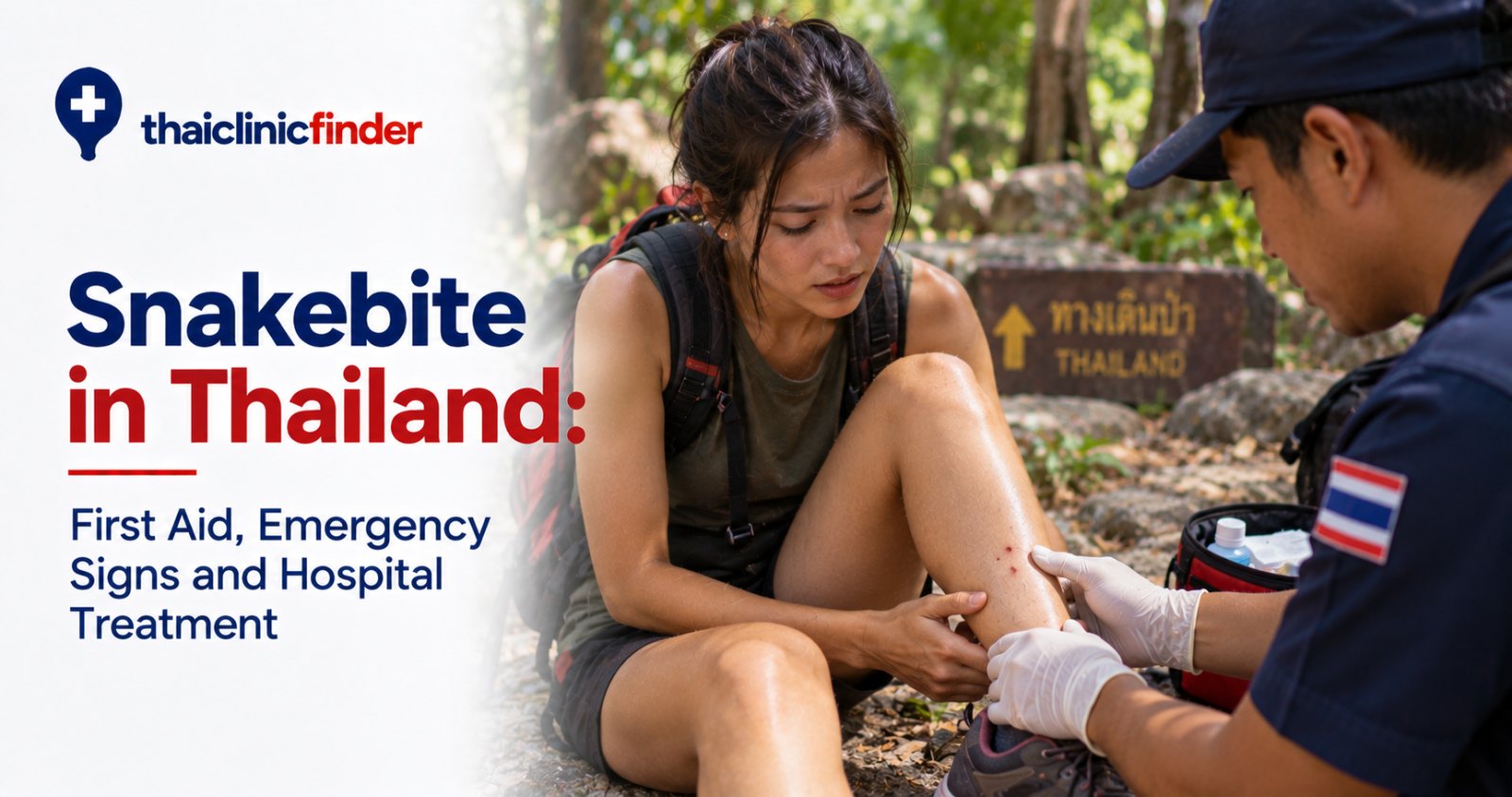
A snakebite in Thailand should be treated as a medical emergency until a qualified clinician determines otherwise. Thailand is home to venomous snakes including cobras, king cobras, kraits, green pit vipers, Malayan pit vipers and Russell's vipers, and different venoms can affect breathing, blood clotting, muscles and local tissue in very different ways.
The safest response is simple: move away from the snake, keep the person as still as possible, immobilize the bitten limb and get to an appropriate hospital without delay.
Do not cut the wound, suck out venom, apply ice, use herbal remedies or tie a tight tourniquet around the limb.
Thailand has an important advantage for snakebite treatment. The Queen Saovabha Memorial Institute of the Thai Red Cross produces multiple species-specific and polyvalent snake antivenoms, including products for cobra, king cobra, kraits and major Thai vipers.
However, antivenom is not something every snakebite automatically requires. Doctors first assess whether clinically significant envenoming has occurred and which type of venom syndrome is developing.
If the person develops difficulty breathing, drooping eyelids, weakness, severe swelling, abnormal bleeding, collapse, confusion or reduced consciousness, call Thailand's emergency medical service on 1669.
What should you do immediately after a snakebite in Thailand?
WHO recommends a straightforward approach focused on limiting movement and getting the patient to medical care.
1. Move away from the snake
Get the bitten person out of immediate danger so that neither the patient nor anyone helping them is bitten again.
Do not try to catch or kill the snake.
If it can be done safely from a distance, a photograph may help clinicians with identification, but never approach the snake for a better picture.
A dead snake can still potentially cause injury through reflex movement, so do not handle it with bare hands.
2. Keep the person still
Movement and muscular activity can increase the movement of venom from the bite area into the circulation.
WHO recommends complete immobilization of the patient, particularly the affected limb.
The person should not walk to the car or motorcycle if there is another way to transport them.
Carry them, use a stretcher or bring transport as close as possible.
3. Immobilize the bitten limb
Keep the limb in a comfortable neutral position and use a splint if available.
The goal is to reduce movement, not to stop blood flow.
A simple improvised splint can be made using a rigid object and loose bandaging, provided circulation is not restricted.
4. Remove rings, watches and tight items
Swelling can increase after some venomous snakebites.
Remove:
- rings
- watches
- bracelets
- anklets
- tight shoes
- restrictive clothing around the limb
Do this early, before swelling makes removal difficult.
5. Arrange transport to hospital
Do not remain at the scene waiting to see if symptoms develop.
WHO advises transporting anyone suspected of a venomous snakebite to an appropriate health facility without delay.
For serious symptoms or difficulty arranging safe transport, call 1669.
For general emergency information, see Medical Emergencies in Thailand: Numbers and Practical Steps.
Do not use a tight tourniquet
This is one of the most important first-aid rules.
WHO explicitly advises against tight arterial tourniquets for snakebite.
A rope, belt, cable or tightly tied cloth can obstruct circulation and cause severe additional injury to the limb.
Possible consequences include:
- nerve damage
- loss of blood supply
- tissue death
- increased swelling
- greater risk of permanent disability
Tourniquets shown in films or older survival advice should not be copied.
Pressure immobilization is not appropriate for every Thai snakebite
This topic can cause confusion because some first-aid guidance from Australia promotes pressure immobilization bandaging.
WHO states that pressure immobilization is mainly recommended for bites from predominantly neurotoxic snakes that do not cause significant local swelling.
That distinction is important in Thailand because several medically important snakes, particularly vipers, can produce substantial local tissue effects and swelling.
Unless you have appropriate training and know that pressure immobilization is indicated for the circumstances, the safer general principles are:
- keep the patient still
- immobilize the limb
- do not constrict circulation
- obtain medical care rapidly
Do not delay hospital transport while attempting complicated bandaging techniques.
Do not cut or suck the bite
Cutting the wound does not reliably remove venom and creates another injury.
It can increase the risk of:
- bleeding
- infection
- nerve damage
- tissue injury
Sucking venom out with the mouth or a suction device is also ineffective and is not recommended by WHO.
Do not use commercial venom extraction pumps as a substitute for medical treatment.
Do not apply ice, electricity or chemicals
Avoid home or traditional treatments such as:
- ice packs directly over the bite
- burning or cauterizing the wound
- electric shock
- herbal pastes
- chemicals
- black stones
- aggressive massage
WHO warns that many traditional snakebite treatments are ineffective, dangerous or simply delay access to effective hospital treatment.
Antivenom and supportive medical care are the treatments that matter when significant envenoming occurs.
Should you wash the snakebite wound?
A superficial wound can ultimately be cleaned as part of medical care, but do not turn wound cleaning into a prolonged procedure that delays transport.
WHO's general animal-bite guidance includes cleansing wounds to reduce infection risk.
However, after a suspected venomous snakebite, the priority is immobilization and transport.
Do not scrub, cut or squeeze the bite in an attempt to force venom out.
Can you drive yourself to hospital after a snakebite?
Ideally, no.
A person who initially feels normal can deteriorate if venom affects the nervous system, blood pressure or clotting.
Someone bitten by a cobra or krait may develop weakness or breathing problems after the journey has already started.
Have another person drive, use an ambulance or arrange other transport while the patient remains as still as possible.
Do not ride a motorbike yourself after a suspected venomous bite.
Which hospital should you go to?
Go to an emergency department or hospital capable of evaluating snakebite and arranging antivenom or transfer when required.
In Bangkok and major provincial cities, this generally means a hospital emergency department rather than a pharmacy or small wellness clinic.
In a rural or island location, go to the nearest appropriate medical facility first rather than spending excessive time trying to identify a specialist hospital online.
The first facility can assess the patient, begin emergency treatment and arrange transfer if antivenom or intensive care is needed.
If you are unsure where to seek care, see Sick in Thailand? What to Do and Where to Get Medical Care.
Call 1669 if serious symptoms develop
Thailand's National Institute for Emergency Medicine operates the 1669 emergency medical system.
Call 1669 particularly if the patient has:
- difficulty breathing
- severe generalized weakness
- drooping eyelids
- trouble speaking or swallowing
- loss of consciousness
- seizures
- collapse
- severe bleeding
- rapidly progressive swelling
- repeated vomiting with deterioration
If the person becomes unconscious but continues breathing, place them in the recovery position if it can be done safely and monitor their airway.
WHO specifically warns that vomiting and airway obstruction can contribute to deaths during transport.
A snakebite can look harmless at first
Two small puncture marks do not tell you how serious the bite is.
Some venomous bites produce marked pain and swelling quickly.
Others, particularly bites from certain neurotoxic snakes, may initially cause surprisingly little local damage.
A person can therefore feel relatively normal after a bite and later develop:
- weakness
- paralysis
- abnormal blood clotting
- kidney injury
- tissue damage
Do not wait for severe symptoms before going to hospital.
Not every venomous snakebite injects a dangerous amount of venom
Some bites are dry bites, meaning little or no venom is injected.
Even when venom is injected, severity varies according to:
- species
- amount of venom
- location of bite
- size and health of patient
- time to medical care
This is one reason antivenom is not given automatically after every suspected bite.
Doctors monitor for clinical and laboratory evidence of envenoming before deciding whether specific treatment is necessary.
Neurotoxic snakebites can affect breathing
Cobras and kraits are among the important neurotoxic snakes in Thailand.
Their venoms can interfere with communication between nerves and muscles.
Potential symptoms include:
- drooping eyelids
- blurred or double vision
- difficulty keeping the eyes open
- difficulty swallowing
- slurred speech
- weakness
- difficulty holding the head up
- paralysis
- breathing difficulty
Breathing problems can become life-threatening.
WHO notes that some patients with neurotoxic envenoming require airway support and mechanical ventilation in addition to antivenom.
Cobra bites may also cause significant local tissue injury
Cobra envenoming is not only a neurological problem.
Some cobra bites can cause:
- pain
- swelling
- blistering
- tissue necrosis
Do not assume a cobra bite will always be painless or limited to paralysis.
The clinical pattern can vary, which is another reason species identification should be left to experienced clinicians whenever possible.
Krait bites may have little local swelling
Krait bites can be particularly deceptive because local pain and swelling may be limited.
Neurological symptoms can develop later, including progressive weakness and respiratory paralysis.
A person bitten at night may initially dismiss the event as a minor bite or scratch.
Any credible snakebite should therefore be medically assessed even when the skin findings are small.
Viper bites can affect blood clotting
Thailand is also home to medically important vipers including:
- green pit vipers
- Malayan pit vipers
- Russell's vipers
Their venom can produce a different pattern from cobra or krait venom.
Possible effects include:
- significant swelling
- bruising
- blistering
- bleeding from the gums or other sites
- abnormal blood clotting
- internal bleeding
- low blood pressure
- kidney injury in some cases
Hospital blood tests are therefore important even when the patient initially feels reasonably well.
Green pit vipers are medically important in Thailand
Green pit vipers are encountered in several parts of Thailand, including urban and semi-urban environments.
A bite can produce substantial local swelling and abnormalities of blood coagulation.
Thailand has a specific Green Pit Viper antivenin, registered through the Thai FDA and produced by the Queen Saovabha Memorial Institute.
Because local swelling can be prominent, applying an indiscriminate tight compression bandage is not appropriate.
Russell's viper can cause serious systemic effects
Russell's viper venom can cause major disturbances in blood coagulation and, in serious cases, kidney injury and other systemic complications.
Thailand's Thai Red Cross produces Russell's Viper antivenin, which is registered in the Thai FDA drug database.
The decision to administer it is made in hospital based on clinical and laboratory evidence rather than simply because the snake is suspected to be a Russell's viper.
Which snake antivenoms are available in Thailand?
The Queen Saovabha Memorial Institute of the Thai Red Cross currently lists seven monovalent antivenoms produced for individual medically important snakes:
- King Cobra antivenin
- Cobra antivenin
- Banded Krait antivenin
- Malayan Krait antivenin
- Malayan Pit Viper antivenin
- Russell's Viper antivenin
- Green Pit Viper antivenin
It also produces two polyvalent products:
- Neuro Polyvalent Snake Antivenin
- Hemato Polyvalent Snake Antivenin
Thai FDA records confirm registration of several of these products, including cobra, king cobra, green pit viper and Russell's viper antivenoms.
This system allows Thai hospitals to treat both identified and certain unidentified venomous snakebites based on the clinical syndrome.
What is polyvalent antivenom?
A monovalent antivenom targets venom from a specific snake or closely defined species.
A polyvalent antivenom is designed to neutralize venom from several medically important snakes within a group.
Thailand produces separate polyvalent antivenoms for:
- neurotoxic snake envenoming
- blood-affecting, or hematotoxic, snake envenoming
This can be useful when the exact snake cannot be identified but the patient's clinical syndrome strongly suggests a particular venom type.
The choice belongs to the treating medical team.
Do you need to know which snake bit you?
Identification can help, but it is not worth risking another bite.
If you can safely take a photograph from a distance, it may be useful.
Do not:
- catch the snake
- put it in a bag
- pick up a dead snake
- chase it through vegetation
- delay hospital transport trying to identify it
Doctors can often use the combination of symptoms, local effects and blood tests to narrow the likely venom syndrome.
Thailand also has both species-specific and polyvalent antivenoms, which can be important when identification is uncertain.
Do not rely on snake identification apps alone
Image-recognition applications and social media groups can misidentify snakes.
Lighting, viewing angle, juvenile coloration and similar-looking species can all create errors.
A phone identification can be supplementary information, but it should never determine whether someone seeks medical care.
If you have a safe photograph, show it to the hospital team.
What happens when you arrive at hospital?
Hospital evaluation may include:
- history of the bite
- time and location of exposure
- examination of bite marks
- measurement of swelling
- neurological examination
- blood pressure and respiratory monitoring
- clotting tests
- complete blood count
- kidney function tests
- urine testing
- repeat laboratory tests over time
The patient may need observation even if initial results are reassuring.
Certain venom effects can take time to develop.
Why might the hospital observe you without giving antivenom?
Antivenom is an important treatment, but it also has potential adverse effects including serious allergic reactions.
Doctors therefore weigh the benefits and risks.
If there is no evidence of significant envenoming, observation and repeat testing may be more appropriate than immediate antivenom.
WHO describes high-quality antivenom as the only specific treatment capable of preventing or reversing many major effects of venomous snakebite, but it should be used when clinically indicated.
When is antivenom usually considered?
The exact criteria vary according to snake species and local protocols.
Potential indications can include evidence of:
- progressive neurotoxicity
- respiratory weakness
- significant clotting abnormality
- spontaneous bleeding
- cardiovascular instability
- severe systemic envenoming
- clinically important progression of certain local effects
The treating doctor determines whether the risk-benefit balance favors antivenom.
Do not purchase antivenom privately or attempt to administer it yourself.
Antivenom can cause allergic reactions
Snake antivenom can trigger reactions including:
- rash
- itching
- wheezing
- low blood pressure
- anaphylaxis
This is why it is administered in a medical environment where staff can monitor the patient and treat reactions immediately.
Potential side effects do not make antivenom unsafe when it is genuinely indicated. In serious envenoming, its benefit can be life-saving.
Some patients also need ventilatory or intensive care support
Antivenom does not instantly reverse every effect that has already occurred.
For example, severe neurotoxic envenoming can require temporary mechanical ventilation while nerve-muscle function recovers.
Patients with major bleeding, kidney injury or tissue damage may also require additional supportive treatment.
A hospital's ability to provide airway support and intensive monitoring can therefore be as important as the presence of antivenom itself.
Should you take painkillers after a snakebite?
WHO states that paracetamol may be used for local pain when appropriate.
Avoid taking aspirin on your own after a snakebite because some venoms affect blood clotting and bleeding.
For the same reason, do not casually take anti-inflammatory medicines such as ibuprofen before medical assessment unless a clinician advises that they are appropriate.
Tell the hospital about any medication you have already taken.
Tetanus vaccination may need to be reviewed
Snakebite also creates a wound.
WHO includes tetanus vaccination among considerations when the patient is not adequately vaccinated.
Tell the medical team when you last received a tetanus-containing vaccine if you know.
Do not delay snakebite treatment while trying to obtain old vaccination records.
Should you eat or drink after a snakebite?
If hospital transfer is imminent, avoid unnecessary food, particularly if the patient is becoming drowsy, weak or nauseated.
Neurotoxic venom can impair swallowing, creating an aspiration risk.
A person with swallowing difficulty should not be given food or drink by mouth.
Follow emergency-service instructions while waiting for transport.
Snakebite while hiking or in a national park
A bite in a remote setting creates a transport problem.
The priorities remain the same:
- move away from the snake
- keep the patient still
- immobilize the limb
- remove tight objects
- call for help
- arrange passive transport
Do not make the bitten person hike several kilometres if they can be carried or evacuated.
Walking increases muscular activity in the affected limb and may speed systemic venom absorption.
If mobile signal is available, contact emergency services and provide as precise a location as possible.
Snakebite on an island in Thailand
If bitten on an island, go to the nearest local hospital or emergency medical facility rather than waiting until you can reach Bangkok.
The local team can:
- assess the bite
- perform blood tests
- stabilize the patient
- determine whether antivenom is available
- arrange transfer if higher-level care is required
The closest appropriate facility is generally the correct first destination.
A long ferry or private car journey without medical assessment may be unsafe if neurological or bleeding complications begin during transit.
What if you are bitten in Bangkok?
Snake encounters can occur even in urban environments, particularly around gardens, canals, undeveloped land and during periods of heavy rain or flooding.
Bangkok has numerous public and private hospital emergency departments capable of assessing snakebite.
Do not spend time traveling across the city specifically to the Snake Farm at Queen Saovabha Memorial Institute after a bite unless medical professionals direct you there.
The institute is an important national antivenom producer and source of expertise, but an acute snakebite requires emergency clinical assessment at an appropriate hospital.
What if you feel completely normal after the bite?
Still seek medical care.
Reasons include:
- the snake may have injected venom without immediate symptoms
- neurotoxic effects can develop later
- clotting abnormalities may initially be invisible
- swelling can progress over time
A normal appearance in the first 30 minutes does not prove that the bite was harmless.
Hospital observation and repeat blood tests may be necessary.
Can a non-venomous snakebite still need treatment?
Yes.
Even if a snake is confirmed as non-venomous, the wound may still need:
- cleaning
- tetanus assessment
- monitoring for infection
The main emergency concern is excluding envenoming, but bite wounds should not simply be ignored once venom is ruled out.
How to reduce snakebite risk in Thailand
WHO recommends several practical prevention measures in areas where venomous snakes occur.
Use a light at night
Some snakes are active after dark.
Use a flashlight or phone light when walking outdoors at night, especially around:
- rural paths
- gardens
- campsites
- fields
- poorly lit resort grounds
Wear appropriate footwear
Closed shoes or boots provide more protection than sandals or bare feet when walking through vegetation or rural areas.
Do not put your hands into places you cannot see
Be cautious around:
- rock piles
- wood piles
- rubbish
- dense vegetation
- holes
- stored building materials
Snakes usually try to avoid humans but may bite when surprised or trapped.
Keep areas around accommodation clear
WHO notes that rubbish, stored materials and rodents can create attractive environments for snakes.
Keeping grass short and reducing clutter around homes can reduce encounters.
Do not handle snakes
This includes apparently dead snakes.
Many bites occur when people deliberately interact with a snake rather than accidentally stepping near one.
A simple snakebite checklist
If you remember nothing else, remember these steps:
- Move away from the snake.
- Do not try to catch it.
- Keep the bitten person still.
- Immobilize the affected limb.
- Remove rings, watches and tight clothing.
- Do not use a tight tourniquet.
- Do not cut, suck, burn or ice the bite.
- Arrange transport to hospital immediately.
- Call 1669 if serious symptoms develop or safe transport is difficult.
- Show clinicians a photo of the snake only if one was obtained safely.
Thailand has established expertise in snakebite management and domestically produced antivenoms for several of its most medically important venomous snakes.
The most useful thing a traveler can do before reaching that treatment is surprisingly simple: do as little as possible to the wound, keep the patient from moving and get them to medical care promptly.
Frequently Asked Questions
What should I do if a snake bites me in Thailand?
Move away from the snake, keep yourself as still as possible, immobilize the bitten limb, remove rings or other tight items and get to a hospital promptly. Do not cut the wound, suck out venom or use a tight tourniquet.
What is the emergency number for a snakebite in Thailand?
Thailand's emergency medical number is 1669. Call it if the person has difficulty breathing, severe weakness, collapse, abnormal bleeding, reduced consciousness or other serious symptoms, or if safe transport is difficult.
Should I use a tourniquet after a snakebite?
No. WHO advises against tight arterial tourniquets because they can obstruct circulation and cause severe additional tissue and nerve damage.
Should I suck the venom out of a snakebite?
No. Suction by mouth or commercial suction devices does not reliably remove venom and can cause additional injury or delay proper medical treatment.
Should I walk to hospital after a snakebite?
Avoid walking if possible. WHO recommends keeping the patient and bitten limb immobilized and transporting the person passively by stretcher, vehicle or another method.
Do all snakebites in Thailand need antivenom?
No. Some bites inject little or no venom. Doctors assess symptoms, examination findings and blood tests before deciding whether antivenom is needed.
What snake antivenoms are available in Thailand?
The Queen Saovabha Memorial Institute produces specific antivenoms for king cobra, cobra, banded krait, Malayan krait, Malayan pit viper, Russell's viper and green pit viper, as well as neurotoxic and hematotoxic polyvalent antivenoms.
What are the warning signs of a venomous snakebite?
Warning signs can include progressive swelling, bruising, abnormal bleeding, drooping eyelids, blurred vision, difficulty swallowing, generalized weakness, breathing difficulty, collapse or reduced consciousness.
Do I need to catch the snake for doctors to treat me?
No. Do not attempt to catch or kill the snake. A photograph taken safely from a distance can help, but doctors can also use symptoms and laboratory findings to determine the likely type of envenoming.
Can I feel fine after a venomous snakebite?
Yes. Some venom effects are delayed, and certain neurotoxic bites may cause little initial pain or swelling. Seek medical assessment even if you initially feel normal.
Sources

Writer
Niran Chaiyasit
Niran Chaiyasit is a Thai health writer with a background in public health and a focus on travel health, disease prevention and healthcare access in Thailand. His work covers topics such as common illnesses, vaccinations, mosquito-borne diseases, food safety and practical health information for travelers and expatriates.

Medical review
Justin Brooks
Justin Brooks is an American health writer with a background in health sciences and a focus on rehabilitation, musculoskeletal health and patient education. He writes about physiotherapy, injury recovery, pain management, preventive health and practical healthcare guidance for international patients and travelers.