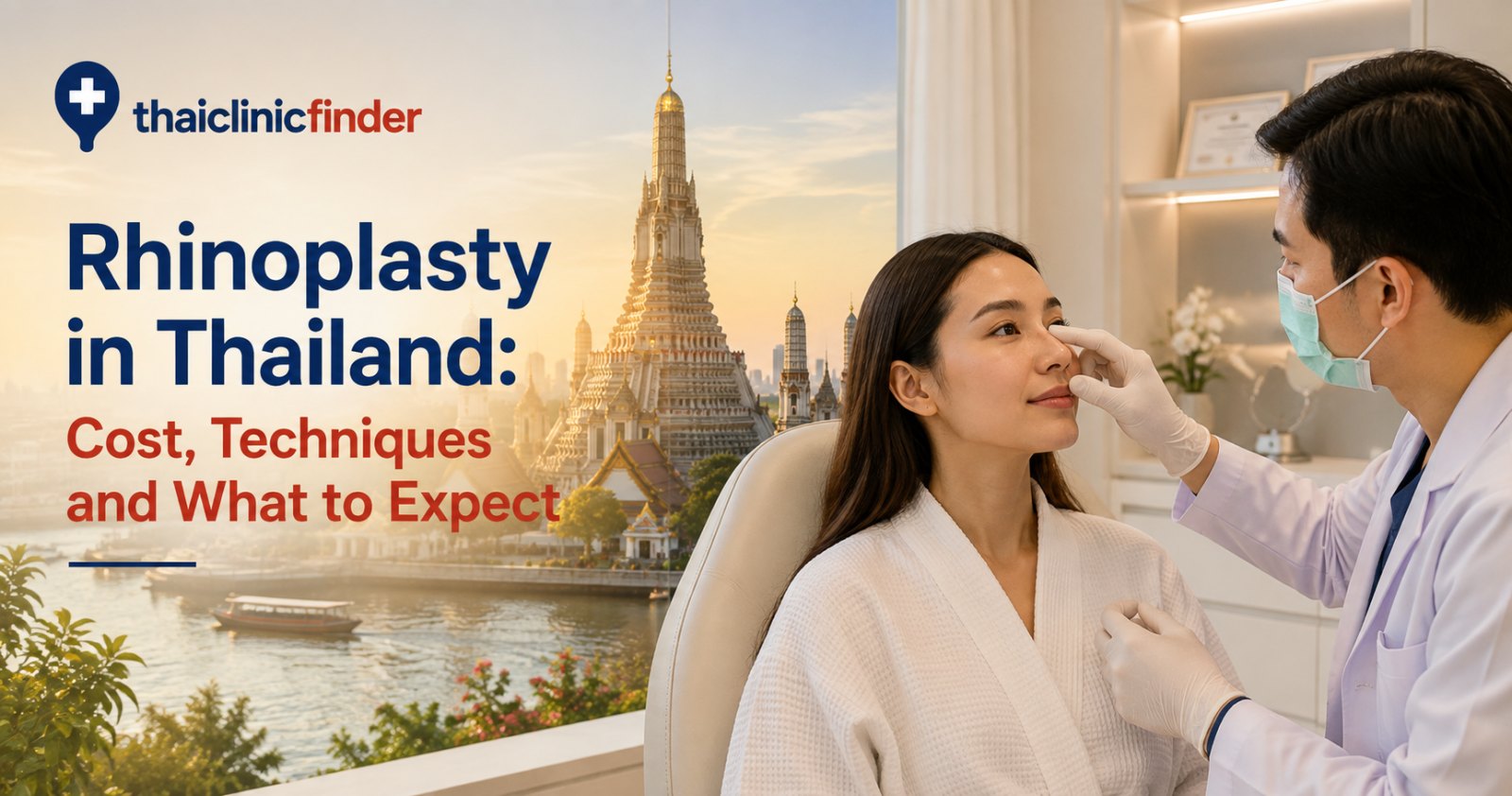
Rhinoplasty in Thailand can cost from around THB 30,000 for a relatively simple silicone nose implant to more than THB 200,000 for complex rhinoplasty, rib-cartilage reconstruction or surgery combining cosmetic and functional correction.
That wide range exists because rhinoplasty is not one standard procedure. A patient who wants to raise a low nasal bridge with an implant is undergoing a very different operation from someone who needs hump reduction, major tip reconstruction, septal correction or revision surgery after a previous rhinoplasty.
Current published Thai hospital prices illustrate the difference. Yanhee International Hospital lists standard augmentation rhinoplasty from THB 30,000, nose reshaping at THB 105,000, ultrasonic rhinoplasty at THB 145,000 and rib-cartilage augmentation at THB 220,000. Bangkok Hospital Headquarters publishes local-anaesthetic rhinoplasty at THB 46,000, reduction rhinoplasty at THB 207,000 and reduction rhinoplasty with septum correction at THB 265,000.
These are individual provider prices rather than an official national average.
How much does rhinoplasty cost in Thailand?
A useful way to understand the market is to separate simpler augmentation procedures from more complex structural surgery.
Current published examples include:
- standard silicone augmentation rhinoplasty: from THB 30,000
- imported silicone implant augmentation: approximately THB 40,000 to THB 50,000
- local-anaesthetic rhinoplasty at Bangkok Hospital: THB 46,000
- Gore-Tex rhinoplasty at Yanhee: THB 70,000
- nose reshaping at Yanhee: THB 105,000
- open rhinoplasty with silicone and ear cartilage at Yanhee: THB 105,000
- open rhinoplasty with Gore-Tex and ear cartilage at Yanhee: THB 120,000
- ultrasonic rhinoplasty at Yanhee: THB 145,000
- reduction rhinoplasty at Bangkok Hospital: THB 207,000
- rib-cartilage augmentation at Yanhee: THB 220,000
- rhinoplasty with reduction and septum correction at Bangkok Hospital: THB 265,000
The exact quotation can be higher if surgery is a revision, requires multiple grafts or involves additional functional nasal work.
A THB 30,000 nose job and a THB 200,000 rhinoplasty are not comparable operations
This is one of the most important things for international patients to understand.
At the lower end, Thailand has augmentation procedures designed primarily to increase the height or projection of the nose using an implant.
At the higher end, surgery may involve:
- reshaping nasal bone
- reducing a dorsal hump
- reconstructing the nasal tip
- cartilage grafting
- osteotomy
- septal correction
- rib cartilage harvest
- revision of previous surgery
- general anaesthesia
- inpatient hospital care
A quotation should therefore be compared according to what is actually being done, not simply according to the word rhinoplasty.
Nose implant surgery is usually the cheapest form of rhinoplasty in Thailand
Augmentation rhinoplasty is particularly common in Asian aesthetic surgery and is designed to increase nasal bridge height or projection.
Yanhee currently publishes:
- standard nose implant: THB 30,000
- USA nose implant: THB 40,000
- Korea nose implant: THB 50,000
- Gore-Tex rhinoplasty: THB 70,000
Its standard silicone augmentation is described as a day-case procedure generally performed under local anaesthesia with sedation.
These procedures can be significantly cheaper than full structural rhinoplasty because they may require less extensive bone and cartilage work.
Open rhinoplasty usually costs more because the surgery can be more extensive
Open rhinoplasty gives the surgeon greater access to the nasal framework through an incision across the columella combined with internal incisions.
It can be useful when substantial tip work, grafting or structural modification is needed.
Yanhee's current published options include:
- open rhinoplasty with silicone and ear cartilage: THB 105,000
- open rhinoplasty with Gore-Tex and ear cartilage: THB 120,000
- open rhinoplasty with silicone, ear cartilage and PCL: THB 150,000
- open rhinoplasty with Gore-Tex, ear cartilage and PCL: THB 202,500
These examples show how material and surgical complexity can change the cost even within open rhinoplasty.
Closed and open rhinoplasty are techniques, not quality rankings
Patients sometimes assume open rhinoplasty is automatically better than closed rhinoplasty.
That is too simplistic.
The appropriate approach depends on what needs to be changed.
Closed rhinoplasty uses incisions inside the nostrils and can avoid an external columellar scar. Open rhinoplasty provides greater exposure of the nasal framework and may be preferred for more complicated structural work.
Ask the surgeon:
- which approach is recommended
- why it suits your anatomy
- what will be changed
- where scars will be located
- whether grafts or implants are required
The technique should follow the surgical problem rather than marketing terminology.
Reduction rhinoplasty is a different operation from augmentation
Some patients want a nose made larger or more projected. Others want parts of the nose reduced.
Reduction rhinoplasty can involve reshaping bone and cartilage to address issues such as:
- dorsal hump
- excessive bridge height
- wide nasal bones
- oversized or projecting tip
- disproportionate nasal structure
Yanhee currently lists nose reshaping at THB 105,000, while Bangkok Hospital Headquarters publishes reduction rhinoplasty at THB 207,000.
The large difference between providers also demonstrates why published prices need to be interpreted in the context of package structure, anaesthesia, hospital stay and surgical plan.
What is ultrasonic rhinoplasty?
Ultrasonic rhinoplasty uses piezoelectric instruments to reshape nasal bone rather than relying entirely on conventional osteotomes or rasps.
Yanhee currently lists ultrasonic rhinoplasty at THB 145,000, including a two-night hospital stay.
The technique can allow controlled bone work, particularly during hump reduction or osteotomy.
It should not automatically be treated as a superior option for every nose.
Ask whether ultrasonic equipment changes the planned outcome in your particular case and whether the additional cost is justified by the surgery required.
Rib cartilage pushes the price much higher
Autologous rib cartilage can be used when the surgeon needs substantial structural material.
This may be considered for:
- major augmentation
- tip reconstruction
- weak nasal support
- complex revision rhinoplasty
- cases where septal or ear cartilage is insufficient
Yanhee currently publishes nose augmentation using rib cartilage at THB 220,000, including one hospital night.
The operation is more involved because cartilage needs to be harvested from the patient's chest before being shaped and used in the nose.
This creates an additional surgical site and its own recovery considerations.
Ear cartilage is commonly used for tip work
Ear cartilage can provide graft material without requiring rib harvest.
Yanhee currently lists tip-plasty with graft at THB 45,500, while some of its open rhinoplasty packages combine ear cartilage with silicone or Gore-Tex implants.
Using ear cartilage can be useful for tip refinement or support, but it provides less material than rib cartilage.
Ask where graft material will come from and what donor-site scar or recovery should be expected.
Septoplasty can change both the operation and the price
Rhinoplasty may be cosmetic, functional or both.
A patient with nasal obstruction or a deviated septum may require septoplasty in addition to external reshaping.
Yanhee currently lists standalone septoplasty at THB 81,000.
Bangkok Hospital Headquarters publishes reduction rhinoplasty with septum correction at THB 265,000, compared with THB 207,000 for reduction rhinoplasty alone.
This is why patients with breathing problems should explain those symptoms during consultation rather than approaching the procedure only as cosmetic surgery.
Rhinoplasty and septorhinoplasty are not interchangeable terms
A cosmetic rhinoplasty focuses on external nasal shape.
Septoplasty focuses on correcting the internal nasal septum, usually for functional reasons.
A septorhinoplasty combines structural or cosmetic nasal surgery with work on the septum.
If a clinic recommends septal surgery, ask:
- what functional problem has been identified
- whether the septum contributes to obstruction
- whether septal cartilage will also be used as graft material
- what part of the quotation relates to functional surgery
The surgical plan should explain both appearance and breathing goals.
Revision rhinoplasty is usually more expensive
Operating on a previously untouched nose is generally different from operating on one that already contains scar tissue, an implant or altered cartilage.
Yanhee currently publishes revision-related prices including:
- correction open rhinoplasty with ear cartilage: THB 150,000
- correction rhinoplasty using rib graft after previous silicone: THB 221,000
- correction open rhinoplasty after previous rib graft: THB 271,000
Revision surgery may need:
- implant removal
- scar tissue removal
- rebuilding structural support
- replacement grafts
- correction of asymmetry
- management of breathing problems
If you have had previous nose surgery, send the new surgeon operative records and implant details if available.
Why revision surgery is more difficult
Previous surgery can change the anatomy.
The surgeon may encounter:
- scar tissue
- reduced septal cartilage
- damaged support structures
- thin skin
- displaced implants
- infection history
- asymmetrical grafts
This can make planning less predictable and increase the need for cartilage from the ear or rib.
Do not compare a revision rhinoplasty quote with a first-time silicone implant package.
Bangkok has the deepest rhinoplasty market
Bangkok is the main destination for international patients considering rhinoplasty in Thailand.
The city has:
- major private hospitals
- dedicated plastic surgery hospitals
- specialist cosmetic clinics
- international patient departments
- extensive laboratory and imaging services
- direct flights from major international cities
It also offers the broadest range of surgical approaches, from relatively simple implant procedures to complex revision and functional rhinoplasty.
Phuket can be convenient for medical tourists
Phuket has a substantial private healthcare and cosmetic surgery sector and is attractive for travelers who want to combine treatment with a longer stay in southern Thailand.
However, rhinoplasty recovery is not the same as a beach holiday.
Swelling, bruising and a nasal splint can make the early postoperative period uncomfortable. Sun exposure, swimming and strenuous activity may also be restricted.
Choose Phuket because the surgeon and facility fit your needs, not simply because the island is part of your holiday itinerary.
Pattaya is another option close to Bangkok
Pattaya has private hospitals and aesthetic providers serving both Thai and international patients.
Its proximity to Bangkok can be useful because patients can access a wider specialist market without needing another domestic flight.
If surgery is being performed in Pattaya, verify the exact surgeon and operating facility rather than assuming a clinic consultation automatically means surgery takes place at the same address.
Chiang Mai has a smaller but established medical market
Chiang Mai has a significant expat population and private healthcare sector.
Rhinoplasty is available, but the number of providers is smaller than in Bangkok.
For simple procedures that may not matter. For complex revision surgery, the larger specialist market in Bangkok may provide more options to compare.
What is included in the rhinoplasty price?
Package inclusions vary significantly.
Yanhee states that its THB 105,000 nose reshaping price includes the surgeon, anaesthesia and the stated two-night hospital stay.
Bangkok Hospital Headquarters states that its plastic surgery packages include items such as:
- operating room
- recovery room
- medical supplies for the operation
- surgeon team
- anaesthesiologist team when applicable
- standard inpatient room for procedures requiring admission
- nursing services
However, Bangkok Hospital also lists exclusions that can include medical clearance, specialist consultation, laboratory testing, special materials and treatment of complications.
Always ask for the exclusions before comparing quotes.
Ask whether implants or special materials are included
An advertised rhinoplasty package can be misleading if important materials are additional.
Bangkok Hospital's package conditions specifically note that some special medical supplies and implants can be excluded.
Ask the provider to confirm in writing:
- implant type
- implant manufacturer
- cartilage source
- additional graft material
- fixation devices
- special instruments
- anaesthesia
- hospital stay
A quote that excludes the implant is not directly comparable with one that includes it.
What does rhinoplasty involve?
The exact surgery depends on the problem being treated.
The surgeon may modify:
- nasal bridge
- nasal bones
- septum
- upper lateral cartilage
- nasal tip cartilage
- nostril width
- columella
Possible techniques can include augmentation, reduction, cartilage grafting, osteotomy, tip-plasty and septal correction.
This is why a useful consultation begins with anatomy and goals rather than choosing a package from a price list.
The consultation should include breathing, not only appearance
Tell the surgeon if you experience:
- chronic nasal obstruction
- difficulty breathing through one side
- previous nasal trauma
- previous septal surgery
- recurrent sinus problems
- sleep-related breathing concerns
Cosmetic changes can affect nasal function, so breathing should be considered before surgery even when appearance is the main motivation.
How long does rhinoplasty take?
Yanhee states that its nose reshaping procedure generally takes approximately one to two hours under general anaesthesia.
More complex procedures may take longer.
Revision rhinoplasty or rib-cartilage surgery can involve considerably more surgical work than simple implant augmentation.
Do not choose a surgeon based on claims that the procedure is unusually fast.
Operating time should follow the complexity of the case.
How long do you stay in hospital?
This varies with the procedure.
Current Yanhee pricing illustrates the difference:
- standard silicone augmentation: day case
- open rhinoplasty combinations: often day case depending on procedure
- nose reshaping: two nights
- ultrasonic rhinoplasty: two nights
- rib-cartilage augmentation: one night
Bangkok Hospital lists one night for reduction rhinoplasty and reduction rhinoplasty with septum correction.
The planned hospital stay should be confirmed during consultation.
How long should you stay in Thailand after rhinoplasty?
International patients should not plan to fly home immediately after leaving hospital.
Yanhee states that the nasal splint is generally removed after approximately 4 to 7 days and that postoperative follow-up is commonly scheduled around 7 to 10 days.
This makes at least a week of local recovery useful for many medical tourists, although the surgeon may recommend longer depending on the procedure.
Ask before booking flights:
- when the splint is removed
- when stitches are reviewed or removed
- when the first follow-up occurs
- when flying is considered appropriate
- what happens if swelling or bleeding increases
A one-night hospital package does not mean you should leave Thailand the following morning.
Swelling takes much longer than a week to disappear completely
Early bruising and swelling can improve substantially over the first few weeks.
Yanhee states that patients often look and feel much closer to normal after approximately two to three weeks.
The final result takes considerably longer.
Nasal tissues can continue changing for months, particularly around the tip. After extensive structural or rib-cartilage surgery, final shape can take up to a year to settle.
Do not judge the success of rhinoplasty from photographs taken immediately after splint removal.
When can you return to work?
Yanhee indicates that many patients return to work after approximately one to two weeks, depending on recovery and type of work.
Someone working remotely from a hotel may feel comfortable earlier than someone whose job requires physical exertion or frequent face-to-face interaction.
Visible bruising and swelling can also influence the practical timeline even when the patient feels physically well.
Exercise has to wait longer
Strenuous exercise and heavy lifting can increase blood pressure and potentially worsen swelling or bleeding during early recovery.
Yanhee advises waiting approximately one to two months before heavy lifting or strenuous exercise after its nose reshaping procedure, although the exact timeline is individualized.
Follow your own surgeon's instructions rather than using another patient's recovery schedule.
What are the main risks?
Rhinoplasty has potential complications including:
- bleeding
- infection
- anaesthesia complications
- delayed wound healing
- asymmetry
- scarring
- numbness
- breathing problems
- dissatisfaction with appearance
- implant displacement or exposure where implants are used
- graft problems
- need for revision surgery
Yanhee also lists risks including nerve injury and tear-duct injury among recognized complications of nose reshaping.
No clinic can guarantee that revision surgery will never be required.
Silicone implants create their own considerations
Silicone augmentation can provide a relatively simple way to increase nasal bridge height, but an implant remains a foreign material.
Potential complications can include:
- infection
- displacement
- visible implant edges
- skin thinning
- extrusion
- dissatisfaction with shape
Ask whether your anatomy provides sufficient tissue coverage and why an implant is being recommended instead of cartilage or another approach.
Rib cartilage avoids a synthetic implant but adds another surgical site
Using your own cartilage can provide substantial graft material and avoids placing a large synthetic implant in certain cases.
However, rib harvest introduces additional issues such as:
- chest incision
- chest discomfort
- donor-site scarring
- potential cartilage warping
- longer surgery
There is no universal rule that rib cartilage is always superior to an implant.
The best material depends on anatomy, previous surgery and the structural goals of the operation.
Check the surgeon independently
Rhinoplasty is one of the more technically demanding cosmetic operations because both appearance and breathing can be affected.
Before booking, obtain the surgeon's full name and verify that the doctor is licensed through the Medical Council of Thailand.
If the surgeon is described as a plastic surgeon, ask about specialist training and experience specifically in rhinoplasty.
A surgeon who performs large numbers of breast operations is not automatically a high-volume rhinoplasty specialist.
Ask to see cases similar to your anatomy
Before-and-after photographs can be useful when interpreted properly.
Look for patients with similar:
- bridge height
- nasal skin thickness
- tip shape
- nostril width
- facial proportions
- previous surgery status
Do not focus only on whether you like the final photograph.
Ask what surgical technique was used and whether the case is truly comparable to yours.
Do not ask for another person's exact nose
A photograph can help communicate preferences, but the surgeon has to work with your anatomy.
Skin thickness, cartilage strength, bone structure and facial proportions all influence what is realistically achievable.
A useful consultation should explain which elements of the reference image are feasible and which are not.
Promises to reproduce another person's nose exactly should be treated cautiously.
Revision policy matters for medical tourists
Before paying a deposit, ask what happens if the result requires additional surgery.
Clarify:
- how long the clinic waits before considering revision
- what qualifies for revision surgery
- whether surgeon fees are waived
- whether hospital and anaesthesia costs are still charged
- whether implants or graft materials are extra
- whether flights and accommodation are your responsibility
A free revision can still become an expensive international trip if the policy covers only the surgeon's fee.
Get the policy in writing.
Insurance usually does not cover purely cosmetic rhinoplasty
Elective cosmetic rhinoplasty is generally not covered by standard health insurance.
Functional surgery may be treated differently if it is medically necessary, for example treatment of significant septal obstruction.
If you expect insurance to cover any portion of surgery, obtain written authorization before treatment.
Travel insurance may also exclude complications related to planned cosmetic surgery.
Your complete medical tourism budget is higher than the surgery price
Add expenses such as:
- flights
- hotel
- local transport
- consultation
- preoperative testing
- medication
- food
- companion expenses
- additional accommodation if recovery takes longer
- flight changes
A THB 105,000 surgical quote can therefore represent only part of the complete trip cost.
If you are comparing cosmetic procedures more broadly, see Plastic Surgery Cost in Thailand: Prices and What to Expect.
Questions to ask before rhinoplasty in Thailand
Before booking surgery, ask:
- Who will perform my rhinoplasty?
- How can I verify the surgeon's licence?
- How often does this surgeon perform rhinoplasty?
- Is the procedure open or closed?
- What exactly will be changed?
- Will you use an implant or cartilage?
- If using an implant, what exact material and manufacturer?
- If using cartilage, where will it come from?
- Do I need septoplasty as well?
- What anaesthesia will be used?
- Is hospital admission required?
- What is included in the quotation?
- What additional costs are possible?
- When will the splint be removed?
- How long should I remain in Thailand?
- When can I fly home?
- What is the revision policy?
- Who provides follow-up after I leave Thailand?
A clinic should be able to answer these questions clearly before you pay a substantial deposit.
The practical cost range
Rhinoplasty cost in Thailand depends heavily on what the word rhinoplasty means in your particular case.
For simple augmentation, current published prices can begin around THB 30,000 to THB 50,000. More extensive nose reshaping and open rhinoplasty commonly move into approximately THB 100,000 to THB 150,000 territory at current published providers.
Complex reduction, rib-cartilage and combined functional procedures can reach THB 200,000 to THB 265,000 or more, while revision surgery may exceed those amounts depending on the previous operation.
Do not choose on price until you know whether the quotation covers the same operation. Compare the surgeon, technique, implant or graft material, anaesthesia, hospital stay, aftercare and revision policy first.
For international patients, a clear surgical plan is more valuable than the lowest advertised rhinoplasty price.
Frequently Asked Questions
How much does rhinoplasty cost in Thailand?
Current published prices range from around THB 30,000 for simple silicone augmentation to more than THB 200,000 for complex structural, rib-cartilage or combined functional rhinoplasty. The exact cost depends on technique, materials and complexity.
How much is a nose job in Bangkok?
Current Bangkok examples include augmentation rhinoplasty from THB 30,000 at Yanhee, nose reshaping at THB 105,000, ultrasonic rhinoplasty at THB 145,000 and Bangkok Hospital reduction rhinoplasty at THB 207,000.
How much does open rhinoplasty cost in Thailand?
Yanhee currently publishes open rhinoplasty combinations from approximately THB 105,000, with more complex material combinations reaching above THB 200,000.
How much does ultrasonic rhinoplasty cost in Thailand?
Yanhee International Hospital currently lists ultrasonic rhinoplasty at THB 145,000 with a two-night hospital stay.
How much does rib-cartilage rhinoplasty cost in Thailand?
Yanhee currently lists nose augmentation using rib cartilage at THB 220,000 with one hospital night. Complex revision procedures using rib cartilage can cost more.
Why is some rhinoplasty in Thailand so cheap?
Lower-priced procedures are often simpler augmentation operations using an implant and may be performed as day cases. Full structural rhinoplasty, revision surgery, septal correction and rib-cartilage grafting involve substantially more surgical work and cost more.
How long should I stay in Thailand after rhinoplasty?
The recommended stay depends on the operation. Yanhee states that splints are commonly removed after 4 to 7 days and follow-up is usually scheduled around 7 to 10 days, so international patients should discuss flight timing with their surgeon before booking.
How can I check a rhinoplasty surgeon in Thailand?
Ask for the surgeon's full name and verify that the doctor is licensed through the Medical Council of Thailand. Also ask about specialist training and specific experience performing rhinoplasty.
Is rhinoplasty cheaper than revision rhinoplasty in Thailand?
Usually. Revision surgery can involve scar tissue, implant removal and additional cartilage grafting. Current Yanhee prices include complex revision procedures above THB 200,000.
Sources
Writer
Niran Chaiyasit
Niran Chaiyasit is a Thai health writer with a background in public health and a focus on travel health, disease prevention and healthcare access in Thailand. His work covers topics such as common illnesses, vaccinations, mosquito-borne diseases, food safety and practical health information for travelers and expatriates.
Medical review
Justin Brooks
Justin Brooks is an American health writer with a background in health sciences and a focus on rehabilitation, musculoskeletal health and patient education. He writes about physiotherapy, injury recovery, pain management, preventive health and practical healthcare guidance for international patients and travelers.