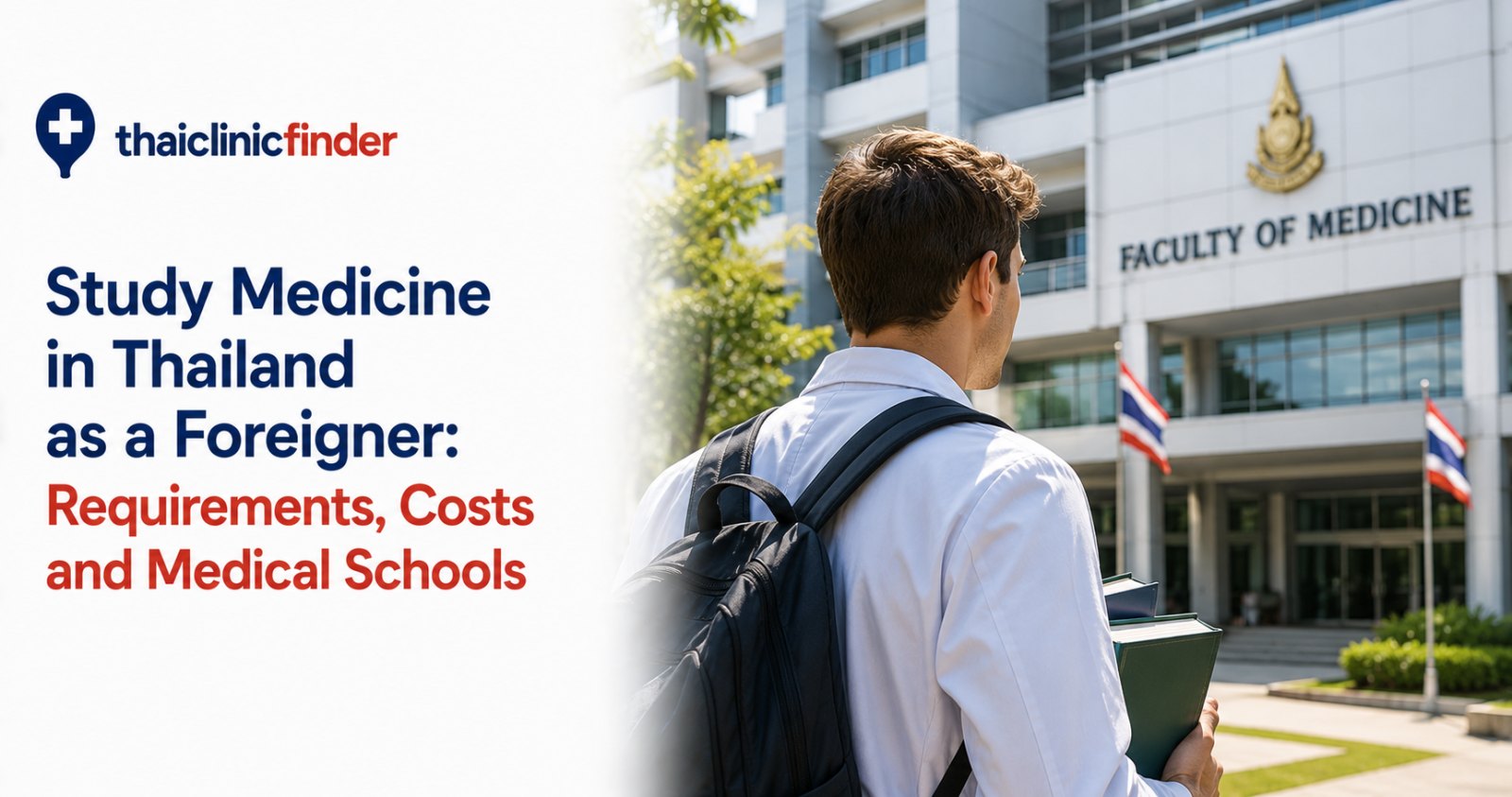
Foreign students can study medicine in Thailand, but finding a suitable program is more complicated than simply applying to any Thai medical school. Our comparison of medical schools in Bangkok focuses on the institutions and their published programmes. Most medical education in Thailand is closely connected to the Thai healthcare system, Thai-speaking patients and national professional requirements, while only a limited number of medical programs are explicitly designed for international applicants.
One of the clearest current options is CU-MEDi, the Doctor of Medicine International Program at the Faculty of Medicine, Chulalongkorn University in Bangkok. The university explicitly states that students of any nationality are encouraged to apply.
CU-MEDi is not a traditional six-year medical degree entered directly from secondary school. It is a four-year graduate-entry Doctor of Medicine program, which means applicants must already hold, or be about to complete, a bachelor's degree.
There is another important distinction international applicants should understand before applying: graduating from medical school in Thailand does not automatically give a foreign national the right to practise medicine in Thailand. Medical licensing is regulated separately by the Medical Council of Thailand.
Yes, foreigners can study medicine in Thailand, but the route matters
Thailand has many established medical faculties, including those associated with Chulalongkorn University, Mahidol University, Chiang Mai University and other public and private universities.
However, a medical faculty being prestigious or having an English-language website does not mean that its standard Doctor of Medicine program accepts international students or teaches the medical curriculum in English.
Foreign applicants should distinguish between:
- Thai-language Doctor of Medicine programs
- international medical programs
- graduate-entry MD programs
- master's and PhD programs offered by medical faculties
- postgraduate clinical programs intended for people who are already doctors
For someone who is not yet a doctor and wants to obtain a primary medical qualification in Thailand, the program must actually lead to a Doctor of Medicine degree. A master's degree in public health, tropical medicine or medical science does not qualify someone as a physician.
CU-MEDi is the clearest international MD route currently available
Chulalongkorn University's Faculty of Medicine operates the Chulalongkorn University International Medical Program, usually shortened to CU-MEDi.
The university describes it as Thailand's first international medical program designed specifically for bachelor's degree graduates.
The program lasts four years and leads to a Doctor of Medicine degree.
CU-MEDi states explicitly in its international student FAQ that students of any nationality are strongly encouraged to apply.
This makes it substantially easier to evaluate for a foreign applicant than programs whose admissions information is intended primarily for Thai secondary-school students.
You cannot enter CU-MEDi straight from high school
This is probably the most important admission detail.
Applicants must already have at least a bachelor's degree or be in the final year of a bachelor's program and complete that degree by the university's specified deadline.
For the 2026 intake, Chulalongkorn required applicants to have graduated with at least a bachelor's degree or to be expected to graduate by July 2026.
The university states that graduates from any academic background can apply.
That means the bachelor's degree does not necessarily have to be in biology, chemistry or another biomedical subject.
However, applicants must still complete the academic selection requirements, including the MCAT.
The MCAT is part of the admission process
CU-MEDi requires applicants to submit a valid Medical College Admission Test, or MCAT, score.
The MCAT is the same standardized examination widely associated with medical-school applications in the United States and Canada.
For the 2026 admissions cycle, Chulalongkorn required the MCAT result to have been obtained within two years of the final application deadline.
The university's published application checklist also requires the verification code associated with the MCAT score.
CU-MEDi does not simply replace the MCAT with an internal science entrance examination for international applicants, so prospective students need to plan the test well before the application window.
English requirements are substantial
Although the program is based in Thailand, CU-MEDi is an international medical program and applicants need to demonstrate sufficient English proficiency unless they qualify for an exemption.
For the 2026 intake, the published minimum scores were:
- TOEFL iBT: at least 85
- IELTS Academic: at least 7.0 overall
The university allows specific exemptions for applicants who meet both nationality and English-medium education conditions published in its admission rules.
Applicants should check the current admission announcement rather than relying on a previous year's score because requirements can change between admissions cycles.
You do not need fluent Thai before applying
CU-MEDi states that international applicants do not need to be fluent in Thai to enter the program.
That does not mean Thai is irrelevant to medical training.
Students take basic Thai language instruction because clinical education involves communication with Thai-speaking patients and their families.
This distinction is important. Lectures being delivered through an international curriculum does not eliminate the need to communicate in the language commonly used by patients during clinical clerkships.
A student who intends to spend four years in Thai hospitals will benefit considerably from developing practical Thai beyond the minimum classroom requirement.
The course is four years, but medicine still requires a major time commitment
CU-MEDi is shorter than a conventional six-year undergraduate medical program because students enter after already completing a bachelor's degree.
Chulalongkorn describes the program as a four-year integrated medical curriculum with clinical exposure beginning early in training.
Students study basic medical sciences alongside clinical material rather than completing all theoretical sciences before any patient exposure.
Before beginning the main curriculum, successful 2026 applicants also completed an eight-week Foundations of Medicine course covering subjects such as:
- cell biology
- metabolism
- genetics and embryology
- histology
- physiology
- immunology
- microbiology
- parasitology
- pharmacology
- pathology
The program therefore remains a substantial commitment even though it takes four years rather than six.
Clinical training means studying medicine in a real Thai healthcare environment
Medical education is different from studying an ordinary English-language university degree.
Students eventually work with patients, clinical teams and hospital systems. Even within an international program, much of that environment is naturally Thai.
CU-MEDi specifically notes that conversational Thai is useful for communicating with patients and their families during clinical clerkships.
This is something international students should consider before choosing Thailand solely because the academic curriculum is delivered internationally.
Being willing to learn Thai can make clinical training considerably more practical.
International clinical exposure is built into CU-MEDi
CU-MEDi states that students may gain clinical experience abroad during the final year through partnered institutions in countries including the United States and United Kingdom.
This international orientation is one of the features distinguishing the program from a conventional Thai-language medical course.
Students considering practising outside Thailand should nevertheless investigate the licensing requirements of their intended destination independently.
Completing an international medical curriculum does not automatically guarantee registration in another country.
How competitive is admission?
Applicants should expect medical-school selection to be competitive.
The process involves more than meeting the minimum English and degree requirements.
For the 2026 intake, application materials included:
- bachelor's degree documentation or proof of expected graduation
- academic transcripts
- English proficiency evidence when required
- MCAT results
- statement of purpose
- curriculum vitae
- recommendation letters
- other documentation required by the university
Applicants who progressed through the process also underwent an interview and psychological assessment.
Meeting a minimum TOEFL or IELTS score therefore does not guarantee admission.
The admissions calendar starts earlier than many foreigners expect
Applicants planning to relocate to Thailand should work backwards from the university's admissions calendar.
For the 2026 academic year, CU-MEDi accepted online applications from 2 to 20 February 2026.
The interview and psychological assessment took place in March, final enrolment results were announced in May, the Foundations course ran during June and July, and the first semester began in August.
The 2026 admissions cycle is already complete. Chulalongkorn states that information for the 2027 intake will be published through the official CU-MEDi admissions website.
Prospective students should therefore monitor the next official announcement rather than assuming the 2026 dates will be repeated exactly.
Studying medicine in Thailand is not particularly cheap through the international route
Thailand can have relatively affordable university programs in some fields, but international medical education should not automatically be viewed as a low-cost option.
CU-MEDi divides its fees into a university tuition fee and a separate program fee.
The program currently publishes:
- international tuition reference: THB 106,000 per semester
- program fee: approximately THB 4.5 million for the complete four-year program
The university notes that the tuition figure displayed on its website is based on the rate published as of December 2019 and can change. It also states that fees can increase in subsequent years.
The approximate THB 4.5 million program fee covers elements including local clerkship and international externship according to the university.
Because tuition information can change, applicants should request a current written fee schedule before making financial plans.
Do not forget the cost of the degree you need before medical school
Because CU-MEDi is graduate entry, its four-year price is not the complete educational cost for someone beginning immediately after secondary school.
A student first needs to complete a bachelor's degree, normally requiring several additional years.
The complete educational pathway can therefore resemble:
- approximately three to four years for a bachelor's degree
- four years at CU-MEDi
- internship or further supervised training depending on the jurisdiction
- residency if pursuing specialist training
For someone choosing between medical-school systems internationally, comparing only the four-year CU-MEDi tuition with a six-year undergraduate medical degree elsewhere can therefore be misleading.
The biggest issue for foreigners comes after graduation
A foreign student can be admitted to CU-MEDi, but that does not mean a foreign graduate automatically receives a Thai licence to practise medicine.
CU-MEDi addresses this directly in its FAQ.
The university states that under current Medical Council of Thailand regulations, foreign nationals are not automatically eligible to apply for a Thai medical licence or practise medicine in Thailand unless they meet the Medical Council's applicable requirements.
This is a major consideration for international applicants whose primary goal is to settle permanently and work as doctors in Thailand.
Admission eligibility and professional licensing eligibility are separate questions.
A Thai MD degree and a Thai medical licence are not the same thing
Graduating from medical school establishes an academic qualification.
Practising independently as a doctor is a regulated professional activity.
The Medical Council of Thailand determines who can register and practise medicine in Thailand. It also publishes specific procedures for foreign physicians seeking registration.
Those rules can involve issues such as:
- recognition of the medical qualification
- professional licensing status
- licensing examinations
- Medical Council membership
- other regulatory conditions applying to foreign physicians
The rules applicable to an established foreign doctor are not necessarily identical to the pathway available to a newly graduated international student.
For that reason, prospective students should obtain current written clarification from CU-MEDi and the Medical Council of Thailand if practising in Thailand after graduation is central to their decision.
Do this before investing several years and millions of baht in the program.
What if you want to practise outside Thailand?
Studying medicine in Thailand does not prevent someone from pursuing a medical career elsewhere, but every country has its own registration system.
CU-MEDi states that its students may pursue medical licensing examinations in Thailand and abroad, including examinations such as the United States Medical Licensing Examination.
However, eligibility to sit an examination is not the same as guaranteed registration.
Before enrolling, investigate the country where you ultimately intend to practise and check:
- whether the medical school is acceptable to that regulator
- required licensing examinations
- internship requirements
- residency rules
- language requirements
- immigration restrictions
- recognition of clinical rotations
This matters particularly if your goal is to return to Europe, North America, Australia or another highly regulated medical system.
Not every international program at a medical faculty makes you a doctor
Thailand has many English-language postgraduate courses run by medical faculties.
Mahidol University, for example, currently offers international graduate programs in areas such as:
- Clinical Tropical Medicine
- Translational Medicine
- Medical Physiology
- Pharmacology and New Drug Development
- Biodesign in Medicine
- Public Health
These can be excellent options for researchers, health professionals or doctors pursuing additional training.
They are not substitutes for a primary Doctor of Medicine degree if your goal is to become a physician from the beginning.
Always check the degree awarded rather than assuming that a program with medicine in its name is medical school.
Already a doctor? Your route is completely different
A foreign physician who already holds an MD or MBBS generally does not need to enrol in a four-year primary medical degree simply to study in Thailand. Applicants searching specifically for the qualification can compare MD and MBBS programmes in Bangkok, while checking the exact degree title awarded.
Thai universities offer postgraduate programs designed for existing doctors.
Mahidol University's Faculty of Tropical Medicine, for example, currently offers an international Master of Clinical Tropical Medicine. Its 2026 admissions information includes separate fee schedules for foreign students and the program is taught in English.
Other master's degrees, doctoral programs, fellowships and specialist educational opportunities may also exist depending on the field.
Professional clinical practice remains subject to Thai licensing rules, so being admitted to a postgraduate medical course does not by itself authorise a foreign doctor to treat patients independently in Thailand.
Student visa arrangements come after university admission
An international student accepted by a recognised Thai university will generally need an appropriate education visa or other immigration status allowing study.
The university normally supplies documents required for the visa application after admission.
Immigration rules can change, and the exact process depends on nationality and circumstances. Prospective medical students should follow the university's current international student instructions and official Thai immigration guidance rather than relying on old student forums.
A four-year medical degree also means maintaining valid immigration status throughout the course, not simply obtaining a visa once before arrival.
Bangkok is likely to be your home, not a temporary medical-tourism stop
CU-MEDi is part of the Faculty of Medicine at Chulalongkorn University in Bangkok.
A medical student therefore needs to budget like a long-term resident rather than a tourist.
In addition to tuition, consider:
- accommodation
- food
- local transport
- health insurance
- visa-related expenses
- books and study materials
- examination fees
- MCAT expenses before admission
- flights home
- clinical clothing and equipment
- international elective expenses not otherwise covered
Four years of living expenses can materially change the total cost of the degree.
Thai language becomes more valuable every year you stay
You can enter CU-MEDi without being fluent in Thai, but the practical value of learning the language increases once clinical work begins.
Medicine involves far more nuanced communication than ordering food or asking for directions.
Patients may need to explain pain, medication use, family history, sensitive symptoms and fears about treatment. Even when supervisors or interpreters are available, direct communication skills can improve the clinical learning experience.
An international applicant who actively wants to learn Thai is likely to find the transition easier than someone expecting an entirely English-speaking environment for four years.
Questions to answer before applying
Before committing to medical school in Thailand, ask yourself:
- Do I already have, or will I complete, a bachelor's degree?
- Can I take the MCAT before the application deadline?
- Do I meet the English-language requirement?
- Can I finance the entire four-year program and living costs?
- Am I willing to learn enough Thai for clinical communication?
- Where do I ultimately want to practise medicine?
- Will that country's regulator recognise my medical education?
- If I want to remain in Thailand, what licensing route would apply to me as a foreign national?
The last two questions are especially important. Choosing a medical school should begin with the licence you ultimately need, not end with it.
A sensible application plan for international students
Someone targeting the next CU-MEDi intake can prepare well in advance.
A practical sequence is:
- Confirm that your bachelor's degree meets the eligibility rules.
- Review the next official CU-MEDi admission announcement.
- Schedule the MCAT early enough to receive a valid score.
- Take IELTS or TOEFL if you do not qualify for an exemption.
- Prepare academic transcripts and degree documentation.
- Arrange recommendation letters early.
- Prepare your CV and statement of purpose.
- Budget for both tuition and the separate program fee.
- Investigate medical licensing in the country where you ultimately want to work.
- Apply during the official admissions window rather than through a third-party education agent unless specifically authorised.
CU-MEDi's 2026 intake is complete, so applicants now considering the program should monitor the university for the 2027 admission announcement.
Is Thailand a good place to study medicine as a foreigner?
Thailand can be a viable option for the right international applicant, particularly someone who already holds a bachelor's degree and wants an English-language graduate-entry medical program in Bangkok.
CU-MEDi provides a clearly documented route open to applicants of any nationality, with a four-year curriculum, clinical education in Thailand and opportunities for international clinical exposure.
The limitations are equally important. The pathway is expensive relative to many Thai university courses, applicants need a prior bachelor's degree and MCAT score, and foreign graduates should not assume they will automatically be allowed to practise medicine in Thailand.
For most prospective students, the most important decision is therefore not simply whether they can study medicine in Thailand. It is whether the degree fits the licensing system and medical career they want after graduation.
Frequently Asked Questions
Can foreigners study medicine in Thailand?
Yes. Chulalongkorn University's CU-MEDi Doctor of Medicine International Program explicitly accepts international applicants and states that students of any nationality are encouraged to apply. Other Thai medical programs have different admission and language requirements.
Can I study medicine in Thailand in English?
Yes. CU-MEDi is an international Doctor of Medicine program at Chulalongkorn University. Students do not need to be fluent in Thai for admission, although basic Thai is taught because clinical training involves Thai-speaking patients.
Can I study medicine in Thailand directly after high school?
Not through CU-MEDi. It is a graduate-entry program requiring applicants to already hold a bachelor's degree or be completing one by the university's specified deadline. Other Thai MD programs follow different admission systems.
How long does medical school take in Thailand for an international student?
CU-MEDi takes four years after a bachelor's degree. This differs from conventional undergraduate medical programs that may begin after secondary school and take longer.
Do foreign applicants need the MCAT to study medicine at Chulalongkorn University?
Yes. CU-MEDi currently requires a valid MCAT result as part of its admissions process.
What IELTS score do I need for CU-MEDi?
For the 2026 intake, CU-MEDi published a minimum IELTS Academic overall score of 7.0 or TOEFL iBT score of 85, subject to specific exemptions. Applicants should check the next admission announcement because requirements can change.
How much does it cost to study medicine in Thailand as a foreigner?
CU-MEDi currently publishes a program fee of approximately THB 4.5 million for the four-year program plus university tuition. Its website displays an international tuition reference of THB 106,000 per semester but notes that this tuition figure dates from 2019 and is subject to change, so applicants should obtain the current fee schedule directly from the university.
Can a foreign student become a doctor in Thailand after graduating?
Graduating from a Thai medical program does not automatically give a foreign national the right to practise medicine in Thailand. Medical licensing is regulated separately by the Medical Council of Thailand, and international students should verify the current rules before enrolling if working in Thailand is their goal.
Do I need to speak Thai to study medicine in Thailand?
CU-MEDi does not require applicants to be fluent in Thai, but students take basic Thai because conversational Thai is useful when working with Thai-speaking patients and families during clinical training.
When can I apply for CU-MEDi?
The 2026 admission cycle is complete. Chulalongkorn University states that information for the 2027 intake will be announced on the official CU-MEDi admissions website.
Sources

Writer
Thai Clinic Finder Editorial Team
The editorial team checks public healthcare information against official provider and institutional sources. It does not provide medical advice.