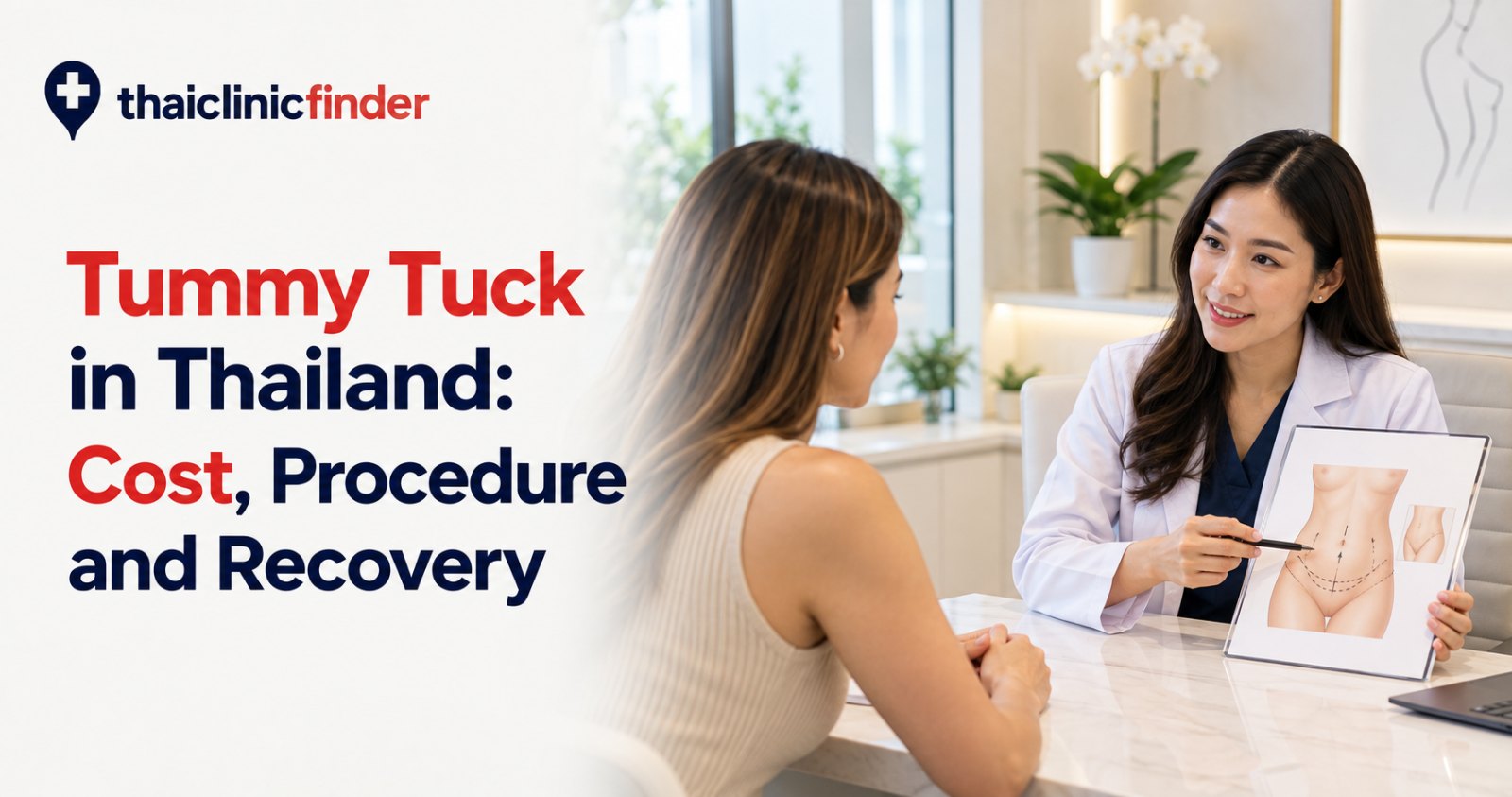
A tummy tuck in Thailand typically costs well over THB 100,000, and current published hospital prices give a useful starting point.
Yanhee International Hospital in Bangkok currently lists a full tummy tuck at THB 126,000 for patients weighing under 70 kg, including a three-night hospital stay. For patients above 70 kg, Yanhee adds THB 18,000 per additional 10 kg. Samitivej currently lists tummy tuck surgery from approximately THB 140,000 in one of its body treatment packages.
These are provider-specific prices rather than a national average. The final cost depends on the amount of excess skin, muscle separation, body weight, whether liposuction is added, operating time, anesthesia and hospital stay.
A tummy tuck is also much more than abdominal liposuction. It removes excess skin and fat and can repair separated abdominal muscles, particularly after pregnancy or major weight loss.
How much does a tummy tuck cost in Thailand?
Current first-party hospital pricing provides the clearest reference.
| Provider | Procedure | Published Price |
|---|---|---|
| Yanhee International Hospital | Full tummy tuck, under 70 kg | THB 126,000 |
| Yanhee International Hospital | Additional weight above 70 kg | THB 18,000 per additional 10 kg |
| Samitivej | Tummy tuck | From approximately THB 140,000 |
Yanhee's current tummy tuck package includes a three-night hospital stay and its published information states that the quoted surgical package includes the surgeon and anesthesia.
Prices can rise when surgery becomes more extensive.
Possible additions include:
- liposuction
- extended skin removal
- muscle repair
- treatment after massive weight loss
- additional hospital nights
- correction of the navel
- revision surgery
For broader cosmetic surgery pricing, see Plastic Surgery Cost in Thailand.
Yanhee's current tummy tuck price
Yanhee currently publishes one of the clearest abdominoplasty tariffs in Thailand.
For patients weighing less than 70 kg, the current price is:
THB 126,000
The hospital stay is listed as three nights.
For patients above 70 kg, the hospital currently adds:
THB 18,000 for each additional 10 kg.
For example, the pricing structure means someone substantially above 70 kg may receive a quote considerably higher than the base THB 126,000 figure.
The final quotation should still be confirmed after consultation because body shape and surgical complexity matter more than weight alone.
What about a mini tummy tuck?
A mini tummy tuck treats mainly the lower abdomen below the belly button.
It generally involves:
- less skin removal
- a shorter scar
- no repositioning of the belly button in many cases
- a more limited muscle repair
Yanhee's Thai-language plastic surgery price information currently lists mini abdominoplasty at THB 81,000.
This is significantly cheaper than a full tummy tuck, but it is suitable only for selected patients.
Someone with significant loose skin above the navel or extensive abdominal muscle separation usually needs a full abdominoplasty rather than a mini procedure.
Choosing a mini tummy tuck simply because it costs less can produce an incomplete result if the problem extends across the whole abdomen.
Full tummy tuck versus mini tummy tuck
The difference is not just price.
Full tummy tuck
A full abdominoplasty typically addresses:
- loose skin above and below the navel
- excess lower abdominal skin
- abdominal wall laxity
- rectus muscle separation
The belly button usually remains attached internally but is brought through a new opening after the surrounding skin is tightened.
The scar generally runs low across the abdomen from one side toward the other.
Mini tummy tuck
A mini procedure focuses on the lower abdomen.
It may suit someone who has:
- a small amount of loose skin below the navel
- relatively good upper abdominal skin
- limited lower abdominal muscle laxity
Bangkok Hospital Pattaya also describes partial abdominoplasty as an option for selected people whose main concern is the lower abdomen.
What exactly does a tummy tuck do?
Abdominoplasty removes excess abdominal skin and fat and can tighten the underlying abdominal wall.
Bangkok Hospital describes the procedure as particularly suitable for people with:
- loose or hanging abdominal skin
- changes after pregnancy
- significant weight loss
- abdominal laxity after previous surgery
Yanhee explains that a full tummy tuck can repair separation of the abdominal muscles while removing excess skin.
This is why a tummy tuck can change the abdominal contour in a way that liposuction alone cannot.
Tummy tuck versus liposuction
These procedures solve different problems.
Liposuction removes fat.
A tummy tuck removes loose skin and can repair abdominal muscle separation.
Someone with good skin elasticity and localized fat may need only liposuction.
Someone with significant loose skin after pregnancy or major weight loss may still have hanging skin even if the fat underneath is removed.
For these patients, liposuction alone can sometimes make skin laxity more obvious.
Yanhee currently lists VASER liposuction of either the upper or lower abdomen at THB 66,000 per area, which gives a useful comparison with its THB 126,000 full tummy tuck price.
Can you combine a tummy tuck with liposuction?
Yes.
Abdominoplasty is often combined with liposuction of areas such as:
- flanks
- waist
- upper abdomen
- lower back
The aim is to improve the contour beyond what skin excision alone can achieve.
However, combining procedures can increase:
- operating time
- cost
- swelling
- recovery demands
- complication risk
Yanhee states that combined tummy tuck and liposuction plans are individually quoted rather than simply adding two published procedure prices together.
Ask for a complete written quotation showing exactly which areas will be treated.
What is diastasis recti?
Diastasis recti is separation of the two vertical rectus abdominal muscles.
It commonly develops after pregnancy but can also occur with major weight change or abdominal stretching.
A patient may notice:
- central abdominal bulging
- a stomach that protrudes despite low body fat
- weakness through the abdominal wall
A tummy tuck can include surgical repair of this separation.
This is one of the main reasons abdominoplasty should not be confused with fat removal.
The operation changes both skin and, in selected cases, the abdominal wall underneath.
Who is a good candidate for abdominoplasty?
Bangkok Hospital Pattaya describes an ideal candidate as someone relatively close to normal weight with excess abdominal skin and weakened muscles.
Typical candidates include people who have:
- completed pregnancy
- lost substantial weight
- loose skin around the abdomen
- abdominal muscle laxity
- stable body weight
Someone planning significant future weight loss may be advised to postpone surgery.
Likewise, people planning another pregnancy may want to delay abdominal muscle repair because another pregnancy can stretch the tissues again.
A tummy tuck is not a weight-loss operation
Abdominoplasty can remove some skin and fat, but its primary purpose is body contouring.
It is not a substitute for:
- diet
- exercise
- obesity treatment
- bariatric surgery
If body weight is still changing significantly, waiting until weight has stabilized can improve surgical planning and reduce the chance of developing new loose skin afterward.
This also helps explain why some hospitals adjust price according to body weight or surgical complexity.
Why body weight affects the price
Yanhee's current pricing structure explicitly increases the tummy tuck price above 70 kg.
This likely reflects the fact that larger procedures may involve:
- more tissue removal
- longer operating time
- more complex dissection
- higher anesthesia requirements
- greater postoperative monitoring
Weight itself does not determine whether someone is a good candidate.
A surgeon should assess overall health, abdominal anatomy and surgical risk rather than using one number alone.
How long does tummy tuck surgery take?
Yanhee currently estimates approximately 2 to 3 hours for a standard tummy tuck.
More complicated procedures can take longer, especially when combined with liposuction or extensive skin removal.
The operation is generally performed under general anesthesia.
A full tummy tuck is therefore a substantial operation rather than a minor outpatient cosmetic procedure.
How long do you stay in hospital?
Yanhee currently includes three hospital nights in its standard tummy tuck package.
Other hospitals may use different protocols depending on:
- extent of surgery
- medical history
- combination procedures
- drainage
- postoperative mobility
International patients should ask both how long they stay in hospital and how long they should remain in Thailand afterward.
Those are not the same thing.
What happens immediately after surgery?
Patients commonly experience:
- abdominal tightness
- swelling
- bruising
- incision discomfort
- difficulty standing completely upright at first
Drains may be used temporarily to remove fluid.
Yanhee advises patients to maintain a slightly flexed position during the earliest recovery period and begin gentle movement early.
The surgeon will usually provide instructions covering:
- wound care
- drains
- pain medication
- compression garments
- walking
- showering
- exercise
Follow those instructions rather than adopting a recovery routine from another patient's social media post.
How long does recovery take?
Yanhee's current guidance states that ordinary activity may resume from around two weeks, while more strenuous exercise and heavy lifting generally need to wait approximately four to six weeks.
Patients are also advised to wear a compression garment for approximately four to six weeks.
Visible swelling can persist beyond the early recovery period.
The final contour and scar appearance continue changing for months.
Someone traveling to Thailand for surgery should therefore not plan a highly active holiday immediately after the operation.
How long should you stay in Thailand?
Yanhee schedules postoperative follow-up and stitch removal at approximately 7 to 10 days.
That gives international patients a useful minimum planning reference.
However, long-haul flying after abdominoplasty deserves additional caution because major surgery and prolonged immobility can increase the risk of deep vein thrombosis and pulmonary embolism.
Your surgeon should decide when you are fit to fly according to:
- procedure extent
- recovery
- mobility
- personal clotting risk
- flight duration
Do not book the cheapest non-changeable flight for a few days after surgery simply because the hospital discharge date is earlier.
Blood clot risk matters more with a tummy tuck
Deep vein thrombosis, or DVT, occurs when a blood clot develops in a deep vein, usually in the leg.
A clot can potentially travel to the lungs and cause pulmonary embolism.
Abdominoplasty is a larger operation than many facial cosmetic procedures, and long periods of immobility can further increase risk.
Patients may be advised to use measures such as:
- early walking
- leg exercises
- compression stockings
- medication in selected higher-risk cases
The correct prevention plan depends on individual risk.
This is particularly relevant to international patients planning a long-haul flight home.
Where is the tummy tuck scar?
A full tummy tuck produces a permanent lower abdominal scar.
It typically runs horizontally across the lower abdomen and is positioned so that it can often be hidden beneath underwear or swimwear.
There is also usually a scar around the navel after a full procedure.
A mini tummy tuck normally produces a shorter lower abdominal scar.
The length depends on how much excess skin needs to be removed.
Anyone considering surgery should ask to see fully healed scars, not only front-facing before-and-after photos taken from a flattering distance.
Stretch marks may improve, but they do not all disappear
A tummy tuck can remove stretch-marked skin when that skin lies within the area being excised, particularly the lower abdomen.
Stretch marks outside the removed skin remain.
Yanhee also separately lists laser treatment for stretch marks at THB 27,500, which highlights that abdominoplasty itself should not be marketed as a complete stretch-mark treatment.
Bangkok Hospital similarly describes abdominoplasty as potentially reducing the area of abdominal stretch marks rather than eliminating every stretch mark.
What are the main risks?
Recognized complications include:
- bleeding
- hematoma
- infection
- seroma
- delayed wound healing
- wound separation
- poor scarring
- numbness
- asymmetry
- skin or fat necrosis
- persistent swelling
- pain
- anesthesia complications
- deep vein thrombosis
- pulmonary embolism
- need for revision surgery
Yanhee specifically identifies DVT and pulmonary embolism among the serious potential complications.
Smoking, obesity, previous clotting history and extensive combined surgery can affect risk.
A consultation should include discussion of your own risk profile rather than only photographs of expected results.
Smoking is particularly problematic
Nicotine reduces blood flow to healing tissues.
This is especially important in a tummy tuck because a large area of abdominal skin is repositioned during surgery.
Poor blood supply can contribute to:
- delayed healing
- wound breakdown
- skin necrosis
- worse scarring
Yanhee currently advises stopping smoking before and after surgery.
Tell the surgeon about cigarettes, vaping and nicotine products rather than treating only traditional smoking as relevant.
Tummy tuck after pregnancy
Pregnancy is one of the most common reasons for considering abdominoplasty.
The operation can address a combination of:
- loose skin
- muscle separation
- lower abdominal overhang
- changes around the navel
However, if another pregnancy is planned soon, postponing surgery may make sense because pregnancy can stretch the repaired abdominal wall and skin again.
A tummy tuck does not prevent pregnancy, but future pregnancy can affect the cosmetic result.
Tummy tuck after major weight loss
People who lose substantial weight can be left with significant hanging skin even after reaching a healthy body weight.
In these cases, abdominoplasty may form part of broader body-contouring surgery.
Depending on the amount and distribution of loose skin, a standard tummy tuck may not be enough.
Some patients need an extended procedure or other body-lift surgery.
Bangkok Hospital Chiang Mai specifically lists body contouring after substantial weight loss among its plastic surgery services.
Can men have a tummy tuck?
Yes.
Abdominoplasty can be performed in both men and women.
For men, common reasons include:
- major weight loss
- loose lower abdominal skin
- abdominal muscle laxity
The scar and surgical planning may differ according to body shape and preferred underwear position.
The procedure is based on anatomy rather than gender.
Bangkok, Pattaya or Chiang Mai?
Tummy tuck surgery is available in several major Thai medical centers.
Bangkok offers the widest choice of large private hospitals and cosmetic surgery facilities.
Bangkok Hospital Pattaya also has a dedicated Dermatology and Plastic Surgery Center that lists abdominoplasty among its services.
Bangkok Hospital Chiang Mai likewise lists tummy tuck and post-weight-loss body contouring through its cosmetic surgery service.
The city should not be the main criterion.
Prioritize:
- surgeon qualifications
- hospital capability
- anesthesia support
- postoperative care
- access to emergency treatment
A beach location is not an advantage if the clinical setup is weaker.
Verify the surgeon before paying
Ask the hospital for the surgeon's full name.
Thailand's Medical Council provides an official English-language doctor verification tool where patients can check whether a physician is currently licensed to practise medicine.
Do not rely only on a clinic biography or social media account.
If the doctor is described as a plastic surgeon, also ask about recognized specialist qualifications and experience with abdominoplasty.
A surgeon who performs many rhinoplasties is not automatically equally experienced in major abdominal body-contouring surgery.
Before-and-after photos need context
Before-and-after galleries are useful, but compare patients whose starting anatomy resembles yours.
Look at:
- degree of loose skin
- body weight
- muscle separation
- previous pregnancy
- previous weight loss
- scar location
- navel shape
Also ask how long after surgery the after photograph was taken.
A photo taken at six weeks does not show the same scar or swelling as a photo taken a year later.
What should be included in the price?
Before paying a deposit, ask for a written quotation showing whether the price includes:
- surgeon
- anesthesiologist
- operating room
- hospital stay
- pre-operative blood tests
- medication
- compression garment
- drains
- follow-up appointments
- stitch removal
Yanhee states that its current package covers the surgeon, anesthesia and listed hospital stay.
Other providers may structure quotations differently.
Budget beyond the surgical fee
International patients also need to consider:
- flights
- hotel accommodation after discharge
- local transport
- companion expenses
- food
- additional medication
- compression garments
- flight changes
- extra nights if recovery is slower than expected
A THB 126,000 surgical quote does not mean the entire medical tourism trip costs THB 126,000.
Build a buffer into the budget rather than planning only for the advertised package price.
Questions to ask before a tummy tuck in Thailand
Before booking, ask:
- Do I need a full or mini tummy tuck?
- Do I have diastasis recti?
- Will you repair the abdominal muscles?
- Do I need liposuction as well?
- Where will the scar be?
- Will my belly button be repositioned?
- Who will perform the surgery?
- Is the doctor a recognized plastic surgery specialist?
- How long will surgery take?
- How many hospital nights are included?
- Will I have drains?
- How long do I need a compression garment?
- When can I walk normally?
- When can I exercise again?
- When can I safely take a long-haul flight?
- How do you assess DVT risk?
- What exactly is included in the price?
- What costs extra?
- What happens if I develop a seroma or wound problem after discharge?
- What is the revision policy?
A good consultation should answer these questions according to your anatomy rather than offering the same procedure to everyone.
The practical cost range
Current first-party pricing suggests that around THB 120,000 to THB 140,000 is a reasonable starting reference for a standard full tummy tuck at major Thai hospitals, although more complex surgery can cost substantially more.
Yanhee currently lists:
- THB 126,000 for a full tummy tuck in patients under 70 kg
- THB 18,000 extra per additional 10 kg above 70 kg
- THB 81,000 for mini abdominoplasty in its Thai-language pricing
Samitivej lists tummy tuck surgery from approximately THB 140,000 in current package information.
The cheapest quoted procedure is not necessarily the best comparison. Make sure two hospitals are quoting the same operation, particularly when one quote includes muscle repair, liposuction, anesthesia and hospital admission while another does not.
For abdominoplasty, the most important variables are how much skin needs to be removed, whether the abdominal wall needs repair and how safely the hospital manages a relatively substantial operation and recovery.
Frequently Asked Questions
How much does a tummy tuck cost in Thailand?
Current first-party hospital pricing suggests around THB 120,000 to THB 140,000 as a useful starting reference for a standard full tummy tuck. Yanhee currently lists THB 126,000 for patients under 70 kg, while Samitivej lists tummy tuck surgery from approximately THB 140,000.
How much does a tummy tuck cost at Yanhee Hospital?
Yanhee currently lists a full tummy tuck at THB 126,000 for patients weighing under 70 kg, including a three-night hospital stay. It adds THB 18,000 for each additional 10 kg above 70 kg.
How much is a mini tummy tuck in Thailand?
Yanhee's current Thai-language plastic surgery pricing lists mini abdominoplasty at THB 81,000. Other hospitals may charge differently.
What is the difference between a tummy tuck and liposuction?
Liposuction removes fat. A tummy tuck removes loose skin and can tighten separated abdominal muscles. Patients with substantial skin laxity often need abdominoplasty rather than liposuction alone.
How long do you stay in hospital after a tummy tuck in Thailand?
Yanhee currently includes three hospital nights with its full tummy tuck package. Hospital stays at other providers can differ according to the procedure and patient's medical condition.
How long is recovery after a tummy tuck?
Yanhee advises that ordinary activity may resume from around two weeks, while heavy lifting and strenuous exercise generally need to wait approximately four to six weeks. Full swelling and scar maturation take much longer.
How long should I stay in Thailand after a tummy tuck?
Yanhee schedules follow-up and stitch removal at around 7 to 10 days, but international patients should ask their surgeon when they are medically fit for their specific flight, especially for long-haul travel.
Does a tummy tuck repair diastasis recti?
A full tummy tuck can include surgical repair of separated abdominal muscles. Whether muscle repair is needed depends on the patient's anatomy and should be confirmed during surgical assessment.
Can I have liposuction with a tummy tuck in Thailand?
Yes. Tummy tuck surgery can be combined with liposuction of areas such as the waist or flanks, but combined procedures usually require an individualized quotation and may increase recovery demands and risk.
How can I check a tummy tuck surgeon in Thailand?
Ask for the surgeon's full name and verify the doctor through the Medical Council of Thailand's official physician database. Also confirm recognized plastic surgery training and specific experience with abdominoplasty.
Sources
Writer
Niran Chaiyasit
Niran Chaiyasit is a Thai health writer with a background in public health and a focus on travel health, disease prevention and healthcare access in Thailand. His work covers topics such as common illnesses, vaccinations, mosquito-borne diseases, food safety and practical health information for travelers and expatriates.
Medical review
Justin Brooks
Daniel Brooks is an American health writer with a background in health sciences and a focus on rehabilitation, musculoskeletal health and patient education. He writes about physiotherapy, injury recovery, pain management, preventive health and practical healthcare guidance for international patients and travelers.