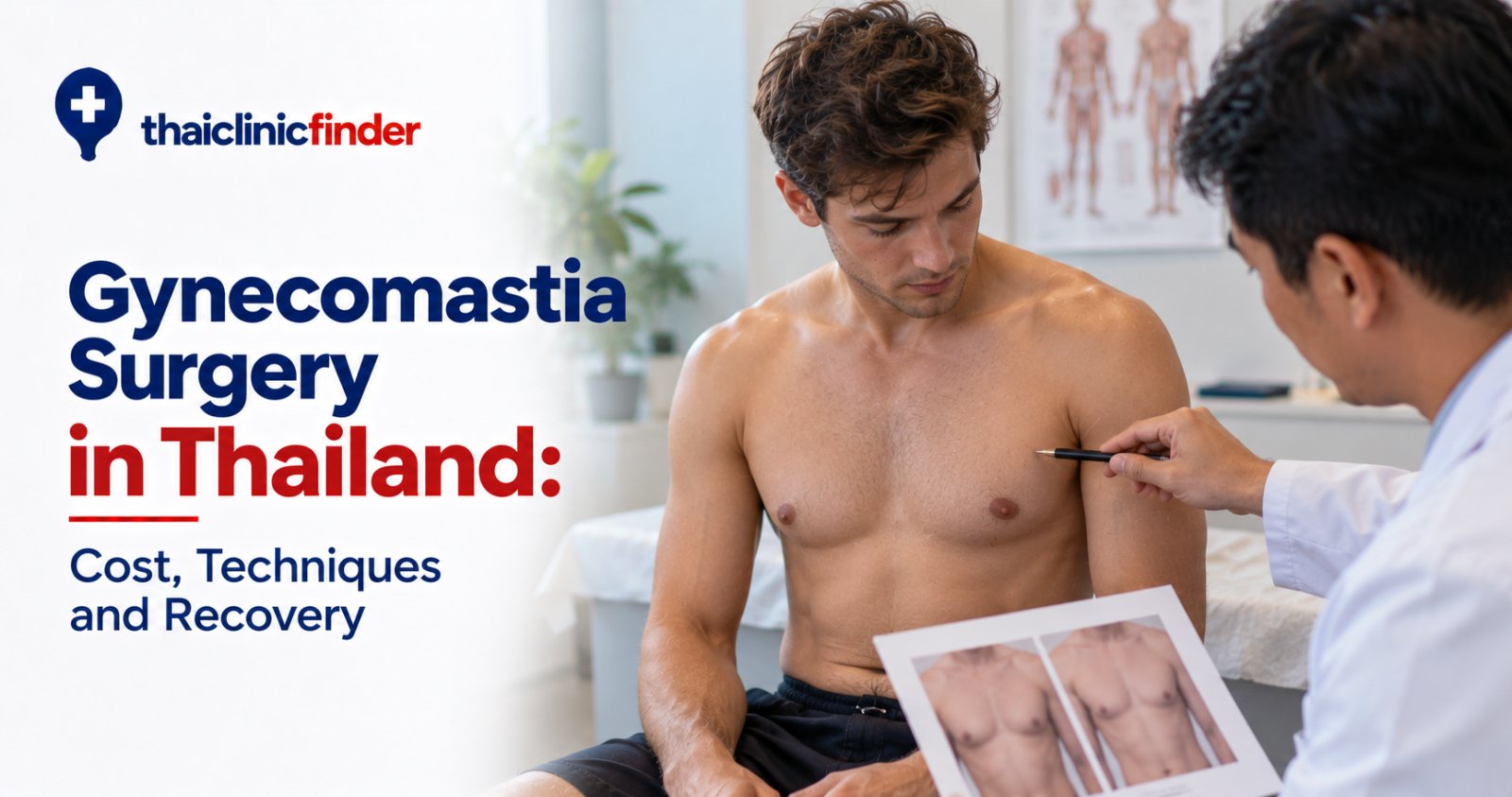
Gynecomastia surgery in Thailand can cost from around THB 71,000 for gland removal alone to approximately THB 106,000 for surgery combining gland removal with VASER liposuction, based on current published pricing from Yanhee International Hospital in Bangkok.
The final cost depends largely on what is causing the enlarged chest. Some men mainly have excess fatty tissue, some have true glandular gynecomastia, and many have a combination of both.
That distinction matters because liposuction removes fat but does not reliably remove firm glandular tissue behind the nipple. Someone with true gynecomastia may need surgical excision, sometimes combined with liposuction to contour the surrounding chest.
Before comparing cosmetic surgery packages, it is also worth confirming that surgery is actually appropriate. Gynecomastia can sometimes be associated with medications, anabolic steroids, hormonal changes or underlying medical conditions. A new, hard or unusual one-sided breast lump should be medically evaluated rather than assumed to be ordinary gynecomastia.
How much does gynecomastia surgery cost in Thailand?
Current published prices from Yanhee International Hospital in Bangkok provide a useful indication of the market:
| Procedure | Published Price | Hospital Stay |
|---|---|---|
| Subcutaneous mastectomy, gland removal | THB 71,000 | 1 night |
| VASER liposuction only | THB 87,000 | 1 night |
| Gland removal + tumescent liposuction | THB 96,000 | 1 night |
| Gland removal + VASER liposuction | THB 106,000 | 1 night |
Yanhee states that these packages include the surgeon, anaesthesia, the stated hospital stay, pre-operative tests and postoperative care.
These are individual hospital prices rather than a national average, and final quotations can vary according to the amount of tissue, surgical complexity, anaesthesia, hospital, surgeon and whether skin removal or nipple repositioning is necessary.
A realistic gynecomastia surgery budget
For many international patients, a realistic starting range is approximately THB 70,000 to THB 110,000 for straightforward male breast reduction at a major Bangkok cosmetic hospital.
More complex cases can cost more, particularly when surgery involves:
- substantial skin removal
- nipple or areola repositioning
- significant asymmetry
- previous surgery
- revision surgery
- larger-volume liposuction
- additional hospital stay
- treatment of another chest condition
The advertised surgical price is also not your complete medical tourism budget.
You may need to add:
- consultation
- additional laboratory tests
- medication
- compression garments if not included
- hotel accommodation
- flights
- local transport
- additional nights in Thailand for follow-up
For a broader comparison of cosmetic procedure prices, see Plastic Surgery Cost in Thailand.
What exactly is gynecomastia?
True gynecomastia is an increase in glandular breast tissue in a male chest.
It commonly develops beneath or around the nipple and may feel firmer than the surrounding fat.
It can affect:
- one breast
- both breasts
- both sides unevenly
Gynecomastia is different from pseudogynecomastia, which refers primarily to increased fatty tissue in the chest.
The distinction is clinically important because the treatments differ.
Fat may respond to weight reduction or liposuction. Established glandular tissue generally does not disappear simply through chest exercises or fat loss.
Gland removal versus liposuction
The operation you need depends on the tissue present.
Gland removal
True glandular tissue is generally removed surgically through an incision, commonly positioned around the edge of the areola.
Yanhee currently lists subcutaneous mastectomy alone at THB 71,000.
This can be appropriate when firm gland is the dominant cause of chest enlargement and there is relatively little excess fat requiring contouring.
Liposuction
Liposuction removes fatty tissue.
Yanhee currently lists VASER liposuction alone for male breast reduction at THB 87,000.
This may be more suitable when chest fullness is primarily caused by fat rather than gland.
Gland removal plus liposuction
Many men have both.
In these cases, gland excision flattens the area beneath the nipple while liposuction blends the surrounding chest contour.
Yanhee currently publishes:
- gland removal with tumescent liposuction: THB 96,000
- gland removal with VASER liposuction: THB 106,000
This combined approach is therefore among the more expensive standard options.
What is VASER gynecomastia surgery?
VASER is a form of ultrasound-assisted liposuction used to help break down fatty tissue before removal.
It can be useful for contouring the chest around the glandular tissue.
However, VASER should not be treated as a substitute for gland excision when a substantial gland is present.
A clinic advertising VASER gynecomastia surgery should explain whether the treatment includes:
- liposuction only
- gland excision
- both procedures
This distinction matters more than the marketing name of the liposuction technology.
Why some gynecomastia surgery is cheaper than other procedures
A simple case may involve a relatively small amount of glandular tissue and limited liposuction.
A more complicated chest can involve:
- dense gland
- substantial fat
- loose skin
- enlarged areolae
- significant asymmetry
- previous surgery
As the operation becomes more extensive, surgical time and complexity increase.
Someone with a small gland behind each nipple should not expect the same treatment plan as a patient with severe breast enlargement and excess hanging skin.
Do you actually have gynecomastia or just chest fat?
This is one of the most important questions before surgery.
Pseudogynecomastia associated primarily with body fat can sometimes improve substantially with weight loss.
True glandular gynecomastia behaves differently.
A surgeon can assess the relative contribution of:
- glandular tissue
- fat
- excess skin
If you are significantly overweight and the chest enlargement appears predominantly fatty, achieving a more stable weight before surgery may improve planning and the final contour.
Can gynecomastia disappear without surgery?
Sometimes.
Gynecomastia occurring during puberty often improves naturally over time.
Adult gynecomastia may also improve if an identifiable cause can be addressed.
Possible causes include:
- hormonal changes
- anabolic steroid use
- certain medications
- liver disease
- kidney disease
- thyroid disorders
- low testosterone
- other endocrine disorders
Do not stop a prescription medicine solely because you suspect it is causing gynecomastia. Discuss it with the doctor who prescribed it.
If hormonal symptoms are part of the picture, medical assessment should come before cosmetic surgery. For context on private hormone services, see Hormone Therapy Cost in Thailand.
Anabolic steroids are particularly relevant
Gynecomastia can occur in people using anabolic-androgenic steroids because steroid use can disrupt the balance between androgens and estrogenic activity.
If ongoing anabolic steroid use contributed to the problem, surgery removes existing tissue but does not necessarily remove the underlying hormonal trigger.
Tell the surgeon about all substances you use, including:
- testosterone
- anabolic steroids
- bodybuilding compounds
- prescription medicines
- supplements
Trying to hide this information can make the medical assessment less accurate.
When a breast lump should be checked before cosmetic surgery
Gynecomastia is usually benign, but not every male breast lump is gynecomastia.
Medical assessment is especially important for a lump that is:
- hard
- fixed
- strongly one-sided
- away from the usual area beneath the nipple
- associated with nipple discharge
- associated with skin or nipple changes
- rapidly enlarging
The clinician may recommend imaging or additional investigation before cosmetic surgery.
A clinic should not rush directly to liposuction or gland excision without examining an unusual breast mass properly.
Bangkok is the main destination for gynecomastia surgery in Thailand
Bangkok offers the deepest plastic surgery market in Thailand and is the most practical destination for many international patients.
Advantages include:
- specialist plastic surgeons
- dedicated cosmetic hospitals
- major private hospitals
- international patient departments
- extensive laboratory and imaging services
- direct international flights
- large hotel market
Yanhee International Hospital, which publishes the specific gynecomastia prices used in this guide, is located in Bangkok.
Can you get gynecomastia surgery in Phuket or Pattaya?
Male breast reduction is also available through plastic surgery providers outside Bangkok, including major tourism destinations such as Phuket and Pattaya.
However, published package prices are not always available online.
For international patients, the surgeon is more important than choosing a city because it is convenient for a holiday.
Verify:
- who performs the operation
- where the surgery takes place
- what technique will be used
- whether follow-up is available locally
A beach destination can be attractive for recovery, but you will generally need to avoid swimming and strenuous activity while incisions heal.
What happens during gynecomastia surgery?
The exact procedure depends on the chest anatomy.
Yanhee describes surgery using general anaesthesia or local anaesthesia with sedation depending on the case.
The surgeon may:
- remove excess fat through liposuction
- make an incision around the areola
- remove firm glandular tissue
- contour the surrounding chest
- reposition the nipple if required in a larger reduction
- close the incisions
- apply a compression garment
The operation is individualized rather than standardized for every patient.
Where are the scars?
When glandular tissue is removed, the incision is commonly placed along part of the border between the areola and surrounding chest skin.
This can make the scar less conspicuous once it matures.
Liposuction usually requires several small access incisions.
More severe gynecomastia with substantial loose skin may require larger scars.
Ask the surgeon to draw the proposed incision locations before surgery rather than relying only on generic before-and-after photographs.
How long do you stay in hospital?
Yanhee's currently published gynecomastia packages include one hospital night.
This applies to:
- gland removal
- VASER liposuction
- combined gland removal and liposuction
Other hospitals may perform selected cases as day surgery or recommend a different length of stay.
The length of admission is not the same as the amount of time you should remain in Thailand after surgery.
How long should you stay in Thailand after gynecomastia surgery?
Yanhee schedules postoperative follow-up approximately 7 to 10 days after surgery.
For an international patient, planning to remain in Bangkok until that initial review can therefore be sensible.
Do not book a return flight solely according to the hospital discharge date.
Before traveling, confirm:
- when the first postoperative check occurs
- whether stitches need removal
- when flying is considered appropriate
- what happens if fluid collection or bleeding develops
- whether remote follow-up is available after you return home
What is recovery like?
Yanhee states that swelling and bruising commonly settle over approximately two weeks.
The final chest contour takes considerably longer to become apparent.
Its current guidance places final shape and scar maturation at approximately 6 to 12 months.
During early recovery you may experience:
- swelling
- bruising
- tenderness
- chest tightness
- numbness
- temporary contour irregularity
The chest should gradually improve rather than being judged during the first few postoperative days.
Compression garments are an important part of recovery
A compression garment is commonly worn after male breast reduction to support the tissues and help control swelling.
Follow the surgeon's instructions about:
- how many hours per day to wear it
- how many weeks it is required
- when it can be removed for showering
Do not automatically wear compression tighter or longer than instructed in the belief that this will create a better result.
When can you return to the gym?
This is particularly relevant because many men seeking gynecomastia surgery train regularly.
Walking usually resumes earlier than heavy upper-body exercise.
Chest training, heavy weights and strenuous activity need to wait until the surgeon is satisfied that healing is sufficient.
The exact timeline depends on:
- amount of gland removed
- extent of liposuction
- incision healing
- swelling
- complications
Do not judge readiness solely by whether pain has disappeared.
Heavy lifting too early can increase swelling or bleeding and disrupt healing.
Can gynecomastia come back after surgery?
Removed glandular tissue generally produces a long-lasting reduction.
However, the appearance of the chest can change again.
Potential factors include:
- substantial weight gain
- renewed anabolic steroid use
- medication-related hormonal effects
- untreated underlying hormonal disease
Some gland may intentionally remain to avoid creating a crater or depressed appearance beneath the nipple.
Ask the surgeon what recurrence means in the context of your specific operation.
What are the risks of male breast reduction?
Recognized surgical risks include:
- bleeding
- hematoma
- infection
- reaction to anaesthesia
- delayed wound healing
- visible or unfavorable scarring
- asymmetry
- contour irregularity
- altered nipple sensation
- numbness
- fluid collection
- loose skin
- over-resection beneath the nipple
- need for revision surgery
A chest can also look temporarily uneven during early healing because swelling does not always resolve symmetrically.
The crater deformity problem
Removing too much tissue directly beneath the nipple can produce a depressed or crater-like appearance.
For this reason, successful gynecomastia surgery is not simply about removing the maximum possible amount of tissue.
The surgeon needs to balance:
- gland removal
- preservation of a natural tissue layer
- fat contouring
- skin retraction
This is one reason specific experience with male chest contouring matters.
Loose skin may not disappear after gland removal
In mild and moderate cases, the skin may retract substantially after tissue removal.
More severe gynecomastia can leave significant excess skin.
Patients with:
- very large breasts
- major previous weight loss
- poor skin elasticity
- substantial nipple descent
may need additional skin excision or nipple repositioning.
That usually means longer scars and potentially a higher surgical cost.
Check your surgeon independently
Before undergoing gynecomastia surgery in Thailand, obtain the surgeon's full name and verify that the doctor is licensed through the Medical Council of Thailand.
If the provider describes the doctor as a plastic surgeon, ask about specialist plastic and reconstructive surgery training as well.
Experience specifically with gynecomastia matters because the operation combines removal and chest contouring.
For broader healthcare-provider checks, see What to Check Before a Medical Appointment in Thailand.
Ask to see comparable before-and-after cases
A useful portfolio should include men with a similar starting anatomy.
Consider:
- amount of gland
- chest fat
- nipple position
- skin quality
- overall body composition
Someone with a small puffy nipple has a different surgical problem from someone with severe breast enlargement and loose skin.
Ask how long after surgery the postoperative photographs were taken. Early images may not represent the final result.
What should be included in the quotation?
Ask the hospital or clinic to state clearly whether your quote includes:
- surgeon fee
- anaesthesia
- operating room
- hospital stay
- pre-operative tests
- medication
- compression garment
- pathology of removed tissue if performed
- follow-up appointments
Yanhee states that its current packages include the surgeon, anaesthesia, one hospital night, pre-operative tests and postoperative care.
Other providers may structure their fees differently.
Medical tourism adds costs that are easy to overlook
A THB 96,000 operation does not mean your Thailand trip costs THB 96,000.
A complete budget can include:
- international flights
- hotel for 7 to 10 days or longer
- airport and hospital transport
- meals
- companion expenses
- additional medication
- extra nights if recovery is slower than expected
- flight changes
This is particularly important when comparing Thailand with surgery in your home country.
Travel insurance may exclude elective cosmetic surgery
Do not assume your normal travel insurance will cover complications from planned gynecomastia surgery.
Policies can exclude:
- elective cosmetic procedures
- complications resulting from planned surgery
- additional hotel accommodation
- flight changes caused by cosmetic treatment
Read the policy before traveling and obtain specialist coverage if necessary.
Communication matters when choosing a clinic
Before booking, make sure you can communicate directly enough with the medical team to understand:
- surgical technique
- expected scars
- risks
- anaesthesia
- aftercare
- revision policy
Do not rely entirely on communication with a salesperson or international coordinator.
If English communication is important, see How to Choose an English-Speaking Clinic in Thailand.
Questions to ask before gynecomastia surgery in Thailand
Before paying a deposit, ask:
- Do I have true glandular gynecomastia, chest fat or both?
- Is there any reason I need hormonal testing or imaging first?
- Who will perform my surgery?
- Is the surgeon licensed in Thailand?
- Does the surgeon have specialist plastic surgery training?
- Do I need gland excision, liposuction or both?
- Will you use standard or VASER liposuction?
- Where will the scars be?
- Will skin need to be removed?
- Will the nipple or areola need repositioning?
- What type of anaesthesia will be used?
- What exactly is included in the price?
- How long will I stay in hospital?
- How long should I remain in Thailand?
- How long do I need to wear a compression garment?
- When can I return to the gym?
- What is your policy if revision surgery is needed?
A surgeon should be able to explain why the proposed operation matches your anatomy rather than simply offering the most expensive package.
The practical cost range
Current published pricing from a major Bangkok cosmetic hospital places gynecomastia surgery at approximately THB 71,000 to THB 106,000 for standard procedures.
The lower end covers gland removal alone, while combined gland excision and VASER liposuction reaches approximately THB 106,000 at the provider reviewed.
The most important factor is not whether VASER sounds more advanced or whether one clinic is THB 10,000 cheaper. It is determining what tissue needs to be removed and how the surgeon plans to create a natural chest contour.
Before undergoing surgery, confirm that persistent gynecomastia has been appropriately assessed, verify the surgeon independently and compare quotations according to the actual operation rather than headline price alone.
Frequently Asked Questions
How much does gynecomastia surgery cost in Thailand?
Current published prices at Yanhee International Hospital range from THB 71,000 for gland removal alone to THB 106,000 for gland removal combined with VASER liposuction.
How much does male breast reduction cost in Bangkok?
A current Bangkok example ranges from THB 71,000 to THB 106,000 depending on whether treatment involves gland removal, liposuction or both. More complex cases can cost more.
How much does VASER gynecomastia surgery cost in Thailand?
Yanhee currently lists VASER liposuction alone at THB 87,000 and gland removal combined with VASER liposuction at THB 106,000, both with a one-night hospital stay.
Is liposuction enough for gynecomastia?
Not always. Liposuction removes fat but does not reliably remove firm glandular breast tissue. Many patients with true gynecomastia need gland excision, sometimes combined with liposuction.
Can gynecomastia go away with weight loss?
Chest enlargement caused mainly by fat can improve with weight loss. True glandular gynecomastia generally does not disappear through weight loss or chest exercise alone.
How long is recovery after gynecomastia surgery?
Swelling and bruising commonly improve over roughly two weeks, although the final chest contour and scar maturation can take 6 to 12 months.
How long should I stay in Thailand after gynecomastia surgery?
Yanhee schedules follow-up around 7 to 10 days after surgery, so international patients should discuss remaining in Thailand until the first postoperative review before booking their return flight.
Can gynecomastia return after surgery?
The reduction is generally long-lasting after glandular tissue is removed, but significant weight gain, anabolic steroid use, medications or untreated hormonal causes can alter the chest again.
How do I check a gynecomastia surgeon in Thailand?
Ask for the surgeon's full name and verify the doctor through the Medical Council of Thailand. Also ask about specialist plastic surgery training and specific experience performing male breast reduction.
Sources
Writer
Niran Chaiyasit
Niran Chaiyasit is a Thai health writer with a background in public health and a focus on travel health, disease prevention and healthcare access in Thailand. His work covers topics such as common illnesses, vaccinations, mosquito-borne diseases, food safety and practical health information for travelers and expatriates.

Medical review
Justin Brooks
Daniel Brooks is an American health writer with a background in health sciences and a focus on rehabilitation, musculoskeletal health and patient education. He writes about physiotherapy, injury recovery, pain management, preventive health and practical healthcare guidance for international patients and travelers.