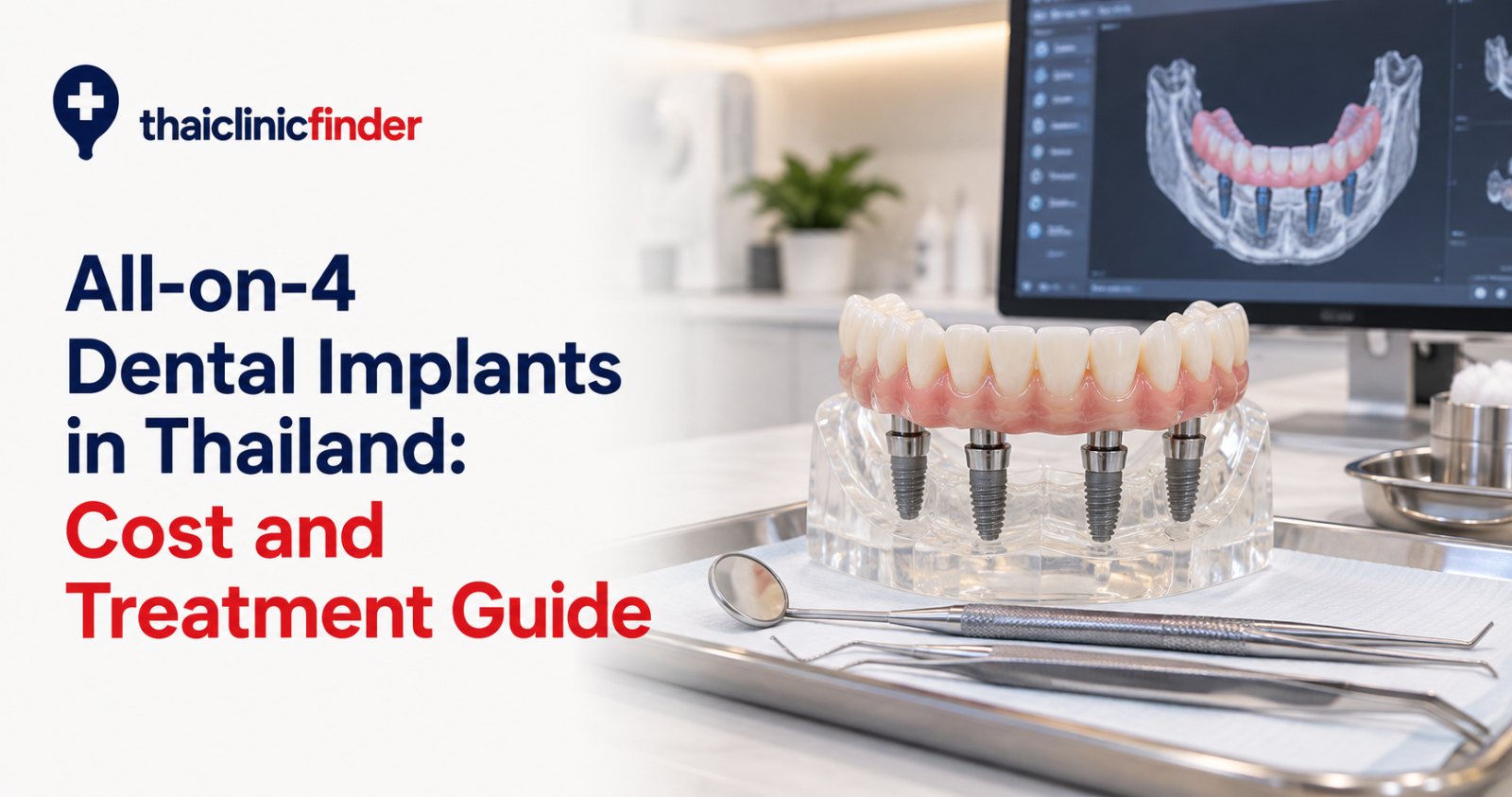
All-on-4 dental implants are a full-arch treatment in which a fixed prosthesis is supported by four implants rather than replacing each missing tooth with a separate implant. In Thailand, this is usually marketed to people who have lost most or all teeth in one jaw, or whose remaining teeth have a poor prognosis.
For someone comparing treatment abroad, the headline price is only the starting point. The useful comparison is the complete cost per jaw, including the implant system, provisional or long-term bridge, imaging, extractions, grafting if needed, anesthesia, and follow-up. A low advertised number can be misleading if those items are excluded.
Published Thai clinic prices also vary by implant brand and prosthetic design. The examples below are provider-published prices, not a national tariff or an endorsement of any clinic.
How much do All-on-4 dental implants cost in Thailand?
A current published example comes from Thantakit International Dental Center in Bangkok. Its dental implant price list, reviewed in August 2026, lists All-on-4 treatment from THB 340,000 to THB 440,000 per jaw, depending on the implant brand. The listed options include DIO or Dentium at THB 340,000, Neodent by Straumann at THB 400,000, and Straumann Roxolid SLA at THB 440,000.
Thantakit states that these prices include the implants and its screw-retained full-arch prosthesis with a reinforced titanium bar. It separately lists computer-guided navigation as an optional per-implant charge. That distinction matters: the same phrase "All-on-4" can describe different prosthetic materials, workflows, and inclusions.
This is one provider's published 2026 pricing. A treatment plan from another Thai clinic may be lower or higher, and the final cost can change after examination and 3D imaging.
If you are comparing implant prices more generally, our guide to dental implant cost in Thailand explains the difference between a single implant quote and a complete restored tooth.
What does All-on-4 actually include?
The All-on-4 concept uses four implants to support a fixed complete-arch prosthesis. Two implants are commonly placed more vertically toward the front and the posterior implants may be angled to use available bone and reduce the need for extensive grafting in selected cases.
The concept should not be interpreted as a promise that four implants are appropriate for everyone. A recent overview of systematic reviews found outcomes broadly comparable with other full-arch implant approaches, but it also emphasized limitations in the quality of the underlying evidence. A 2026 consensus statement on full-arch rehabilitation likewise stresses individualized risk assessment, implant distribution, prosthetic material selection, and maintenance.
A proper plan therefore starts with diagnosis rather than package selection. The dentist or implant team may assess:
- the amount and quality of available bone;
- remaining teeth and whether any are worth preserving;
- gum and periodontal health;
- bite forces and parafunctional habits such as grinding;
- smoking and relevant medical conditions;
- medications that may affect healing;
- the opposing arch;
- whether immediate loading is clinically appropriate.
Do not assume that "teeth in a day" means the final prosthesis is completed in one visit. Some protocols place a provisional fixed bridge soon after implant surgery and replace or upgrade it later.
What can make the price higher?
Extractions
If failing teeth need to be removed before implant placement, extraction fees may be additional. Complex surgical extractions can cost more than straightforward removals.
Bone grafting or sinus procedures
One attraction of tilted posterior implants is that they can sometimes reduce the need for bone grafting. That does not mean grafting is never required. A patient with significant bone loss, infection, anatomy that limits implant positioning, or another surgical issue may need additional procedures.
CT or CBCT imaging
Full-arch implant planning usually involves three-dimensional imaging. Ask whether the scan is included in the package or charged separately.
Sedation or anesthesia
Some patients have treatment under local anesthesia, while others may use sedation or another anesthesia arrangement. The setting and type of anesthesia can alter the bill.
Implant brand and components
The published Thantakit example shows a THB 100,000 difference per jaw between its lowest and highest listed All-on-4 implant-brand options. Brand is not the only quality factor, but it affects component costs and may matter for future servicing.
Prosthesis material
Acrylic or PMMA, reinforced hybrid designs, and zirconia restorations are not interchangeable products. Ask exactly which material is included for the provisional and final prosthesis.
Additional treatment
Periodontal treatment, management of infection, temporary dentures, extra laboratory work, repairs, night guards, and treatment of the opposing arch can all affect the final price.
One jaw versus both jaws
Published All-on-4 prices are often per arch or per jaw. If both upper and lower arches require fixed full-arch rehabilitation, do not simply assume that the one-jaw price can be doubled. The treatment sequence, anesthesia, laboratory work, bite design, temporary prostheses, and surgical plan may be different.
Ask for a written quote that labels the upper and lower treatment separately. It should also identify which costs are shared and which are repeated.
Is All-on-4 cheaper than individual implants?
For a completely edentulous arch, placing an implant for every missing tooth would generally be unnecessary and is not the usual comparison. The relevant alternatives may include:
- a conventional removable complete denture;
- an implant-retained removable overdenture;
- a fixed full-arch restoration supported by four implants;
- a fixed restoration supported by more than four implants;
- retaining selected natural teeth where clinically appropriate.
A systematic review and meta-analysis comparing complete-arch fixed prostheses supported by fewer than five implants with those supported by five or more did not find a significant difference in implant or prosthesis survival in the included studies. That does not make the number of implants irrelevant. Bone anatomy, implant distribution, loading, prosthetic design, and individual risk still influence treatment planning.
Removing maintainable natural teeth simply to fit a package should not be treated as a routine shortcut. A long-term systematic review specifically cautioned against strategic removal of teeth with a satisfactory prognosis solely to deliver a full-arch implant prosthesis.
How to compare quotes from Thai clinics
A useful quote should be itemized. Before paying a deposit, ask the provider to state in writing:
- implant brand and exact number of implants;
- whether abutments are included;
- type and material of the temporary bridge;
- type and material of the definitive bridge;
- CT or CBCT fee;
- extraction fees;
- bone graft or membrane fees if required;
- sedation or anesthesia fees;
- medication and laboratory fees;
- number of planned follow-up visits;
- repair policy for the provisional and final prosthesis;
- what happens if an implant does not integrate;
- whether hygiene and maintenance visits are included;
- how long you should remain in Thailand for each stage.
The goal is not to identify the lowest line item. It is to make two quotes genuinely comparable.
Our guide on how to compare dental clinics in Thailand covers practical questions for evaluating a clinic without relying on marketing claims.
How long does the treatment take?
Timelines vary. Some patients can receive a fixed provisional prosthesis shortly after implant placement if primary stability and other clinical conditions are suitable. Other patients need a delayed loading protocol.
The final restoration may require later visits after healing and integration. International patients should ask for a stage-by-stage schedule before booking flights, including contingency time if swelling, healing, prosthetic adjustments, or an unexpected finding changes the plan.
A clinic's published standard timeline is not a guarantee for an individual patient.
What are the main risks and complications?
All-on-4 is surgery plus a complex prosthetic rehabilitation. Reported complications include implant failure, mucositis or peri-implantitis, screw or component problems, and fracture or wear of a provisional or definitive prosthesis.
A 2025 overview of systematic reviews reported high cumulative survival across included reviews, but the authors also found that most reviews had high risk of bias or low methodological quality. The sensible interpretation is that the approach is well established, not that it is risk-free.
Long-term maintenance matters. Full-arch fixed bridges still require cleaning around the implant-prosthesis interface, professional review, and management of inflammation or mechanical problems.
Aftercare when you live outside Thailand
Medical tourism creates a practical issue that is easy to overlook: who will maintain and repair the restoration when you are back home?
Before treatment, ask for copies of:
- implant brand and model;
- implant positions and sizes;
- abutment information;
- radiographs and scans;
- prosthesis material and laboratory information;
- torque and component records where applicable;
- maintenance instructions.
A local dentist in your home country may need these details later. It is also worth checking whether replacement components are readily available where you live.
When is All-on-4 not the right choice?
Only an implant dentist or appropriately trained dental team who has examined you can answer this for an individual case. Reasons to consider another plan can include salvageable teeth, unsuitable anatomy, active untreated disease, inability to maintain the prosthesis, or medical and behavioral risk factors that make surgery less predictable.
A second opinion is reasonable before irreversible treatment, especially if the plan involves extracting multiple teeth. The Thai healthcare access guide can help visitors understand how private consultations and specialist care generally work.
Bottom line
All-on-4 dental implants in Thailand can cost several hundred thousand baht per jaw. One current Bangkok provider lists THB 340,000 to THB 440,000 per jaw for its All-on-4 options, but that is a provider-specific example rather than a national price range.
Compare the full treatment plan, not just the advertised package. Confirm the implant system, prosthesis material, imaging, extractions, grafting, anesthesia, temporary and final teeth, follow-up, and repair arrangements before committing to treatment.
Frequently Asked Questions
How much is All-on-4 in Thailand?
Published prices vary by provider and treatment design. Thantakit's August 2026 price list shows THB 340,000 to THB 440,000 per jaw for its All-on-4 options, depending on implant brand. Other clinics may price differently, so use an itemized treatment plan.
Is an All-on-4 price normally for one jaw?
Usually, yes. Full-arch implant packages are commonly quoted per upper or lower arch. Confirm this explicitly because treatment for both jaws can involve different surgical, laboratory, and anesthesia costs.
Does All-on-4 always avoid bone grafting?
No. The implant configuration may reduce the need for grafting in selected patients, but anatomy and bone volume differ. Imaging and a clinical examination are needed to determine whether grafting or another approach is required.
Can I get permanent teeth in one day?
Some protocols allow a fixed provisional prosthesis soon after surgery when clinical conditions are suitable. The definitive prosthesis may be delivered later, so ask the clinic to distinguish the temporary and final restoration in its timeline and quote.
Is All-on-4 better than six implants?
Evidence does not support a simple universal answer. Systematic reviews have found similar survival outcomes in some comparisons, but implant number is only one part of treatment planning. Anatomy, risk, implant distribution, prosthetic design, and maintenance also matter.
What should I take home after treatment in Thailand?
Ask for implant brand and model details, radiographs, component and abutment information, prosthesis material, and maintenance instructions. These records can make future care or repairs easier outside Thailand.
Sources
Writer
Niran Chaiyasit
Niran Chaiyasit is a Thai health writer with a background in public health and a focus on travel health, disease prevention and healthcare access in Thailand. His work covers topics such as common illnesses, vaccinations, mosquito-borne diseases, food safety and practical health information for travelers and expatriates.
Medical review
Justin Brooks
Daniel Brooks is an American health writer with a background in health sciences and a focus on rehabilitation, musculoskeletal health and patient education. He writes about physiotherapy, injury recovery, pain management, preventive health and practical healthcare guidance for international patients and travelers.