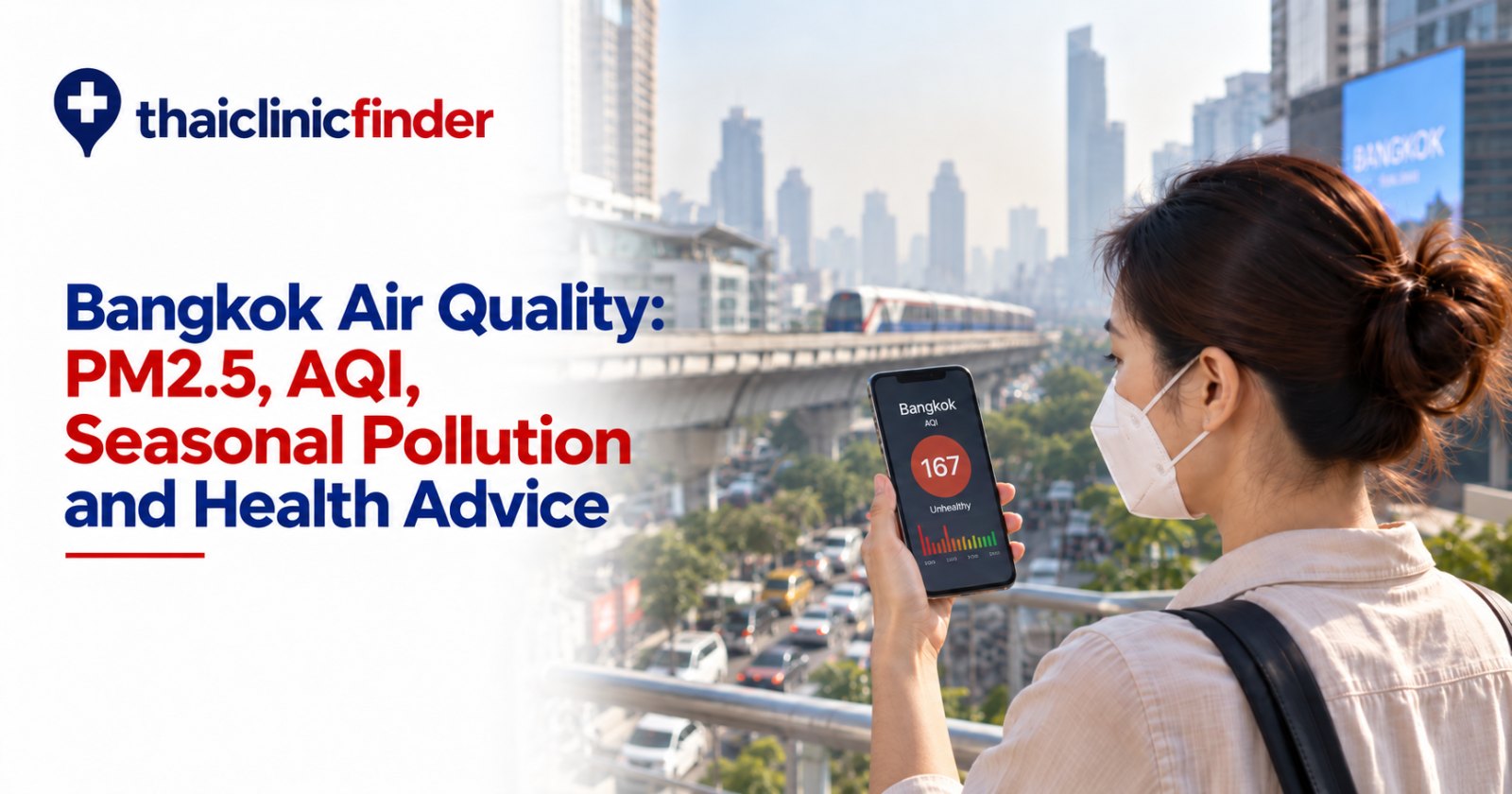
Bangkok's air quality can change sharply from one day to the next, especially during the cooler and drier part of the year. For residents and visitors, the main pollutant to watch is usually PM2.5, fine particulate matter small enough to reach deep into the lungs.
Bangkok does not have uniformly poor air every day. Conditions depend on traffic emissions, weather, regional smoke, wind, rainfall and how well pollution disperses. The practical approach is to check the local reading before long outdoor activities, understand what the number means, and adjust exposure when pollution is elevated.
This guide explains how to read Bangkok air quality information, when PM2.5 tends to be worse, what the main health concerns are, and what sensible precautions can reduce exposure.
What does "air quality in Bangkok" usually mean?
Air quality is a broad term that can include several pollutants, including particulate matter, nitrogen dioxide, ozone, sulfur dioxide and carbon monoxide. In everyday Bangkok pollution alerts, however, PM2.5 is often the main concern.
PM2.5 means airborne particles with a diameter of 2.5 micrometres or less. Because these particles are so small, they can be inhaled deeply into the respiratory tract. Short-term exposure can irritate the eyes and airways, aggravate asthma and other respiratory conditions, and contribute to cardiovascular stress. Long-term exposure is associated with more serious health risks.
When is Bangkok air quality usually worse?
Bangkok's PM2.5 problem is strongly seasonal. Bangkok Metropolitan Administration material describes December to March as a recurring higher-risk period, while other city data show especially elevated levels during the winter months from December to February.
The reason is not simply that more pollution is produced in winter. Weather conditions also matter. During some cool-season periods, weak winds and atmospheric temperature inversions reduce vertical mixing, allowing pollution to remain close to the ground instead of dispersing.
Bangkok city material also identifies traffic and fuel combustion as important local sources, alongside construction dust, industrial activity, household combustion and open burning. Smoke transported from outside the city can add to local pollution during some episodes.
This means two days with similar traffic can still have very different pollution levels. A breezy or rainy day may disperse and remove particles more effectively, while stagnant air can allow PM2.5 to build up.
What about the rainy season?
Rain often lowers airborne particulate levels by helping remove particles from the atmosphere, and stronger ventilation can reduce accumulation. Bangkok data generally show cleaner conditions during much of the rainy season than during the cool dry season.
That does not mean every rainy-season day has clean air, or every cool-season day has unhealthy air. Daily monitoring is more useful than relying only on the month.
Thailand's PM2.5 standard and the WHO guideline
Thailand's current national 24-hour PM2.5 standard is 37.5 micrograms per cubic metre (µg/m³). The Pollution Control Department states that this tighter 24-hour standard took effect on 1 June 2023. Thailand's annual PM2.5 standard is 15 µg/m³.
These national standards should not be confused with the World Health Organization's health-based guideline values. WHO's 2021 global air quality guidelines recommend:
- PM2.5 annual average: 5 µg/m³
- PM2.5 24-hour average: 15 µg/m³
The WHO guideline is more stringent than Thailand's legal or regulatory standard. That difference matters when comparing apps or websites, because different platforms may classify the same concentration differently depending on the AQI scale or health benchmark they use.
AQI versus PM2.5 concentration
People often use "AQI" and "PM2.5" as if they were the same thing, but they are not.
PM2.5 concentration is a measured amount of particulate matter in the air, usually shown in µg/m³.
AQI, or Air Quality Index, converts pollutant concentrations into a simplified scale intended to communicate health risk. Different countries and apps may use different AQI formulas and category boundaries.
As a result, two apps can show different AQI numbers for the same PM2.5 concentration. When comparing sources, check:
- whether the value is AQI or µg/m³;
- which AQI system is being used;
- whether the reading is hourly, rolling or a 24-hour average;
- which monitoring station is closest to you.
For health decisions, the trend and the actual PM2.5 concentration can be more informative than a single colored icon.
Where to check Bangkok air quality
For official local monitoring, Bangkok Metropolitan Administration recommends checking AirBKK and the national Air4Thai system.
Air4Thai is run by Thailand's Pollution Control Department and provides monitoring information from stations around the country. AirBKK focuses on Bangkok and is useful for comparing conditions across districts.
Because air pollution can vary across a large city, use a station reasonably close to where you are staying, working or exercising. A reading from a distant district may not reflect roadside exposure near your location.
It is also worth checking conditions again later in the day if you plan a run, cycle ride or other extended outdoor activity. Bangkok city information notes that some pollution patterns can be more pronounced overnight and in the morning when dispersion is weak.
Why PM2.5 can vary across Bangkok
Bangkok is not one uniform air basin. Local exposure depends on several factors.
Road traffic
Vehicle exhaust, especially combustion-related emissions, is a major urban source. Exposure can be higher near congested roads, intersections, bus corridors and areas with heavy diesel traffic.
Weather and ventilation
Weak winds and stable atmospheric conditions allow fine particles to accumulate. Conversely, wind and rainfall can help reduce concentrations.
Regional smoke
Bangkok can also be affected by smoke transported from outside the metropolitan area. The contribution varies by episode and weather pattern, so it is inaccurate to attribute every bad-air day to one source.
Street-level conditions
Even when a district-wide monitor looks acceptable, pollution immediately beside a busy road may be higher than in a park or a quieter residential street.
For that reason, route choice matters if you are walking, running or cycling for long periods.
Who is more vulnerable to Bangkok air pollution?
Anyone can experience symptoms when pollution is high, but some groups are more susceptible to adverse effects.
These include:
- children;
- older adults;
- pregnant people;
- people with asthma or chronic lung disease;
- people with cardiovascular disease;
- people who work or exercise outdoors for long periods.
Thailand's Department of Disease Control advises higher-risk groups to reduce outdoor activity when PM2.5 is elevated and to monitor for symptoms.
People with asthma or another chronic respiratory condition should continue following their clinician's treatment plan rather than making medication changes based on an air-quality app.
Symptoms that can occur during polluted days
Short-term exposure to elevated PM2.5 may be associated with symptoms such as:
- coughing;
- throat or airway irritation;
- eye irritation;
- shortness of breath;
- chest tightness;
- headache;
- worsening asthma symptoms.
Symptoms are not specific to air pollution. Respiratory infections, allergies, heat, dehydration and other conditions can cause similar problems.
If you become unwell while in Thailand and are unsure whether you need medical care, see what to do if you get sick in Thailand.
How to reduce exposure on high-PM2.5 days
The goal is not to eliminate all outdoor activity whenever the air is imperfect. It is to reduce unnecessary exposure when pollution is meaningfully elevated.
Check conditions before prolonged outdoor exercise
Running and intense exercise increase ventilation, which means you breathe more air and potentially more pollution. Bangkok Metropolitan Administration advises reducing or avoiding outdoor exercise when PM2.5 levels are high.
If the air is poor, consider moving the session indoors, shortening it, or choosing a cleaner time and location.
Move away from heavy traffic
A quieter side street, park interior or indoor route can reduce exposure compared with prolonged time next to dense traffic.
Use a well-fitting particulate respirator when appropriate
For routine movement outdoors during polluted periods, a properly fitted respirator designed to filter fine particles, such as an N95-type mask, can reduce inhalation of particulate matter when worn correctly.
A loose surgical mask does not provide the same level of fine-particle filtration and seal.
Bangkok's public guidance specifically recommends masks that protect against PM2.5 when people need to go outside during higher-risk conditions.
Improve indoor air
When outdoor pollution is high:
- keep windows closed if outdoor air is clearly worse than indoor air;
- use air conditioning in recirculation mode when appropriate;
- use a correctly sized air purifier with a particle filter if available;
- avoid adding indoor particle sources such as smoking, candles or heavy incense.
An air purifier is most useful in a room that is reasonably closed and sized appropriately for the device.
Should you wear an N95 while exercising?
Bangkok Metropolitan Administration's public guidance advises against wearing an N95 respirator during exercise. High-intensity activity increases breathing demand, and a tight respirator can make exercise uncomfortable.
A better strategy on a severely polluted day is usually to move the workout indoors or postpone strenuous outdoor exercise rather than trying to compensate with a tight respirator during the session.
For lower-intensity outdoor movement, a well-fitting particulate respirator may still be useful when pollution is high.
Is Bangkok air pollution dangerous for a short holiday?
A short visit does not automatically mean you will develop a health problem. Risk depends on pollution levels, duration of exposure, activity intensity and individual susceptibility.
A healthy adult spending a few days in Bangkok during relatively clean conditions has a different exposure profile from someone with asthma doing long outdoor workouts during a severe PM2.5 episode.
If you are planning a trip in the cool season, it is sensible to check recent air-quality trends, but there is usually no reason to make travel decisions based on a single daily reading weeks in advance.
Air quality and asthma
Air pollution can aggravate asthma, and people with asthma may notice symptoms at lower pollution levels than people without respiratory disease.
If you use a reliever or controller inhaler, travel with an adequate supply and keep it accessible. Do not stop or change prescribed treatment because the air looks better or worse on a particular day.
Seek medical assessment if your usual asthma plan is not controlling symptoms, if you need a reliever much more often than usual, or if breathing becomes difficult.
When to seek urgent medical care
Air pollution can irritate the respiratory system, but severe symptoms should not simply be blamed on PM2.5.
Seek urgent medical attention for symptoms such as:
- severe or rapidly worsening difficulty breathing;
- chest pain or pressure;
- fainting or marked weakness;
- bluish lips or face;
- confusion;
- severe wheezing not responding to your usual prescribed rescue treatment.
For emergency contacts and practical steps, see our guide to medical emergencies in Thailand.
Practical advice for residents and long-stay visitors
If you live in Bangkok, the most useful approach is to build air-quality checks into your routine during the pollution season.
A simple routine is:
- Check AirBKK or Air4Thai in the morning.
- Look at the PM2.5 concentration and nearby stations, not only the color label.
- If levels are elevated, reduce long roadside exposure and strenuous outdoor exercise.
- Use indoor filtration if you spend many hours in one room.
- Recheck later, because conditions can improve or worsen during the day.
This is more practical than treating Bangkok as either "safe" or "unsafe" for air quality. Exposure changes by place, time and weather.
The bottom line
Bangkok's air quality is most likely to become a concern during the cooler dry-season months, particularly from December through March, when weak ventilation can allow PM2.5 to accumulate. Traffic and other combustion sources contribute locally, while transported smoke can worsen some episodes.
Thailand's 24-hour PM2.5 standard is 37.5 µg/m³, while the WHO health guideline is lower at 15 µg/m³. Check AirBKK or Air4Thai for local conditions, reduce strenuous outdoor activity when pollution is high, and pay particular attention if you have asthma, heart disease or another condition that makes air pollution more risky.
For most people, the best response is not panic but day-to-day exposure management based on current local readings.
Frequently Asked Questions
What is the air quality like in Bangkok?
Bangkok air quality varies considerably by day and season. PM2.5 is often the main pollutant of concern, with higher-risk periods commonly occurring during the cooler dry-season months.
What months have the worst air pollution in Bangkok?
Bangkok Metropolitan Administration information identifies December to March as a recurring PM2.5 problem period, with December to February often particularly affected by stagnant conditions and temperature inversions.
What is Thailand's PM2.5 limit?
Thailand's national 24-hour PM2.5 standard is 37.5 µg/m³, effective since 1 June 2023. The annual national standard is 15 µg/m³.
Where can I check Bangkok PM2.5 levels?
Official options include Bangkok's AirBKK system and the Pollution Control Department's Air4Thai platform. Check a monitoring station close to your location because conditions can vary across the city.
Should I wear an N95 mask in Bangkok?
A well-fitting particulate respirator such as an N95-type mask can reduce particle exposure during polluted periods when worn correctly. Bangkok public guidance recommends PM2.5-protective masks when exposure is unavoidable, but advises against N95 use during exercise.
Is Bangkok air pollution dangerous for tourists?
Risk depends on the pollution level, duration of exposure, activity and individual health. Most short visits do not automatically create a serious health problem, but people with asthma, heart disease or other vulnerabilities should be more cautious during high-PM2.5 episodes.
Sources

Writer
Niran Chaiyasit
Niran Chaiyasit is a Thai health writer with a background in public health and a focus on travel health, disease prevention and healthcare access in Thailand. His work covers topics such as common illnesses, vaccinations, mosquito-borne diseases, food safety and practical health information for travelers and expatriates.

Medical review
Jonathan García-Allen
Psychologist, author and digital strategist specializing in health, mental health and digital publishing. He co-founded Psicología y Mente, one of the world’s most visited psychology and mental health websites, reaching more than 20 million visits per month. With over 10 years of experience in health content, SEO and digital strategy, he has helped psychologists, therapists, clinics and healthcare businesses strengthen their online presence, attract patients and build trusted digital brands.