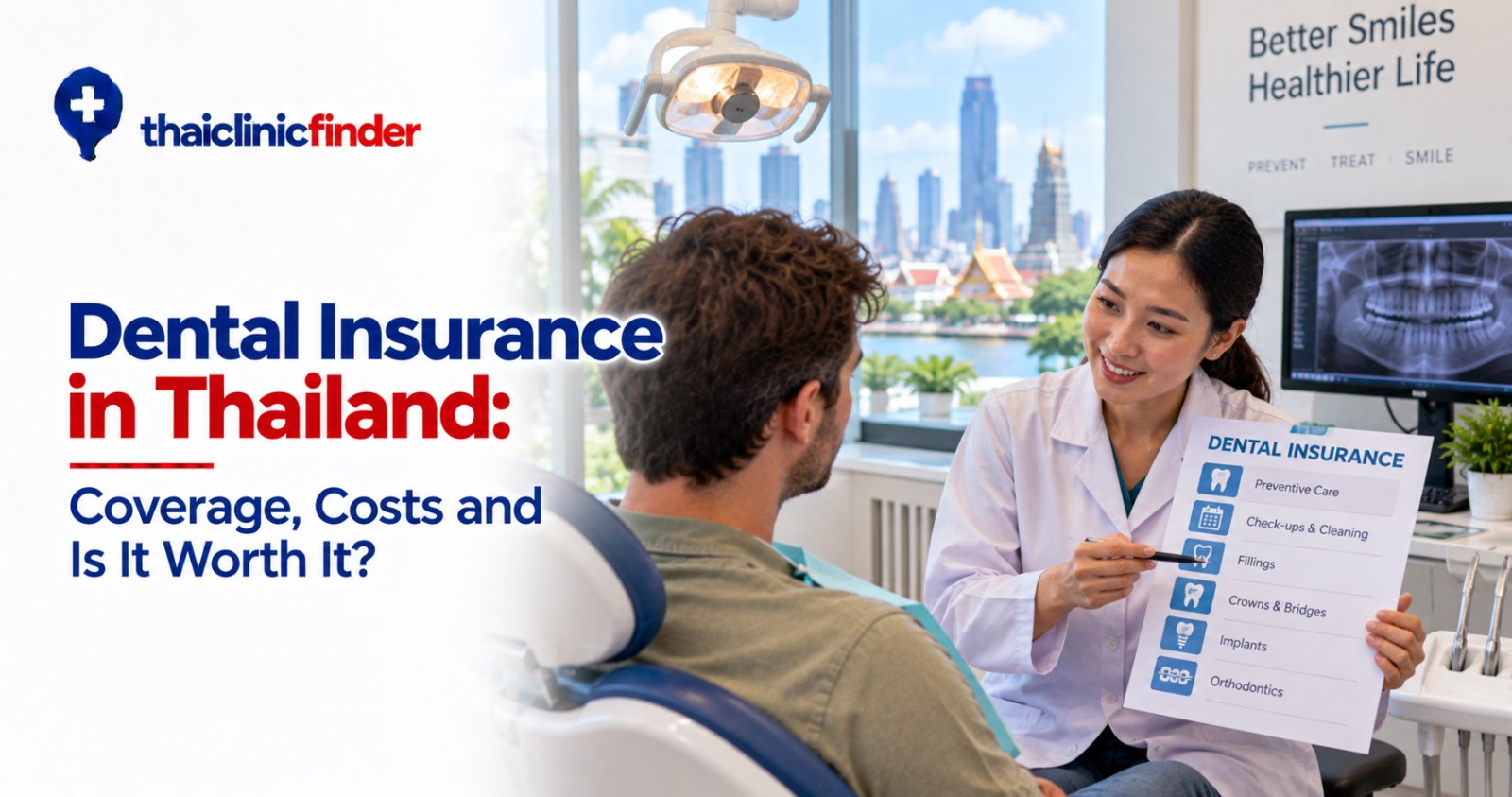
Dental insurance in Thailand exists, but it often works differently from the standalone dental plans common in some countries.
For many residents and expats, dental cover is added to a broader private health insurance policy rather than purchased as a completely separate product.
Current examples show how varied that cover can be. AXA SwitchCare offers optional annual dental limits ranging from THB 6,000 to THB 48,000, while Allianz Ayudhya's FlexCare currently offers optional combined dental and optical benefits of up to THB 34,000 or THB 68,000, depending on the plan.
At the lower end, employer group schemes may offer only THB 3,000 to THB 5,000 per year for routine dental treatment.
The important question is therefore not simply whether a policy includes dental. You need to know what type of dentistry is covered, the annual maximum, any waiting period, whether you pay part of the bill yourself, and whether expensive work such as implants or orthodontics is excluded.
Dental insurance in Thailand is usually an add-on
Many Thai private health plans focus primarily on:
- hospitalization
- surgery
- cancer treatment
- outpatient medical care
Dental treatment is often offered as an optional additional benefit.
For example, AXA SwitchCare currently makes dental, optical and maternity benefits available as optional extras when both inpatient and outpatient cover are selected.
Allianz FlexCare similarly offers dental and optical cover as an optional module linked to eligible outpatient plans.
This means someone searching only for cheap dental insurance may discover that they first have to purchase a broader health insurance policy.
That can make the economics very different from simply paying for routine dental care yourself.
How much dental coverage can you get?
Current Thai insurer examples show a wide range.
| Insurance example | Current annual dental benefit |
|---|---|
| Allianz Employee We Care | THB 3,000 or THB 5,000 |
| AXA SmartCare Essential wellness option | THB 3,000 combined wellness benefit |
| AXA SwitchCare Plan 1 | THB 6,000 |
| AXA SwitchCare Plan 2 | THB 12,000 |
| AXA SwitchCare Plan 3 | THB 24,000 |
| AXA SwitchCare Plan 4 | THB 48,000 |
| Allianz FlexCare dental/optical option | Up to THB 34,000 or THB 68,000 depending on eligible plan |
| AXA International Exclusive selected plan | THB 38,000 |
| Allianz premium health plan example | Up to THB 50,000 or THB 100,000, with 80% reimbursement |
These figures are current examples rather than a complete list of every policy sold in Thailand.
The benefit amount alone is not enough to compare plans because some policies apply:
- waiting periods
- co-payments
- percentage reimbursement
- restrictions on major dental treatment
- combined dental and optical limits
Routine dental treatment is the easiest to insure
Basic dental benefits most commonly cover services such as:
- dental examination
- scaling
- fillings
- simple extraction
- dental X-ray
For example, Allianz Employee We Care currently offers group dental options of THB 3,000 or THB 5,000 per year covering scaling, fillings, extractions, examinations and dental X-rays.
For an employee who receives this benefit through work at little or no personal premium cost, even a modest dental allowance can be useful.
For someone buying a complete individual health policy primarily to obtain THB 3,000 of dental cover, the calculation is very different.
Major dental treatment usually has more restrictions
More expensive dentistry may include:
- crowns
- bridges
- root canal treatment
- periodontal treatment
- complex restorative dentistry
AXA SwitchCare distinguishes between routine dental care and major restorative dental treatment.
Its current policy information shows that major restorative treatment is covered within the selected dental limit, but it carries a six-month waiting period and a 20% co-payment.
That means an insured patient may still have to pay part of the treatment cost personally.
If your dentist recommends THB 30,000 of eligible work and your policy reimburses 80%, the insurer may pay THB 24,000 while you pay THB 6,000, assuming the treatment falls within the annual limit and all other conditions are met.
A waiting period can make insurance useless for an immediate dental problem
Waiting periods are one of the most important details to check before buying.
If you purchase insurance after discovering that you need a crown, implant or other expensive treatment, the policy may not pay for it immediately.
Current examples include:
- AXA SwitchCare major restorative dental: 6-month waiting period
- AXA SmartCare Essential optional wellness benefit including dental: 6-month waiting period
The purpose is to prevent people from buying insurance only after they already know they need expensive treatment.
Always check the waiting period before taking out a policy specifically because you expect dental work.
Co-payment means the insurer does not pay the whole bill
Some policies reimburse only a percentage of eligible dental expenses.
AXA SwitchCare currently applies a 20% co-payment to major restorative dental care.
AXA International Exclusive similarly lists dental coverage with a 20% co-payment on the relevant plan.
An Allianz premium health plan example states that dental treatment is reimbursed at 80% of medical treatment fees, up to the annual dental maximum.
In practical terms, even a policy with a THB 50,000 dental limit may still require you to pay 20% of each eligible claim.
This makes the effective value of the benefit lower than the headline maximum.
Are dental implants covered by insurance in Thailand?
You should not assume implants are covered.
Dental implants are expensive and may fall under:
- major restorative dentistry
- prosthodontics
- elective treatment
- excluded dental services
Some policies may cover part of implant-related treatment, while others exclude implants completely.
Even when covered, the amount may be restricted by:
- annual dental maximum
- waiting period
- co-payment
- treatment category limit
For example, a policy with a THB 24,000 annual dental limit will not meaningfully cover the complete cost of multiple implants if the dental bill is much higher.
Before buying insurance for implant treatment, obtain the policy wording and look specifically for implants, prosthodontics and major restorative dentistry rather than relying on the general phrase dental cover.
What about crowns and bridges?
Crowns and bridges are more likely than routine fillings to fall under major restorative benefits.
They may therefore be subject to:
- a longer waiting period
- co-payment
- annual maximum
- pre-authorization
A policy that offers THB 6,000 of annual dental cover may be useful for routine care but provide only limited protection against an expensive crown or bridge.
For substantial restorative work, compare the insurance benefit with actual self-pay dental prices before deciding that insurance represents good value.
Is orthodontics covered?
Orthodontic treatment such as braces or clear aligners is commonly excluded or heavily restricted in standard dental benefits.
Insurance products are generally designed to pay for medically necessary routine and restorative dental treatment rather than long-term cosmetic orthodontics.
If orthodontic cover matters to you, ask explicitly about:
- braces
- Invisalign or other aligners
- orthodontic consultations
- retainers
Do not assume that a policy with a large dental maximum automatically includes them.
Cosmetic dentistry is usually different again
Treatments performed primarily for appearance are commonly outside normal dental insurance coverage.
Examples may include:
- cosmetic veneers
- tooth whitening
- aesthetic reshaping
If a procedure has both functional and cosmetic components, coverage may depend on the insurer's interpretation and documentation from the dentist.
For example, a crown required after major structural damage is a different insurance situation from replacing healthy teeth solely for cosmetic reasons.
For self-pay cosmetic dental planning, see How to Compare Dental Clinics in Thailand.
Employer dental insurance can be surprisingly useful
For many people working in Thailand, the most economical dental cover is not an individually purchased policy at all.
It is an employer group benefit.
Allianz Employee We Care currently offers optional annual dental limits of:
- THB 3,000
- THB 5,000
These benefits cover basic services such as:
- scaling
- fillings
- extraction
- examination
- X-ray
The limits are modest, but when the employer pays most or all of the insurance premium, the benefit can effectively make routine dentistry substantially cheaper.
Employees should check their company benefit booklet before paying for basic dental care themselves.
International health insurance can offer much larger dental limits
Expats with international private medical insurance may have access to much higher dental benefits.
AXA SwitchCare currently lists annual dental maximums of:
- THB 6,000
- THB 12,000
- THB 24,000
- THB 48,000
AXA International Exclusive currently lists THB 38,000 per year in dental cover on the applicable plan, with a 20% co-payment.
Allianz FlexCare currently offers optional dental and optical benefits of up to THB 34,000 or THB 68,000 depending on the selected core plan.
Premium international-style policies can offer even higher limits, but premiums are correspondingly higher.
These products are usually purchased primarily for comprehensive medical protection, with dental being an additional benefit rather than the main reason for buying the plan.
Be careful with combined dental and optical limits
Some plans combine dental and optical benefits under a single annual maximum.
For example, a policy might advertise THB 34,000 Dental / Optical.
That does not necessarily mean you receive THB 34,000 for dentistry plus another THB 34,000 for glasses.
The same pool may need to cover both.
Before comparing limits, determine whether the amount is:
- dental only
- optical only
- combined dental and optical
This small detail can materially change the real value of the plan.
Dental insurance versus self-pay dentistry
Thailand's relatively affordable dental prices make this comparison particularly important.
For routine services such as:
- cleaning
- simple fillings
- examination
- basic X-rays
self-paying may be economical enough that purchasing a separate insurance upgrade purely for dental care does not make financial sense.
The calculation changes when you expect more expensive treatment such as:
- root canal treatment
- crowns
- bridges
- periodontal treatment
However, those are also exactly the services most likely to face waiting periods, co-payments and annual limits.
Insurance should therefore be compared with realistic expected treatment costs rather than assumed to be automatically cheaper.
When dental insurance may be worth it
Dental cover can make sense when:
- it is included cheaply through your employer
- you already need comprehensive health insurance and dental is a reasonably priced add-on
- you use routine dental services every year
- the annual maximum is meaningful relative to the additional premium
- major restorative care is covered under acceptable terms
It can be less attractive when:
- the premium increase is high
- the annual dental limit is very low
- most treatments you want are excluded
- you mainly need cosmetic dentistry
- you already know you need treatment that falls inside a waiting period
The right calculation is personal.
Example: is a THB 6,000 dental benefit worth it?
Imagine that adding dental coverage increases your annual insurance premium substantially, but the maximum dental reimbursement is only THB 6,000.
If you normally spend only THB 2,000 to THB 4,000 per year on routine dental care, paying a large additional premium for that benefit may not make sense.
On the other hand, if the dental option is inexpensive and you reliably use several covered services each year, it can be worthwhile.
Always compare:
additional premium versus realistic annual reimbursement.
Do not compare only the headline policy maximum.
Annual limits reset every policy year
Dental benefits normally have a maximum payable per policy year.
Once the limit is exhausted, additional dental bills are paid by the patient until the next policy year.
This can matter if you need multiple procedures.
Suppose your policy has a THB 12,000 annual dental limit and you use all of it on root canal treatment and a crown. A later filling during the same year may receive no additional reimbursement.
For planned treatment, ask whether clinically appropriate procedures can be spread across policy years, but do not delay necessary care solely for insurance reasons.
Pre-existing dental problems may be excluded
As with other insurance, problems that already exist before cover begins can be treated differently from new conditions.
Policies may restrict or exclude treatment related to:
- missing teeth
- known periodontal disease
- treatment already recommended before enrollment
- existing major restorative needs
The exact wording matters.
If you are buying a policy after a dentist has already told you that you need extensive work, ask the insurer in writing whether that treatment will be eligible after any waiting period.
Direct billing is not always available for dentistry
Health insurance may offer cashless treatment at network hospitals while dental claims still work on a reimbursement basis.
That can mean:
- you pay the dentist
- obtain an itemized receipt
- submit the claim
- wait for reimbursement
Other networks may support direct billing at selected dental facilities.
If cash flow matters, check the claims process before treatment.
What documents do you need for a dental claim?
Insurers may request:
- claim form
- original receipt
- itemized invoice
- dentist diagnosis
- treatment details
- dental X-rays for major work
- pre-authorization for expensive procedures
Routine cleaning may require very little documentation compared with a major restorative claim.
For expensive treatment, contact the insurer before starting rather than assuming reimbursement will be automatic.
Dental insurance for expats in Thailand
Long-term expatriates generally have three main approaches.
1. International health insurance with dental add-on
Useful for people who want broader regional or global medical protection.
2. Thai private health insurance with dental option
Can be more locally focused and potentially cheaper depending on age and benefits.
3. Self-pay dental care
Often practical for people who are comfortable paying routine Thai dental prices directly and mainly insure against large medical rather than dental expenses.
For broader health insurance decisions, see How to Choose Health Insurance in Thailand.
Dental insurance for retirees
Older patients should pay particular attention to:
- entry age limits
- renewal conditions
- existing dental disease
- implants and dentures
- periodontal treatment
A policy with excellent hospitalization cover may have only modest dental benefits.
If dental treatment is a major expected expense in retirement, compare the actual dental benefit separately from the medical insurance maximum.
A THB 20 million health plan can still provide only THB 10,000 or THB 20,000 of dental coverage.
Dental insurance for families
Families may use dental benefits more consistently because several members require annual examinations and preventive care.
However, determine whether limits apply:
- per person
- per family
- per policy year
Children may also need services such as orthodontics that standard dental cover does not include.
A family plan with generous routine benefits but no orthodontic cover may still leave the family's largest dental expense entirely self-funded.
Should tourists buy dental insurance for Thailand?
For a short holiday, buying a dedicated Thai dental insurance plan is rarely practical.
Travel insurance may cover emergency dental treatment, usually only when it results from an accident or sudden painful condition and often with a relatively small limit.
It generally does not cover planned work such as:
- implants
- veneers
- routine cleaning
- elective crowns
Someone traveling to Thailand specifically for dental treatment should assume they are self-paying unless their insurer has explicitly confirmed otherwise.
Dental tourism and insurance are separate concepts
Thailand is a popular destination for dental tourism because private treatment can be less expensive than in some Western countries.
Insurance does not automatically reimburse treatment abroad merely because it is medically necessary.
International patients should check:
- whether overseas dental treatment is covered
- whether the dentist must be in network
- whether prior approval is required
- whether reimbursement is based on Thai or home-country fee schedules
For major dental tourism procedures, obtain a detailed treatment plan before booking flights.
How to compare dental insurance plans
Instead of asking only which policy has the largest maximum, compare:
- annual dental maximum
- routine dental coverage
- major restorative coverage
- waiting period
- co-payment percentage
- implant coverage
- crowns and bridges
- root canal coverage
- orthodontic exclusion
- cosmetic dentistry exclusion
- pre-existing condition rules
- cashless network availability
- reimbursement process
A THB 48,000 benefit with significant restrictions can sometimes be less useful than a smaller benefit that covers the services you actually use.
Current insurance examples
Several current Thai market examples illustrate the differences.
AXA SwitchCare
Optional dental limits currently range from THB 6,000 to THB 48,000 per year.
Routine dental care is covered within the selected maximum.
Major restorative dental work has a six-month waiting period and a 20% co-payment.
Allianz FlexCare
Current optional combined dental and optical benefits include selected plans up to THB 34,000 or THB 68,000, depending on the core and outpatient configuration.
Allianz Employee We Care
Group-employer dental options currently provide THB 3,000 or THB 5,000 per year for basic services such as cleaning, fillings, extraction, examination and X-rays.
AXA International Exclusive
The relevant high-level plan currently includes THB 38,000 per year for dental care with a 20% co-payment.
These are examples of how different the market can be, not recommendations for a particular insurer.
The practical answer
Dental insurance in Thailand is usually best viewed as an optional benefit attached to broader health insurance, not as a product that automatically pays every dental bill.
Current annual limits range from only a few thousand baht in employer plans to THB 48,000, THB 68,000 or more in higher-level private plans.
Before buying, check:
- the annual limit
- waiting period
- co-payment
- whether major restorative work is included
- whether implants and orthodontics are excluded
- whether the benefit is dental-only or shared with optical care
For routine dental care, self-paying in Thailand can sometimes be more economical than paying a large extra insurance premium. Dental cover becomes more valuable when it is included cheaply through an employer or as part of a comprehensive health plan you already need.
The best policy is therefore not the one with the largest headline number. It is the one whose covered treatments, waiting periods and reimbursement rules actually match the dental care you are likely to use.
Frequently Asked Questions
Can you get dental insurance in Thailand?
Yes. Dental coverage is available in Thailand, but it is commonly offered as an optional benefit within a broader private health insurance plan rather than as standalone dental insurance.
How much dental coverage do Thai health insurance plans provide?
Current examples range from THB 3,000 to THB 5,000 annually in some employer plans to THB 48,000, THB 68,000 or more in higher-level private health policies.
Does dental insurance in Thailand cover implants?
Not automatically. Implant treatment may be excluded or treated as major restorative dentistry subject to annual limits, waiting periods and co-payments. Check the specific policy wording.
Does dental insurance cover crowns and root canals in Thailand?
Some plans cover major restorative treatment such as crowns or root canal-related care, but waiting periods, co-payments and annual maximums can apply.
Does dental insurance cover braces in Thailand?
Standard dental benefits commonly exclude orthodontics or restrict it heavily. Confirm braces and clear aligner coverage separately before buying a policy.
Is there a waiting period for dental insurance in Thailand?
There can be. For example, AXA SwitchCare currently applies a six-month waiting period to major restorative dental treatment, while other plans have their own conditions.
Is dental insurance worth it in Thailand?
It can be, especially when included cheaply through an employer or existing health plan. For inexpensive routine dental care, self-paying may sometimes cost less than adding a high-premium dental option.
Can expats get dental insurance in Thailand?
Yes. Expats can access Thai private insurance and international health plans that include or offer optional dental benefits, subject to eligibility and underwriting.
Do Thai employer health plans include dental?
Some do. Allianz Employee We Care, for example, currently offers annual dental benefit options of THB 3,000 or THB 5,000 for basic dental services.
Sources

Writer
Niran Chaiyasit
Niran Chaiyasit is a Thai health writer with a background in public health and a focus on travel health, disease prevention and healthcare access in Thailand. His work covers topics such as common illnesses, vaccinations, mosquito-borne diseases, food safety and practical health information for travelers and expatriates.

Medical review
Justin Brooks
Daniel Brooks is an American health writer with a background in health sciences and a focus on rehabilitation, musculoskeletal health and patient education. He writes about physiotherapy, injury recovery, pain management, preventive health and practical healthcare guidance for international patients and travelers.