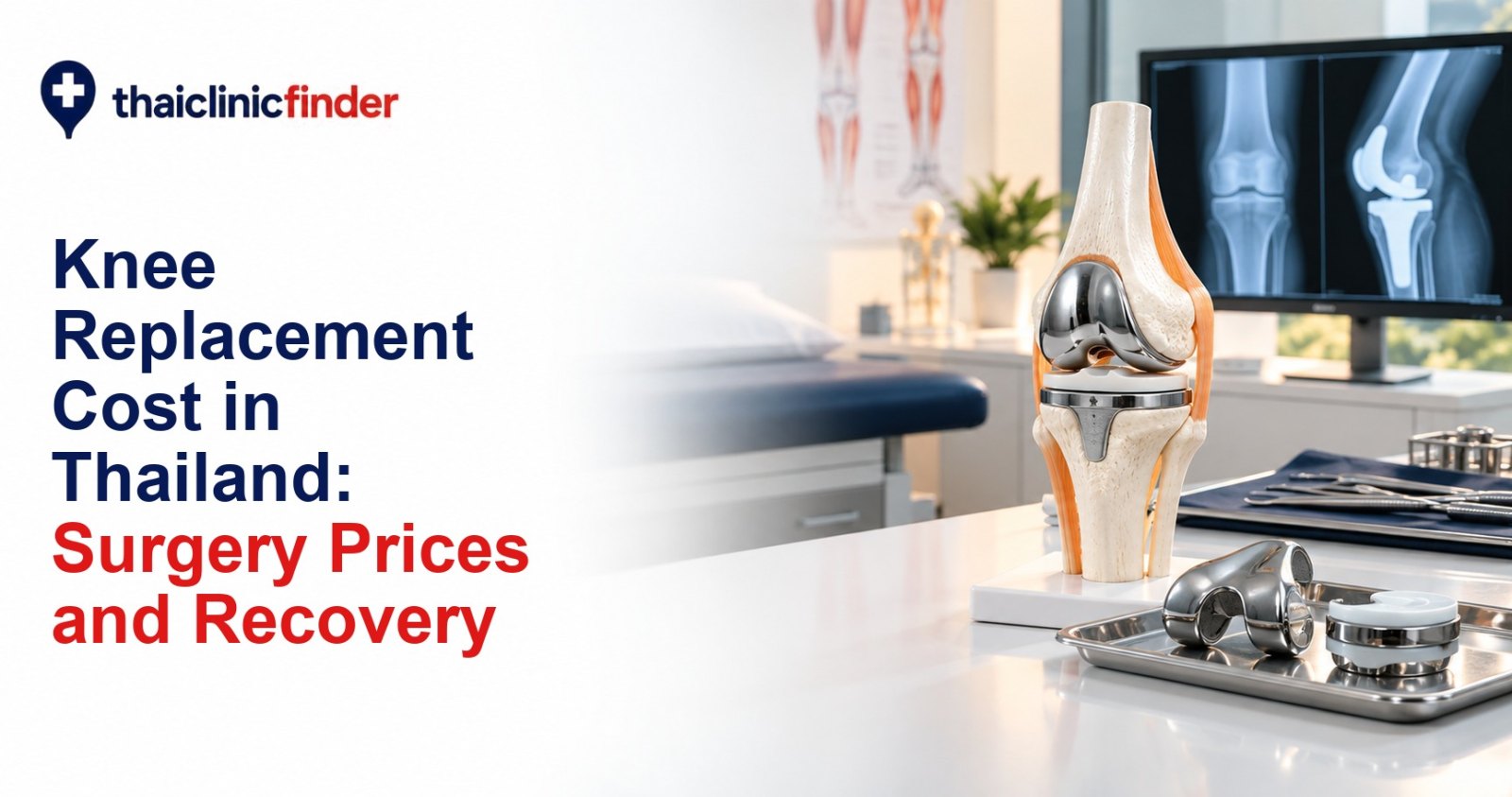
Knee replacement surgery in Thailand can cost from the low two-hundred-thousand-baht range at some regional hospitals to more than THB 400,000 for premium robotic surgery in Bangkok.
The price depends heavily on whether the implant is included, whether the operation is conventional or robot-assisted, the hospital, the length of stay and the patient's medical needs.
A published package should therefore be read as a starting point, not as a universal national price.
Current hospital price examples
Bangkok Hospital Muangraj currently lists a one-knee replacement package at THB 219,000.
Bangkok Hospital Chanthaburi has published a one-knee total replacement package at THB 250,000.
Bangkok International Hospital currently lists:
- total knee replacement, one side, implant excluded: THB 310,000
- robotic total knee replacement, one side, implant included: THB 460,000
- robotic total knee replacement, two sides, implants included: THB 745,000
These examples show why the implant line matters so much.
Implant included versus implant excluded
A quote can look cheaper because the prosthesis is billed separately.
Before comparing packages, ask whether the price includes:
- femoral component
- tibial component
- patellar component when used
- bone cement
- robotic consumables
- surgical instruments
An implant-excluded THB 310,000 package is not directly comparable with a THB 460,000 robotic package that includes the stated implant.
Who usually needs knee replacement?
Total knee replacement is generally considered for severe joint damage when pain and functional limitation persist despite appropriate non-surgical treatment.
Common causes include:
- osteoarthritis
- inflammatory arthritis
- major joint degeneration
- selected post-traumatic damage
The decision should be based on symptoms, examination, imaging and response to previous treatment.
Knee replacement is different from arthroscopy
Arthroscopy is a different operation used for selected meniscus, ligament and other joint problems.
It does not replace the joint.
Bangkok Hospital's arthroscopy packages are priced separately and should not be used to estimate the cost of total knee replacement.
Conventional versus robotic surgery
Robotic systems can assist the surgeon with planning and component positioning.
Robot-assisted surgery usually costs more because of technology, instruments and implant packages.
The presence of a robot does not replace the surgeon.
Ask what clinical advantage the surgeon expects in your specific case rather than choosing technology from marketing alone.
What is usually included in a package?
A knee replacement package may include:
- operating room
- anesthesia team
- surgeon
- standard room
- nursing
- routine medicines
- basic rehabilitation
- implant, in some packages
Exclusions can include medical clearance, treatment of unrelated conditions, extra ICU care and some special supplies.
Request the full package document.
Preoperative assessment
Before surgery, patients may need:
- blood tests
- chest imaging
- ECG
- medical clearance
- dental or infection review in selected cases
People with diabetes, heart disease or anticoagulant use may need additional planning.
These assessments can add cost when they are outside the package.
Hospital stay
Current premium Bangkok packages commonly list several hospital nights.
Bangkok International Hospital's one-sided total knee replacement package lists four nights.
Actual discharge depends on:
- mobility
- pain control
- wound condition
- medical stability
- physiotherapy progress
Do not assume a fixed discharge date if recovery is slower than expected.
Rehabilitation is part of the real cost
The surgery is only one part of recovery.
Patients may need:
- inpatient physiotherapy
- outpatient physiotherapy
- walking aids
- home exercises
- follow-up imaging
Ask whether rehabilitation sessions are included or billed separately.
For an international patient, several weeks of local recovery can materially increase the overall trip budget.
Flying after knee replacement
Major orthopedic surgery increases the importance of blood-clot prevention.
Ask the surgeon when long-haul flying is appropriate.
The answer depends on:
- thrombosis risk
- mobility
- anticoagulation plan
- wound healing
- flight duration
Do not schedule a fixed long-haul return immediately after discharge.
Risks to discuss
Potential complications include:
- infection
- blood clots
- bleeding
- stiffness
- nerve or vessel injury
- implant loosening
- persistent pain
- need for revision
A reputable consultation should discuss risks as well as expected benefits.
Revision surgery costs more
Revision knee replacement is usually more complex than first-time surgery.
It may require:
- removal of old components
- bone reconstruction
- specialized implants
- longer operating time
- longer hospital stay
Do not use a primary knee-replacement package to estimate revision cost.
Public versus private hospitals
Government and university hospitals may cost less than premium private hospitals.
Private hospitals may offer:
- faster scheduling
- international coordination
- more transparent packages
- private rooms
The exact surgeon and orthopedic program matter more than the label public or private.
Insurance
Knee replacement can be covered by health insurance when medically necessary, subject to:
- pre-existing-condition rules
- waiting periods
- annual limits
- implant limits
- network rules
- pre-authorization
Obtain written authorization before planned surgery.
Questions before booking
Ask:
- Is the implant included?
- Which implant brand and model?
- Is surgery conventional or robotic?
- How many hospital nights?
- Is physiotherapy included?
- What tests are extra?
- What happens if I need ICU care?
- When can I fly?
- What is the revision policy?
- Who will provide follow-up after I leave Thailand?
Getting a quotation that can be compared
Send the hospital recent X-rays, the orthopedic assessment and a concise medical history before asking for a firm price. A coordinator may provide an initial range, but the surgeon needs to determine whether you need total or partial replacement, one knee or both, and whether robotic assistance is appropriate. The implant choice also affects cost.
Ask the quotation to name the implant brand and model, room category, expected length of stay, surgeon and anaesthetist fees, medicines, physiotherapy and follow-up. An implant-excluded package is not directly comparable with an implant-included package. Bangkok Hospital's current one-sided conventional package is THB 310,000 but excludes the implant, while its THB 460,000 robot-assisted one-sided package includes the specified implant.
Pre-operative clearance, specialist consultations, additional laboratory tests and treatment of other conditions can sit outside a package. Ask what happens financially if surgery is postponed after tests, if you need extra nights or if a complication requires higher-level care.
Preparing before surgery
A knee replacement is major surgery. The team will review heart and lung health, infection risk, medicines, dental issues where relevant and the support available after discharge. Give a complete list of prescription medicines, supplements and allergies. Do not stop anticoagulants or other prescribed drugs unless the responsible clinician tells you how and when.
Practical preparation matters too. Arrange a safe place to recover, transport from hospital and help with shopping or stairs. If you live alone or are staying in a hotel, discuss that openly with the discharge team. The cheapest room plan can become difficult if it does not support safe mobility and rehabilitation.
Recovery and physiotherapy
Most people begin supported movement soon after surgery, but recovery is individual. Early rehabilitation commonly focuses on safe transfers, walking with an aid, swelling control and gradually improving movement and strength. Progress depends on health before surgery, pain control, the condition of the other leg and consistent rehabilitation.
Ask how many inpatient physiotherapy sessions are included and what outpatient work is recommended. Confirm the price of extra sessions, walking aids, wound care and follow-up X-rays. A package ending at discharge can leave a substantial part of the practical recovery budget unexplained.
Seek urgent medical advice for chest pain, sudden shortness of breath, fainting or symptoms that could indicate a blood clot. Increasing wound redness, drainage, fever or rapidly worsening pain also needs prompt assessment. The hospital should give you clear contact instructions rather than relying on generic aftercare advice.
Flying home after knee replacement
Do not choose a return flight before the surgeon has assessed your recovery. Long travel soon after surgery raises practical concerns about mobility, swelling and blood-clot risk. Ask the surgical and insurance teams about timing, airport assistance, seating, medication documentation and what would happen if you were not fit to fly on the booked date.
Carry the discharge summary, operation note, implant details, current medicine list and copies of relevant images. Arrange a named clinician at home for wound review and ongoing rehabilitation. If the Thai surgeon offers remote follow-up, clarify what it covers and where you should seek hands-on care.
Insurance and financial planning
Insurers usually assess knee replacement as planned inpatient treatment and may require pre-authorisation. Confirm the hospital, surgeon, implant and rehabilitation benefits, along with deductibles, co-payments and annual limits. Ask whether complications or an extended stay would be handled under the same authorisation.
Medical travel policies often exclude planned treatment, while ordinary health policies may limit care outside a network. Get the answer in writing. Our guide to medical costs in Thailand explains other charges that can appear around a hospital package, and the hip replacement cost guide offers a useful comparison for another major joint procedure without implying that the operations cost the same.
Building a realistic knee-replacement budget
Current official examples range from THB 230,000 for one knee at Bangkok Hospital Udon to THB 460,000 for a one-sided robot-assisted package at Bangkok Hospital in Bangkok. Those figures describe different packages; the lower number is not evidence of the same implant, technique, inclusions or patient eligibility.
Ask for a patient-specific written quotation after the surgeon has reviewed your records. Check the implant, medical clearance, consultations, tests, hospital nights, physiotherapy and complication terms, then compare the result with the wider context in our medical costs in Thailand guide.
Budget beyond the operation itself. Safe accommodation, mobility aids, rehabilitation, an adjustable return journey and follow-up at home all matter. A well-planned package is one that supports recovery after discharge, not simply the lowest price attached to the operating theatre.
Frequently Asked Questions
How much does knee replacement cost in Thailand?
Current hospital examples range from about THB 219,000 at a regional hospital to THB 460,000 for a premium robotic one-sided package with implant.
Is the knee implant included in the price?
Sometimes. Some Bangkok packages explicitly exclude the implant, so check the quotation carefully.
How long is the hospital stay?
Premium one-sided packages can list around four nights, but discharge depends on recovery.
Does robotic knee replacement cost more?
Usually yes because of the technology, consumables and package structure.
Does insurance cover knee replacement in Thailand?
It may when medically necessary, subject to underwriting, pre-authorization and policy limits.
Sources
Writer
Niran Chaiyasit
Niran Chaiyasit is a Thai health writer with a background in public health and a focus on travel health, disease prevention and healthcare access in Thailand. His work covers topics such as common illnesses, vaccinations, mosquito-borne diseases, food safety and practical health information for travelers and expatriates.

Medical review
Justin Brooks
Daniel Brooks is an American health writer with a background in health sciences and a focus on rehabilitation, musculoskeletal health and patient education. He writes about physiotherapy, injury recovery, pain management, preventive health and practical healthcare guidance for international patients and travelers.