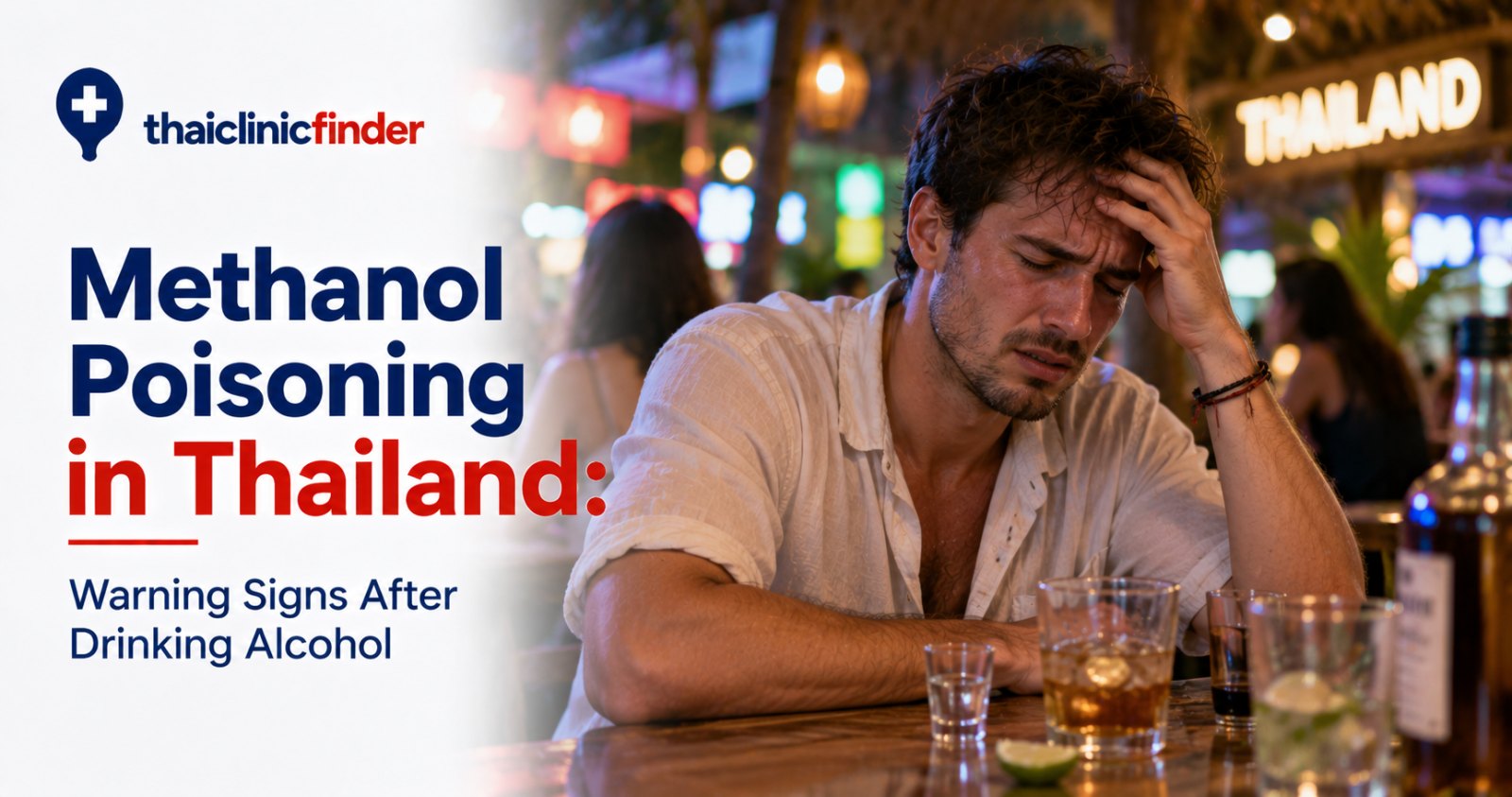
Methanol poisoning is a rare but potentially fatal complication of drinking contaminated or illegally produced alcohol. Travelers in Thailand should know the warning signs because the early symptoms can resemble ordinary drunkenness, food poisoning or a bad hangover.
The UK government's current Thailand travel advice warns that serious illness and deaths have occurred in Thailand after people consumed alcoholic drinks containing methanol. Thailand's Department of Disease Control has also issued warnings following cases linked to counterfeit or improperly produced alcohol.
Methanol is particularly dangerous because you cannot reliably detect it by taste or smell. A drink may look and taste normal.
The most concerning warning signs after drinking alcohol include:
- blurred or abnormal vision
- difficulty seeing clearly
- severe headache
- dizziness
- repeated vomiting
- significant abdominal pain
- confusion or unusual drowsiness
- difficulty walking or coordinating movements
- rapid or abnormal breathing
- seizures
- loss of consciousness
Symptoms may not appear immediately. Methanol poisoning can have a delayed phase lasting many hours, which means someone can initially feel relatively well and become seriously ill later.
If methanol poisoning is suspected in Thailand, seek emergency medical care immediately. Do not wait for symptoms to improve on their own.
Why methanol can end up in alcoholic drinks
Methanol is a toxic alcohol used in industrial products and chemical processes.
Small amounts can arise during alcohol production, but properly manufactured commercial alcoholic beverages are produced and controlled so that dangerous concentrations are not present.
Problems can occur when alcohol is:
- illegally distilled
- produced without appropriate quality control
- contaminated during manufacturing
- deliberately adulterated
- sold as counterfeit branded alcohol
- made using industrial alcohol or inappropriate ingredients
CDC travel guidance notes that improperly distilled homemade alcohol can retain dangerous contaminants, including methanol. Methanol may also be deliberately substituted for ethanol because it can be cheaper.
The resulting drink may still appear to be ordinary vodka, whisky, spirits or a mixed cocktail.
Methanol poisoning has occurred in Thailand
Methanol contamination is not only a theoretical travel risk.
Thailand's Department of Disease Control issued a public warning after an outbreak involving counterfeit alcohol and traditional infused liquor. The agency warned that methanol exposure could cause severe vomiting, abdominal pain, dizziness, abnormal vision, seizures and death.
Current UK travel advice for Thailand also specifically warns travelers that deaths and serious illness have occurred from alcoholic drinks containing methanol in Thailand.
This should be kept in perspective. Most legally produced alcohol consumed in established Thai restaurants, hotels and licensed venues is not contaminated with methanol.
The practical risk is more relevant when alcohol comes from an uncertain source, particularly unlabelled spirits, homemade alcohol, counterfeit bottles or drinks sold through informal channels.
You cannot tell whether a drink contains methanol by tasting it
One of the most dangerous misconceptions is that contaminated alcohol will taste strange.
It may not.
Official UK travel advice specifically states that methanol cannot be identified in alcoholic drinks by taste or smell.
Do not rely on:
- smell
- taste
- color
- whether the drink burns strongly
- whether friends drank the same thing
- whether the bottle appears similar to a known brand
Counterfeit bottles can also look convincing.
The safest strategy is to reduce exposure to alcohol from uncertain sources rather than trying to identify methanol once the drink has been served.
Early symptoms can look like ordinary alcohol intoxication
Methanol poisoning can initially produce relatively nonspecific symptoms.
CDC describes early effects including:
- headache
- dizziness
- drowsiness
- confusion
- impaired coordination
- nausea
- vomiting
This overlap creates a major problem.
Someone returning from a bar at 2 a.m. may simply appear drunk. A few hours later, that person may develop worsening abdominal symptoms, visual problems or abnormal breathing.
Friends should not automatically assume that someone who remains unusually confused, weak or difficult to wake is simply sleeping off alcohol.
The dangerous symptoms may be delayed
Methanol toxicity does not always produce immediate severe illness.
CDC notes that significant health effects can be delayed for hours after exposure, with an asymptomatic or relatively mild period occurring before serious toxicity develops.
In some cases, symptoms may take approximately 12 to 24 hours to become obvious, although the timing varies and can be longer.
CDC emergency guidance describes a potential latent period ranging from 1 to 72 hours.
This delay occurs because the body converts methanol into toxic metabolites, particularly formic acid.
Someone can therefore drink contaminated alcohol at night, wake up feeling like they have a severe hangover and deteriorate later that morning or afternoon.
Vision problems are one of the most important warning signs
Methanol is particularly toxic to the eyes and optic nerve.
Visual symptoms can include:
- blurred vision
- reduced visual sharpness
- difficulty focusing
- sensitivity to light
- seeing spots or flashes
- hazy or misty vision
- a sensation sometimes described as looking through a snowstorm
- partial loss of vision
- complete blindness in severe cases
Thailand's Department of Disease Control specifically warns about abnormal vision or inability to see in suspected methanol poisoning.
Blurred or strange vision after drinking should not be dismissed as dehydration or fatigue, particularly when accompanied by nausea, vomiting, severe headache or abdominal pain.
Seek emergency medical assessment.
Why methanol can cause blindness
Methanol itself is dangerous, but much of the severe toxicity develops after the body metabolizes it.
Methanol is converted into compounds including formic acid, which can produce severe metabolic acidosis and damage the optic nerve and retina.
CDC describes potential outcomes including:
- permanent visual impairment
- optic nerve damage
- blindness
- neurological injury
- organ failure
- death
This is why early treatment matters.
The objective is to prevent further conversion of methanol into its toxic metabolites and, in severe cases, remove methanol and formate from the bloodstream.
A severe headache after drinking is not enough to diagnose methanol poisoning
Headache is common after ordinary alcohol consumption and dehydration.
Methanol poisoning should be suspected based on the overall pattern, not one symptom alone.
A routine hangover can cause:
- headache
- thirst
- nausea
- fatigue
- sensitivity to light
More concerning features include:
- visual disturbance
- symptoms that worsen rather than gradually improve
- repeated or severe vomiting
- substantial abdominal pain
- confusion
- unusual sleepiness
- shortness of breath or rapid breathing
- seizures
- several people becoming ill after drinking the same alcohol
If you are unsure and the symptoms are significant, err on the side of medical assessment.
Methanol poisoning versus a hangover
A hangover generally becomes unpleasant as blood alcohol levels fall and then gradually improves with time, fluids, food and rest.
Methanol poisoning can behave differently.
A person may:
- drink normally in the evening
- initially appear intoxicated
- sleep or feel relatively well for several hours
- develop worsening nausea, abdominal pain or headache
- begin experiencing blurred or abnormal vision
- develop confusion or abnormal breathing as metabolic acidosis worsens
The presence of visual symptoms is particularly concerning.
There is no safe home test that can reliably distinguish methanol poisoning from an ordinary hangover.
Methanol poisoning versus ordinary alcohol poisoning
Ordinary ethanol poisoning can also be life-threatening.
Severe ethanol intoxication can cause:
- vomiting
- reduced consciousness
- slow or abnormal breathing
- aspiration
- coma
- death
Thailand's Department of Disease Control warns that very high ethanol levels can suppress breathing and consciousness.
Methanol poisoning is different because of its delayed toxic metabolism and characteristic risk of severe metabolic acidosis and optic nerve injury.
In practice, a person who is unconscious, breathing abnormally or difficult to wake after drinking needs emergency medical care regardless of which alcohol is responsible.
Several people becoming sick after the same drinks is a major clue
Methanol outbreaks often affect more than one person because several people consume alcohol from the same contaminated batch.
Be particularly cautious if two or more people who shared:
- the same bottle
- shots from the same bar
- homemade spirits
- locally infused liquor
- alcohol from the same party container
develop similar symptoms.
One person may become ill before another because dose, body size and amount consumed differ.
Do not wait until everyone becomes sick before seeking medical help.
What should you do if you suspect methanol poisoning in Thailand?
Treat it as an emergency.
1. Stop drinking the suspected alcohol
Do not consume any more of the drink.
Keep the bottle, container, receipt or photograph if this can be done safely. It may help clinicians or public health authorities identify the product.
2. Go to a hospital immediately
Do not wait for visual symptoms if there is a credible reason to suspect contaminated alcohol and significant symptoms are developing.
A hospital emergency department is more appropriate than a pharmacy or routine cosmetic or outpatient clinic because treatment may require urgent blood tests, antidotal therapy and dialysis.
3. Call 1669 for a medical emergency
Thailand's National Institute for Emergency Medicine confirms 1669 as the country's emergency medical number.
Call 1669 if the person is:
- unconscious
- having a seizure
- severely confused
- difficult to wake
- breathing abnormally
- rapidly deteriorating
For more emergency information, see Medical Emergencies in Thailand: Numbers and Practical Steps.
4. Tell doctors exactly what was consumed
If possible, provide:
- name or type of alcohol
- where it was purchased
- approximate quantity consumed
- time drinking began and ended
- whether anyone else drank the same alcohol
- when symptoms started
- whether other drugs or medications were taken
Do not hide recreational drug or medication use from the emergency team. It can materially affect diagnosis and treatment.
Do not try to make yourself vomit
Current CDC emergency guidance for methanol ingestion advises not to induce vomiting.
Vomiting does not reliably remove methanol once it has been absorbed and can create additional risks, particularly if the person is drowsy or confused.
Do not attempt home detoxification with salt water, coffee, activated charcoal or similar remedies.
Methanol poisoning requires professional medical treatment.
Do not try to treat methanol poisoning yourself with alcohol
Ethanol can be used medically as an antidote for methanol poisoning because it competes for the enzyme that metabolizes methanol.
Thailand's current National List of Essential Medicines includes ethanol for acute methanol poisoning, together with calcium folinate in relevant treatment protocols.
However, this does not mean a patient should drink vodka or whisky at home as treatment.
Medical ethanol treatment requires controlled dosing, laboratory monitoring and management of blood glucose, acid-base status and other complications.
Self-treatment can delay proper care and cause additional intoxication.
If methanol poisoning is suspected, go to hospital.
How hospitals diagnose methanol poisoning
Doctors may use a combination of the exposure history, physical examination and laboratory testing.
Potential findings can include:
- metabolic acidosis
- abnormal blood pH
- increased anion gap
- increased osmolar gap
- measurable methanol concentration when testing is available
- abnormal kidney or electrolyte results
- visual or neurological abnormalities
Direct methanol measurement may not be immediately available at every hospital, so clinicians can begin treatment based on a strong clinical suspicion when necessary.
Treatment should not be delayed solely because a confirmatory methanol level is unavailable.
How methanol poisoning is treated
Treatment depends on severity and hospital resources.
Possible components include:
- airway and breathing support
- intravenous fluids
- correction of metabolic acidosis
- antidotal therapy
- folate or folinic acid therapy
- hemodialysis in severe poisoning
CDC identifies fomepizole and ethanol as effective antidotes because they reduce the conversion of methanol into toxic metabolites.
Severe metabolic acidosis, visual toxicity or major clinical deterioration can require urgent dialysis.
Thailand's National List of Essential Medicines includes ethanol for treatment of acute methanol and ethylene glycol poisoning and calcium folinate for use in methanol poisoning treatment protocols.
Why dialysis may be needed
Hemodialysis can rapidly remove methanol and its toxic metabolites while helping correct severe acid-base disturbances.
It may be considered when poisoning is severe, particularly with findings such as:
- major metabolic acidosis
- visual abnormalities
- neurological deterioration
- high methanol concentration
- organ dysfunction
This is another reason suspected methanol poisoning belongs in a hospital rather than a standard outpatient clinic.
What happens if treatment is delayed?
Delay can allow more methanol to be converted into toxic metabolites.
CDC notes that toxicity becomes more severe as metabolic acidosis worsens and as the time between exposure and treatment increases.
Potential complications include:
- permanent blindness
- brain injury
- seizures
- coma
- respiratory failure
- cardiovascular collapse
- death
A patient who appears relatively stable early in the course can still deteriorate later.
Can someone recover completely from methanol poisoning?
Yes, particularly when the exposure is recognized and treated early.
Outcome depends on factors including:
- amount consumed
- delay before treatment
- degree of metabolic acidosis
- presence of visual symptoms
- level of consciousness
- access to antidotal treatment and dialysis
Severe poisoning can leave permanent neurological or visual impairment even when the patient survives.
Which alcohol is most likely to be risky?
No particular style of alcoholic drink is automatically contaminated.
Risk is more strongly related to source and production control.
Higher-risk situations can include:
- unlabelled spirits
- homemade distilled alcohol
- counterfeit branded spirits
- alcohol sold in reused bottles
- very cheap spirits from uncertain sources
- informal alcohol sold outside regulated venues
- locally mixed or infused spirits when the origin of the base alcohol is unknown
Commercial beer or wine in sealed original packaging from established retailers is generally easier to verify than an unlabelled spirit poured from an unknown container.
What about buckets and cocktails in tourist nightlife areas?
Mixed drinks create an obvious problem: once alcohol has been poured into a cocktail, you may not know which bottle it came from.
This does not mean cocktails in Thailand are inherently dangerous.
Risk reduction is about choosing venues where alcohol supply and handling are more transparent.
Consider:
- ordering established brands
- watching the drink being prepared when practical
- avoiding suspiciously cheap spirits
- avoiding alcohol served from unmarked containers
- not accepting opened bottles from strangers
You should also remain aware of drink spiking, which is a separate risk from methanol contamination.
Does buying a known brand eliminate the risk?
It reduces uncertainty but cannot completely eliminate counterfeit products.
When buying a bottle yourself:
- use established retailers
- check that packaging appears intact
- avoid bottles with damaged seals
- be cautious with unusually cheap premium spirits
- avoid products with missing or obviously poor-quality labels
Do not attempt to authenticate alcohol by tasting a small quantity. Methanol cannot reliably be detected that way.
Is locally made alcohol always dangerous?
No.
Many locally produced alcoholic beverages are made legally and safely.
The issue is unregulated or improperly produced alcohol, not whether the drink is Thai or imported.
A licensed Thai producer following appropriate manufacturing standards is fundamentally different from an anonymous spirit produced without quality controls.
Avoid stigmatizing all local alcohol while still being cautious about products of uncertain origin.
Herbal liquor and infused alcohol deserve the same caution
Thailand's Department of Disease Control has specifically warned about methanol poisoning associated with counterfeit or improperly produced alcohol and certain traditional infused alcoholic drinks.
The herbs themselves are not necessarily the source of methanol.
The risk may come from the alcohol used as the base ingredient.
If you cannot determine where the underlying spirit came from, the fact that the drink contains herbs does not make it safer.
Can methanol poisoning happen from beer?
Methanol outbreaks are more commonly associated with improperly distilled or adulterated spirits than with commercially produced beer.
The distillation process is particularly relevant because poor production can allow methanol to remain concentrated in the final product.
However, deliberately adulterated drinks can theoretically involve many types of alcoholic beverages.
Focus on product authenticity and source rather than assuming a specific beverage category is completely risk-free.
Can methanol poisoning happen after only a small amount?
Potentially, yes.
The severity depends on the concentration of methanol in the drink and the amount consumed.
Government travel advice emphasizes that even relatively small amounts can cause severe poisoning or death.
There is no practical safe amount of contaminated alcohol that travelers should attempt to calculate.
If a drink is suspected of containing methanol, stop consuming it and seek medical advice if exposure may have occurred.
Why drinking ordinary ethanol can delay methanol symptoms
When methanol and ethanol are consumed together, ethanol can temporarily slow the metabolism of methanol because both compete for the same metabolic enzyme.
This can delay the onset of severe methanol toxicity.
A person may therefore continue drinking, feel relatively normal or experience only ordinary intoxication before developing serious symptoms later.
The absence of symptoms immediately after drinking should not provide false reassurance if contaminated alcohol exposure is strongly suspected.
Travelers should not wait until they lose vision
Visual symptoms are a classic sign, but waiting for them can mean waiting until significant toxicity has already developed.
Seek urgent care earlier if there is a credible exposure combined with symptoms such as:
- severe or worsening headache
- repeated vomiting
- severe abdominal pain
- unusual confusion
- marked weakness
- rapid breathing
- multiple people becoming sick after the same alcohol
Methanol poisoning is one of the situations where early medical evaluation has a meaningful effect on outcome.
What if you drank the same alcohol but feel fine?
If another person who drank the same alcohol is diagnosed or strongly suspected of having methanol poisoning, tell healthcare professionals that you shared the exposure even if you currently feel well.
Because symptoms may be delayed, absence of symptoms does not necessarily exclude significant exposure.
Do not wait for blurred vision to appear before seeking advice in a confirmed cluster.
What if symptoms begin after you have left Thailand?
Tell the emergency department or doctor:
- that you recently traveled in Thailand
- what alcohol you drank
- where you drank it
- when the exposure occurred
- whether anyone else became ill
Methanol toxicity can be delayed, so the travel and drinking history can be diagnostically important.
If you become generally unwell during your trip and are unsure where to seek care, see Sick in Thailand? What to Do and Where to Get Medical Care.
What should friends do if someone is unconscious after drinking?
Do not assume they simply need to sleep.
Call emergency medical services if the person:
- cannot be awakened normally
- is breathing slowly or irregularly
- has a seizure
- vomits while unconscious
- appears blue or severely pale
- has severe confusion
- cannot stand or communicate normally
In Thailand, call 1669 for emergency medical assistance.
Do not leave an unconscious intoxicated person alone.
Practical ways to reduce methanol risk in Thailand
The objective is not to avoid every alcoholic drink in Thailand. It is to avoid alcohol with an uncertain origin.
Useful precautions include:
- choose established bars, restaurants and hotels
- buy sealed alcohol from reputable retailers
- prefer recognizable brands when the source is uncertain
- avoid unlabelled spirits
- be cautious with extremely cheap alcohol
- avoid homemade distilled products from unknown producers
- do not drink from bottles with broken seals
- do not accept alcohol from unmarked containers
- remain with friends when drinking in unfamiliar nightlife areas
UK and Australian travel guidance also advises travelers in Thailand to remain alert to drink spiking and contaminated alcohol.
Methanol poisoning is an emergency, not a hangover problem
The most important distinction is simple.
A headache and nausea after drinking can be a normal hangover. Abnormal vision, worsening vomiting, severe abdominal pain, confusion, unusual breathing, seizures or several people becoming seriously ill after sharing alcohol are not symptoms to manage casually in a hotel room.
Methanol poisoning can progress from relatively mild symptoms to blindness, severe metabolic acidosis, coma and death.
In Thailand, go to an emergency department or call 1669 if symptoms are severe.
The earlier clinicians recognize the possibility of methanol exposure, the sooner they can begin the specific treatment needed to stop production of toxic metabolites and manage complications.
Frequently Asked Questions
What are the first signs of methanol poisoning after drinking alcohol?
Early symptoms can include headache, dizziness, nausea, vomiting, drowsiness, confusion and impaired coordination. These can initially resemble ordinary alcohol intoxication or a hangover.
What is the biggest warning sign of methanol poisoning?
Visual disturbance is particularly concerning. Blurred vision, difficulty focusing, hazy vision, seeing spots or flashes, reduced vision or blindness can occur because methanol metabolites damage the optic nerve.
How long after drinking does methanol poisoning start?
Symptoms can be delayed for many hours. Severe toxicity often becomes apparent after a latent period of roughly 12 to 24 hours, although CDC guidance notes that the asymptomatic period can range from about 1 to 72 hours depending on the exposure and circumstances.
Can you taste methanol in alcohol?
No reliable taste or smell test can tell you whether an alcoholic drink contains dangerous methanol. Official travel advice specifically warns that contaminated alcohol may not be identifiable by taste or smell.
Has methanol poisoning happened in Thailand?
Yes. Thailand's Department of Disease Control has reported methanol poisoning associated with counterfeit or improperly produced alcohol, and current UK travel advice warns that serious illness and deaths from methanol-contaminated alcoholic drinks have occurred in Thailand.
What should I do if I suspect methanol poisoning in Thailand?
Stop drinking the suspected alcohol and seek emergency medical care immediately. If the person is unconscious, having seizures, breathing abnormally or rapidly deteriorating, call Thailand's emergency medical number 1669.
Should I make myself vomit after drinking suspected methanol?
No. CDC emergency guidance advises against inducing vomiting after methanol ingestion. Seek urgent medical treatment instead.
Can I treat methanol poisoning by drinking vodka or whisky?
No. Although medically administered ethanol can act as an antidote, treatment requires controlled dosing and hospital monitoring. Drinking alcohol at home can delay proper treatment and cause additional harm.
How is methanol poisoning treated?
Hospital treatment can include antidotes such as fomepizole or medically administered ethanol, correction of metabolic acidosis, folate or folinic acid, supportive care and hemodialysis in severe cases.
How can I reduce the risk of methanol poisoning while drinking in Thailand?
Choose established venues and reputable retailers, avoid unlabelled or homemade spirits from unknown sources, check bottle seals and be cautious with extremely cheap or counterfeit-looking alcohol.
Sources
- Thailand Department of Disease Control - Warning About Methanol in Counterfeit Alcohol
- UK Government - Thailand Travel Advice, Methanol Poisoning
- Australian Government Smartraveller - Thailand Travel Advice
- Ramathibodi Poison Center - Methanol Poisoning
- Thai FDA National Drug Information - National List of Essential Medicines, Methanol Poisoning
- National Institute for Emergency Medicine Thailand - EMS 1669

Writer
Niran Chaiyasit
Niran Chaiyasit is a Thai health writer with a background in public health and a focus on travel health, disease prevention and healthcare access in Thailand. His work covers topics such as common illnesses, vaccinations, mosquito-borne diseases, food safety and practical health information for travelers and expatriates.

Medical review
Justin Brooks
Justin Brooks is an American health writer with a background in health sciences and a focus on rehabilitation, musculoskeletal health and patient education. He writes about physiotherapy, injury recovery, pain management, preventive health and practical healthcare guidance for international patients and travelers.