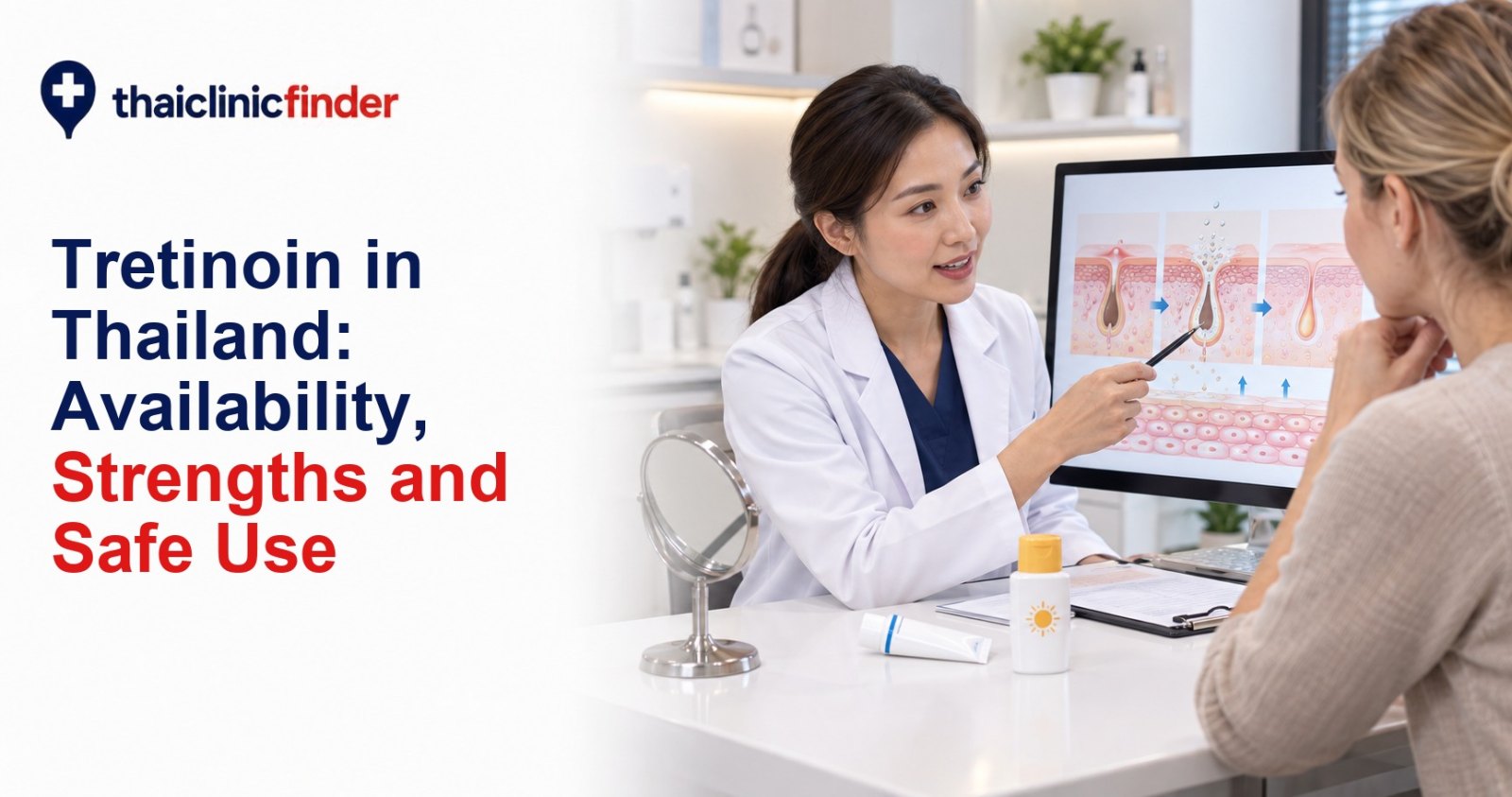
Tretinoin is widely discussed in Thailand for acne and photoaged skin, and Thai FDA records list registered topical products. That does not make it a casual cosmetic. Tretinoin is a potent retinoid medicine that can irritate skin, interact badly with an overcomplicated routine and require special caution around pregnancy.
If you are looking for tretinoin in Thailand, focus first on the condition you want to treat and the product's active ingredient, strength and registration. More irritation is not evidence that a stronger product is working better. A pharmacist or dermatologist can help match the formulation to your skin and identify acne that needs a different approach.
What topical tretinoin is used for
Topical tretinoin is used primarily in acne treatment. It helps keep pores from becoming blocked and can support the gradual improvement of comedonal acne, such as blackheads and whiteheads. It may also be used medically for signs of sun-damaged skin, but results, tolerability and suitable formulations vary.
Tretinoin is not the same as oral isotretinoin. Oral isotretinoin is a systemic medicine with different indications, monitoring and pregnancy precautions. If that is the treatment you are researching, read our separate guide to isotretinoin in Thailand and arrange proper clinical supervision.
It is also different from over-the-counter retinol used in cosmetics. Retinol must be converted in the skin and is generally less potent. Packaging that says retinol, retinyl palmitate or retinal does not contain tretinoin merely because all belong to the retinoid family. Check the actual active ingredient rather than relying on front-label language.
Availability in Thailand and how to verify a product
The Thai FDA National Drug Information database lists multiple registered topical tretinoin products, including creams and gels in commonly encountered strengths. Registration status can change, and a record does not guarantee that a particular pharmacy has stock. Search by active ingredient or registration number and ask the pharmacist to confirm the exact product.
Packaging should identify the manufacturer, active ingredient, strength and registration details. Avoid loose tubes, decanted cream or products sold through unverified social accounts. Heat and inappropriate storage can affect medicines, while counterfeit or mislabelled skincare creates a separate risk. A surprisingly cheap product is not a bargain if its origin cannot be checked.
Pharmacy practice and product classification can be confusing to visitors. Even when a pharmacy supplies tretinoin, professional advice is still useful. Ask how to use it, how to store it in Thailand's heat, what reactions are expected and when to stop. For broader pharmacy context, see our Thailand pharmacy price guide, while confirming the current price and supply directly.
Choosing between 0.025% and 0.05%
Strength describes how much tretinoin the formulation contains, not how suitable it is for your skin. A 0.05% product contains a higher concentration than 0.025%, but the stronger option may cause more redness, dryness and peeling. Starting too aggressively can lead to discomfort, missed applications and worsening irritation.
A clinician may consider your diagnosis, previous retinoid use, skin sensitivity, climate, other products and ability to follow a gradual routine. Someone who has tolerated a lower strength for months is in a different position from a first-time user arriving during Thailand's hottest season. Formulation also matters: gel and cream vehicles can feel and behave differently.
Do not mix strengths to invent an intermediate dose or copy someone else's schedule. If a product causes persistent burning or dermatitis, applying more moisturiser while continuing unchanged may not solve the problem. Pause and seek advice about frequency, formulation, strength or an alternative treatment.
A cautious way to begin
Follow the instructions supplied with your medicine and the advice of the professional who assessed you. Tretinoin is usually applied as a thin layer to the treatment area, not dotted only on individual spots, but the exact plan depends on the indication and formulation. Applying extra does not accelerate results.
Cleanse gently and let skin dry before application if instructed. Damp skin can increase penetration and irritation for some people. Use a small amount and avoid the eyes, lips, corners of the nose, broken skin and sunburned areas. Wash your hands afterwards.
Many people need a gradual introduction, such as less frequent application at first, but the schedule should reflect the product and skin response. A plain moisturiser can improve comfort. Some people use moisturiser before or after tretinoin, yet there is no need to copy elaborate online routines. Consistency at a tolerable level is usually more useful than an intense start followed by a long break.
Irritation, purging and signs to stop
Dryness, mild peeling, stinging and redness can occur early in treatment. These effects should be monitored rather than celebrated. Severe burning, swelling, blistering, crusting or pain is not a goal. Stop using the product and seek medical or pharmacy advice if the reaction is significant.
Acne can appear worse during the early weeks for some users, often described online as purging. The term is sometimes used too broadly. A rash, contact dermatitis, widespread irritation or acne in unusual areas should not automatically be dismissed as purging. A dermatologist can distinguish treatment irritation from progression of the underlying condition or another diagnosis.
Introduce other active ingredients carefully. Benzoyl peroxide, salicylic acid, alpha-hydroxy acids, scrubs, alcohol-heavy toners and other retinoids can increase irritation depending on timing and formulation. Do not layer everything in the hope of faster results. If benzoyl peroxide is part of an acne plan, ask how to separate or combine it because product stability and instructions vary.
Sun and heat matter in Thailand
Tretinoin-treated skin can be more vulnerable to irritation from sun exposure. Use broad-spectrum sunscreen, shade, a hat and protective clothing as appropriate. Reapply sunscreen according to the label, especially after sweating or swimming. Sunscreen is part of the treatment plan, not a way to tolerate unlimited sun.
Thailand's humidity can also change how products feel. Heavy occlusive layers may be uncomfortable, while frequent cleansing after sweating can strip the skin barrier. Choose a gentle cleanser and non-comedogenic moisturiser that you can use consistently. If sunscreen stings, ask for help finding a simpler formulation rather than abandoning protection.
Store the medicine according to the label and away from direct sun, hot vehicles and steamy bathrooms. Do not refrigerate unless the product specifically requires it. If the cream changes colour, smell or texture, or if packaging is damaged, ask a pharmacist before continuing.
Pregnancy and breastfeeding require direct advice
Topical retinoids are generally avoided during pregnancy as a precaution. If you are pregnant, trying to conceive or think you may be pregnant, stop self-directed use and contact a clinician. Do not rely on claims that topical use is automatically safe because absorption is lower than with oral isotretinoin.
If exposure occurred before you realised you were pregnant, do not panic or make decisions based on internet anecdotes. Contact your obstetric clinician or an appropriate medicines-in-pregnancy service for individual assessment. Bring the product, strength, application area and dates of use.
Breastfeeding advice is also individual. Avoid applying tretinoin where an infant could contact or ingest it, and discuss the treatment area and alternatives with a clinician. Pregnancy and breastfeeding are not good times to improvise with imported products or unlabeled compounded creams.
When acne needs a dermatologist
Tretinoin can be useful, but it is not the answer to every breakout. Painful nodules, cysts, scarring, sudden severe acne or acne associated with other symptoms deserves assessment. Delaying effective treatment can allow permanent scarring, while escalating topical products can worsen irritation without addressing the cause.
A dermatologist may combine treatments, investigate contributing factors or recommend oral medicine. Antibiotics should be used carefully to reduce resistance, and hormonal treatment is suitable only for selected patients. If mental health is affected by acne, say so; that impact is medically relevant even when the skin findings look modest.
Seek prompt care for facial swelling, widespread blistering, eye involvement or signs of severe allergy. If the issue is limited irritation, a pharmacy or dermatology appointment may be appropriate. Confirm the language available for the exact appointment if you need English support.
Keeping the routine simple enough to follow
Choose a gentle cleanser, moisturiser and sunscreen before adding tretinoin. Record the product and strength, take occasional photos in similar lighting and judge progress over a sensible timeframe rather than from one morning to the next. Improvement in acne usually takes weeks, and photoaging changes can take longer.
Avoid changing several products simultaneously. If irritation appears, you need to know what caused it. Keep makeup and sunscreen non-comedogenic where possible, wash gently after heavy sweating, and resist picking spots. A simple routine makes it easier to tell whether tretinoin is helping.
Costs vary by brand, strength, formulation and pharmacy. Ask for the total price and whether a generic equivalent has the same active ingredient and strength. If acne requires ongoing visits or tests, our overview of medical costs in Thailand can help with budgeting.
A sensible next step before buying tretinoin
First, confirm the diagnosis and your goals. Take a list of your current skincare, medicines, pregnancy plans and previous reactions to a pharmacist or dermatologist. Ask which registered product and strength fit your skin, and request clear instructions for frequency, moisturiser and sun protection.
Once you begin, give the routine enough time while respecting your skin barrier. Mild early dryness may be manageable, but severe or persistent irritation needs review. Do not chase rapid peeling, and do not use someone else's tube or prescription.
Finally, buy from a reputable pharmacy, keep the packaging and return for help if acne is scarring, worsening or affecting your wellbeing. For the important distinction between topical tretinoin and a monitored oral retinoid, revisit our guide to Accutane and isotretinoin in Thailand.
Frequently Asked Questions
Is tretinoin available in Thailand?
Yes. The Thai FDA database lists multiple registered topical tretinoin creams and gels.
What strengths are available?
Registered products include common strengths such as 0.025% and 0.05%.
Is 0.05% better than 0.025%?
Not necessarily. Higher strength can cause more irritation, and the best choice depends on skin and treatment goals.
Can I use tretinoin while pregnant?
Topical retinoids are generally avoided during pregnancy. Discuss use with a clinician if pregnant or trying to conceive.
How do I check a Thai tretinoin product?
Search the brand or active ingredient in the Thai FDA National Drug Information database.
Sources

Writer
Niran Chaiyasit
Niran Chaiyasit is a Thai health writer with a background in public health and a focus on travel health, disease prevention and healthcare access in Thailand. His work covers topics such as common illnesses, vaccinations, mosquito-borne diseases, food safety and practical health information for travelers and expatriates.

Medical review
Justin Brooks
Daniel Brooks is an American health writer with a background in health sciences and a focus on rehabilitation, musculoskeletal health and patient education. He writes about physiotherapy, injury recovery, pain management, preventive health and practical healthcare guidance for international patients and travelers.