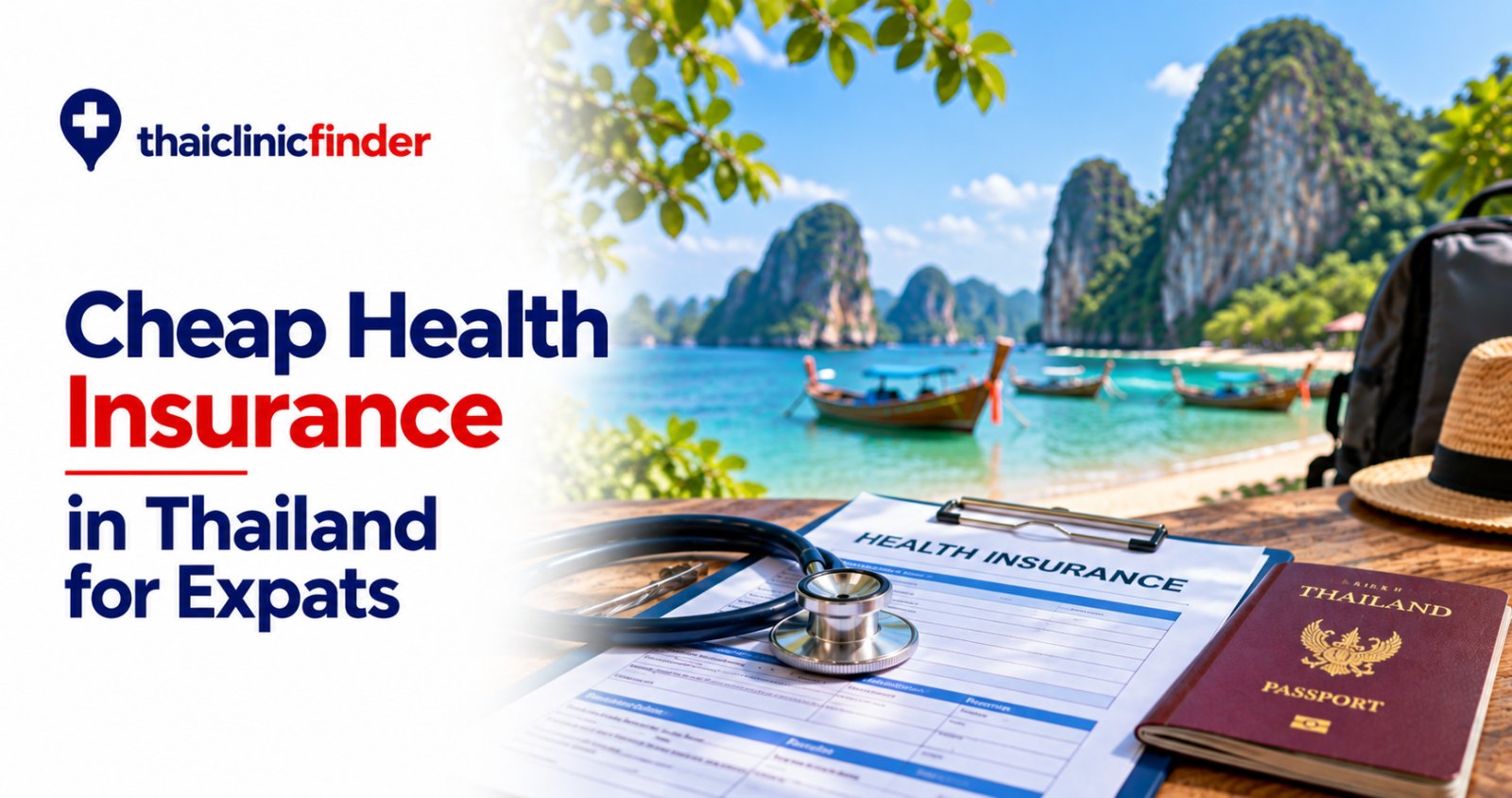
Health insurance in Thailand can be relatively affordable for younger and healthy expats, but there is a major difference between a genuinely useful low-cost policy and a plan that is cheap because it provides very limited protection.
The lowest advertised Thai health insurance premiums can start at under THB 10,000 per year for selected applicants and products. However, age, medical history, annual limits, deductibles, outpatient cover and geographical coverage can change the final premium substantially.
For many expats, the most cost-efficient approach is not finding the absolute cheapest policy. It is choosing strong inpatient protection for large hospital bills, then self-paying for inexpensive routine consultations and pharmacy purchases in Thailand.
How much does cheap health insurance cost in Thailand?
There is no universal expat premium because insurers price policies according to factors such as:
- age
- medical history
- coverage limit
- deductible
- outpatient benefits
- geographical coverage
- optional benefits
As a current market reference, AXA Thailand advertises its SmartCare Value health insurance from approximately THB 6,700 per year, with annual medical coverage up to THB 4 million under the product's conditions.
AXA SmartCare Essential is advertised from approximately THB 15,680 per year, with higher benefit limits.
These are starting premiums rather than quotations for every foreign resident. Your actual price can be substantially higher depending on age and underwriting.
What is realistic for an expat?
A healthy person in their 20s, 30s or early 40s can sometimes find local Thai medical insurance at relatively modest annual premiums.
Premiums generally rise as you get older.
Someone in their 60s or 70s should not expect the same pricing as a 30-year-old, even when both are healthy.
Pacific Cross specifically notes that health insurance becomes increasingly expensive after around age 60 and that deductibles and co-payments can be useful for controlling premiums.
The cheapest strategy is often inpatient-only insurance
Routine healthcare in Thailand can be relatively inexpensive compared with major hospitalization.
A simple private-hospital consultation may cost hundreds or a few thousand baht. Major surgery, intensive care or cancer treatment can cost hundreds of thousands or even millions of baht.
For this reason, one of the most practical ways to reduce insurance costs is to buy inpatient-focused insurance and pay for ordinary outpatient care yourself.
This can work particularly well for people who rarely visit doctors.
Pacific Cross itself notes that dental treatment, routine health checks and ordinary doctor visits can increase premiums even though these services remain relatively affordable to self-pay in Thailand.
Removing outpatient cover can reduce the premium
Outpatient insurance generally pays for services such as:
- GP consultations
- specialist consultations
- diagnostic tests
- prescribed medication
- outpatient procedures
It is convenient, but it also increases the price of the policy.
If you visit a doctor only several times per year, self-paying outpatient costs may be cheaper than buying comprehensive outpatient insurance.
This is particularly relevant in Thailand, where many routine private healthcare costs remain manageable compared with countries such as the United States.
A deductible can make insurance much cheaper
A deductible is the amount you agree to pay yourself before the insurer starts paying eligible costs according to the policy.
For example, an expat could choose a deductible of:
- THB 20,000
- THB 40,000
- THB 100,000
- THB 200,000
- THB 300,000
Pacific Cross currently offers deductible options across this range on selected plans.
The company states that choosing a reasonable deductible can reduce annual premiums by 20% or more in some situations.
This can be a very efficient strategy for someone who could comfortably pay the first THB 50,000 or THB 100,000 of a medical bill but wants protection against a THB 1 million hospitalization.
A deductible is not the same as having weak insurance
A policy with a THB 100,000 deductible and a strong annual medical limit can sometimes provide better catastrophic protection than a zero-deductible policy with very low benefit caps.
The important question is:
How much money could you comfortably pay yourself before a medical bill becomes financially painful?
Insurance is most valuable for expenses you cannot realistically absorb yourself.
Local Thai insurance is usually cheaper than international insurance
Expats generally have two broad options:
- Thai local health insurance
- international private medical insurance
A local Thai policy is usually cheaper because coverage is primarily designed around treatment in Thailand.
International plans can cover treatment across Asia or worldwide and may include benefits such as international evacuation and planned treatment abroad.
Those benefits are useful for some expats, but they increase premiums.
If you live mainly in Thailand and expect to receive planned medical care here, paying for worldwide coverage may be unnecessary.
For a wider comparison of benefits, limits and exclusions, read the guide to choosing health insurance in Thailand.
Limit geographical coverage to Thailand
Some insurers let you choose a geographical area.
Pacific Cross Expat Care, for example, offers different zones including:
- Thailand
- Asia
- worldwide excluding the USA
Restricting planned treatment to Thailand can make more financial sense for an expat who does not need international healthcare access.
Including countries with very expensive private healthcare can substantially increase insurer risk and therefore premiums.
Be careful with very low annual coverage limits
A cheap policy is less useful if the annual limit can be exhausted by one serious admission.
Private hospital treatment in Thailand can become expensive for:
- cancer
- cardiovascular surgery
- intensive care
- serious road injuries
- major orthopedic surgery
- long hospital admissions
When comparing cheap insurance, look beyond the premium and check the maximum annual benefit.
For context on hospital costs, see Medical Costs in Thailand.
Check room limits carefully
Some inexpensive policies limit the amount paid for a hospital room each day.
If your policy pays THB 3,000 per night but the hospital room costs THB 7,000, you may need to pay the difference yourself.
Room limits can also affect other hospital benefits depending on policy wording.
Ask whether the policy pays:
- actual room cost
- a fixed daily amount
- a percentage of the room bill
This is especially relevant if you expect to use premium private hospitals in Bangkok, Phuket or Chiang Mai.
Co-payments can also reduce premiums
A co-payment means you pay a percentage of eligible costs.
For example, with a 20% co-payment you may pay THB 20,000 of a THB 100,000 eligible claim while the insurer pays the remaining amount, subject to the policy conditions.
Selected Pacific Cross products currently offer co-payment structures.
A co-payment can reduce the premium, but make sure you could still afford your share during a major hospitalization.
Cheap insurance and pre-existing conditions
Pre-existing conditions are one of the biggest complications for expat insurance.
A cheap policy may exclude conditions you already have.
Depending on the insurer and condition, underwriting can result in:
- full exclusion
- premium loading
- waiting period
- restricted benefits
- application rejection
Pacific Cross states that pre-existing conditions are typically excluded initially on many plans, although some products can consider coverage under specific terms.
Its Expat Care product specifically offers limited pathways for certain pre-existing conditions after a moratorium period.
Never assume an illness is covered simply because your application was accepted.
Read the underwriting offer before paying
The final insurance offer may differ from the brochure.
Look specifically for wording such as:
- exclusion
- special condition
- deductible
- co-payment
- waiting period
- benefit sub-limit
If an insurer excludes your most important existing condition, a very low premium may no longer represent good value.
AXA offers some relatively low-cost Thai-market options
AXA Thailand currently advertises several health products at different price points.
Its SmartCare Value product is promoted with premiums starting around THB 6,700 per year and medical benefits up to THB 4 million annually under the stated product conditions.
SmartCare Essential starts higher but offers different benefits and higher limits.
AXA also offers EasyCare Visa, designed specifically for foreigners who need insurance for selected Thai long-stay visas.
Do not assume the lowest AXA plan automatically satisfies your visa or medical needs. Check eligibility and policy conditions for the exact product.
Pacific Cross can be configured around budget
Pacific Cross is another insurer commonly considered by foreign residents in Thailand.
Its online application allows users to modify pricing by selecting:
- outpatient cover or no outpatient cover
- different deductibles
- visa requirements
- coverage level
Pacific Cross also operates a cashless treatment network across hundreds of hospitals in Thailand, although hospital participation and authorization conditions should always be confirmed before treatment.
Allianz Ayudhya is another local-market option for expats
Allianz Ayudhya offers health insurance to Thai residents and expatriates.
Its FlexCare eligibility information states that applicants can include Thai nationals and expatriates, and that a work permit is not required for eligible applicants.
The company also notes that premiums vary according to age, health history and level of cover, so there is no single price that applies to all expats.
When comparing insurers, request equivalent quotations rather than comparing one insurer's cheapest plan with another insurer's comprehensive plan.
Do you need worldwide coverage?
Many expats pay extra for international insurance because it sounds safer.
Ask yourself whether you genuinely need planned medical treatment in:
- Singapore
- Europe
- Australia
- the United States
If your plan is to use Thai hospitals for almost all treatment, Thailand-only coverage can be considerably more cost-efficient.
Travel insurance can then sometimes provide emergency medical protection during shorter trips abroad.
Travel insurance is not a replacement for expat health insurance
Cheap travel insurance can look attractive because annual policies may cost much less than full medical insurance.
But travel insurance is designed for temporary trips, not permanent residence and long-term healthcare.
Potential limitations include:
- maximum trip duration
- emergency-only treatment
- pre-existing-condition exclusions
- no routine chronic care
- no planned treatment
Do not use travel insurance as your only medical insurance if you live permanently in Thailand unless you fully understand those limitations.
Health insurance for retirees is more expensive
Age is one of the largest drivers of premiums.
An expat in their 65s or 70s can pay several times more than a younger adult.
Older applicants can also encounter:
- stricter medical underwriting
- higher deductibles
- age-based premium increases
- lower entry-age limits
If you plan to retire in Thailand, obtaining insurance while you are still younger and healthy can sometimes make long-term coverage easier.
Visa insurance and normal health insurance are not always the same thing
Certain Thai long-stay visa categories can have specific insurance requirements.
A plan designed mainly to satisfy immigration requirements may not necessarily provide the medical protection you would personally choose.
Conversely, a strong international policy may require additional documentation before it can be used for immigration purposes.
If insurance is required for your visa, check the current immigration requirements and approved documentation before purchasing a cheap plan.
Direct billing is worth paying attention to
A cheap policy can become inconvenient if you must personally pay THB 300,000 and wait for reimbursement.
Ask whether the insurer offers cashless or direct billing at hospitals you are likely to use.
Also check whether pre-authorization is required for planned admissions.
Direct billing can be particularly valuable during major hospitalization.
Cheap health insurance for digital nomads
Digital nomads have an unusual insurance problem because they may live in Thailand for months but continue traveling internationally.
A local Thai plan may be cheaper if Thailand is clearly the main base.
An international policy may be more suitable when the person regularly lives in several countries.
A practical low-cost insurance strategy
For a healthy expat who mainly lives in Thailand, a cost-conscious structure could look like this:
- Thailand-focused inpatient insurance
- a meaningful annual medical limit
- no routine outpatient cover
- THB 40,000 to THB 100,000 deductible if affordable
- self-pay routine doctor and pharmacy costs
- separate travel insurance for short overseas trips
This is only an example rather than a universal recommendation.
Someone with chronic illness, frequent specialist visits or substantial international travel may need a very different structure.
What should you compare besides the premium?
Before choosing the cheapest quotation, compare:
- annual coverage limit
- hospital room limit
- ICU coverage
- cancer treatment
- surgery
- deductible
- co-payment
- outpatient benefits
- pre-existing-condition exclusions
- waiting periods
- hospital network
- direct billing
- geographical coverage
- renewal age
A difference of THB 5,000 per year is insignificant if the cheaper policy leaves you exposed to hundreds of thousands of baht during a serious illness.
Questions to ask before buying
Ask the insurer or broker:
- What is the total annual premium?
- What is the annual medical limit?
- What deductible applies?
- Is outpatient treatment included?
- Which hospitals offer direct billing?
- What is excluded because of my medical history?
- Does the policy cover cancer treatment?
- What is the room limit?
- Is treatment outside Thailand covered?
- Until what age can the policy be renewed?
- Does the plan satisfy my visa requirements if relevant?
- How much can the premium increase as I get older?
Get important answers in writing.
So, what is the cheapest health insurance in Thailand for expats?
There is no single cheapest insurer for every expat because premiums depend heavily on age, medical history and benefits.
Current Thai-market products can advertise starting premiums below THB 10,000 per year, while comprehensive expat insurance can cost many times more.
For many healthy foreign residents, the most economical structure is local Thailand-focused inpatient insurance with a deductible and without expensive outpatient extras.
The cheapest premium should not be the only objective. A useful policy should protect you against the type of medical bill that could genuinely damage your finances while allowing you to self-pay smaller costs that are affordable in Thailand.
Frequently Asked Questions
How much is cheap health insurance in Thailand for expats?
Some Thai-market health policies advertise starting premiums below THB 10,000 per year, but actual expat premiums depend on age, health history, deductible and coverage. Comprehensive plans can cost substantially more.
What is the cheapest way to get health insurance in Thailand?
For many healthy expats, Thailand-only inpatient insurance with no outpatient cover and a reasonable deductible can substantially reduce the annual premium.
Can foreigners buy Thai health insurance?
Yes. Several Thai insurers accept foreign residents, subject to eligibility and medical underwriting. Some plans do not require a Thai work permit.
Is THB 6,000 to THB 10,000 per year enough for health insurance?
Some policies have starting premiums in that range, but low-cost plans can have important limits, deductibles or eligibility conditions. Check the annual limit and exclusions rather than relying only on price.
Is local health insurance cheaper than international insurance in Thailand?
Usually yes. Thailand-focused coverage generally costs less because the insurer is not providing broad planned medical treatment across expensive international markets.
Should expats buy outpatient health insurance in Thailand?
Not necessarily. Routine outpatient care can be relatively affordable, so some expats self-pay these costs and insure mainly against hospitalization and major treatment.
Does a higher deductible make health insurance cheaper?
Yes. Pacific Cross states that selecting a reasonable deductible can reduce annual premiums by 20% or more in some cases.
Can expats with pre-existing conditions get cheap health insurance in Thailand?
It can be more difficult. Insurers may exclude the condition, increase premiums, apply waiting periods or offer restricted coverage depending on underwriting.
Sources

Writer
Niran Chaiyasit
Health writer with a background in public and travel health
Niran Chaiyasit is a Thai health writer with a background in public health and a focus on travel health, disease prevention and healthcare access in Thailand.
View profile
Medical review
Sumait Premmanisakul
Medical Director (Thailand)
Dr. Sumait Premmanisakul is Medical Director (Thailand) at Global Doctor Bangkok. His work spans aviation medicine, occupational medicine and travel medicine. The clinic lists him on its medical team in Bangkok, where it serves residents and travellers from its Asoke and Silom locations.
View profile