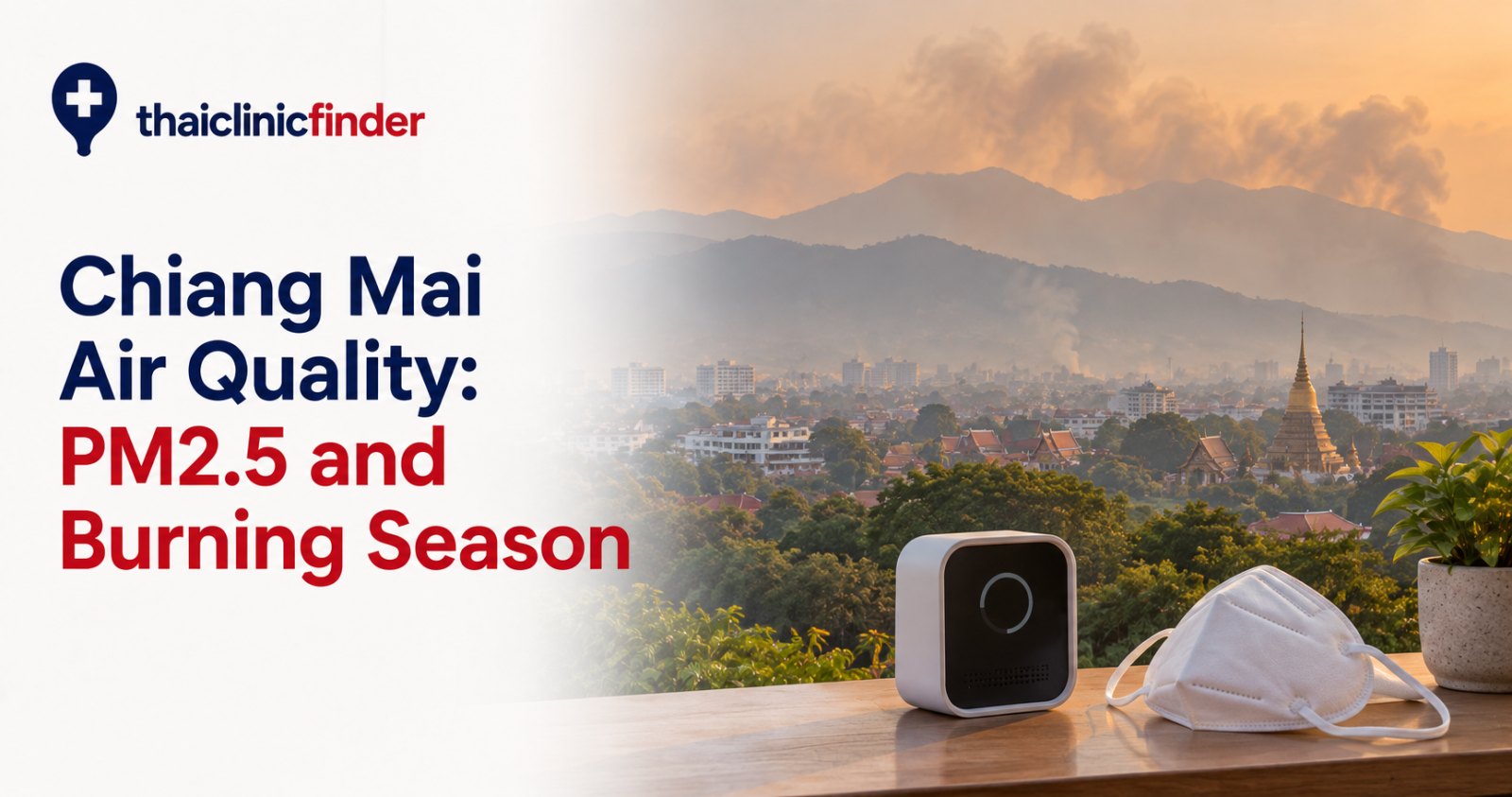
Chiang Mai is one of Thailand's best-known destinations, but its air quality can become a serious practical concern during the annual smoke and haze season. The main pollutant to watch is usually PM2.5, fine particulate matter that can penetrate deep into the lungs and affect both respiratory and cardiovascular health.
Air quality in Chiang Mai is not poor all year. Conditions vary strongly by season, weather, wildfire and agricultural burning activity, local emissions and regional smoke transport. During some periods, especially around March and April, official monitoring has recorded PM2.5 well above Thailand's national standard.
For residents, digital nomads and travelers, the most useful strategy is to understand the seasonal pattern, check official local readings every day during the haze season, and reduce exposure when pollution is high.
Why Chiang Mai has a seasonal air pollution problem
Chiang Mai's air pollution is different from Bangkok's in several important ways.
Bangkok's PM2.5 problem is strongly linked to traffic, urban combustion and stagnant weather. Chiang Mai also has traffic and urban emissions, but biomass burning and wildfire smoke are especially important during the northern haze season.
Research from Chiang Mai University has found substantially higher PM2.5 and pollution-related compounds during high biomass-burning periods than during lower-burning periods. Official environmental authorities also issue repeated smoke and PM2.5 warnings during the northern dry season.
The province has introduced no-burning periods and fire-prevention measures to reduce the problem. For 2026, Chiang Mai authorities set a "no burn" period from 1 January through 31 May.
When is Chiang Mai air quality usually worst?
There is no single date when the smoke season begins or ends, because conditions depend on rainfall, fires, wind and regional transport.
However, March and April are often the most difficult months. In late March and early April 2026, Thailand's Environmental and Pollution Control Office 1 issued repeated warnings for Chiang Mai and nearby northern provinces after PM2.5 exceeded national standards, with some monitoring locations reaching levels categorized as harmful to health.
That does not mean every day in March or April is equally polluted. A windy or rainy period can temporarily improve conditions, while a cluster of fires combined with stagnant air can cause a rapid deterioration.
A useful way to think about the year is:
- roughly January to May: higher probability of smoke and burning-related pollution;
- March and April: often the highest-risk period;
- rainy season: generally cleaner because rainfall suppresses fires and removes particles from the air;
- late year: conditions are often much better than peak haze season, but daily checks are still sensible.
PM2.5: the main number to watch
PM2.5 refers to particles with an aerodynamic diameter of 2.5 micrometres or less.
Because these particles are extremely small, they can reach deep into the lungs. The World Health Organization links particulate air pollution with respiratory and cardiovascular disease and other adverse health outcomes.
Thailand's current national PM2.5 standard is:
- 37.5 µg/m³ as a 24-hour average
- 15 µg/m³ as an annual average
The WHO's 2021 health-based guideline is more stringent:
- 15 µg/m³ for a 24-hour PM2.5 average;
- 5 µg/m³ for an annual average.
The WHO values are guidelines rather than Thai legal standards, so an app can show air that meets a Thai standard but still exceeds the WHO health guideline.
For a Thailand-wide explanation of the pollutant and national standards, see PM2.5 in Thailand.
AQI and PM2.5 are not the same thing
Travelers often search for "Chiang Mai AQI" and see different numbers on different apps.
AQI stands for Air Quality Index. It converts pollution concentrations into a simplified health scale. Different platforms can use different AQI systems, so the same PM2.5 concentration may produce different AQI numbers.
The actual PM2.5 concentration in µg/m³ is often the most useful number for comparing readings across sources.
When checking an app, confirm:
- whether the number is AQI or PM2.5 concentration;
- whether the reading is current, hourly or a 24-hour average;
- which monitoring station is being shown;
- whether the app uses Thai AQI, US AQI or another scale.
Where to check Chiang Mai air quality
The most important official source is Air4Thai, operated by Thailand's Pollution Control Department. Environmental and Pollution Control Office 1 also publishes regional PM2.5 summaries and alerts for Chiang Mai, Chiang Rai, Lamphun and Mae Hong Son.
Official alerts can be particularly useful during severe episodes because they provide health recommendations as well as monitoring data.
Do not rely entirely on a single city-wide number. Chiang Mai Province is large, and PM2.5 can differ between urban areas, valleys and districts closer to active fires.
If you are deciding whether to exercise outside, ride a motorbike for several hours or take children outdoors, use a monitoring point reasonably close to your actual location.
Why smoke can become trapped around Chiang Mai
Chiang Mai sits in a basin surrounded by mountains. Local geography can contribute to poor dispersion under certain weather conditions, especially when winds are weak and the atmosphere is stable.
That does not mean the mountains create pollution. The pollution comes from emissions and smoke. Geography and weather can simply make it harder for those pollutants to disperse.
During intense haze events, smoke may come from a mixture of:
- forest and vegetation fires;
- agricultural burning;
- burning in neighboring provinces;
- cross-border smoke transport;
- road traffic and local combustion.
The contribution of each source changes by episode, so it is misleading to blame every bad-air day on one activity.
Is Chiang Mai air pollution dangerous?
The health risk depends on concentration, duration, activity and individual susceptibility.
A short exposure to moderately elevated PM2.5 is not the same as breathing heavily polluted air for weeks. Someone doing outdoor endurance training also inhales more air than someone spending most of the day indoors.
WHO identifies children, pregnant people, older adults and people with chronic disease as groups at greater risk from air pollution.
People with asthma, chronic obstructive pulmonary disease, cardiovascular disease or other relevant medical conditions should be especially careful during severe episodes.
Common symptoms during heavy smoke
High PM2.5 can contribute to:
- coughing;
- throat irritation;
- eye irritation;
- wheezing;
- shortness of breath;
- chest discomfort;
- headaches;
- worsening asthma symptoms.
These symptoms are not specific to pollution. Respiratory infections, allergies, heat and other conditions can cause similar complaints.
If you become unwell while living or traveling in Thailand, see our practical guide on what to do if you get sick in Thailand.
How to reduce exposure during Chiang Mai's smoke season
Check the air before planning outdoor activity
During the haze season, make air-quality checking part of your daily routine.
Conditions can change quickly. A morning that looks clear from a window can still have elevated PM2.5, and visible haze does not always track perfectly with particle concentration.
Reduce strenuous outdoor exercise on bad days
Exercise increases breathing rate and total inhaled air. When PM2.5 is high, that increases the dose of pollution reaching the lungs.
Official Thai public-health advice during severe pollution episodes includes reducing or avoiding outdoor activity and limiting heavy outdoor exercise.
If the air is poor, moving the workout indoors is usually more sensible than trying to push through a long run or bike ride.
Use a particulate respirator when exposure is unavoidable
A well-fitting respirator designed to filter fine particles, such as an N95-type mask, can reduce inhalation of PM2.5 when worn correctly.
Fit matters. Gaps around the cheeks or nose reduce effectiveness.
A loose surgical mask does not provide the same level of protection against fine particles as a fitted particulate respirator.
Create a cleaner indoor space
During severe smoke:
- keep doors and windows closed when outdoor air is worse;
- use air conditioning in recirculation mode when appropriate;
- run a correctly sized particle air purifier;
- avoid indoor smoking, incense and other particle-generating activities;
- spend more time in the room with the best filtration.
A purifier is most effective when the room is reasonably sealed and the device is appropriately sized for the space.
Limit long motorbike exposure
Long rides can mean prolonged exposure to roadside pollution and regional smoke. If PM2.5 is very high, consider shortening trips or using enclosed transport with filtered air when practical.
Should you cancel a trip to Chiang Mai because of smoke?
It depends heavily on timing.
If your trip is scheduled for peak haze season, particularly March or April, there is a meaningful chance of poor air quality. However, pollution cannot be predicted precisely months in advance.
A single AQI screenshot is not a good basis for deciding whether to cancel a future trip. Instead, look at:
- the time of year;
- recent PM2.5 trends;
- fire activity and official warnings;
- whether you have asthma or another relevant condition;
- how much outdoor activity your trip requires.
Travelers with significant respiratory disease may want to discuss travel timing with their clinician before visiting during the highest-risk period.
Is the air better outside Chiang Mai city?
Not necessarily.
Some rural or mountainous areas may have less traffic, but they can also be closer to wildfire or agricultural burning. During widespread regional haze, air quality can be poor across multiple northern provinces at the same time.
Official monitoring in 2026 showed severe PM2.5 episodes affecting Chiang Mai together with Chiang Rai, Lamphun and Mae Hong Son.
So moving a short distance outside the city is not guaranteed to solve the problem.
Hotels, condos and air purifiers
If you are staying in Chiang Mai during smoke season, indoor air quality can materially affect comfort.
Before booking a long stay, it can be useful to ask:
- whether the room has a dedicated air purifier;
- whether windows seal properly;
- whether air conditioning recirculates indoor air;
- whether replacement filters are maintained.
Do not assume a building has clean indoor air simply because it is modern. Indoor PM2.5 can rise when outdoor air enters through open windows, doors or poorly sealed gaps.
When to seek medical care
Pollution can cause irritation, but severe symptoms should not be dismissed as "just the smoke."
Seek medical assessment if you develop persistent breathing difficulty, significant wheezing, worsening asthma, chest symptoms or other concerning symptoms.
Seek urgent medical help for severe shortness of breath, chest pain, fainting, confusion, bluish lips or face, or rapidly worsening symptoms.
If urgent help is needed, see medical emergencies in Thailand.
Practical routine for residents and digital nomads
For people staying in Chiang Mai for weeks or months, a simple routine is often enough:
- Check Air4Thai each morning during the dry season.
- Look at the PM2.5 concentration, not just the AQI color.
- Reduce outdoor exercise if levels are high.
- Wear a well-fitting particulate respirator when necessary.
- Keep one indoor room filtered and relatively sealed.
- Recheck conditions later because readings can change during the day.
The goal is not to treat every polluted day as an emergency. It is to reduce cumulative exposure when conditions are clearly poor.
The bottom line
Chiang Mai's air quality is highly seasonal. The city and surrounding northern provinces can experience severe PM2.5 pollution during the dry-season burning and wildfire period, with March and April often among the worst months.
Thailand's 24-hour PM2.5 standard is 37.5 µg/m³, while the WHO health guideline is 15 µg/m³. During the 2026 haze season, official monitoring recorded repeated exceedances and issued health warnings in Chiang Mai.
Check Air4Thai, reduce strenuous outdoor activity when pollution is high, use effective particulate filtration and take extra precautions if you have asthma, heart disease or another condition that increases your vulnerability.
Frequently Asked Questions
When is Chiang Mai's burning season?
The higher-risk period generally falls in the dry season, with March and April often producing the worst smoke and PM2.5 conditions. Exact timing varies each year with fires, rainfall and weather.
What is the worst month for air quality in Chiang Mai?
March is frequently among the worst months, and severe episodes can continue into April. Official monitoring in 2026 recorded repeated high PM2.5 levels in late March and April.
Where can I check Chiang Mai air quality?
Air4Thai, operated by Thailand's Pollution Control Department, is a key official source. Environmental and Pollution Control Office 1 also publishes northern Thailand PM2.5 reports and warnings.
Is Chiang Mai air quality bad all year?
No. Air pollution is strongly seasonal. The rainy season is generally much cleaner, while the dry-season haze period has a higher risk of severe PM2.5.
Should I wear an N95 in Chiang Mai?
A well-fitting particulate respirator such as an N95-type mask can reduce PM2.5 exposure when worn correctly. It is most useful during polluted periods when outdoor exposure cannot be avoided.
Should I avoid Chiang Mai in March?
March has a relatively high probability of smoke and poor air quality, so travelers with respiratory disease or plans for intensive outdoor activity should consider the risk. Conditions vary by year, so check current official monitoring closer to travel.
Sources
Writer
Niran Chaiyasit
Niran Chaiyasit is a Thai health writer with a background in public health and a focus on travel health, disease prevention and healthcare access in Thailand. His work covers topics such as common illnesses, vaccinations, mosquito-borne diseases, food safety and practical health information for travelers and expatriates.

Medical review
Justin Brooks
Daniel Brooks is an American health writer with a background in health sciences and a focus on rehabilitation, musculoskeletal health and patient education. He writes about physiotherapy, injury recovery, pain management, preventive health and practical healthcare guidance for international patients and travelers.