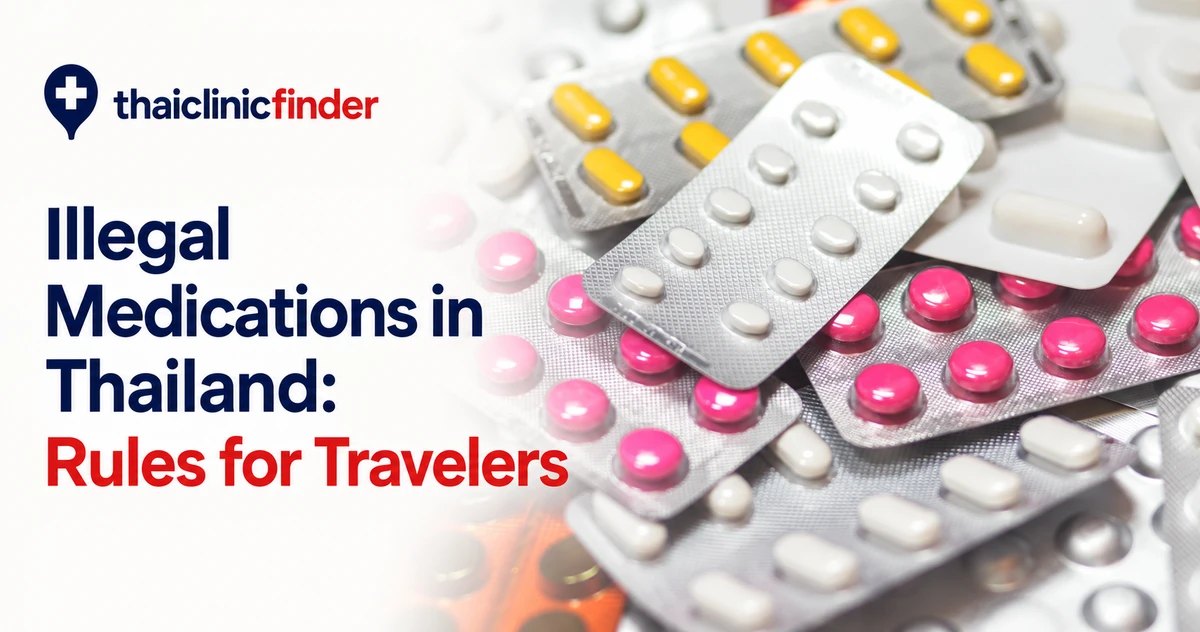
Travelling with medication is usually straightforward until a product falls under Thailand's narcotics or psychotropic-substance rules. A medicine that is routine in your home country may require documents, prior permission or a different plan in Thailand. Brand names are a poor guide because the legal status depends on the active ingredient and quantity, not the packaging.
This guide explains how tourists and expatriates can check a medicine before travel, what the Thai Food and Drug Administration says about personal supplies, and what to do when a product cannot be carried legally. It is general information, not individual legal or medical advice. Rules and controlled-substance lists can change, so check each ingredient with the Thai FDA before departure.
What "banned medication" actually means in Thailand
Online discussions often group all difficult medicines together as "banned drugs." That wording hides several distinct situations. A product may be an ordinary modern medicine allowed in a limited personal quantity, a controlled psychotropic substance, a controlled narcotic, or a substance for which a traveller exemption is unavailable. The paperwork and quantity limits differ.
The Thai FDA's general FAQ says a traveller may bring a modern drug for personal use for no longer than 30 days under the Drugs Act. That general rule should not be applied automatically to narcotics or psychotropic substances. Those medicines sit under a separate controlled-substance process, and some require permission before arrival.
The safest approach is therefore not to search for a single informal "banned list." Use the Thai FDA's traveller portal to check the generic ingredient, its schedule and the current carry-in guidance. If the result is unclear, contact the Narcotics Control Division in writing and keep its response.
Start with the active ingredient, not the brand
Two products sold under similar names can contain different ingredients in different countries. Conversely, the same controlled ingredient may appear under many brand names. Before checking the rules, make a simple medication record containing:
- the generic or international non-proprietary name;
- strength, dosage form and daily dose;
- total quantity you intend to carry;
- prescribing clinician and medical condition;
- travel dates and expected length of stay.
Look at the pharmacy label and prescription rather than relying on memory. Combination products need every active ingredient checked. This matters with pain medicines, cough preparations, sleep medicines, anxiety treatments and attention-deficit medicines, where one component may determine the legal status.
Thai Clinic Finder's guide to pharmacies and prescription medicines in Thailand explains the separate question of obtaining medicines after arrival. Buying a product in Thailand is not a workaround for importing a controlled medicine, and availability abroad does not show that the same product is legally sold in Thailand.
Thailand's main traveller categories
Ordinary personal medication
For a modern medicine that is not regulated as a narcotic or psychotropic substance, the Thai FDA states that a traveller may bring a personal supply for up to 30 days. The FDA's page on bringing health products also says the medicine should be for personal use and accompanied by a medical certificate specifying the need.
Carry the medicine in its original, clearly labelled container. Bring a prescription or clinician's letter that identifies you, the medical condition, the generic ingredient, strength, dose and quantity. An English document is practical for inspection, although travellers should confirm whether any additional format is required for their specific product.
Psychotropic substances
Thailand's Narcotics Control Division publishes schedules and a dedicated traveller process. Its current English guidance says Schedule II, III and IV psychotropic medicines may be carried for personal treatment in a quantity not exceeding 30 days when the traveller has a certificate or prescription from the prescriber. For a prescribed supply of 31 to 90 days, prior Thai FDA permission is required.
Do not infer the schedule from what happened on a previous trip. Search the current official list by ingredient. The Thai FDA portal was updated with controlled-substance lists in September 2025 and newer carry-in guidance in May 2026, which illustrates why copied blog lists become outdated.
Narcotic medicines
The current Thai FDA guidance permits certain prescribed Schedule II and III narcotic medicines for personal treatment, up to a 90-day supply, but requires a permit. The application should be submitted through the official traveller portal at least 15 days before arrival. The FDA says a complete application is generally processed in about three working days, but that is not a reason to apply late: missing documents or questions about an ingredient can extend the process.
Other narcotic schedules do not automatically qualify for this traveller route. Check the restriction table and ask the Narcotics Control Division rather than assuming that a foreign prescription makes possession lawful.
Medicines that commonly deserve an early check
The practical warning signs are the medicine class and ingredient, not a list of brand names. Check early if your treatment includes:
- opioid pain medicines or opioid-containing combination products;
- stimulants used for ADHD or narcolepsy;
- benzodiazepines and other sedative or anxiety medicines;
- strong sleep medicines;
- certain cough medicines containing controlled ingredients;
- medical cannabis products or cannabinoid preparations;
- any medicine described as a narcotic, controlled drug or psychotropic medicine at home.
This is not a claim that every medicine in those broad groups is prohibited. Some can be carried within a traveller exemption, while others require permission or cannot use that route. For stimulant-specific context, read bringing Adderall to Thailand and the broader guide to ADHD medication in Thailand. The official ingredient check must still decide your own case.
Cannabis rules require particular care. Changes to domestic availability do not mean a traveller can import a cannabis medicine, extract, oil or edible. Border controls and medical-product rules are separate from possession or treatment inside Thailand. Ask the Thai FDA and Thai Customs about the exact product before carrying it.
How to apply for a Thai FDA permit
Use the Permit for Traveler website operated by the Narcotics Control Division. Select the carry-in guidance, verify the drug and follow the current application route. The portal describes the permit as Form IC-2 for qualifying controlled medicines.
Prepare the documents before starting. The official guidance calls for a prescription or medical certificate from the treating practitioner, and the application needs enough information to match the traveller, itinerary, ingredient, dose and quantity. Names should be consistent across the passport, ticket and medical paperwork.
Submit at least 15 days before the arrival date when a permit is required. Save the approval and carry it with the medicine. A screenshot alone is less useful than an accessible PDF or printout if a device is flat or has no connection at inspection.
If you have a connecting itinerary, check every transit country separately. A Thai permit governs entry to Thailand; it does not authorise possession in another jurisdiction or during an airport transfer there.
Packing and arrival checklist
Keep the supply in original pharmacy packaging with readable labels. Do not consolidate different prescription medicines into an unlabelled pill organiser for border travel. A small organiser can be useful after arrival, but the main supply should remain identifiable.
Place controlled medicines and documents where you can present them during inspection. Do not send them separately by post or courier on the assumption that personal-use rules will apply. Importing an unaccompanied parcel can involve a different process.
Carry:
- your prescription or clinician's letter;
- the Thai FDA permit, when required;
- a copy of the passport identity page;
- the medicine in original containers;
- a list of generic ingredients and quantities;
- contact details for the prescriber and Thai FDA.
If asked to declare the medicine, answer accurately and show the documents. A permit does not justify carrying more than the approved quantity or a different ingredient.
If your medicine cannot be brought into Thailand
Do not stop an essential medicine suddenly without medical advice, especially a medicine associated with withdrawal, seizures or deterioration when interrupted. Contact the prescriber well before travel. They may be able to discuss a lawful alternative, adjust the travel plan or coordinate care in Thailand.
A Thai clinician may need to assess you before issuing a local prescription. Bring a concise medical summary, recent relevant results and the generic treatment history. Confirm the exact department, appointment language and documents directly with the hospital or clinic. A provider's ability to prescribe also depends on the medicine and the clinician's assessment.
Never buy a substitute through an informal seller or social-media account. Counterfeit, mislabelled and improperly stored medicines add a health risk to the legal problem. Use a licensed pharmacy and seek a doctor when a prescription is required.
What if you are already at the airport or border?
If you discover a problem before departure, do not hide the medicine or discard it into a public bin. Speak to the airline and the relevant border or medicines authority. If you are at a Thai checkpoint, cooperate with Thai Customs and the Thai FDA officers and provide the prescription and packaging.
An internet post, overseas pharmacy receipt or doctor's note does not replace a permit where Thai rules require one. The outcome depends on the ingredient, schedule, quantity and circumstances. Because penalties and enforcement are legal matters, obtain advice from the responsible Thai authority or a qualified Thai lawyer rather than relying on predictions online.
If missing medicine creates an immediate health risk, tell airport staff and seek medical assistance. For a non-urgent replacement after entry, contact a hospital or licensed clinic and explain exactly what you normally take.
Staying in Thailand for longer than your supply
Long-stay residents should plan continuity of care rather than importing repeated personal supplies without checking the rules. Ask a Thai doctor whether the same active ingredient and formulation are approved and clinically suitable. A brand may differ even when a generic medicine is available.
Keep copies of medical records and arrange follow-up before running low. Insurance may treat routine prescriptions, pre-existing conditions and outpatient consultations differently, so confirm benefits and reimbursement documents in advance. Availability, pricing and prescribing requirements can change.
A careful pre-travel decision
The useful question is not simply whether a medicine is "legal in Thailand." Ask which ingredient it contains, how Thailand classifies it, how many days you are carrying and whether the current traveller exemption requires prior approval.
Check the official Thai FDA portal before booking around an essential treatment, apply early when required, and travel with matching medical documents and original packaging. If the status of an ingredient is unclear, ask the Narcotics Control Division before departure rather than leaving the decision until the border.
Frequently Asked Questions
Can I bring prescription medication into Thailand?
Many ordinary medicines may be carried for personal use, but controlled ingredients follow separate rules. Check the generic ingredient through the Thai FDA traveller portal and carry the required prescription, certificate and permit.
How much medicine can I bring to Thailand?
The Thai FDA states a general limit of up to 30 days for ordinary modern medicines. Controlled psychotropic and narcotic medicines have schedule-specific limits and may require prior permission, so verify the exact ingredient.
Do I need a Thai FDA permit for my medication?
It depends on the active ingredient, schedule and quantity. The official Permit for Traveler portal provides a drug check and current carry-in guidance.
Is a foreign prescription enough at Thai customs?
Not when Thai rules require prior permission. A prescription or medical certificate supports the traveller application, but it does not replace a required Thai FDA permit.
Sources

Writer
Niran Chaiyasit
Niran Chaiyasit is a Thai health writer with a background in public health and a focus on travel health, disease prevention and healthcare access in Thailand. His work covers topics such as common illnesses, vaccinations, mosquito-borne diseases, food safety and practical health information for travelers and expatriates.

Medical review
Justin Brooks
Daniel Brooks is an American health writer with a background in health sciences and a focus on rehabilitation, musculoskeletal health and patient education. He writes about physiotherapy, injury recovery, pain management, preventive health and practical healthcare guidance for international patients and travelers.