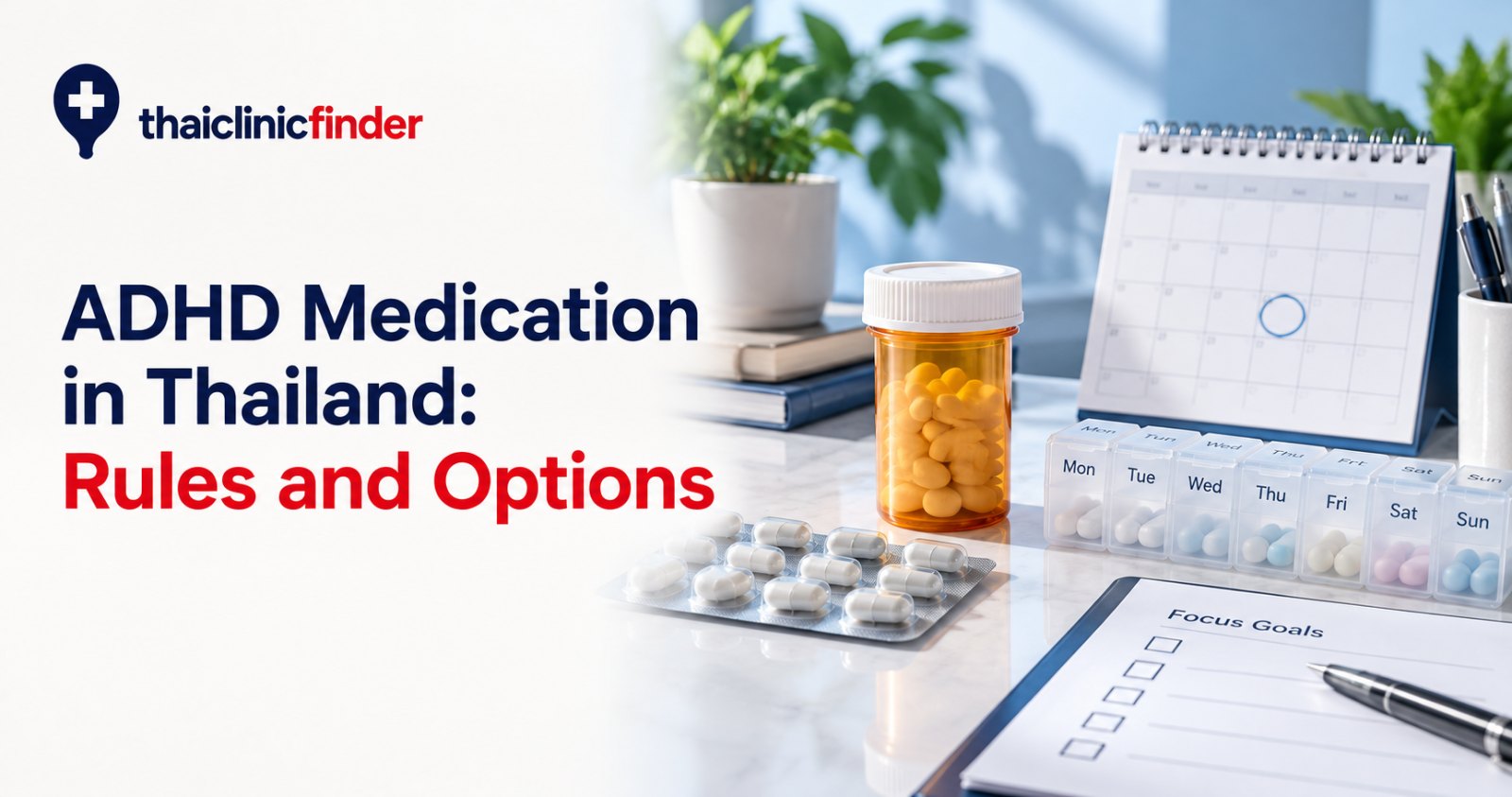
ADHD medication is available in Thailand, but the options and legal controls differ from those in the United States, Europe or Australia. Methylphenidate is used for ADHD in Thailand and is a Category 2 psychotropic substance, while atomoxetine is also registered for ADHD and is classified as a dangerous drug under Thai drug law. Amphetamine-based medicines require much more caution because some amphetamine substances are prohibited from being brought into Thailand.
For an expat, traveler or long-term resident, the safest plan is to identify the active ingredient in your current medicine before you travel, check its Thai legal category, and arrange local medical follow-up rather than assuming the same brand will be available.
This guide covers the main medication routes, prescription controls, travel rules and practical steps for getting ADHD treatment in Thailand.
What ADHD medications are used in Thailand?
Thailand has registered medicines for ADHD, but the local medication mix is not identical to every other country.
Two important options are:
- methylphenidate, a stimulant medicine used for ADHD and narcolepsy;
- atomoxetine, a non-stimulant medicine registered for ADHD in children, adolescents and adults.
The Thai FDA's National List of Essential Medicines includes methylphenidate 10 mg tablets for ADHD and narcolepsy. Thai FDA materials also classify methylphenidate as a Category 2 psychotropic substance because it has legitimate medical use but also a significant potential for misuse.
Thai FDA product records show registered atomoxetine products and describe atomoxetine as indicated for ADHD. Unlike methylphenidate, the cited Thai registration record classifies atomoxetine as a "dangerous drug" rather than a controlled psychotropic substance.
Other treatment options may exist, but availability, brand names and prescribing practice can change. A Thai clinician should determine the suitable medication rather than a patient trying to reproduce an overseas regimen independently.
Is methylphenidate legal in Thailand?
Yes. Methylphenidate has a recognized medical use in Thailand, including ADHD treatment. However, it is tightly controlled.
The Thai FDA classifies methylphenidate as a Category 2 psychotropic substance. Category 2 substances have accepted medical use but are controlled more strictly because of abuse potential.
This means methylphenidate should not be treated like an ordinary pharmacy medicine. Patients generally need specialist or appropriate medical assessment and lawful prescribing and dispensing channels.
The Thai FDA reported in February 2025 that methylphenidate supply had been affected by broader shortages, particularly for long-acting ADHD products that Thailand relied on imports to supply. That report describes a supply issue at that time, not a guarantee that a shortage continues today. Current stock should be confirmed directly with the treating hospital or pharmacy.
Is Concerta or Ritalin available in Thailand?
Brand availability can change, so it is better to ask about the active ingredient methylphenidate and the exact release formulation rather than relying only on a brand name.
Immediate-release and long-acting products are not clinically identical. If you already take a modified-release product, tell the doctor the exact brand, strength and dosing schedule. Bring a photograph of the packaging or a copy of the prescription if possible.
Do not substitute an immediate-release tablet for an extended-release product, or vice versa, without a prescriber's instructions.
Because methylphenidate is a controlled psychotropic medicine, a pharmacy may not dispense it in the same way as ordinary prescription drugs. A hospital or clinic familiar with ADHD care is often the most practical starting point.
For a wider overview of accessing care, see how healthcare access works in Thailand for visitors and residents.
Is atomoxetine available in Thailand?
Yes. Thai FDA records show registered atomoxetine products for ADHD. One current product record states that atomoxetine is indicated for Attention-Deficit/Hyperactivity Disorder in children from age 6, adolescents and adults.
Atomoxetine is a non-stimulant medicine. The Thai product record cited by the FDA classifies it as a dangerous drug, which is a regulated medicine category, but it is not listed in the same Category 2 psychotropic group as methylphenidate.
That distinction matters for both local prescribing and travel rules. It does not mean atomoxetine is suitable for everyone or that it should be started without medical supervision.
A doctor will consider previous treatment response, cardiovascular history, mental health history, other medicines and adverse effects when choosing treatment.
What about Adderall and amphetamine ADHD medication?
This is the area where travelers can make a serious mistake.
Adderall contains mixed amphetamine salts. Thai FDA traveler guidance lists amphetamine and dexamphetamine among substances travelers are forbidden from transporting into or out of Thailand, describing them as prohibited substances with no recognized medical use in Thailand under the cited rules.
That is very different from methylphenidate.
If your home-country ADHD treatment contains amphetamine, dexamphetamine or a related substance, do not put it in your luggage simply because you have a foreign prescription. Check the exact active ingredients against the current Thai FDA controlled-substance rules before travel.
Thai Clinic Finder covers this specific issue separately in the guide on bringing Adderall to Thailand. You can also read the broader guide to bringing prescription medicines into Thailand.
Can you bring methylphenidate into Thailand?
Thai FDA guidance allows travelers under treatment to carry Category 2, 3 and 4 psychotropic medicines for personal use under specified conditions.
For up to a 30-day prescribed supply, current Thai FDA guidance says the traveler should carry a medical certificate or prescription from the prescribing physician. For a 31 to 90-day supply, a Thai FDA permit is required in advance, and the FDA advises applying at least 15 days before travel.
Because methylphenidate is Category 2, these psychotropic-substance rules apply to it.
Your documentation should clearly identify the patient, diagnosis, medicine, strength, directions, prescribed quantity and prescriber. Keep the medicine in its original labeled container.
Rules can change, so use the Thai FDA traveler portal before every trip rather than relying on an old forum answer.
How to get ADHD medication in Thailand
For ongoing treatment, a practical process is:
- Bring evidence of your diagnosis and current treatment. Useful documents include a diagnostic report, recent clinic letter, prescription history and medication packaging.
- Identify the active ingredient. Brand names vary internationally.
- Book an appropriate doctor. Psychiatry, child and adolescent psychiatry, or another clinician experienced in ADHD may be relevant depending on age and circumstances.
- Expect a clinical reassessment. A Thai doctor is not required to reproduce an overseas prescription automatically.
- Use the hospital or licensed pharmacy channel recommended by the prescriber. This is especially important for controlled psychotropic medicines.
- Plan refills early. Controlled medicines and imported formulations can have supply constraints.
If you also need broader mental health care, see the mental health in Thailand guide.
Do you need a prescription for ADHD medicine in Thailand?
For medicines such as methylphenidate and atomoxetine, medical prescribing and supervised dispensing are the appropriate route.
Methylphenidate is especially controlled as a Category 2 psychotropic substance. It should not be expected to be available as an ordinary over-the-counter pharmacy purchase.
Atomoxetine is registered as a dangerous drug. Thai drug categories do not map perfectly onto terms such as "prescription-only" used in other countries, but its legal classification and ADHD indication mean it should be obtained through legitimate medical and pharmacy channels.
Avoid sellers who offer controlled ADHD medicine without a normal medical process.
Can a foreign prescription be used in Thailand?
An overseas prescription is useful evidence of ongoing treatment, but it does not guarantee that a Thai pharmacy can dispense the same medicine directly.
A local clinician may need to review your history and issue a Thai prescription. This is particularly likely for controlled medicines such as methylphenidate.
Bring the following:
- your prescription;
- a brief medical summary;
- your diagnosis and previous treatment history;
- the generic and brand names;
- the exact release formulation;
- the dose and schedule;
- previous adverse effects or failed treatments.
This can reduce confusion and help the doctor distinguish, for example, immediate-release methylphenidate from a long-acting formulation.
How much does ADHD medication cost in Thailand?
There is no single national retail price for ADHD treatment. The total cost can include the consultation, medicine, follow-up and sometimes additional assessment.
The price can also vary by brand and formulation. Imported extended-release medicines may cost more than older immediate-release formulations, but do not rely on an unverified online price as a current quote.
Thai government drug-price data contain reference pricing for some medicines, including atomoxetine, but reference or procurement pricing is not necessarily the amount a private patient will pay at a specific hospital.
Ask the provider to separate the consultation and medicine charges. The medical costs in Thailand guide gives more context on private and hospital billing.
What if your usual ADHD medicine is unavailable?
Do not switch yourself to a different stimulant or change the release formulation because a pharmacy is out of stock.
A clinician may consider:
- a different registered formulation of the same active ingredient;
- a non-stimulant option such as atomoxetine;
- another treatment plan appropriate to the patient's diagnosis and history.
These are medical decisions. The fact that a medicine is available in another country does not mean it is registered or legal in Thailand.
If your treatment depends on a particular imported product, plan appointments and refills before you run out.
Safety and monitoring
ADHD medicines can affect appetite, sleep, heart rate, blood pressure and mood, and different medicines have different adverse-effect profiles.
Before prescribing, a clinician may ask about cardiovascular history, anxiety or mood symptoms, substance-use history, sleep and other medicines. Children and adolescents may require growth and developmental monitoring.
Seek medical advice if you develop significant palpitations, fainting, severe agitation, concerning mood changes or another serious reaction. In an emergency, seek urgent local care.
Do not share ADHD medication with another person. Controlled medicines are prescribed for a specific patient and can create legal as well as medical problems if transferred.
Bottom line
ADHD medication is available in Thailand, but the rules depend on the active ingredient. Methylphenidate is a Category 2 psychotropic medicine used for ADHD, while atomoxetine is a registered non-stimulant ADHD medicine classified as a dangerous drug.
Amphetamine-based medicines are a different legal issue. Thai FDA traveler guidance identifies amphetamine and dexamphetamine as prohibited for travelers to transport into Thailand.
Before traveling or arranging a refill, check the generic ingredient, bring medical documentation and use a legitimate Thai medical provider. That is far safer than assuming a familiar overseas brand will have the same legal status or availability.
Frequently Asked Questions
Can you get ADHD medication in Thailand?
Yes. Thailand uses registered ADHD medicines including methylphenidate and atomoxetine. The exact medicine, formulation and availability depend on clinical assessment, regulation and local stock.
Is methylphenidate legal in Thailand?
Yes. Methylphenidate has recognized medical use for ADHD and narcolepsy in Thailand, but the Thai FDA classifies it as a Category 2 psychotropic substance and it is tightly controlled.
Can I bring methylphenidate to Thailand?
Thai FDA rules allow travelers to carry Category 2 psychotropic medicines under conditions. Up to a 30-day prescribed supply requires appropriate medical documentation, while a 31 to 90-day supply requires an FDA permit in advance.
Is atomoxetine available in Thailand?
Yes. Thai FDA product records list atomoxetine for ADHD in children, adolescents and adults. It is classified as a dangerous drug rather than in the same psychotropic category as methylphenidate.
Can I bring Adderall to Thailand?
Do not assume you can. Thai FDA traveler guidance lists amphetamine and dexamphetamine among substances travelers are forbidden from transporting into or out of Thailand, even though they may be prescribed in other countries.
Do foreign ADHD prescriptions work at Thai pharmacies?
An overseas prescription is useful medical documentation, but a Thai clinician may need to reassess you and issue a local prescription, especially for controlled medicines such as methylphenidate.
Sources

Writer
Niran Chaiyasit
Niran Chaiyasit is a Thai health writer with a background in public health and a focus on travel health, disease prevention and healthcare access in Thailand. His work covers topics such as common illnesses, vaccinations, mosquito-borne diseases, food safety and practical health information for travelers and expatriates.

Medical review
Justin Brooks
Daniel Brooks is an American health writer with a background in health sciences and a focus on rehabilitation, musculoskeletal health and patient education. He writes about physiotherapy, injury recovery, pain management, preventive health and practical healthcare guidance for international patients and travelers.