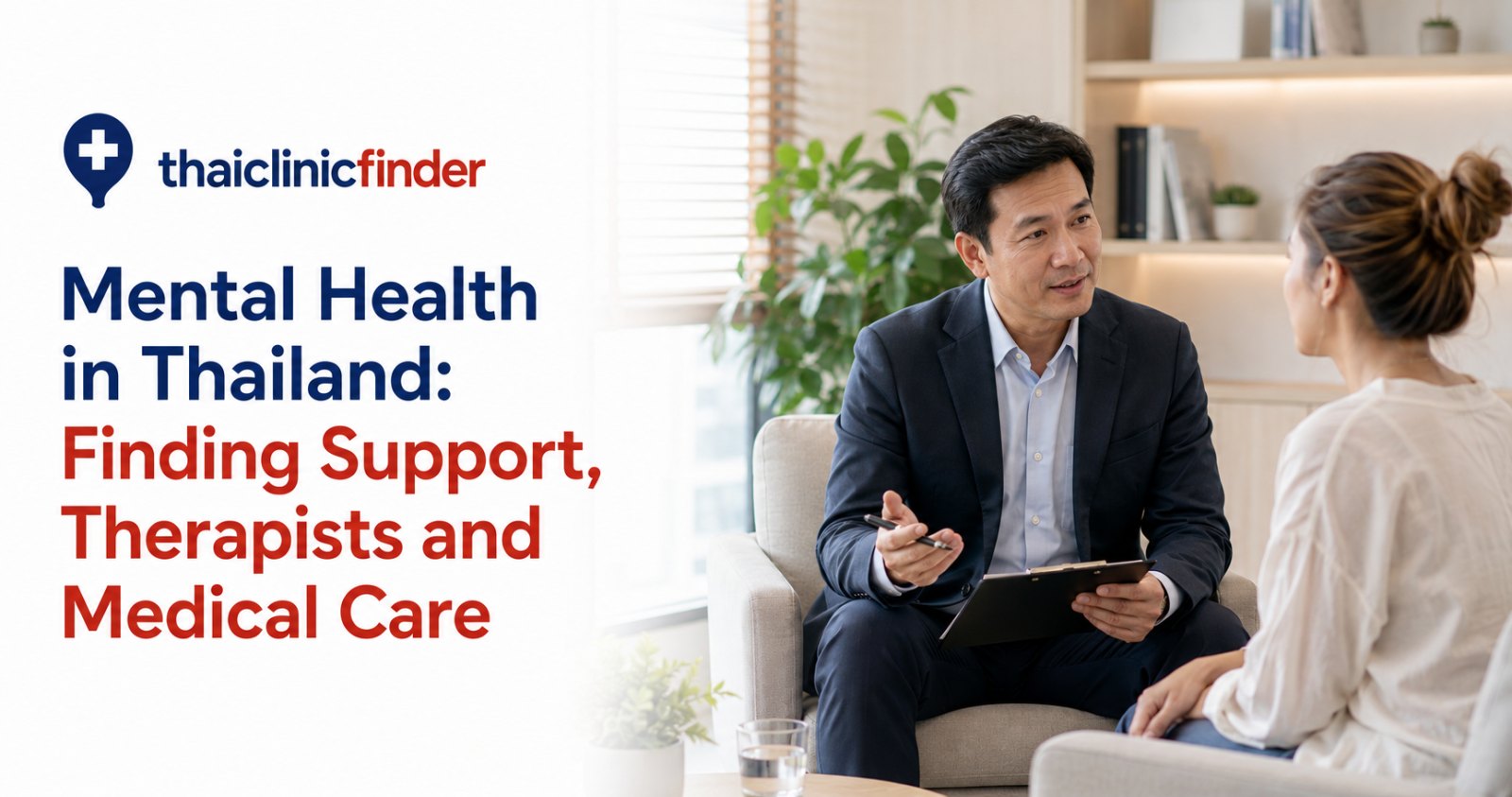
Finding mental health support in Thailand can mean very different things depending on what you need. Someone looking for regular therapy in English has different requirements from a person who needs a psychiatrist to review medication, a parent looking for child mental health care or someone experiencing an acute psychiatric crisis.
Thailand has a substantial mental health system that includes psychiatric hospitals, psychiatric departments within general hospitals, community services, psychologists and private outpatient providers. WHO's Mental Health Atlas 2024 reports 20 psychiatric hospitals and 127 psychiatric units in general hospitals in Thailand, alongside community-based services.
For international residents and travelers, the main challenge is often not whether mental health care exists, but finding the right professional, language and level of care.
Start by deciding what kind of help you actually need
Mental health care is not a single service.
You may be looking for:
- psychotherapy or counseling
- evaluation of anxiety, depression or another mental health problem
- psychiatric medication
- assessment of attention, mood or sleep problems
- relationship or family therapy
- child or adolescent mental health care
- addiction treatment
- urgent crisis support
- longer-term psychiatric follow-up
Knowing the main reason for the appointment makes choosing a provider much easier.
If you are not sure, an initial appointment with a mental health professional or doctor can help determine what type of care is appropriate.
Psychiatrist, psychologist or therapist?
These terms are sometimes used loosely online, but they describe different roles.
A psychiatrist is a medical doctor who has trained in psychiatry. Psychiatrists can assess mental health conditions, consider physical and medical causes of symptoms and prescribe psychiatric medication when appropriate.
A psychologist is trained in psychology and may provide psychological assessment and psychotherapy depending on their qualifications and role.
The words therapist and counselor are broader. People using these titles can have different academic backgrounds, training and professional qualifications.
That means a profile saying English-speaking therapist is not enough information by itself.
Ask what professional qualification the person holds and what type of therapy they are trained to provide.
If medication is part of the problem, start with a medical professional
If you need to start, stop, change or review psychiatric medication, a psychiatrist or another appropriately qualified physician is generally the relevant professional.
This includes medicines used for conditions such as:
- depression
- anxiety disorders
- bipolar disorder
- psychotic disorders
- ADHD
- severe insomnia in selected circumstances
A therapist may work alongside the prescribing doctor, but psychotherapy and medication management are separate functions.
Do not change a regular psychiatric medicine abruptly simply because you have moved to Thailand or cannot immediately find the same brand.
Verify psychiatrists through the Medical Council of Thailand
The Medical Council of Thailand provides an official English-language physician verification system.
You can search using the doctor's first and last name and, if available, the medical licence number.
The system states that its results contain active physicians licensed to practise medicine.
This is useful when a clinic website describes someone as a psychiatrist or doctor and you want independent confirmation that the physician is licensed in Thailand.
For therapists and psychologists, ask directly about academic qualifications, clinical training, professional role and experience with the problem for which you are seeking care.
English-speaking mental health care is easiest to find in larger cities
Bangkok has the largest concentration of private hospitals, psychiatric departments and international healthcare services.
English-language options can also be found in major destinations such as Chiang Mai, Phuket, Pattaya and other cities with sizeable international populations.
Availability becomes less predictable in smaller towns and rural areas.
Even at a hospital that markets itself internationally, do not assume every psychiatrist, psychologist or counselor offers consultations in English.
When booking, ask specifically:
- Does the clinician conduct the appointment in English?
- Will an interpreter be needed?
- Is the same clinician available for follow-up?
- Can therapy be continued online if I later leave Thailand?
For general advice on language and medical facilities, see How to Choose an English-Speaking Clinic in Thailand.
Private hospitals are one route, but not the only one
Large private hospitals can be convenient for international patients because they often combine several services in one place.
Depending on the hospital, this can make it easier to arrange:
- psychiatric consultation
- medication review
- laboratory testing
- other specialist consultations
- emergency assessment
- insurance administration
The trade-off can be price.
Independent mental health clinics and individual therapists may be more suitable for someone seeking weekly psychotherapy rather than hospital-based medical care.
Public and Department of Mental Health facilities are another part of Thailand's mental health system.
Thailand also has specialist public psychiatric services
Thailand's Department of Mental Health operates a network of specialist facilities around the country.
Its official service directory includes psychiatric hospitals and institutes in different regions.
For example, the department lists Suan Prung Psychiatric Hospital in Chiang Mai with a general psychiatric outpatient clinic operating on weekdays.
Other Department of Mental Health facilities include institutions in Bangkok and different regions of the country.
Public psychiatric services can be important for specialist and continuing care, although language, appointment and administrative arrangements can differ from private international hospitals.
International patients should contact the specific facility before attending if English support is important.
Thailand's mental health system extends beyond psychiatric hospitals
Mental health care in Thailand is increasingly integrated into broader health services.
WHO reports that Thailand has incorporated mental health services into primary health care as part of its universal health coverage strategy.
WHO's Mental Health Atlas 2024 also records 127 psychiatric units in general hospitals, demonstrating that specialist mental health treatment is not confined to stand-alone psychiatric hospitals.
This can be useful if you need mental health assessment alongside treatment for another medical condition.
Therapy does not always need to happen inside a hospital
For many problems, outpatient psychotherapy is the main intervention rather than hospital treatment.
People commonly seek therapy for issues such as:
- anxiety
- stress
- relationship difficulties
- grief
- adjustment to living abroad
- burnout
- low mood
- trauma-related symptoms
- work difficulties
An expat experiencing stress or isolation does not necessarily need psychiatric hospital care.
Likewise, someone with severe mood symptoms, psychosis or significant safety concerns may need more medical involvement than weekly counseling alone.
The intensity of care should match the situation.
Ask what kind of therapy the clinician actually provides
The word therapy does not tell you much about how treatment works.
Depending on the clinician and problem, approaches may include forms of:
- cognitive behavioral therapy
- acceptance and commitment therapy
- interpersonal therapy
- trauma-focused therapy
- couples therapy
- family therapy
- supportive psychotherapy
You do not necessarily need to choose a therapy model before the first appointment.
However, it is reasonable to ask whether the clinician has experience treating the main problem you want help with.
A therapist who works primarily with couples may not be the best match for someone seeking specialist treatment for obsessive-compulsive disorder, for example.
Qualifications matter more than a polished website
Mental health services marketed to foreigners can range from established medical departments to individual coaching or wellness businesses.
Before starting treatment, look beyond testimonials and branding.
Ask:
- What degree does the clinician hold?
- Where did they train?
- Are they a psychiatrist, psychologist, counselor or another type of professional?
- What clinical experience do they have?
- What type of clients do they usually treat?
- How do they manage emergencies?
- What happens if you need psychiatric medication or hospital care?
Someone may be useful as a coach without being qualified to diagnose or treat a mental health disorder. Those roles should not be confused.
One consultation is enough to decide whether communication works
Mental health treatment depends heavily on communication.
English fluency on a clinic profile does not guarantee that you will feel understood during a complex psychological conversation.
The first appointment can help you assess whether:
- communication feels clear
- the clinician understands your main concern
- treatment goals make sense
- you can discuss sensitive issues comfortably
- the proposed plan seems appropriate
It is reasonable to change clinicians if the professional relationship is not working, particularly for longer-term psychotherapy.
Expats can face problems that are easy to underestimate
Living in Thailand can be exciting while also creating stresses that differ from a short holiday.
International residents may experience:
- isolation from family
- relationship problems
- work pressure
- language barriers
- cultural adjustment
- loss of established social networks
- uncertainty about visas or employment
- difficulty maintaining previous medical care
These issues do not automatically represent a psychiatric disorder, but they can still be valid reasons to seek psychological support.
Therapy can be useful before distress becomes severe enough to disrupt work, relationships or daily functioning.
Online therapy can make continuity easier
Teletherapy can be practical for people who travel frequently or live outside Bangkok.
It may allow someone to continue working with the same clinician while moving between Chiang Mai, Phuket, Bangkok or other locations.
Before booking online treatment, ask about:
- where the clinician is professionally based
- whether they can legally provide care while you are located in Thailand
- privacy and video platform arrangements
- how emergencies are handled remotely
- whether the service can continue if you move to another country
Cross-border professional rules can become complicated, particularly when a therapist and patient are located in different jurisdictions.
Online therapy is not a substitute for every form of care
Video appointments can work well for many outpatient problems, but they are not suitable for every situation.
In-person medical care may be more appropriate when someone needs:
- physical examination
- urgent psychiatric assessment
- medication monitoring requiring medical tests
- hospital admission
- intensive crisis intervention
If a remote clinician believes your condition has become unsafe to manage online, they may recommend local in-person care.
Psychiatric medication should be reviewed before you run out
If you live in Thailand and take regular psychiatric medication, do not wait until the final tablet to arrange follow-up.
Brand names differ between countries, and availability can vary.
Bring or keep records showing:
- generic medicine name
- dose
- formulation
- prescribing doctor's information
- relevant diagnosis or medical summary
The generic name is particularly useful because a familiar overseas brand may have another name in Thailand.
If you are entering Thailand with regular medication, check the import rules as well. Some psychiatric medicines fall under controlled psychotropic categories and can have additional documentation or permit requirements.
See Bringing Prescription Medicines into Thailand: A Practical Guide before traveling with medication.
Do not buy psychiatric medicine solely because someone online says it is available
Thailand has extensive pharmacy access, but psychiatric medicines can fall into different regulatory categories.
The fact that a medicine can sometimes be obtained does not mean it is appropriate to start without an assessment.
This is particularly important with medicines where incorrect use can cause withdrawal, sedation, dependence, mood destabilization or other significant problems.
If you already take medication, bring the exact prescription history to the doctor rather than asking for something that sounds similar.
Mental Health Check-In is an official Thai screening resource
Thailand's Department of Mental Health operates Mental Health Check-In, an online screening platform developed to provide initial mental health assessment and identify people who may need additional support.
The current system includes screening related to:
- stress
- burnout
- depression
- suicide risk
- resilience
The Department of Mental Health makes clear that the tool is for initial assessment and connection to appropriate support.
An online screening result is not the same as a diagnosis from a psychiatrist or psychologist.
It can nevertheless provide a starting point for deciding whether professional help would be useful.
Thailand's Mental Health Hotline is 1323
Thailand's Department of Mental Health operates the 1323 Mental Health Hotline.
The department currently describes the service as free, confidential and available 24 hours a day for mental health consultation involving concerns such as stress, anxiety, sadness and loss. For text support, the department says that its 1323 consultation service moved to LINE Official Account from 1 July 2026. The account listed by the department is @1323th. Language availability can vary, so ask about English support if you need it.
The hotline can provide immediate support and guidance, but it should not replace emergency medical services when someone is in immediate physical danger.
Because language availability can vary, international callers who need support in a particular language should not assume that an English-speaking counselor will always be immediately available.
Know when the situation has moved beyond an ordinary therapy appointment
Some mental health situations require urgent assessment rather than waiting several days for a scheduled therapist appointment.
Seek urgent medical help if a person:
- is in immediate danger of harming themselves or another person
- is severely confused or disoriented
- is experiencing severe agitation that cannot be safely managed
- has lost contact with reality and cannot remain safe
- has taken a potentially dangerous overdose
- has severe symptoms after abruptly stopping medication or using drugs
- cannot care for basic physical needs because of an acute psychiatric condition
For an immediate medical emergency in Thailand, call 1669 or go to an appropriate emergency department.
The 1323 Mental Health Hotline can also provide mental health support, but emergency medical services are the appropriate route when there is immediate danger or a medical emergency.
A psychiatric crisis can also be a medical emergency
Mental and physical health are not separate during a crisis.
An overdose, severe intoxication, head injury, medication reaction or altered consciousness can initially look psychiatric while requiring urgent medical treatment.
Do not attempt to diagnose the cause yourself when someone is unconscious, having seizures, severely confused or medically unstable.
Call 1669 for emergency medical assistance.
For broader emergency information, see Medical Emergencies in Thailand: Numbers and Practical Steps.
If you are helping a friend, focus on getting them connected to care
You do not need to become the person's therapist.
Practical help can include:
- staying with them if immediate safety is a concern
- helping contact a clinic or hospital
- calling 1323 for mental health support
- calling 1669 during a medical emergency
- helping gather medication information
- accompanying them to an appointment when appropriate
Avoid making complicated medication decisions on another person's behalf unless you are their treating clinician.
Child and adolescent mental health may require specialist services
Children and teenagers should not automatically be booked with an adult therapist simply because that person speaks English.
Ask whether the clinician specifically works with the child's age group and presenting problem.
Thailand's mental health system includes specialist child and adolescent services. WHO's Mental Health Atlas 2024 reports dedicated outpatient and inpatient mental health facilities for children and adolescents in the country.
Depending on the problem, care may involve parents, schools, pediatricians, psychologists and child psychiatrists rather than one professional working in isolation.
Addiction treatment may need more than general counseling
Alcohol, stimulant, opioid and other substance problems can involve both psychological and physical dependence.
Someone at risk of significant withdrawal may need medical supervision rather than attempting abrupt detoxification alone.
Ask whether a provider has specific experience in addiction treatment and whether medical support is available when necessary.
A general therapist may still play an important role during recovery, but withdrawal management and medication can require medical care.
How much will mental health care cost?
There is no meaningful single price for mental health treatment in Thailand.
Costs vary according to:
- public or private facility
- psychiatrist or therapist
- hospital or independent clinic
- length of appointment
- psychological testing
- medication
- laboratory tests
- frequency of therapy
Before booking private care, ask for the consultation fee and whether additional hospital or administrative charges apply.
For ongoing therapy, monthly cost can matter more than the price of the first session because effective treatment may involve repeated appointments.
If you want to compare specific providers, explore our ranking of mental health clinics in Thailand to review different options and find a clinic that matches your location, language needs and the type of support you are looking for.
Will health insurance cover therapy or psychiatry?
Coverage varies widely.
Some international health insurance policies include outpatient mental health benefits, while others impose:
- annual limits
- session limits
- deductibles
- prior authorization
- exclusions for pre-existing conditions
Travel insurance may be much more restrictive than comprehensive international health insurance.
Ask the insurer specifically about outpatient psychiatry, psychotherapy and psychiatric medication, rather than simply asking whether mental health is covered.
See How to Choose Health Insurance in Thailand for a broader framework.
Privacy is worth asking about directly
Mental health information can be particularly sensitive.
Before starting ongoing treatment, ask how the clinic handles:
- medical records
- online communication
- appointment reminders
- video consultations
- sharing information with another doctor
- insurance documentation
Thailand's Department of Mental Health states that its Mental Health Check-In system handles personal information under Thailand's Personal Data Protection Act framework.
Private providers should also be able to explain how patient information is managed.
Your first appointment is easier if you prepare a short history
You do not need to write your life story before seeing a therapist or psychiatrist.
A short summary can help cover the essentials:
- main problem
- when it began
- previous diagnoses
- previous therapy
- psychiatric medications taken now or previously
- important physical health conditions
- alcohol or drug use when relevant
- major recent life changes
- what you want help with
If you take medication, bring the packaging or a photograph showing the active ingredient and dose.
Questions worth asking before choosing a therapist in Thailand
Before committing to regular sessions, consider asking:
- What is your professional qualification?
- Do you regularly work with this type of problem?
- Do you provide sessions fully in English?
- What therapy approach do you use?
- How long is each session?
- What is the fee?
- How often do you normally meet clients?
- Do you offer online follow-up?
- What happens if I need a psychiatrist?
- What should I do if I experience a crisis between appointments?
A competent professional should be able to answer basic questions about how the service works.
Mental health support in Thailand is broader than it used to be
WHO describes Thailand as expanding community-based, digital and recovery-oriented mental health services.
In 2024, Thailand's Department of Mental Health approved a service standard for peer recovery-oriented mental health care, formally recognizing a role for people with lived experience within mental health services.
Thailand has also adapted WHO digital mental health interventions and integrated mental health into primary care.
This does not mean access is identical throughout the country. WHO continues to highlight disparities in mental health service availability, particularly outside areas with a larger health workforce.
The practical route to getting help
If you need mental health support in Thailand, begin with the type and urgency of the problem.
For ongoing therapy, look for a qualified psychologist, counselor or therapist with relevant experience and a language you can communicate in comfortably.
For diagnosis, psychiatric medication or a more complex medical presentation, consider a psychiatrist or hospital mental health department. Verify physicians through the Medical Council of Thailand when appropriate.
For public mental health support, Thailand's Department of Mental Health operates the 1323 hotline 24 hours a day and provides the Mental Health Check-In screening platform.
If someone is in immediate danger or experiencing a medical emergency, call 1669 or go to an emergency department rather than waiting for a routine therapy appointment.
The best mental health care in Thailand is not necessarily the most expensive hospital or the therapist with the largest online presence. It is care delivered by an appropriately qualified professional who understands the problem, communicates clearly and can connect you to a higher level of care when necessary.
Frequently Asked Questions
How can I find mental health support in Thailand?
Options include psychiatrists, psychologists, therapists, private hospitals, public psychiatric services and Department of Mental Health facilities. The right option depends on whether you need psychotherapy, medication, specialist assessment or urgent care.
Can I find an English-speaking therapist in Thailand?
Yes, particularly in Bangkok and other major international destinations, but availability varies by clinician. Confirm that the exact therapist conducts sessions in English before booking.
What is the difference between a psychiatrist and a psychologist in Thailand?
A psychiatrist is a medical doctor who can assess mental health conditions and prescribe medication when appropriate. Psychologists generally focus on psychological assessment and therapy according to their training and professional role.
How can I check whether a psychiatrist in Thailand is a licensed doctor?
The Medical Council of Thailand provides an official English-language physician search where you can verify active doctors using their name or medical licence number.
What is Thailand's mental health hotline?
The Department of Mental Health operates the 1323 Mental Health Hotline. The department currently describes it as a free, confidential mental health consultation service available 24 hours a day.
What should I do during a mental health emergency in Thailand?
If someone is in immediate danger, has taken an overdose, is severely medically unstable or requires emergency intervention, call Thailand's emergency medical service on 1669 or go to an emergency department.
Can I get psychiatric medication in Thailand?
Psychiatric medication is available in Thailand, but individual medicines fall under different legal classifications and should be managed by an appropriately qualified medical professional. Do not assume a medicine has the same brand name or pharmacy rules as in your home country.
Can I do online therapy while living in Thailand?
Online therapy can be practical, particularly outside major cities, but professional licensing, privacy and cross-border practice rules can depend on where both patient and clinician are located. Ask the provider before beginning treatment.
Does Thailand have public psychiatric hospitals?
Yes. Thailand's Department of Mental Health operates specialist psychiatric facilities, and WHO's Mental Health Atlas 2024 reports 20 psychiatric hospitals as well as 127 psychiatric units in general hospitals.
Does health insurance cover mental health treatment in Thailand?
It depends on the policy. Some international health plans cover outpatient psychiatry and psychotherapy, while others impose limits, deductibles, prior authorization or exclusions. Check the mental health benefits specifically.
Sources
- Thailand Department of Mental Health - Mental Health Hotline 1323
- Thailand Department of Mental Health - Mental Health Check-In
- Thailand Department of Mental Health - Mental Health and Psychiatric Service Directory
- Medical Council of Thailand - Doctor Verification
- World Health Organization - Mental Health Atlas 2024, Thailand Country Profile
- World Health Organization Thailand - Transforming Mental Health Care Through Peer Support
- Thai Department of Mental Health. 1323 LINE OA notice

Writer
Jonathan García-Allen
Psychologist, author and digital strategist specializing in health, mental health and digital publishing. He co-founded Psicología y Mente, one of the world’s most visited psychology and mental health websites, reaching more than 20 million visits per month. With over 10 years of experience in health content, SEO and digital strategy, he has helped psychologists, therapists, clinics and healthcare businesses strengthen their online presence, attract patients and build trusted digital brands.
Medical review
Niran Chaiyasit
Niran Chaiyasit is a Thai health writer with a background in public health and a focus on travel health, disease prevention and healthcare access in Thailand. His work covers topics such as common illnesses, vaccinations, mosquito-borne diseases, food safety and practical health information for travelers and expatriates.