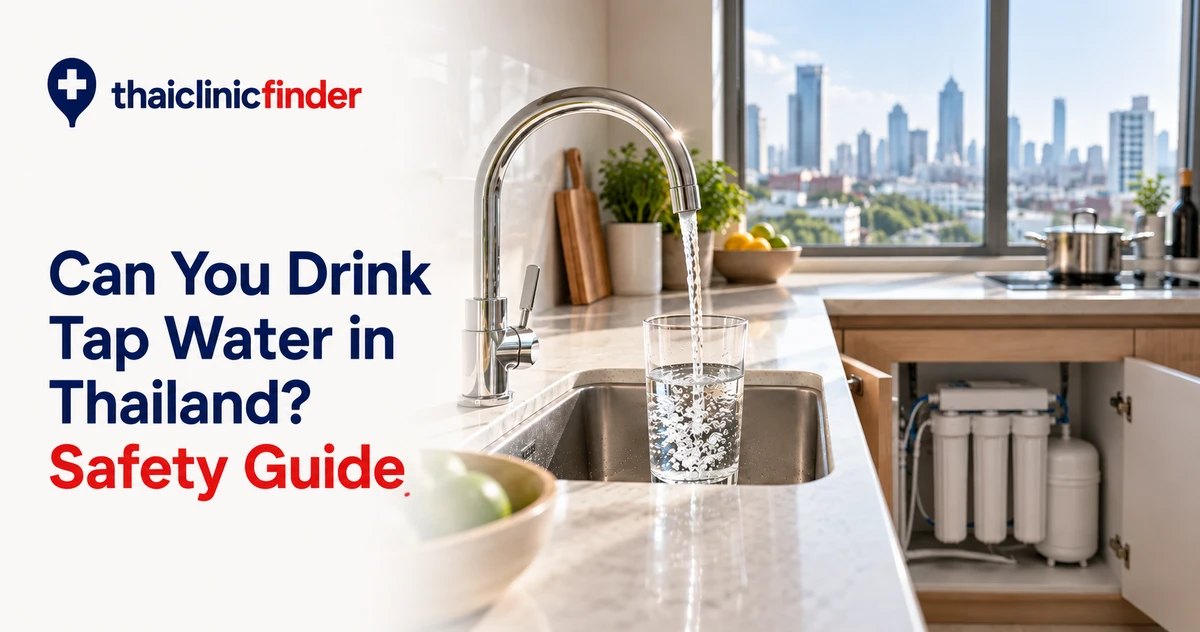
Ask whether tap water is safe in Thailand and you will hear two confident but incomplete answers: that nobody drinks it, or that the utility says it is drinkable. The reality depends on where the water comes from and what happens between the treatment plant and your glass.
Bangkok, Nonthaburi and Samut Prakan are served by the Metropolitan Waterworks Authority, usually called MWA. Provincial areas are generally served by the Provincial Waterworks Authority, local government systems, private estates or other arrangements. Even where the supplied water meets a drinking-water standard, a poorly maintained building tank or internal pipe can change its quality. This guide helps expats assess that full route without treating every Thai tap as identical.
The short answer
MWA publishes water-quality data and says its treated water complies with its specifications, which reference World Health Organization guidance. Its 2025 confidence report recorded compliant average results for listed physical, microbial and chemical parameters, including no detected E. coli in the reported 100 mL measure and average turbidity of 0.36 NTU. This is meaningful evidence about the metropolitan supply.
It is not a certificate for every kitchen tap. MWA's own consumer material stresses that household plumbing and water storage affect quality. Water may pass through a ground-level tank, pump, rooftop tank and older building pipes before reaching an apartment. Maintenance, stagnation, leaks and cross-connections all matter.
The practical answer is therefore: municipal water may leave the network within standard, but you should check the condition of the building system and current local notices before drinking it. Outside the MWA area, obtain information from the relevant supplier rather than applying Bangkok data to the entire country.
Who supplies your water?
Start with the bill, landlord, juristic office, hotel or property manager. Ask for the name of the utility and whether the unit receives water directly or through storage tanks. In central metropolitan Bangkok and neighbouring serviced areas, MWA provides public information, branch contacts and online monitoring. PWA operates across many provincial service areas, but some islands, rural properties, condominiums and private developments can have different sources or management arrangements.
Do not infer the source from the province alone. Ask:
- Which utility or system supplies this building?
- Is water stored in a basement, ground or rooftop tank?
- When were the tanks last inspected and cleaned?
- Have there been recent outages, pipe repairs, floods or notices?
- Is there a recent test from a sample taken inside the building?
A general laboratory report from a treatment plant answers a different question from a sample taken at your tap. Both can be useful, but they are not interchangeable.
What Bangkok's published results show
MWA's Tap Water Quality 2025 report lists average values and the authority's specifications. It reports absence of E. coli and coliform bacteria in the stated measure, a pH of 7.38, total dissolved solids of 161 mg/L and results within the listed criteria for metals and other parameters. MWA also operates an online system showing measures such as turbidity, free residual chlorine, pH, conductivity, salinity and chloride at monitoring stations.
The report is reassuring about the managed network, but averages do not describe every moment or every private pipe. The WHO's drinking-water framework emphasises risk management from catchment to consumer, health-based targets and independent surveillance. In October 2026, WHO Thailand reported continued work with MWA and Thailand's Department of Health on water safety planning. The audit noted progress as well as opportunities to strengthen areas including storage inspection, backflow prevention and risk assessment.
That is how water safety works in practice: it is an ongoing system, not a permanent yes-or-no badge.
The building can be the weak link
Condominiums and houses often use storage because it helps maintain supply and pressure. If a tank is not sealed, cleaned or operated properly, sediment and microorganisms can accumulate. Chlorine residual also declines with time. Corroded internal pipes or fixtures can affect colour, taste and metal levels. A pump connected incorrectly can create contamination risk during low pressure or a leak.
MWA's 2023 annual report recommends inspecting and cleaning water storage every six months. It also explains that an old study of about 10,000 storage samples found E. coli in 6.43 percent. That historic figure should not be read as a current national contamination rate. Its useful lesson is narrower: treated water can deteriorate in storage, and building maintenance deserves evidence rather than assumption.
If a manager cannot provide a cleaning record, ask whether the condominium committee can arrange inspection or testing. A laboratory should advise on correct sample collection. Filling a random bottle from the tap can contaminate the sample and produce a misleading result.
Warning signs and temporary precautions
Stop using the tap for drinking until you have reliable advice if the water becomes visibly cloudy, rusty, unusually coloured, oily or foul-smelling, especially after an outage, flood or repair. A chlorine smell alone does not necessarily indicate danger; utilities use chlorine to control microbial contamination. A sudden change, however, is worth reporting.
Check the supplier's current notice and contact the building manager. MWA's published call centre is 1125. Elsewhere, use the contact shown on the water bill or the relevant PWA or local authority channel. Do not rely on an old social-media post from another neighbourhood.
During a confirmed microbiological warning, follow the authority's precise advice about boiling, food preparation, ice and tooth brushing. Boiling addresses many microorganisms but does not remove metals, salts, pesticides or other dissolved chemicals. If the concern is chemical contamination, boiling may be inappropriate. Use the alternative source recommended for that incident.
People who are immunocompromised, pregnant, very young, older or medically vulnerable should ask their clinician whether extra precautions are appropriate. This article cannot determine whether a particular tap is safe for a particular person.
Filters: useful only when chosen and maintained correctly
A filter is not one universal device. Sediment filters, activated carbon, ultraviolet units and reverse-osmosis systems target different issues. A carbon cartridge may improve taste and reduce selected substances but does not automatically make microbiologically unsafe water safe. A UV system needs suitable pretreatment and functioning equipment. Reverse osmosis produces reject water and requires maintenance.
Before buying, identify the problem with a reliable test or supplier information. Ask the vendor for certification relevant to the contaminant, replacement intervals and local servicing. Record every cartridge change. A neglected filter can harbour microorganisms, reduce flow or release accumulated material.
If the building already has a central treatment system, ask for its maintenance log and recent output test. Installing another unit without understanding the first system can add cost without solving the actual issue.
Bottled and dispenser water
Sealed bottled water from an established producer is a common practical choice for drinking. Check that the cap seal is intact and the bottle is not damaged. Store it away from direct sunlight and high heat. Reusable large bottles and delivery systems need clean handling at both ends. Wash the dispenser contact surfaces and reusable containers according to manufacturer guidance.
A water dispenser does not stay clean indefinitely. Biofilm can develop in reservoirs, taps and hoses. Offices, gyms and shared residences should have a documented cleaning schedule. Do not let a cup or bottle mouth touch the nozzle.
Ice from a reputable commercial supply is generally produced for consumption, but a clean production source can still be undermined by dirty scoops, hands or storage bins. If you are already unwell or uncertain about hygiene, skip unpackaged ice. Our guide on street food safety in Thailand covers food handling and practical risk reduction in more detail.
Cooking, washing produce and brushing teeth
MWA states that its water can be used for cooking rice and food. In a building with a verified supply and maintained system, cooking and washing are generally more straightforward decisions than drinking from an unknown tank. Yet the same warning applies: a utility statement cannot vouch for a neglected private system.
For brushing teeth, use the same standard you use for drinking. If a local notice says the water is unsafe, if there is flood contamination, or if the building source is unknown, use verified bottled or appropriately treated water. For washing raw produce, consider whether the food will be cooked and follow public-health advice during an incident.
Do not confuse water-related illness with one specific cause. Diarrhoea can come from food, hands, surfaces, ice or person-to-person transmission as well as water. Our articles on giardia in Thailand and hepatitis A prevention explain two different infections without implying that ordinary Thai municipal tap water is their source. Persistent diarrhoea, blood in stool, high fever or signs of dehydration need medical assessment.
A checklist for a new home
When moving into a Thai property:
- Identify the supplier and save its outage and quality-information channels.
- Ask how water reaches the unit and where it is stored.
- Request the last tank-cleaning and maintenance date.
- Run the tap and note any unusual colour, particles or smell.
- Ask whether recent building-level laboratory results are available.
- If using a filter, identify its type and replace overdue components.
- Choose a verified temporary drinking source until questions are resolved.
Hotels and short-term rentals may not have records readily available. Ask the accommodation directly whether tap water is intended for drinking. If the answer is vague, use sealed water for drinking while still using the tap for normal hygiene unless a local notice says otherwise.
The sensible conclusion
There is no honest countrywide answer based solely on the words "Thailand tap water". MWA provides strong, current evidence for the quality of its managed metropolitan supply. The final metres inside a property, and the many water systems outside MWA territory, require local information.
Check the utility, check the building and check current notices. If those three pieces are sound, you can make an informed choice. If one is unknown, use a verified alternative for drinking while you obtain the missing evidence rather than assuming either that all tap water is unsafe or that every tap reflects treatment-plant quality.
Frequently Asked Questions
Is Bangkok tap water safe to drink?
The Metropolitan Waterworks Authority reports that the water it supplies meets its drinking-water specifications. Safety at an individual tap also depends on the building's pipes, storage tanks and maintenance, so residents should verify those conditions rather than relying only on treatment-plant results.
Can I use tap water to brush my teeth in Thailand?
Many residents use treated municipal water for brushing, but local supply and building conditions vary. If there is a boil-water notice, visible discoloration, unusual odour, recent flooding or uncertainty about the tank, use a safer verified source until the issue is checked.
Does boiling tap water remove every contaminant?
Boiling can inactivate many disease-causing organisms when done correctly, but it does not remove dissolved chemicals or metals and can concentrate some substances as water evaporates. Follow local authority advice for the specific incident.
Do I need a water filter in Thailand?
That depends on the source, building plumbing and the problem you are trying to solve. A filter must be suitable for the target contaminant and maintained on schedule; an expired or poorly cleaned unit can worsen water quality.
Is bottled water always safer than tap water?
Sealed water from a reputable producer can be a practical option, but storage and package integrity still matter. Avoid bottles with a broken seal, damage or prolonged heat exposure, and use clean dispensers and reusable containers.
Sources
- Metropolitan Waterworks Authority, Tap Water Quality 2025
- Metropolitan Waterworks Authority, Annual Water Quality Report 2023
- Metropolitan Waterworks Authority, Real-time Water Quality Monitoring
- World Health Organization, Guidelines for drinking-water quality
- World Health Organization Thailand, Strengthening water safety in Thailand
- Provincial Waterworks Authority, official website

Writer
Niran Chaiyasit
Niran Chaiyasit is a Thai health writer with a background in public health and a focus on travel health, disease prevention and healthcare access in Thailand. His work covers topics such as common illnesses, vaccinations, mosquito-borne diseases, food safety and practical health information for travelers and expatriates.

Medical review
Justin Brooks
Daniel Brooks is an American health writer with a background in health sciences and a focus on rehabilitation, musculoskeletal health and patient education. He writes about physiotherapy, injury recovery, pain management, preventive health and practical healthcare guidance for international patients and travelers.