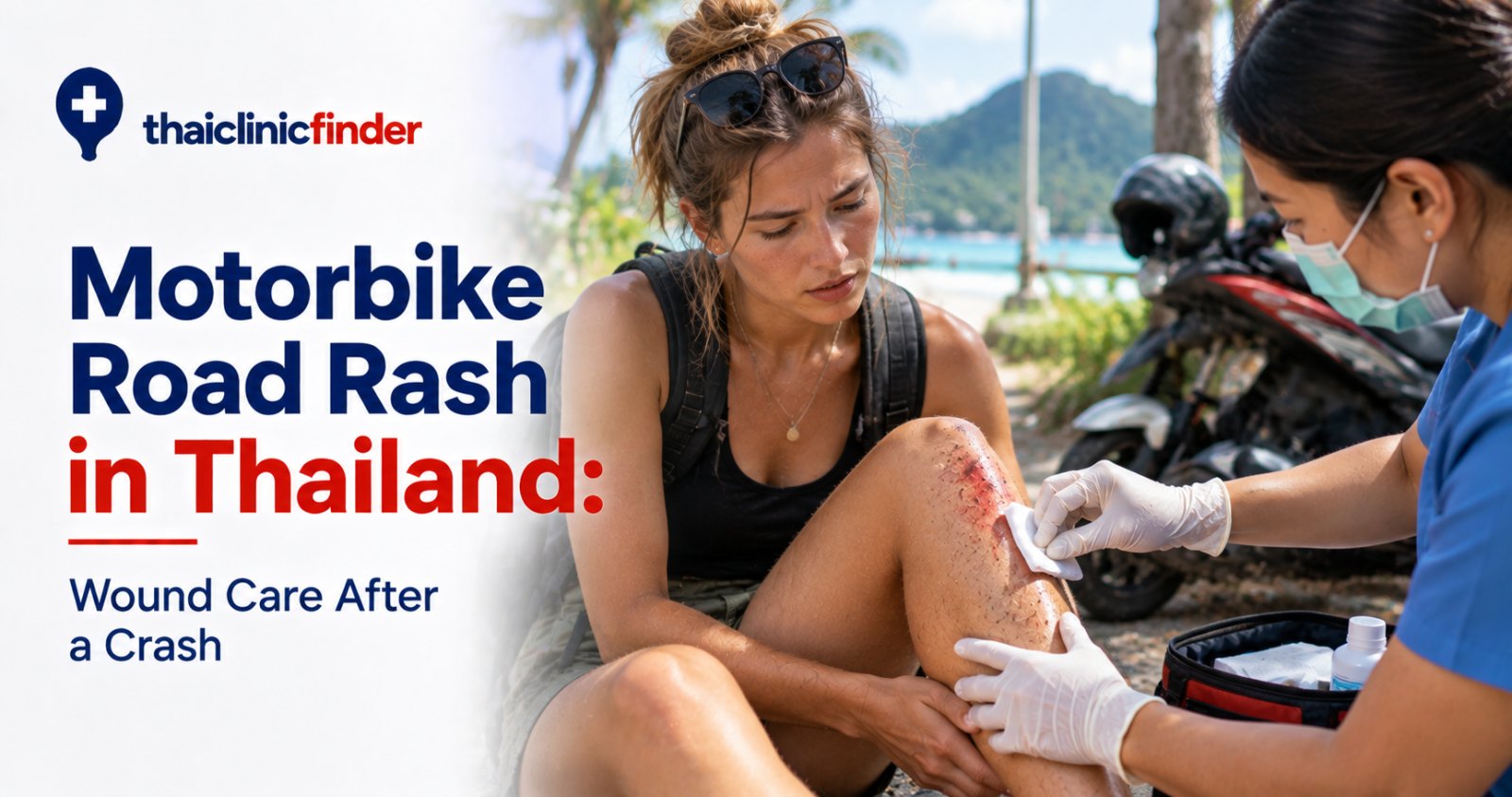
Motorbike road rash is common after scooter and motorcycle crashes in Thailand. At its mildest, it may look like a large graze. At its worst, it can involve deeply abraded skin, embedded gravel, bleeding, burns from friction and injuries underneath the wound that are not immediately obvious.
The first priority after a crash is not the scrape itself. Make sure there is no head injury, fracture, severe bleeding, chest or abdominal injury, loss of consciousness or spinal injury before focusing on road rash.
If the crash was significant, the person is confused, cannot stand, has severe pain or is bleeding heavily, call Thailand's emergency medical number 1669 or go to an emergency department.
For uncomplicated road rash, the main goals are to control bleeding, remove dirt and gravel, rinse the wound thoroughly, cover it with a clean dressing and monitor for infection.
Thailand's warm climate, humidity, road contamination and frequent exposure to seawater, swimming pools and outdoor environments make proper wound care particularly important.
First, check for injuries more serious than road rash
A large abrasion can be visually dramatic and distract from more important injuries.
After a motorbike crash, assess for:
- loss of consciousness
- confusion or memory loss
- severe headache
- vomiting
- neck or back pain
- difficulty breathing
- chest pain
- abdominal pain
- severe limb pain
- inability to bear weight
- obvious deformity
- numbness or weakness
- uncontrolled bleeding
WHO identifies motorcyclists as one of the groups most affected by road trauma, and Thailand continues to have a high burden of road traffic injury.
A person can have a fracture or concussion even if they are able to stand up immediately after the crash.
If there was a significant impact, especially involving the head, chest, abdomen or a high-speed collision, medical assessment may be appropriate even when the road rash appears to be the main visible injury.
For severe crashes or major injuries, see Medical Emergencies in Thailand: Numbers and Practical Steps.
How to clean road rash after a motorbike crash
Cleaning is one of the most important parts of road-rash care.
Road abrasions often contain:
- sand
- grit
- gravel
- dust
- fragments of asphalt
- clothing fibers
- plant material
Leaving debris embedded in the skin increases the risk of infection and can lead to permanent dark particles becoming trapped in the skin as the wound heals.
Step 1: wash your hands
Before touching the wound, clean your hands thoroughly with soap and water if possible.
Use clean disposable gloves if they are available.
Step 2: control active bleeding
If the wound is bleeding, apply firm pressure with clean gauze or a clean cloth.
If blood soaks through, add another dressing over the top rather than repeatedly removing the first one.
Bleeding that does not stop with firm pressure needs medical assessment.
Step 3: rinse the wound thoroughly
Once bleeding is controlled, rinse the abrasion with plenty of clean running water or sterile saline.
Current wound-care guidance supports irrigation with clean tap water for many uncomplicated wounds.
The goal is to physically remove contamination rather than simply pour antiseptic over the surface.
Step 4: remove visible loose debris
Small loose pieces of dirt or gravel may sometimes be gently removed with clean forceps.
Do not aggressively dig into tissue yourself.
If gravel, glass or other material remains embedded, or cleaning is too painful to complete properly, go to a clinic or hospital. Local anaesthetic can make professional cleaning and debridement much more tolerable.
Do not leave gravel inside the wound
One of the main problems with road rash is traumatic tattooing.
This can happen when asphalt, dirt or gravel becomes embedded in the skin and the skin heals over it.
The particles can leave permanent grey, blue or black discoloration.
Early thorough cleaning is therefore important for both infection prevention and cosmetic outcome.
If you cannot remove visible contamination with gentle irrigation and cleaning, seek medical care rather than allowing the wound to close over debris.
Should you use hydrogen peroxide or alcohol on road rash?
Strong antiseptics are often overused on abrasions.
Products such as hydrogen peroxide or concentrated alcohol can irritate exposed tissue and may damage cells involved in healing.
For most uncomplicated abrasions, thorough irrigation with clean water or saline is more important than repeatedly applying harsh antiseptic solutions.
A clinician may use appropriate antiseptic products when cleaning a contaminated wound, but there is no need to repeatedly soak an abrasion in alcohol at home.
Keep the wound covered rather than letting it dry out completely
Large abrasions generally heal better when protected with an appropriate dressing rather than left exposed to air until a thick scab forms.
A dressing can:
- protect against dirt
- reduce friction from clothing
- absorb wound fluid
- reduce contamination
- maintain an environment that supports healing
Options include non-adherent dressings, sterile gauze and modern wound dressings depending on the size and depth of the abrasion.
A pharmacy or clinic in Thailand can help select an appropriate dressing if the wound is straightforward.
How often should you change the dressing?
Change the dressing when it becomes:
- wet
- dirty
- loose
- saturated with wound fluid
For many simple abrasions, a daily dressing change is reasonable at first, although some modern dressings are designed to remain in place longer.
Follow the instructions for the exact dressing you are using.
Each time you change it, look for signs of infection or worsening tissue damage.
Road rash can look worse the day after the crash
Some increase in soreness and inflammation during the first day can occur.
Large abrasions may also ooze clear or slightly yellow fluid as part of normal healing.
That is not the same as pus.
More concerning changes include:
- redness spreading beyond the wound
- increasing warmth
- progressively worsening pain
- swelling
- thick yellow or green discharge
- bad smell
- fever
- red streaking extending away from the wound
These findings can indicate infection and should be assessed medically.
When should a clinic clean the wound professionally?
Professional wound care is advisable when:
- dirt or gravel remains embedded
- the wound is deep
- a large area of skin has been removed
- the wound extends into fat or deeper tissue
- cleaning is too painful to perform properly
- there is an associated deep cut
- bleeding continues
- you cannot move the affected joint normally
- sensation is reduced
- the abrasion crosses a large joint
- there is concern about infection
A clinician may use local anaesthetic, irrigation and debridement to remove damaged tissue and contamination.
Deep wounds may also need assessment for tendon, nerve or joint injury.
Road rash over the knee, elbow or hand deserves extra attention
Abrasions over joints can repeatedly reopen with movement.
Road rash over the:
- knee
- elbow
- ankle
- knuckles
- fingers
may also hide deeper injury after a fall.
Seek medical assessment if movement is significantly limited, the joint is very swollen or you cannot put normal weight through the limb.
Hand injuries are particularly important because small fractures, tendon injuries and nerve damage can have long-term consequences if missed.
Do you need a tetanus shot after road rash in Thailand?
Possibly.
Thailand's Department of Disease Control has current guidance on wound care and tetanus prevention. The need for vaccination depends on:
- how contaminated the wound is
- your vaccination history
- how long it has been since your last tetanus-containing vaccine
Road rash can qualify as a contaminated wound because dirt, soil and road debris may be ground into the skin.
If your vaccination history is incomplete or uncertain, tell the clinician.
For a person who has completed a primary tetanus vaccination series, booster recommendations depend on the wound category and how long it has been since the previous dose.
Do not assume that childhood vaccination provides lifelong protection without boosters.
What if you do not remember your last tetanus vaccine?
This is common among travelers.
If you cannot confirm your vaccination history, tell the treating doctor or nurse.
Thailand's current tetanus wound-care guidance includes vaccination and, in selected high-risk cases, tetanus immunoglobulin when appropriate.
The decision depends on wound type and previous immunization history.
A contaminated motorbike abrasion is a good reason to review tetanus status rather than waiting until you return home.
Do you need antibiotics for road rash?
Not automatically.
Many superficial abrasions heal with good cleaning and dressing alone.
Oral antibiotics are not routinely necessary for every scrape.
They may be considered when there is:
- established infection
- extensive contaminated tissue injury
- deeper wound involvement
- certain high-risk medical conditions
- a clinician-specific concern based on examination
Using antibiotics without adequate cleaning does not solve the problem of gravel or devitalized tissue left inside a wound.
For general guidance on antibiotic use in Thailand, see Antibiotics in Thailand: Prescription Rules and Safe Use.
Topical antibiotic ointments are not always necessary either
Some clinicians use topical antibiotic ointment for selected abrasions, but they are not required for every wound.
They can also occasionally cause contact dermatitis, which may look like worsening redness or irritation.
The basics remain:
- clean the wound properly
- keep it protected
- use an appropriate dressing
- monitor healing
If you are unsure which topical product to use, ask a pharmacist or clinician rather than applying several creams at once.
Can you shower with road rash?
Usually, yes, once active bleeding is controlled.
Clean running water can help gently rinse the area.
Avoid aggressive scrubbing.
After washing:
- gently pat the surrounding skin dry
- avoid rubbing the raw surface with a towel
- apply a clean dressing
Follow any specific instructions given by the clinic if a more complex dressing has been applied.
Should you swim in the sea after road rash?
It is safer to avoid swimming until the wound has closed substantially.
Open road rash exposed to seawater can come into contact with bacteria and other microorganisms.
This is particularly relevant in tropical coastal environments.
Avoid:
- swimming in the sea
- swimming pools
- hot tubs
- rivers
- waterfalls
while the abrasion is still open or actively draining unless a clinician has specifically advised otherwise.
A waterproof dressing reduces contamination but does not make an open wound completely risk-free for swimming.
Thailand's heat and humidity can make dressings difficult
Sweat can loosen adhesive dressings and keep the surrounding skin excessively moist.
If you are recovering in Thailand:
- change wet dressings promptly
- use breathable clothing
- avoid tight fabric rubbing over the abrasion
- carry spare dressings if you are outside for the day
- keep the wound away from sand and dirty surfaces
Large hip, knee or shoulder abrasions can be especially uncomfortable in hot weather because clothing repeatedly rubs against them.
Avoid direct sun on healing road rash
Newly healed skin can develop darker pigmentation after inflammation, especially with strong sun exposure.
Once the surface has fully closed, protecting it from intense sunlight can help reduce post-inflammatory pigmentation.
Use clothing or appropriate sun protection once the wound is sufficiently healed for sunscreen to be applied safely.
Do not rub sunscreen directly into a fresh open abrasion.
How long does road rash take to heal?
Healing time depends on depth.
A superficial abrasion may begin improving within several days and heal over roughly one to two weeks.
Deeper abrasions can take several weeks.
Healing may be slower when there is:
- infection
- repeated friction
- extensive tissue loss
- diabetes
- poor circulation
- smoking
- inadequate nutrition
A wound that is not showing progressive improvement should be reassessed.
Pain can be significant even when the wound is superficial
Road rash exposes many nerve endings, so a broad shallow abrasion can be extremely painful.
For many adults, paracetamol can be used for pain when medically appropriate.
Ibuprofen and other anti-inflammatory medicines may also be suitable for some people, but they are not appropriate for everyone, especially if there is significant bleeding, kidney disease, stomach ulcer risk or another contraindication.
Do not use pain medication to ignore severe worsening pain, which can be a sign of infection or deeper injury.
Watch for cellulitis
Cellulitis is an infection of the deeper layers of skin and surrounding tissue.
Warning signs include:
- expanding redness
- increasing warmth
- swelling
- worsening tenderness
- fever
- feeling generally unwell
The redness may spread beyond the original abrasion.
Cellulitis needs medical assessment and may require antibiotics.
Do not wait several days if the redness is clearly spreading or systemic symptoms develop.
Pus, bad smell or black tissue are not normal healing
Seek medical care if you notice:
- thick pus
- strong unpleasant odor
- black or grey tissue
- worsening swelling
- rapidly increasing pain
- fever
Black tissue can represent dead tissue that may require debridement.
A wound that initially looked superficial can sometimes be deeper than expected after the damaged tissue evolves over the first few days.
What if the wound starts bleeding again?
Minor bleeding can occur if a dressing sticks to the wound or the abrasion reopens with movement.
Apply steady pressure with clean gauze.
Seek medical care if:
- bleeding will not stop
- blood is spurting
- the wound is deep
- you feel faint
- you take blood-thinning medication
Do not repeatedly pull off a dressing that has become stuck. Moistening it with saline or clean water can make removal gentler.
What if part of the road rash is actually a deep cut?
Motorbike crashes frequently cause mixed injuries.
A patient may have a large abrasion plus a deeper laceration from metal, glass or road debris.
Deep cuts may require:
- sutures
- staples
- wound closure strips
- delayed closure if heavily contaminated
The wound should be assessed quickly because the timing and method of closure can depend on contamination and injury type.
What if there is glass or metal in the wound?
Do not pull out a large embedded object yourself.
An object can sometimes be limiting bleeding, and removing it can worsen injury.
Apply pressure around the object rather than directly over it and seek urgent medical care.
Small superficial debris can sometimes be washed out, but deeply embedded glass or metal may require examination and imaging.
Motorbike burns can accompany road rash
Exhaust pipes are a common source of burns after scooter and motorcycle incidents.
A person may therefore have both:
- friction abrasion from the road
- thermal burn from the exhaust
Burns are managed differently from ordinary abrasions.
Cool a recent thermal burn with cool running water rather than ice and seek medical assessment if it is deep, extensive or located over sensitive areas.
Do not assume every painful red area after a crash is road rash.
Head injury can be easy to miss after a scooter crash
If your helmet hit the ground, or you were not wearing one, monitor carefully for concussion or more serious head injury.
Seek urgent assessment for:
- loss of consciousness
- repeated vomiting
- worsening headache
- confusion
- memory loss
- unusual behavior
- extreme drowsiness
- seizure
- weakness or numbness
- fluid or blood from the ear or nose
Alcohol can make head-injury assessment more difficult because intoxication and concussion can produce overlapping symptoms.
Do not assume confusion after a crash is simply because someone has been drinking.
When should you call 1669?
Thailand's National Institute for Emergency Medicine uses 1669 for emergency medical services nationwide.
Call for emergency help after a motorbike crash if there is:
- unconsciousness
- severe head injury
- breathing difficulty
- major bleeding
- suspected spinal injury
- severe chest or abdominal pain
- obvious fracture
- inability to move normally
- rapidly worsening condition
NIEMS states that the 1669 emergency service operates nationwide, 24 hours a day.
Where should you go for road rash treatment in Thailand?
For a simple abrasion, options can include:
- local clinic
- general medical clinic
- hospital outpatient department
- emergency department for deeper or more serious injuries
Private hospitals in Bangkok, Phuket, Pattaya, Chiang Mai and other tourist areas are accustomed to treating motorcycle injuries in international patients.
Public hospitals can also provide appropriate emergency and wound care.
If you need help finding medical care, see Sick in Thailand? What to Do and Where to Get Medical Care.
For communication concerns, see How to Choose an English-Speaking Clinic in Thailand.
Keep receipts and medical records if travel insurance may be involved
If the crash results in hospital treatment, keep:
- medical report
- prescriptions
- receipts
- X-ray or imaging reports
- discharge instructions
- police documentation if applicable
Travel insurance claims may require evidence of the accident and treatment.
Motorbike coverage can also depend on policy conditions such as licence status, helmet use, alcohol use and engine size.
Check your own policy rather than assuming every scooter crash is covered.
What to buy from a Thai pharmacy for minor road rash
For a small uncomplicated abrasion, useful supplies may include:
- sterile saline
- sterile gauze
- non-adherent dressing
- adhesive tape
- clean bandages
- simple pain relief if appropriate
Avoid turning a minor wound into a complicated home treatment regimen with multiple antiseptics, powders and antibiotic products.
If the abrasion is large enough that cleaning or dressing it is difficult, a clinic visit is usually more useful than buying more supplies.
Questions to ask at a clinic after a motorbike crash
Useful questions include:
- Is all gravel and debris removed?
- Does the wound need debridement?
- Is there any deeper tendon, joint or nerve injury?
- Do I need an X-ray?
- Is my tetanus vaccination up to date?
- Do I need a tetanus booster or immunoglobulin?
- Do I actually need antibiotics?
- What dressing should I use?
- How often should I change it?
- Can I shower normally?
- When can I swim again?
- Which signs of infection should make me return?
- When should the wound be reviewed?
If the clinic does not know your tetanus history, provide as much vaccination information as you can.
The practical approach after a crash
For straightforward motorbike road rash in Thailand, the essentials are simple:
- make sure there is no serious hidden injury
- control bleeding
- rinse the wound thoroughly
- remove dirt and loose debris
- seek professional cleaning if gravel remains embedded
- cover the wound with a clean dressing
- check tetanus vaccination status
- avoid swimming until the wound is substantially closed
- watch for spreading redness, pus, fever or increasing pain
Do not underestimate a wound simply because it looks like a scrape.
Road rash can involve a surprisingly large area of damaged skin, and contaminated wounds can become infected if they are not cleaned adequately.
At the same time, antibiotics and strong antiseptics are not substitutes for good irrigation and proper wound care.
If the injury is deep, heavily contaminated, increasingly painful or associated with a significant motorbike crash, have it assessed at a clinic or hospital rather than trying to manage it entirely from a hotel room.
Frequently Asked Questions
How do you treat road rash after a motorbike crash in Thailand?
Control bleeding, rinse the abrasion thoroughly with clean water or sterile saline, remove loose dirt and gravel, cover it with a clean non-adherent dressing and monitor for infection. Seek professional wound cleaning if contamination remains embedded.
Should I go to hospital for road rash in Thailand?
Go to a clinic or hospital if the wound is deep, very large, heavily contaminated, cannot be cleaned properly, continues bleeding, crosses a major joint or is associated with severe pain, head injury, fracture or other significant trauma.
Do I need a tetanus shot after a scooter crash?
Possibly. Road rash can be a contaminated wound. The need for a tetanus booster depends on your vaccination history, the wound type and how long it has been since your previous dose.
Should I use hydrogen peroxide on road rash?
Routine repeated use of strong antiseptics such as hydrogen peroxide is generally unnecessary and can irritate healing tissue. Thorough irrigation with clean water or saline and an appropriate dressing are usually more important.
Sources

Writer
Niran Chaiyasit
Niran Chaiyasit is a Thai health writer with a background in public health and a focus on travel health, disease prevention and healthcare access in Thailand. His work covers topics such as common illnesses, vaccinations, mosquito-borne diseases, food safety and practical health information for travelers and expatriates.

Medical review
Justin Brooks
Justin Brooks is an American health writer with a background in health sciences and a focus on rehabilitation, musculoskeletal health and patient education. He writes about physiotherapy, injury recovery, pain management, preventive health and practical healthcare guidance for international patients and travelers.