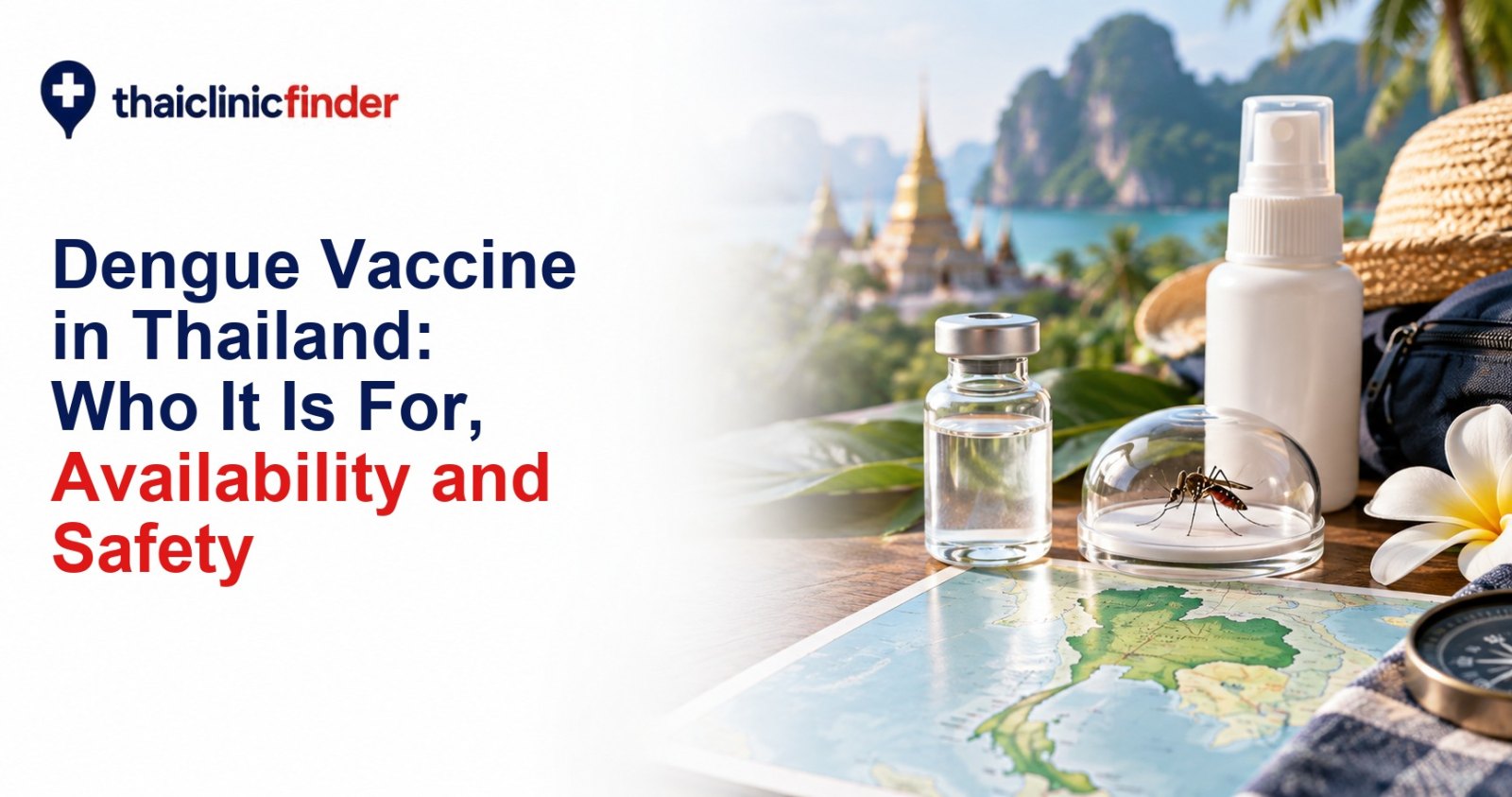
Dengue is part of everyday health planning in Thailand, especially during periods of heavy rain and in places where mosquito control is difficult. A vaccine is available, but that simple fact can be misleading: dengue vaccination is not a universal recommendation for every visitor or resident. Age, previous infection, health history, exposure and the specific product all matter.
This guide focuses on Qdenga, the tetravalent live attenuated dengue vaccine registered by the Thai Food and Drug Administration. It explains what to ask before booking, why mosquito prevention remains essential and which symptoms need urgent assessment. It is general information, not a personal recommendation to be vaccinated.
Start with your actual dengue exposure
Dengue is transmitted by infected Aedes mosquitoes, which commonly bite during the day. Risk is uneven across Thailand and changes with rainfall, local outbreaks, housing, mosquito density and time spent outdoors. A week in an air-conditioned hotel is not the same exposure as months in a house with unscreened windows, but neither setting makes infection impossible.
Length of stay matters because repeated days of exposure accumulate. Residents, frequent visitors and people staying through rainy periods may want a fuller prevention discussion than a short-stay traveller. Previous dengue also matters clinically, since a second infection with a different virus serotype can carry a higher risk of severe disease. That history must be discussed accurately rather than treated as a reason to self-select a vaccine.
No online article can calculate an individual's risk. A clinician needs to consider age, pregnancy, immune status, medical conditions, medicines, earlier dengue infection and the likelihood of future exposure. Bring any previous dengue test or hospital record if you have one; memory of a vaguely similar fever is not proof of infection.
What Qdenga registration does and does not mean
The Thai FDA database lists Qdenga as a registered tetravalent live attenuated dengue vaccine. Registration confirms that a product is authorised under the relevant regulatory route. It does not mean the vaccine is suitable for every person, stocked by every clinic, paid for by every insurer or recommended for every itinerary.
Because Qdenga is a live attenuated vaccine, eligibility deserves careful screening. Live vaccines can be unsuitable in some forms of immune suppression and require specific consideration during pregnancy. Do not rely on a receptionist's price quote as a substitute for clinical assessment. When booking, ask whether a clinician will review contraindications before vaccination.
The product schedule requires planning rather than a single last-minute visit. Ask the clinic to confirm the current official schedule, the interval between doses and what to do if travel interrupts it. Also ask for the product name and batch details to be recorded. Requirements and availability can change, so use the current product information and the clinician's advice rather than an old social-media post.
Keep that record with your other vaccination documents, particularly if the course may be completed in another country. A clear record prevents uncertainty about which dengue vaccine was used and when. It also helps a future clinician distinguish vaccination history from a documented dengue infection. If a clinic proposes a different product or timing from the one originally discussed, ask why and request updated written instructions before proceeding.
Previous dengue infection needs a careful conversation
People often encounter mixed messages online about whether a dengue vaccine requires evidence of previous infection. Some of that confusion comes from advice about different vaccines, studied populations and national programmes. Recommendations for one dengue vaccine should not be transferred automatically to another.
Tell the clinician about any confirmed past infection, where it was diagnosed, when it occurred and whether you have records. If testing is proposed, ask what test is being used and how the result will affect the decision. Antibody tests have limitations, including possible cross-reactivity with related viruses and vaccines, so interpretation belongs with a qualified professional.
Someone who has never knowingly had dengue should not assume they are definitely dengue-naive, just as someone who remembers a severe fever should not assume it was dengue. The practical approach is to be honest about uncertainty and let the clinician apply current guidance to the exact product and patient.
This distinction matters because dengue policy is still developing as evidence and national programmes evolve. Recommendations may focus on particular age groups or places with substantial transmission rather than every individual traveller. Ask which current guideline the clinic is applying and whether its advice is intended for routine population vaccination, individual protection or both. That question often resolves apparently conflicting claims found online.
Who should pause before booking
Pregnant people, those planning pregnancy, people who are immunocompromised and anyone with a history of a serious vaccine reaction should obtain individual advice before receiving a live vaccine. The same applies to children, because age eligibility and programme recommendations are specific. Do not split an adult dose, use another person's appointment or purchase a product for unsupervised use.
If you are acutely unwell, tell the clinic before attending. A mild illness and a significant febrile illness may be handled differently. The clinician also needs a complete medicine list, including immune-modifying drugs, steroids, cancer treatment and recent vaccines. Seemingly unrelated treatment can change the timing or suitability of a live vaccine.
International travellers should also check the guidance used in their country of residence. A vaccine being registered in Thailand does not guarantee that it is part of another country's routine travel recommendation or that a foreign insurer will reimburse it.
Cost, availability and choosing a clinic
Qdenga availability can vary between hospitals, travel clinics and vaccination centres. Contact the exact branch you intend to visit and ask whether the vaccine is in stock, whether an appointment is required and whether the consultation and administration fees are included. A low advertised price may cover only the product, while a higher quotation may include clinical assessment and documentation.
Ask whether both scheduled doses can be supplied and what happens if stock changes before the second appointment. If you may be outside Thailand, discuss whether the same branded product is available at your destination and whether the schedule can be completed there. Do not shorten the interval to fit a flight without medical approval.
Language support is also branch-specific. Request an English-speaking vaccination consultation when booking if you need one, and confirm that your record will show the product, date and batch clearly. For a broader sense of consultation and hospital charges, see our guide to medical costs in Thailand.
Health insurance often treats travel and preventive vaccines differently from illness. Read the outpatient, preventive-care and vaccination sections of your policy, then ask whether pre-authorisation is required. Paying directly may be simpler when the benefit is excluded or below a deductible.
Vaccination does not replace mosquito control
No dengue vaccine removes the need to prevent bites. Use an effective repellent according to its label, wear clothing that covers more skin when practical, and use screens or air conditioning where available. Empty standing water around accommodation, including plant trays and small containers, because Aedes mosquitoes can breed close to homes.
Protection is particularly important during daytime activities. Reapply repellent as directed after sweating or swimming, and avoid assuming that a high floor or urban address eliminates mosquitoes. Accommodation staff can often address damaged screens or local breeding sites if the problem is reported. Close doors promptly and check balconies after rain, since very small water collections can support breeding nearby.
Mosquito control also protects people for whom vaccination is unsuitable and reduces exposure to other mosquito-borne infections. It should be treated as the baseline, with vaccination considered as an additional measure for selected people. Our guide to mosquito bites in Thailand covers repellents and bite prevention in more detail, while a clinician should handle vaccine decisions.
Recognising illness after a bite or vaccination
Dengue symptoms can include high fever, severe headache, pain behind the eyes, muscle and joint pain, nausea and rash. Those symptoms overlap with other infections. A mosquito bite does not prove dengue, and vaccination does not make a later fever harmless.
Seek medical assessment for suspected dengue, especially if fever is persistent or you feel significantly unwell. Warning signs can appear as fever starts to settle and may include severe abdominal pain, persistent vomiting, bleeding, marked drowsiness or restlessness, breathing difficulty, cold clammy skin or rapid deterioration. These signs need urgent medical care.
Until a clinician has assessed possible dengue, avoid self-treating with aspirin or ibuprofen because bleeding risk can be a concern. Paracetamol may be used in some circumstances, but dose and suitability depend on age, liver health and other medicines. Ask a clinician or pharmacist, and do not combine products that contain the same ingredient.
Common vaccine reactions and serious symptoms should also be distinguished. Ask the vaccination clinic what is expected, how long it usually lasts and where to call after hours. Breathing difficulty, facial swelling, collapse or other signs of a severe allergic reaction require emergency help.
A decision process that avoids guesswork
First, define why you are considering vaccination: long residence, repeated travel, a local clinician's recommendation or concern after a previous infection. Gather your medical and vaccination records and describe your likely exposure honestly. That creates a useful consultation instead of a yes-or-no request based on fear.
Next, ask the clinic to explain eligibility for the exact vaccine, expected benefits and limitations, contraindications, the full schedule and total cost. Keep a written record and continue daytime mosquito precautions before, during and after the course. The vaccine is one layer of protection, not permission to ignore bites or symptoms.
Finally, make a plan for illness. Know where you would seek care, and read our guide to dengue fever in Thailand for practical preparation. If warning signs develop, go for urgent assessment rather than waiting to see whether the vaccine changes the course.
Frequently Asked Questions
Is there a dengue vaccine in Thailand?
Yes. Qdenga is registered with the Thai FDA as a tetravalent live attenuated dengue vaccine.
Should every traveler to Thailand get a dengue vaccine?
No. The decision depends on age, health, length of stay, exposure risk and current medical guidance.
Does dengue vaccination prevent all dengue infections?
No vaccine eliminates all risk. Mosquito-bite prevention remains important.
Where can I get a dengue vaccine in Thailand?
Selected hospitals and travel medicine clinics may offer it. Confirm the exact vaccine, stock and appointment requirements.
Can immunocompromised people receive Qdenga?
Because Qdenga is a live attenuated vaccine, immune status requires medical assessment and can affect eligibility.
Sources

Writer
Niran Chaiyasit
Niran Chaiyasit is a Thai health writer with a background in public health and a focus on travel health, disease prevention and healthcare access in Thailand. His work covers topics such as common illnesses, vaccinations, mosquito-borne diseases, food safety and practical health information for travelers and expatriates.

Medical review
Justin Brooks
Daniel Brooks is an American health writer with a background in health sciences and a focus on rehabilitation, musculoskeletal health and patient education. He writes about physiotherapy, injury recovery, pain management, preventive health and practical healthcare guidance for international patients and travelers.