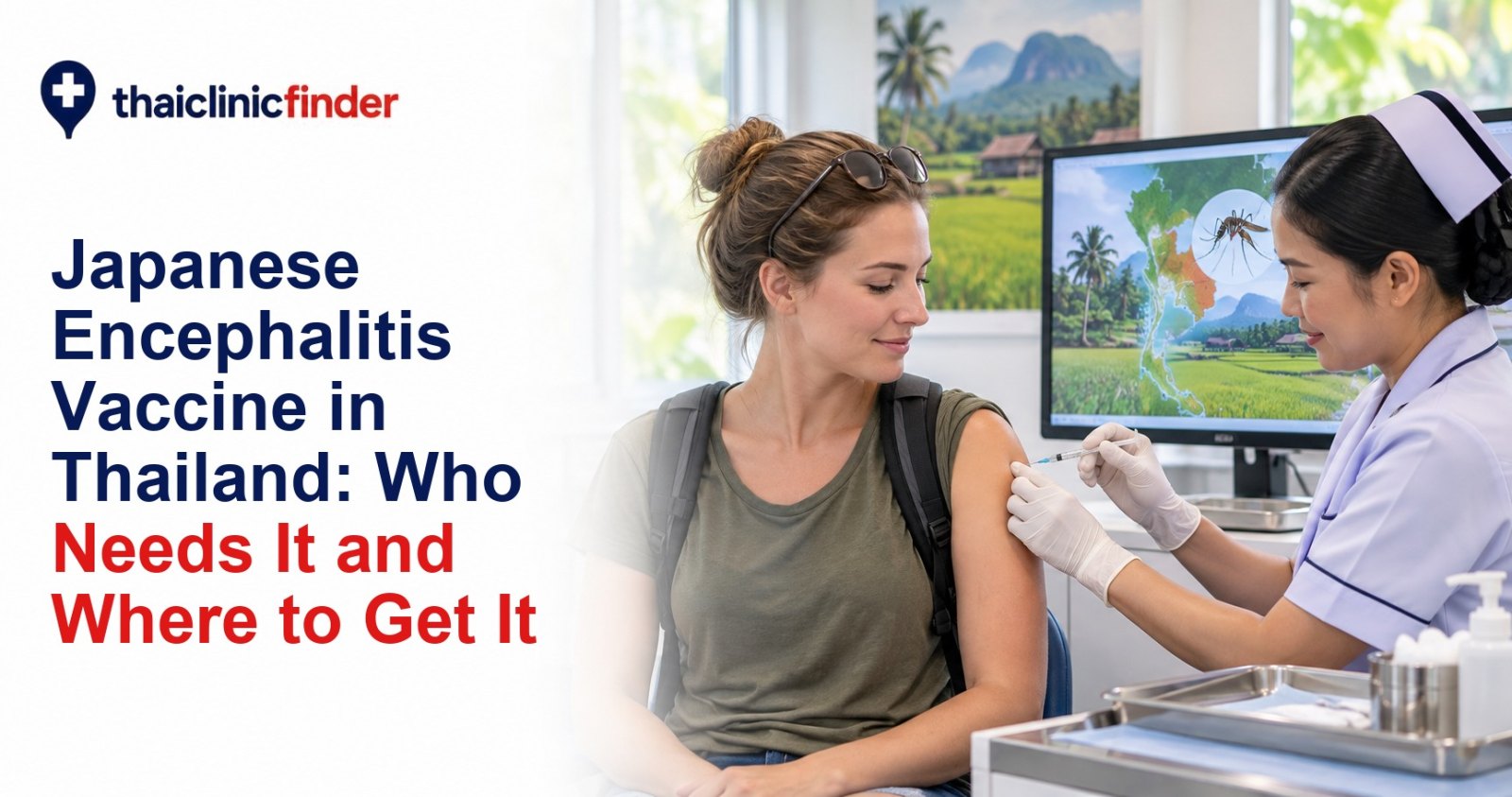
Japanese encephalitis is a mosquito-borne viral infection found in parts of Asia, including Thailand. For travelers, the chance of infection is generally low, but the consequences can be severe when the virus causes inflammation of the brain. The decision about vaccination therefore depends less on nationality and more on where you will go, how long you will stay and what you will do.
A two-night stop in central Bangkok is not the same exposure as a month of cycling through rural provinces, sleeping near rice fields or returning repeatedly for work. This guide helps you prepare for a useful conversation with a travel-medicine clinician. It does not replace an individual vaccine assessment, particularly for children, pregnancy, immune conditions or previous serious reactions.
Understanding the risk rather than the map alone
Japanese encephalitis virus is maintained in a transmission cycle involving mosquitoes and animal hosts, particularly pigs and wading birds. People are incidental hosts and do not usually develop enough virus in the blood to infect mosquitoes. You cannot catch the illness through ordinary contact with another traveler.
Most human infections cause no symptoms or a mild nonspecific illness. A small proportion progress to encephalitis, with fever, headache, vomiting, confusion, seizures, weakness or altered consciousness. Severe disease is a medical emergency and can cause death or lasting neurological disability. Anyone with confusion, a seizure, marked drowsiness or new weakness needs urgent hospital assessment. In Thailand, the medical emergency number is 1669.
Risk varies within the country and over time. Rural agricultural areas, rice-growing environments and places where pigs are raised can support transmission. Mosquito exposure often increases around dusk and during the night, though avoiding bites at all times is sensible. Seasonal rainfall can influence mosquito numbers, but it is misleading to treat one month as completely safe and another as automatically dangerous.
Who should seriously discuss vaccination
International guidance generally recommends or considers Japanese encephalitis vaccination for people with higher-risk travel patterns. This includes longer stays in endemic areas, repeated visits and trips involving substantial rural or outdoor exposure. Camping, hiking, cycling, fieldwork and staying in accommodation without reliable screens or air conditioning can all change the calculation.
The vaccine may also be worth discussing when plans are uncertain. A traveler who expects to remain in Bangkok but may spend several weeks in rural areas has a different decision from someone on a fixed urban business itinerary. Similarly, a short trip can still involve concentrated exposure if it centres on overnight outdoor activity in a transmission setting.
For many short-term visitors whose travel is limited to urban areas, vaccination is not routinely recommended. That does not mean risk is literally zero. It means the balance of exposure probability, vaccine timing, cost and individual circumstances is different. A clinician should help you interpret the itinerary rather than applying a single rule to every trip to Thailand.
Children, older adults and people with chronic medical conditions need the same itinerary-based discussion, with added attention to age approvals and personal health. If you are also reviewing routine and travel vaccines, our guide to typhoid in Thailand explains why food-and-water precautions remain necessary even after vaccination.
Timing the appointment before departure
Arrange travel-health advice early, ideally several weeks before departure. The exact Japanese encephalitis vaccine schedule depends on the product and your age. Some schedules involve two doses separated by a defined interval, and protection takes time to develop after the final dose. Accelerated options may exist for eligible adults using a particular product, but they are not appropriate for everyone.
Bring a clear itinerary and your vaccine record. Dates, product names and previous doses matter. If you were vaccinated years ago, do not assume you must restart or that protection is automatically current. A clinician can decide whether the documented primary series is valid and whether a booster is indicated for continuing or renewed exposure.
If departure is soon, still ask for advice. The clinician can explain what can realistically be completed and place extra emphasis on mosquito avoidance. Do not compress dose intervals yourself or mix products without professional guidance. An incomplete series should not be represented as full protection.
Vaccination may be available in Thailand through some private hospitals, travel clinics and public services, but availability can change. Ask the exact facility about the product stocked, eligible ages, number of visits, total fee and whether an English vaccination record will be issued. Confirm the language of the appointment rather than assuming it from a hospital's general website.
What to tell the vaccine clinician
A good consultation is more than naming the country. List each destination, travel dates, expected accommodation and rural side trips. Mention overnight stays near farmland, extensive evening activity, camping, caving, cycling, military work, humanitarian response or research in outdoor settings. Explain if you travel to Thailand regularly, because cumulative exposure may alter the recommendation.
The clinician also needs your age, pregnancy status, allergies, immune conditions, regular medicines and history of vaccine reactions. Bring evidence of previous Japanese encephalitis vaccination if available. A photograph of a record is better than relying on memory, but the vaccine name and date must be readable.
Ask which product is being offered and what reactions are expected. Pain, redness or swelling at the injection site and short-lived headache or muscle aches can occur. Severe allergic reactions are rare but require immediate care. The clinic should tell you when to seek help and how long to remain for observation after vaccination.
If you use regular medication, carry enough for the trip in original packaging and check the rules before flying. Thailand's prescription-medication customs guide covers the documents and checks that may be needed; vaccine appointments do not change import requirements for personal medicines.
Vaccination during pregnancy or with immune conditions
Pregnancy requires an individual risk-benefit discussion. The clinician will consider whether travel can be postponed, how significant the exposure is and what safety information applies to the available vaccine. Do not accept a categorical answer from a booking desk that has not reviewed the product and medical history.
People who are immunocompromised may have a weaker response to some vaccines and may need specialist advice. The type of immune condition or treatment matters, as does the vaccine technology. Bring a current medicine list and, when possible, a letter from the treating specialist. Never stop immune-suppressing medicine merely to receive a travel vaccine unless the prescribing team directs you.
For infants and children, age eligibility and dosing are product-specific. A family appointment should include each child's record rather than treating everyone as one booking. Parents should also plan bite prevention carefully because young children may not reliably report mosquito bites or tolerate every repellent formulation.
Mosquito protection remains essential
The vaccine only addresses Japanese encephalitis, not dengue or every other mosquito-borne infection found in Thailand. Use an effective insect repellent according to its label, reapplying as directed after sweating or washing. Apply sunscreen first and repellent afterward when both are needed. Adults should apply repellent to children rather than letting them handle it, and age restrictions must be followed.
Wear loose, light-coloured clothing that covers more skin when practical. Long sleeves and trousers are particularly useful for evenings outdoors. Choose accommodation with intact window screens or air conditioning, and use a mosquito net where the sleeping area is exposed. Remove standing water around longer-term accommodation when it can be done safely.
Do not rely on bracelets, ultrasonic devices or a single citronella candle for meaningful protection. A layered approach works better: repellent, clothing and a protected sleeping space. Our dengue guidance for Thailand provides further context for daytime mosquito precautions, which complement the evening-focused habits often discussed for Japanese encephalitis.
If illness develops during or after the trip
A fever alone is much more likely to have another cause than Japanese encephalitis, but it still deserves sensible assessment when persistent or accompanied by concerning symptoms. Tell the clinician where you travelled, including rural areas, and give the dates. Mention mosquito exposure and vaccination status without assuming either confirms or excludes a diagnosis.
Seek emergency care for confusion, seizures, inability to wake normally, a severe or rapidly worsening headache, new weakness, breathing difficulty or collapse. Do not drive yourself if awareness is affected. Japanese encephalitis is diagnosed through specialist assessment and laboratory testing; there is no safe home test that can distinguish it from other neurological infections.
Treatment for encephalitis is supportive and hospital-based. This is one reason prevention receives so much attention. Keep travel insurance details accessible, but do not delay emergency assessment while seeking insurer approval. A companion should bring vaccine records and a medication list if available.
Making a proportionate vaccine decision
Start with the real itinerary, not fear. Note trip length, rural nights, outdoor hours, season, accommodation and how often you return to Thailand. Take that information and your vaccine history to a qualified travel-medicine clinician early enough to complete any recommended schedule.
If vaccination is advised, confirm the product, dates, common reactions, documentation and any future booster requirement. If it is not advised, that does not make mosquito protection optional. Repellent, suitable clothing and protected accommodation remain useful throughout Thailand because several infections are transmitted by mosquitoes.
Finally, plan how you would obtain care if neurological symptoms appeared. Save 1669, keep insurance details with you and review medical costs in Thailand before departure so that practical questions do not distract from urgent decisions. A well-matched vaccine plan and consistent bite prevention are more useful than a blanket answer applied to every traveler.
Frequently Asked Questions
Does everyone visiting Thailand need a Japanese encephalitis vaccine?
No. Vaccination is generally considered for longer stays, repeated travel and itineraries with meaningful rural or outdoor exposure. A short urban trip usually carries a much lower risk, but a travel-medicine clinician should assess the full itinerary.
Can I get the Japanese encephalitis vaccine after arriving in Thailand?
The vaccine may be available through some Thai hospitals and travel clinics, but product, schedule, age approval and appointment availability can differ. Starting before travel is often simpler because the series needs time to produce protection.
How many doses of Japanese encephalitis vaccine are needed?
The schedule depends on the vaccine product, age and national guidance. Do not assume that a schedule found online applies to the product offered at your clinic; confirm the exact dates and whether a booster is advised.
Is Japanese encephalitis only a rainy-season risk?
Transmission is often associated with rural mosquito exposure and may increase seasonally, but risk is not confined to a single calendar window everywhere in Thailand. Itinerary and activity remain important even outside a commonly described peak.
Does the vaccine replace mosquito precautions?
No. No vaccine is completely protective, and mosquito precautions also reduce the risk of dengue and other infections. Use repellent, suitable clothing and screened or air-conditioned accommodation where practical.
Sources

Writer
Niran Chaiyasit
Niran Chaiyasit is a Thai health writer with a background in public health and a focus on travel health, disease prevention and healthcare access in Thailand. His work covers topics such as common illnesses, vaccinations, mosquito-borne diseases, food safety and practical health information for travelers and expatriates.

Medical review
Justin Brooks
Daniel Brooks is an American health writer with a background in health sciences and a focus on rehabilitation, musculoskeletal health and patient education. He writes about physiotherapy, injury recovery, pain management, preventive health and practical healthcare guidance for international patients and travelers.