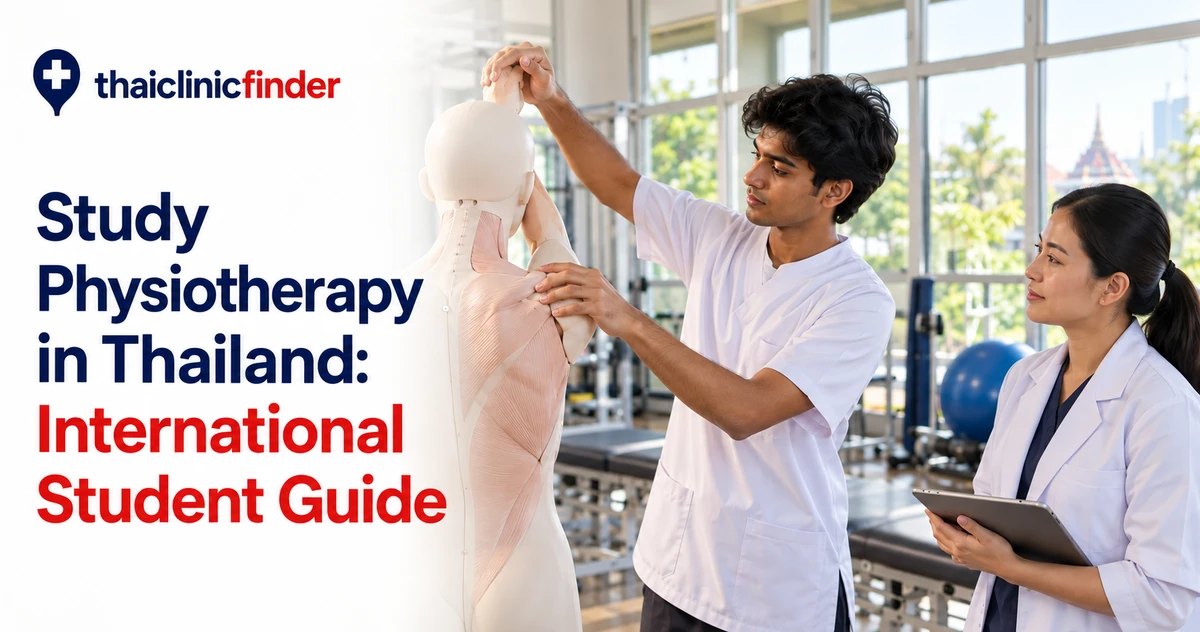
Studying physiotherapy in Thailand can be attractive if you want clinical training in a large healthcare system, experience in Southeast Asia and access to respected universities. It is also a decision that requires more checking than a general academic degree. Physiotherapy is a regulated clinical profession, so the language of teaching, eligibility for patient placements and the route to a professional licence matter as much as the university name.
This guide is written for international students considering a bachelor's or postgraduate physiotherapy programme in Thailand. It explains what official university pages establish, what they do not establish, and which questions to resolve before paying a deposit. The most important starting point is simple: an English webpage is not proof that a degree is taught entirely in English or designed for international admission.
The short answer
Thailand has established four-year bachelor's degrees in physical therapy and international postgraduate options. Mahidol University says its Bachelor of Science in Physical Therapy dates from 1965 and is accredited against World Physiotherapy standards. Chulalongkorn University lists a four-year, 139-credit Bachelor of Science in Physical Therapy. Both are serious professional programmes, but their public admissions information points to Thailand's domestic admission system rather than clearly advertising a separate English-medium international bachelor's intake.
For an applicant who does not read and speak Thai at a high level, that distinction is decisive. Clinical education involves patient interviews, consent, safety instructions, records and teamwork with Thai healthcare staff. Never infer that clinical placements will be available in English simply because course information appears in English. Ask the faculty to confirm the language used in lectures, assessments and every placement for the exact academic year.
International postgraduate study is clearer. Mahidol advertises an MSc in Physical Therapy as an international programme. Its 2026 admission page lists a two-year coursework-and-thesis plan, a fixed fee of THB 40,000 per semester for foreign students, THB 100,000 in other programme fees, and an additional foreign-student health-insurance fee of THB 3,500 per academic year. These are official figures for that named intake, not a general price for all Thai physiotherapy degrees.
Bachelor's study: professional training, not just classroom science
A Thai physiotherapy bachelor's degree combines biomedical science, assessment, treatment techniques, ethics and supervised clinical practice. Chulalongkorn's revised programme lists 139 credits over four years, including 66 credits of professional courses. Mahidol describes training across musculoskeletal, neurological, cardiopulmonary and paediatric practice and says students receive real clinical experience at approved sites.
Mahidol's programme page also states that graduates must complete at least 1,000 hours of clinical practice, meet curriculum and English standards, and pass comprehensive knowledge and practical assessments. Those requirements show why a prospective student must investigate much more than tuition. Placement timetables can be intensive, may occur away from the main campus and require communication with patients who do not speak English.
The right first email to a faculty should ask:
- whether non-Thai citizens can apply in the intended admission round;
- whether admission runs through TCAS or a separate international route;
- the teaching language for each academic year;
- the language of written examinations and practical assessments;
- the Thai-language level required before patient contact;
- whether all clinical sites accept international students;
- whether the degree is currently recognised by Thailand's Physical Therapy Council;
- and whether completing it makes a non-Thai graduate eligible for the Thai licensing process.
Get the answers in writing. A general statement that a university welcomes international students does not necessarily cover a particular regulated health programme.
Admission requirements and language evidence
Bachelor's admission commonly depends on a science-focused secondary-school background and the university's current selection route. Exact subject requirements, grade calculations and accepted tests can change between intakes. Mahidol's public bachelor's page refers applicants to the Thai University Central Admission System and lists English graduation thresholds such as IELTS 5.0, TOEFL iBT 64, TOEIC 600 and specified Mahidol tests. These published English scores are useful, but an English proficiency threshold is not the same thing as English-medium teaching.
International applicants should send certified transcripts and ask whether their school qualification needs Thai equivalency or additional authentication. If documents are not in Thai or English, the admissions office may require certified translations. Applicants should also clarify whether biology, chemistry, physics or mathematics prerequisites are assessed course by course.
Clinical programmes may require health screening, immunisation evidence, professional insurance, police or conduct documents, and the ability to meet physical and communication requirements. Do not wait until arrival to investigate these conditions. If a clinical site rejects incomplete documentation, a student could be unable to progress even after being admitted academically.
Students comparing education with healthcare employment may also find our guide to working as a nurse in Thailand as a foreigner useful. The professions have different regulators, but the central lesson is the same: university admission, immigration status and permission to practise are separate questions.
Postgraduate options for international students
A master's degree can be the more realistic Thailand-based option for someone who already holds a recognised physiotherapy qualification. Mahidol's international MSc accepts applicants with a bachelor's degree in physical therapy, normally with a cumulative GPA of at least 2.50 or 75%, subject to programme decisions. The faculty asks for an English test result, CV, research-interest statement and transcripts, and it may assess essential physiotherapy knowledge.
The official 2026 Mahidol admission listing gives foreign students a fixed fee of THB 40,000 for each of four semesters plus THB 100,000 in other programme fees. On those published components, the academic total is THB 260,000, before the annual THB 3,500 health-insurance charge and any summer registration, research, equipment, living or immigration costs. Confirm the final invoice with the programme because rules and fees can change.
A research master's does not automatically grant a new clinical licence. It may strengthen academic, specialist or research knowledge, but practice rights depend on the regulator and the person's underlying professional qualification. Ask whether any activity described as clinical observation, laboratory work or data collection involves direct patient care and what authorisation is required.
Tuition and the true cost of studying
Universities may quote per-semester tuition, a fixed programme fee, per-credit charges or a mixture. Compare like with like. A useful budget separates:
- application and admission-confirmation fees;
- tuition for regular and summer terms;
- laboratory, research and equipment charges;
- clinical placement travel and accommodation;
- uniforms, shoes and required devices;
- student health insurance and vaccinations;
- visa extensions, re-entry permits and document certification;
- housing deposits, utilities and daily living costs.
Bangkok living costs can vary widely depending on distance from campus and whether a student needs to travel to placement sites. A cheaper room can become expensive if it creates long daily journeys. Ask current students how often placements start early, finish late or take place outside the city.
Do not use treatment prices to estimate university costs. Patient-facing guides such as physiotherapy and rehabilitation clinics in Bangkok explain how patients find services, while an academic programme has a different cost structure. For wider context on hospital bills and insurance, see medical costs in Thailand and how to choose health insurance in Thailand.
Professional licensing in Thailand
Thailand's Physical Therapy Council regulates professional practice. Its published English procedure for people graduating from foreign institutions describes several steps, including Council membership, individual recognition of the overseas degree and the professional licensing process. The document lists a THB 20,000 degree-certification fee and asks for evidence such as the degree and details of clinical training. Fees and procedures should be reconfirmed directly because the published document can be revised.
The Council's download centre also provides forms for membership, licence registration, examinations and recognition of foreign qualifications. Do not assume that a foreign licence transfers automatically. Course content, clinical hours, documents, examinations and Thai communication ability may all affect the process.
A student completing a Thai degree should likewise confirm that the exact curriculum and intake carry current Council recognition, and that nationality does not create an additional barrier to examination or registration. Ask the Council, not only a recruitment agent or university salesperson.
Licensing is also distinct from the right to work. A foreign national may need an appropriate visa and work authorisation, and some occupations or roles may be restricted. A hospital's willingness to interview someone is not proof that all legal steps are available. Before making a career plan, obtain advice for the exact role and nationality.
How to compare universities responsibly
A glossy campus tour cannot answer the questions that matter most. Build a comparison sheet using official documents for the current intake. Record accreditation, admission route, teaching language, Thai-language expectations, clinical hours, placement locations, cohort size, progression rules, complete fees and graduate licensing eligibility.
Look closely at the clinical teaching model. Ask how supervisors are assigned, how students are assessed, what happens if a placement is failed and whether remediation creates extra tuition or visa problems. International students should also ask whether counselling, disability support and academic advice are available in English. For broader support options, our guide to finding mental-health support in Thailand can help students plan before a crisis.
Talk to current international students if the faculty can connect you, but verify factual claims against regulations. One student's smooth visa or placement experience may not apply to a different nationality or academic year.
A practical application timeline
Start 12 to 18 months before the intended intake. First identify whether you need a professional bachelor's degree or already qualify for postgraduate study. Then contact the programme and regulator with a concise list of questions. Request the current curriculum, admission notice, fee schedule and written language policy.
Next, arrange transcript certification, translations and English testing. If Thai proficiency is required, calculate honestly whether you can reach the clinical level before placements begin. Basic conversational Thai is not the same as taking a history, explaining risk or responding during an emergency.
After admission, confirm visa documents, insurance, accommodation and payment deadlines directly with the university. Keep copies of every receipt and official email. Before travelling, learn how to access urgent care and save Thailand's emergency contacts; our medical emergencies in Thailand guide provides a practical starting point.
Is Thailand the right choice?
Thailand can be a strong choice for a student who finds a properly recognised programme, can meet its language demands and understands where they intend to practise after graduation. It is a poor choice if the decision rests only on an English marketing page, an assumed low tuition figure or the belief that a degree guarantees a Thai job.
For bachelor's applicants, language and licensing should be resolved before cost comparisons. For qualified physiotherapists seeking advanced study, an international MSc such as Mahidol's offers a clearer English-language route, but it remains an academic programme rather than an automatic practice permit.
The best next step is not to send money. It is to obtain written confirmation from the faculty and the Physical Therapy Council covering your nationality, previous education, teaching language and intended professional outcome. That small amount of verification can prevent a very expensive misunderstanding.
Frequently Asked Questions
Can international students study physiotherapy in Thailand?
Yes, but applicants must confirm that the specific intake accepts non-Thai students and that they can study and complete clinical placements in the programme's teaching language. Many Thai professional bachelor's degrees are not international English-medium programmes.
Is a Thai physiotherapy bachelor's degree taught in English?
Do not assume so from an English-language programme webpage. Mahidol and Chulalongkorn publish English descriptions of their bachelor's degrees, but their admissions information points to Thailand's TCAS route. Ask the faculty in writing which courses, examinations and clinical placements are available in English for your intake.
How long is a physiotherapy degree in Thailand?
The bachelor's programmes described by Mahidol and Chulalongkorn are four-year professional degrees. International master's programmes are usually shorter; Mahidol's 2026 MSc international programme lists a two-year plan.
Can a foreign graduate work as a physiotherapist in Thailand?
A degree alone does not authorise practice. The Physical Therapy Council publishes a route for graduates of foreign institutions involving degree recognition, Council membership and professional licensing requirements. Confirm the current process directly before enrolling or accepting work.
What should I budget beyond tuition?
Allow for visa and immigration costs, insurance, uniforms, laboratory or clinical expenses, transport to placements, accommodation, deposits and daily living costs. Request the university's complete written fee schedule because headline tuition may exclude several of these items.
Sources
- Mahidol University Faculty of Physical Therapy: BSc Physical Therapy
- Chulalongkorn University Faculty of Allied Health Sciences: BSc Physical Therapy
- Mahidol University 2026 MSc Physical Therapy international admission and fees
- Mahidol University Faculty of Physical Therapy: MSc international programme
- Physical Therapy Council: licensing procedure for foreign graduates
- Physical Therapy Council: forms and licensing downloads
Writer
Niran Chaiyasit
Health writer with a background in public and travel health
Niran Chaiyasit is a Thai health writer with a background in public health and a focus on travel health, disease prevention and healthcare access in Thailand.
View profile