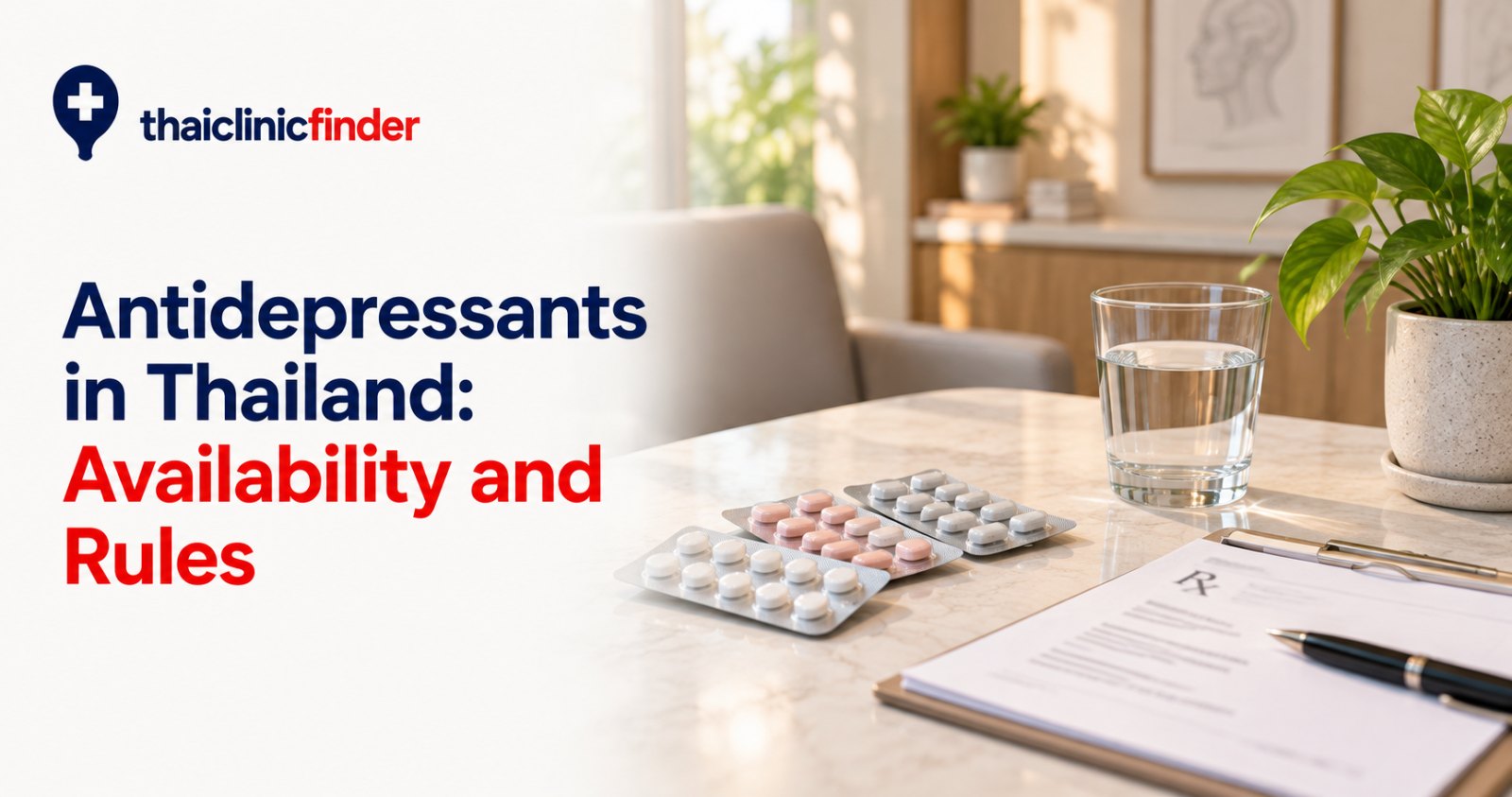
Antidepressants are available in Thailand, including widely used medicines such as sertraline and fluoxetine. Thai FDA product records show multiple registered antidepressants, and several common SSRIs are classified as dangerous drugs under Thai drug law, meaning they require pharmacist oversight and should be used through legitimate medical care.
For an expat or traveler already taking an antidepressant, the main issues are continuity of treatment, finding the same active ingredient, and carrying enough documentation. Brand names can differ, and abruptly stopping some antidepressants can cause withdrawal symptoms or a return of the underlying condition.
This guide explains what is available, how access works, what to bring from home and why controlled sedatives should not be confused with antidepressants.
Are antidepressants available in Thailand?
Yes. Thailand has registered products across several antidepressant classes.
Thai FDA product and drug-pricing records include medicines such as:
- sertraline;
- fluoxetine;
- escitalopram and related SSRIs;
- duloxetine and other SNRIs;
- bupropion;
- agomelatine;
- other antidepressant medicines.
Actual stock varies by hospital, clinic and pharmacy. A brand used in the United States or Europe may not be sold under the same name in Thailand, but the active ingredient may be available in another registered product.
When asking for continuity of treatment, use the generic name, strength and formulation, not only the brand name.
Do you need a prescription for antidepressants in Thailand?
Thai FDA product records for sertraline and fluoxetine classify them as dangerous drugs. This is a legal supply category in Thailand and indicates that dispensing should occur under pharmacist control rather than as an ordinary household medicine.
In practice, people with depression, anxiety or other psychiatric conditions should use antidepressants through a doctor or mental health professional who can assess diagnosis, interactions, side effects and follow-up.
Do not assume that a pharmacy's willingness to sell a medicine without seeing a foreign prescription means self-treatment is appropriate or that all antidepressants have the same legal status.
Thai Clinic Finder has a broader guide to mental health care in Thailand.
Which antidepressants are commonly registered?
Thai FDA records confirm registered products containing common SSRIs such as sertraline and fluoxetine.
Sertraline records list indications including depression and several anxiety-related or obsessive-compulsive conditions. Fluoxetine records include depression.
Other antidepressant classes are also represented in Thai government drug databases. Availability changes with manufacturer, hospital formulary and supply, so the most useful question is usually whether your specific generic medicine is available.
If you are switching products or classes, that should be a medical decision. Equivalent milligram numbers do not mean two antidepressants are interchangeable.
Can you buy sertraline in Thailand?
Sertraline is registered in Thailand. Thai FDA records classify sertraline products as dangerous drugs and list depression among their approved indications.
A resident or traveler seeking sertraline should ideally bring a prior prescription or medical record and obtain ongoing treatment through a clinician and licensed pharmacy.
If the exact brand is unavailable, a doctor or pharmacist can identify a registered product with the same active ingredient and appropriate strength.
Can you buy fluoxetine in Thailand?
Yes. Thai FDA records show registered fluoxetine products, commonly in 20 mg presentations, and classify them as dangerous drugs.
Fluoxetine has a relatively long half-life compared with some other SSRIs, but that does not make dose changes or discontinuation a do-it-yourself decision.
If you are stable on fluoxetine, carry documentation and avoid changing brand, dose or schedule simply because another product is easier to find.
Antidepressants are not the same as benzodiazepines
This distinction is especially important in Thailand.
Antidepressants such as SSRIs are different from sedatives such as diazepam, lorazepam, alprazolam and clonazepam. Several benzodiazepines are classified as controlled psychotropic substances in Thailand and have specific travel and possession rules.
A person may take a benzodiazepine for anxiety, but that does not make it an antidepressant.
If your prescription includes both an antidepressant and a controlled sedative, check each active ingredient separately before traveling. The rules may be different.
Can you bring antidepressants into Thailand?
Thai FDA guidance says travelers may generally bring a limited personal supply of ordinary modern medicines for personal use, with the medicine in its original container and accompanied by a prescription.
However, psychotropic or narcotic medicines have separate rules. This matters if your mental-health medication list includes controlled sedatives, stimulants or sleep medicines in addition to an antidepressant.
Before flying:
- list every active ingredient;
- check whether any ingredient is psychotropic or narcotic under Thai law;
- keep medicines in original labeled packaging;
- carry a prescription or medical letter;
- do not bring more than the permitted personal-use quantity.
See the dedicated guide on bringing prescription medicines into Thailand.
How to continue antidepressant treatment in Thailand
If you are moving to Thailand or staying for several months, arrange continuity before your supply runs low.
Bring:
- your current prescription;
- a treatment summary if available;
- the generic medicine name;
- strength and daily schedule;
- a list of previous antidepressants and adverse effects;
- relevant diagnoses and medical history.
A local doctor may not need to repeat an entire diagnostic process, but they should still review the treatment before issuing ongoing prescriptions.
If you are looking for an English-speaking service, see how to choose an English-speaking clinic in Thailand.
Should you stop an antidepressant if you cannot find your brand?
No. Do not abruptly stop or change an antidepressant because a particular brand is unavailable.
Some antidepressants can cause discontinuation symptoms if stopped suddenly. Symptoms can include dizziness, sleep disturbance, anxiety, flu-like sensations and sensory symptoms, depending on the medicine.
The underlying depression or anxiety can also recur.
If your exact product is unavailable, a clinician can determine whether the same active ingredient exists under another brand or whether a medically supervised alternative is necessary.
What if your symptoms worsen?
Depression can worsen even while someone is on treatment. Seek professional help if symptoms become more severe, if daily functioning deteriorates, or if side effects are difficult to manage.
If you have thoughts of self-harm or suicide, seek urgent local help immediately. Do not wait for a routine appointment or rely on an online article.
Thailand has medical emergency services, hospital emergency departments and mental-health services. The medical emergencies in Thailand guide explains practical emergency routes.
Side effects and interactions
Different antidepressants have different adverse-effect profiles. Common problems can include nausea, sleep changes, sexual side effects, headache, sweating or changes in anxiety, but the pattern varies by medicine.
Important interactions can occur with other psychiatric medicines, migraine medicines, anticoagulants, supplements and recreational drugs.
Tell the prescriber and pharmacist about everything you take. Do not combine medicines solely because both were available over the counter or recommended by different pharmacies.
How much do antidepressants cost in Thailand?
Costs vary by active ingredient, generic or brand product, hospital or pharmacy, consultation fees and quantity.
Government reference-price data exist for some antidepressants, but those figures do not necessarily represent the final private retail price paid by a foreign patient.
Ask the provider for:
- consultation price;
- medicine price per prescribed quantity;
- follow-up cost;
- any additional tests if clinically necessary.
For broader billing context, see medical costs in Thailand.
Can you buy antidepressants online in Thailand?
Avoid unverified sellers.
A registered medicine should be obtained through a licensed pharmacy or healthcare facility. Informal online sellers can create risks around authenticity, storage, labeling and inappropriate self-medication.
This is especially important if the seller offers a psychiatric medicine without asking basic safety questions or claims that no medical review is ever needed.
Can a Thai doctor change your antidepressant?
Yes, if clinically appropriate, but a change should be based on a medical assessment.
Reasons might include lack of efficacy, side effects, interactions, pregnancy considerations, availability or another diagnosis. Switching antidepressants can require tapering, waiting periods or other precautions depending on the medicines involved.
Do not copy a switching schedule from a forum. The safe method depends on the specific drugs and the individual patient.
Choosing between a pharmacy refill and a psychiatric appointment
If you have been stable on the same antidepressant for years, the immediate need may be continuity rather than a new diagnostic work-up. Even so, a local doctor is useful when the stay is long, the prescription is running out, or the exact formulation is unavailable.
A psychiatric appointment is especially appropriate when symptoms are changing, several medicines are involved, there is a history of bipolar disorder or mania, side effects are significant, or the person is considering a medication switch.
For a straightforward refill, bring enough documentation that the clinician can see the original indication and current regimen. Avoid presenting only a photo of loose tablets, because color and shape are not reliable identifiers.
Thailand has both hospital-based psychiatry and private mental-health services. Cost, appointment length and medication stock vary, so ask whether the facility can provide the exact generic medicine before booking a refill-only visit.
Bottom line
Antidepressants are widely available in Thailand, and Thai FDA records confirm registered products such as sertraline and fluoxetine. These medicines are regulated and should be obtained through legitimate medical and pharmacy channels.
For travelers and expats, the most important practical step is to know the generic name and bring documentation. Do not confuse antidepressants with controlled benzodiazepines or stimulants, because travel rules can be much stricter for those medicines.
If you need ongoing treatment, arrange a local clinician before your supply runs out rather than stopping suddenly or buying from an unverified seller.
Frequently Asked Questions
Can you get antidepressants in Thailand?
Yes. Thai FDA records show registered antidepressants including sertraline and fluoxetine, along with medicines from several other classes.
Do you need a prescription for sertraline in Thailand?
Thai FDA records classify sertraline as a dangerous drug. It should be obtained through legitimate medical and pharmacy channels with pharmacist oversight.
Is fluoxetine available in Thailand?
Yes. Thai FDA product records list fluoxetine, commonly in 20 mg products, for depression.
Can I bring my antidepressant to Thailand?
Ordinary modern medicines can generally be carried in a limited personal supply under Thai FDA conditions, but controlled psychotropic or narcotic medicines have separate rules. Check every active ingredient.
Are benzodiazepines treated like antidepressants in Thailand?
No. Benzodiazepines such as diazepam and lorazepam are controlled psychotropic substances and have separate travel and possession rules.
What if my antidepressant brand is unavailable?
Do not stop suddenly. A Thai clinician or pharmacist can check whether the same active ingredient is available under another registered brand or advise a supervised alternative.
Sources
Writer
Niran Chaiyasit
Niran Chaiyasit is a Thai health writer with a background in public health and a focus on travel health, disease prevention and healthcare access in Thailand. His work covers topics such as common illnesses, vaccinations, mosquito-borne diseases, food safety and practical health information for travelers and expatriates.

Medical review
Justin Brooks
Daniel Brooks is an American health writer with a background in health sciences and a focus on rehabilitation, musculoskeletal health and patient education. He writes about physiotherapy, injury recovery, pain management, preventive health and practical healthcare guidance for international patients and travelers.