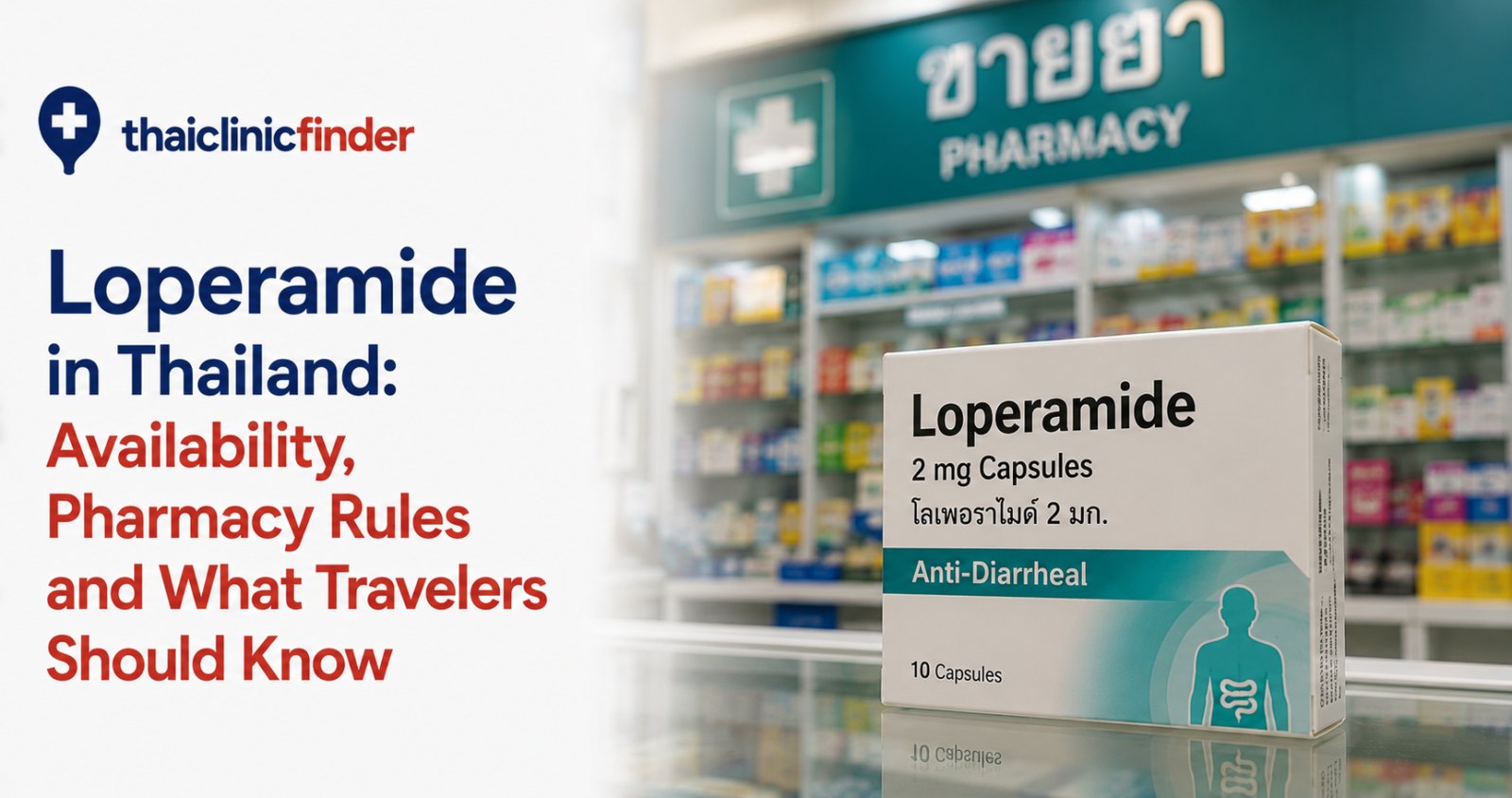
Loperamide is available in Thailand and the Thai Food and Drug Administration lists numerous registered products containing loperamide hydrochloride 2 mg. Travellers may encounter the medicine under international brands such as Imodium or under Thai generic brand names.
The more important detail is how Thailand regulates it. Thai FDA product records classify loperamide as a dangerous drug, or ยาอันตราย. Despite the English wording, this does not mean that loperamide is prohibited or that patients need a doctor's prescription in the same way as a specially controlled medicine. Thailand's dangerous-drug category is generally a behind-the-counter pharmacy category in which a pharmacist acts as the gatekeeper.
For a traveller with uncomplicated watery diarrhoea, a licensed pharmacy is therefore the most appropriate place to ask about loperamide. It should not be treated like an ordinary convenience-store product, and its availability should not be confused with whether it is medically appropriate for your symptoms.
Is loperamide available in Thailand?
Yes.
The Thai FDA National Drug Information database contains numerous registered medicines containing loperamide hydrochloride 2 mg in tablet or capsule form.
Current database entries include products marketed under names such as:
- Imodium
- Lomedil
- Diarine
- Diara
- Daiven
- Loramide
- Mantil
- Pybutil
- Mecodium
- Entermid
- Lomide
- Impelium
This is not a complete list, and individual product registrations and commercial availability can change.
The practical point is that you do not need to find one particular overseas brand. If a Thai pharmacy does not stock Imodium, ask the pharmacist for loperamide hydrochloride 2 mg and confirm the active ingredient on the packaging.
Thailand does not use the same OTC terminology as every other country
This is where travellers can become confused.
Medicines in Thailand are divided into legal categories that do not map perfectly onto terms such as prescription-only and over-the-counter used in the United States or Europe.
Thai drug categories include:
- specially controlled drugs
- dangerous drugs
- non-dangerous drugs
- household remedies
Loperamide products checked in the Thai FDA database are classified as dangerous drugs.
Research describing Thailand's legal drug-classification system identifies dangerous drugs as a pharmacist-controlled, behind-the-counter category. Unlike specially controlled drugs, they do not generally require a physician's prescription, but they are intended to be supplied under pharmacist supervision.
That distinction is more accurate than simply describing loperamide as OTC in Thailand.
Does loperamide require a prescription in Thailand?
For the registered loperamide products reviewed in the Thai FDA database, the legal category is dangerous drug rather than specially controlled drug.
Under Thailand's drug-classification framework, dangerous drugs are generally dispensed by pharmacists without a physician prescription requirement.
This means a traveller would normally approach a licensed pharmacy and discuss the symptoms with the pharmacist rather than first needing a doctor's prescription solely to obtain loperamide.
However, a pharmacist can still decide that your symptoms are not suitable for self-treatment and recommend medical assessment instead.
The absence of a physician-prescription requirement does not mean that the medicine should be used without any clinical judgement.
Why the words dangerous drug sound more alarming than they are
Thailand's legal term ยาอันตราย is commonly translated as dangerous drug.
That label can sound as though the medicine is unusually hazardous or controlled in the same way as a narcotic. That is not what the category means.
Thailand uses dangerous drug as a regulatory category covering many medicines that are kept under pharmacist control. Academic analysis of the Thai system describes these as behind-the-counter medicines for which the pharmacist acts as the gatekeeper.
The Thai FDA also requires dangerous drugs to be handled through appropriate medicine-distribution channels rather than ordinary unrestricted retail.
Loperamide is therefore available, but the correct comparison is closer to a pharmacist-only medicine than to something sold casually from any supermarket shelf.
A licensed pharmacy is the right place to ask
If you need loperamide in Thailand, look for a proper pharmacy and ask the pharmacist.
You can say:
Loperamide hydrochloride, 2 milligrams.
Using the generic name is useful because the pharmacy may stock a Thai brand rather than Imodium.
Before taking the medicine, tell the pharmacist if you have:
- blood in the stool
- fever
- severe abdominal pain
- persistent vomiting
- marked abdominal swelling
- significant dehydration
- diarrhoea lasting several days
These symptoms can change whether loperamide is appropriate.
What if the pharmacist is not there?
Thailand's pharmacy rules distinguish between medicines that can be freely sold and medicines that require pharmacist involvement.
Thai Pharmacy Council Good Pharmacy Practice guidance states that dangerous and specially controlled medicines should not be dispensed when the pharmacist responsible for the pharmacy service is absent.
Some Thai pharmacies therefore display notices indicating that pharmacist-controlled medicines cannot be supplied during periods when the pharmacist is off duty.
If a pharmacy cannot dispense loperamide at that moment, try another licensed pharmacy rather than buying unidentified tablets from an informal source.
Can you buy loperamide at 7-Eleven in Thailand?
Travellers frequently search for loperamide Thailand 7-Eleven, particularly when diarrhoea begins late at night.
Loperamide should not be treated as a standard 7-Eleven medicine.
Thai FDA records classify loperamide as a dangerous drug, a pharmacist-controlled category. We also could not verify an official nationwide 7-Eleven listing establishing loperamide as a routinely stocked product.
A licensed pharmacy is the more appropriate and reliable place to ask for loperamide.
Convenience stores may carry general health products or household remedies, but that is different from pharmacist-controlled medicines.
Do not confuse another diarrhoea medicine with loperamide
Thailand has numerous gastrointestinal products, including medicines and traditional or herbal preparations.
If you specifically want loperamide, check that the package states:
loperamide hydrochloride 2 mg
Do not assume that every product marketed for diarrhoea works in the same way.
Different products may contain:
- adsorbents
- probiotics
- herbal ingredients
- antimicrobial agents
- other antidiarrhoeal medicines
Ask the pharmacist what the active ingredient is rather than choosing from packaging alone.
Imodium is not your only option
Travellers from Europe, Australia or North America may recognise the name Imodium more readily than loperamide.
Thai FDA records confirm a registered Imodium product containing loperamide hydrochloride 2 mg, but the database also contains many generic alternatives.
A generic product contains the same active ingredient but can have a different:
- brand name
- manufacturer
- packaging
- tablet or capsule appearance
If you are offered an unfamiliar brand, check the active ingredient and strength.
You do not need to insist on Imodium if an appropriately registered 2 mg loperamide product is available.
How can you check whether a Thai loperamide product is registered?
Thai FDA operates the National Drug Information database and health-product search systems.
These databases can show information such as:
- active ingredient
- trade name
- dosage form
- strength
- registration number
- registered company
- legal classification for individual products
Searching for loperamide hydrochloride returns numerous 2 mg products registered in Thailand.
This is more reliable than identifying a medicine solely from packaging photographs on travel forums.
When loperamide is actually useful
Loperamide is mainly used for temporary control of diarrhoea.
It slows movement through the intestine, which can reduce stool frequency and urgency.
For travellers, it can be particularly useful when uncomplicated watery diarrhoea interferes with:
- a flight
- a long bus trip
- a train journey
- sightseeing
- sleep
It does not kill the bacteria, virus or parasite that may be causing the diarrhoea.
For the full medical guide, including dosage and side effects, see Loperamide: Uses, Dosage, Side Effects and When Not to Take It.
Do not automatically take it for every case of food poisoning
Loperamide can reduce symptoms, but some gastrointestinal illnesses should not simply be suppressed.
CDC advises against using loperamide alone when diarrhoea is bloody or accompanied by fever.
These features can suggest an invasive intestinal infection and can change the recommended treatment.
If you have suspected food poisoning with simple watery diarrhoea and otherwise feel reasonably well, loperamide may be useful for symptom control.
For a broader approach to foodborne illness, see Food Poisoning in Thailand: Symptoms, Treatment and What to Do.
Blood in your stool is a reason to stop self-treating
Visible blood is not ordinary uncomplicated traveller's diarrhoea.
CDC categorises dysentery, meaning diarrhoea containing visible blood, as severe travellers' diarrhoea.
Do not rely on repeated loperamide doses if you have blood in the stool.
Medical assessment may be needed to consider:
- bacterial infection
- dehydration
- appropriate antimicrobial treatment
- another gastrointestinal diagnosis
Tell the doctor or pharmacist how much loperamide you have already taken.
Fever changes the decision too
Significant fever combined with diarrhoea is another reason to be cautious.
CDC advises against loperamide monotherapy for febrile diarrhoea.
If you have substantial fever, especially together with abdominal pain, weakness, vomiting or blood in the stool, seek medical advice instead of assuming that suppressing bowel movements is enough.
Thailand has many potential causes of fever, and gastrointestinal symptoms do not automatically establish food poisoning as the diagnosis.
Hydration is more important than loperamide
Loperamide may reduce the number of bowel movements, but it does not replace lost water and electrolytes.
For repeated watery diarrhoea, oral rehydration solution can be one of the most useful treatments.
Drink regularly and watch for signs of dehydration such as:
- dizziness
- dry mouth
- unusual weakness
- very dark urine
- urinating much less than usual
If vomiting prevents you from keeping fluids down, medical assessment may be needed.
What dose is commonly used?
Loperamide products commonly contain 2 mg per tablet or capsule.
A common adult regimen for acute diarrhoea begins with 4 mg followed by 2 mg after subsequent loose stools.
CDC travellers' diarrhoea guidance uses a maximum of 16 mg in 24 hours in its treatment regimens.
However, travellers should follow the instructions for the exact product supplied and any advice from the pharmacist or clinician.
Do not exceed the recommended dose. Excessive loperamide can cause serious toxicity, including dangerous heart rhythm disturbances.
For the complete dosage discussion, see the dedicated loperamide guide.
Do not keep taking it for days because you are travelling
Short-term symptom control is different from treating persistent diarrhoea.
If diarrhoea continues beyond approximately 48 hours without clear improvement, particularly if you have been repeatedly taking loperamide, consider medical assessment.
Persistent diarrhoea can have causes requiring a different treatment strategy.
If symptoms continue for two weeks or longer, parasitic infections become increasingly relevant. See 10 Common Intestinal Parasites in Thailand: Symptoms, Risks and Prevention.
Travellers' diarrhoea is the context where loperamide makes most sense
For a traveller who suddenly develops uncomplicated watery diarrhoea, loperamide can be a useful practical medicine.
The goal is often not to cure the illness instantly but to make bowel urgency manageable while the illness resolves and hydration is maintained.
If you are currently unwell, see I Have Travelers' Diarrhea in Thailand: What Should I Do? for a step-by-step approach to fluids, food, medication and warning signs.
What should you tell the Thai pharmacist?
You do not need sophisticated medical vocabulary.
Useful information includes:
- how long you have had diarrhoea
- how many loose stools you have had
- whether there is blood
- whether you have fever
- whether you are vomiting
- whether abdominal pain is severe
- whether you are able to drink
- what medicines you already took
If you simply walk in and ask for Imodium, the pharmacist may not know whether loperamide is appropriate for your situation.
A short symptom description gives them more useful information.
Can tourists use Thai pharmacies without registering with a doctor?
Yes, travellers can use community pharmacies in Thailand for minor health problems and pharmacist-controlled medicines where the legal classification allows pharmacist dispensing.
You do not need to be registered with a Thai general practitioner merely to speak with a community pharmacist.
However, pharmacy treatment has limits.
A pharmacist may recommend that you attend a clinic or hospital when symptoms suggest dehydration, infection or another condition that needs examination or testing.
Pharmacy access is useful, but it should not delay medical care
Thailand's accessibility of pharmacies can be convenient for travellers, but easy medicine access can encourage excessive self-treatment.
A pharmacy is reasonable for mild uncomplicated diarrhoea.
A clinic becomes more appropriate if you have:
- blood in the stool
- significant fever
- severe abdominal pain
- repeated vomiting
- inability to stay hydrated
- marked weakness
- persistent symptoms
- worsening illness
If English communication is important, see How to Choose an English-Speaking Clinic in Thailand.
Avoid buying loperamide from unverified online or informal sellers
The Thai FDA has warned consumers against purchasing medicines through unauthorised internet channels because of the risk of counterfeit, substandard or improperly supplied products.
For a common medicine such as loperamide, there is little reason to rely on unidentified tablets from a marketplace, social-media seller or other informal source when licensed pharmacies are widely available in Thai cities and tourist areas.
Use identifiable packaging and check the active ingredient, strength and expiry date.
Can you bring your own loperamide into Thailand?
Thai FDA guidance allows travellers to bring ordinary modern medicines for personal use within its applicable personal-use rules.
Its medicines FAQ states that a traveller may bring a modern drug for personal use for no longer than 30 days, with the medicine kept in its original container and accompanied by the doctor's prescription.
Separate and stricter rules apply to narcotic and psychotropic medicines.
Loperamide is not classified as a narcotic or psychotropic substance in the Thai FDA records discussed here, but travellers should still follow the current general medicine-import guidance.
See Bringing Prescription Medicines into Thailand: A Practical Guide for the wider rules.
What to remember if you need loperamide tonight
If you have mild watery diarrhoea in Thailand and want loperamide:
- Look for a licensed pharmacy.
- Ask for loperamide hydrochloride 2 mg.
- Tell the pharmacist if you have fever, blood, severe pain or vomiting.
- Check the active ingredient and strength on the package.
- Follow the product instructions.
- Keep drinking fluids and consider oral rehydration salts.
- Do not continue self-treatment if symptoms become severe or persist.
If you are specifically searching for loperamide at 7-Eleven, a pharmacy is the more appropriate option because Thai FDA classifies loperamide as a pharmacist-controlled dangerous drug rather than an unrestricted household remedy.
The practical answer for travellers
Loperamide is widely represented in Thailand's registered medicine database and is available in 2 mg formulations under multiple brands.
Legally, it is more accurate to describe it as a pharmacist-controlled dangerous drug than as an ordinary unrestricted OTC product. That category generally allows pharmacist dispensing without the physician-prescription requirement that applies to specially controlled drugs.
For uncomplicated watery diarrhoea, ask at a licensed pharmacy and use the medicine according to the product directions. If you have blood in the stool, significant fever, severe pain, dehydration or persistent symptoms, the more important question is not where to buy loperamide but whether you need medical assessment.
Frequently Asked Questions
Can you buy loperamide in Thailand?
Yes. The Thai FDA National Drug Information database lists numerous registered 2 mg loperamide hydrochloride products, including Imodium and multiple generic brands.
Do you need a prescription for loperamide in Thailand?
Thai FDA product records classify loperamide as a dangerous drug. Under Thailand's drug-classification framework, dangerous drugs are generally pharmacist-controlled medicines that can be dispensed without the physician prescription required for specially controlled drugs.
Is loperamide over the counter in Thailand?
Calling it ordinary OTC medicine can be misleading. Loperamide is classified as a dangerous drug in Thai FDA records, which is generally a behind-the-counter category supervised by a pharmacist.
Can I buy loperamide at 7-Eleven in Thailand?
A licensed pharmacy is the more appropriate place to obtain loperamide. It is a pharmacist-controlled dangerous drug, and there is no verified nationwide 7-Eleven listing showing loperamide as a standard convenience-store product.
Is Imodium available in Thailand?
Yes. Thai FDA records include a registered Imodium product containing loperamide hydrochloride 2 mg. Many generic loperamide products are also registered.
What should I ask for at a pharmacy in Thailand?
Ask for loperamide hydrochloride 2 mg. Using the generic name is useful because the pharmacy may stock a Thai generic brand rather than Imodium.
Should I take loperamide if I have bloody diarrhoea?
No, not as sole treatment. CDC advises against loperamide monotherapy when diarrhoea is bloody or accompanied by fever. Seek medical advice instead.
When should I see a doctor instead of using loperamide?
Seek medical care for bloody diarrhoea, significant fever, severe abdominal pain, repeated vomiting, dehydration, worsening illness or diarrhoea that persists despite short-term self-care.
Sources

Writer
Niran Chaiyasit
Niran Chaiyasit is a Thai health writer with a background in public health and a focus on travel health, disease prevention and healthcare access in Thailand. His work covers topics such as common illnesses, vaccinations, mosquito-borne diseases, food safety and practical health information for travelers and expatriates.

Medical review
Justin Brooks
Justin Brooks is an American health writer with a background in health sciences and a focus on rehabilitation, musculoskeletal health and patient education. He writes about physiotherapy, injury recovery, pain management, preventive health and practical healthcare guidance for international patients and travelers.