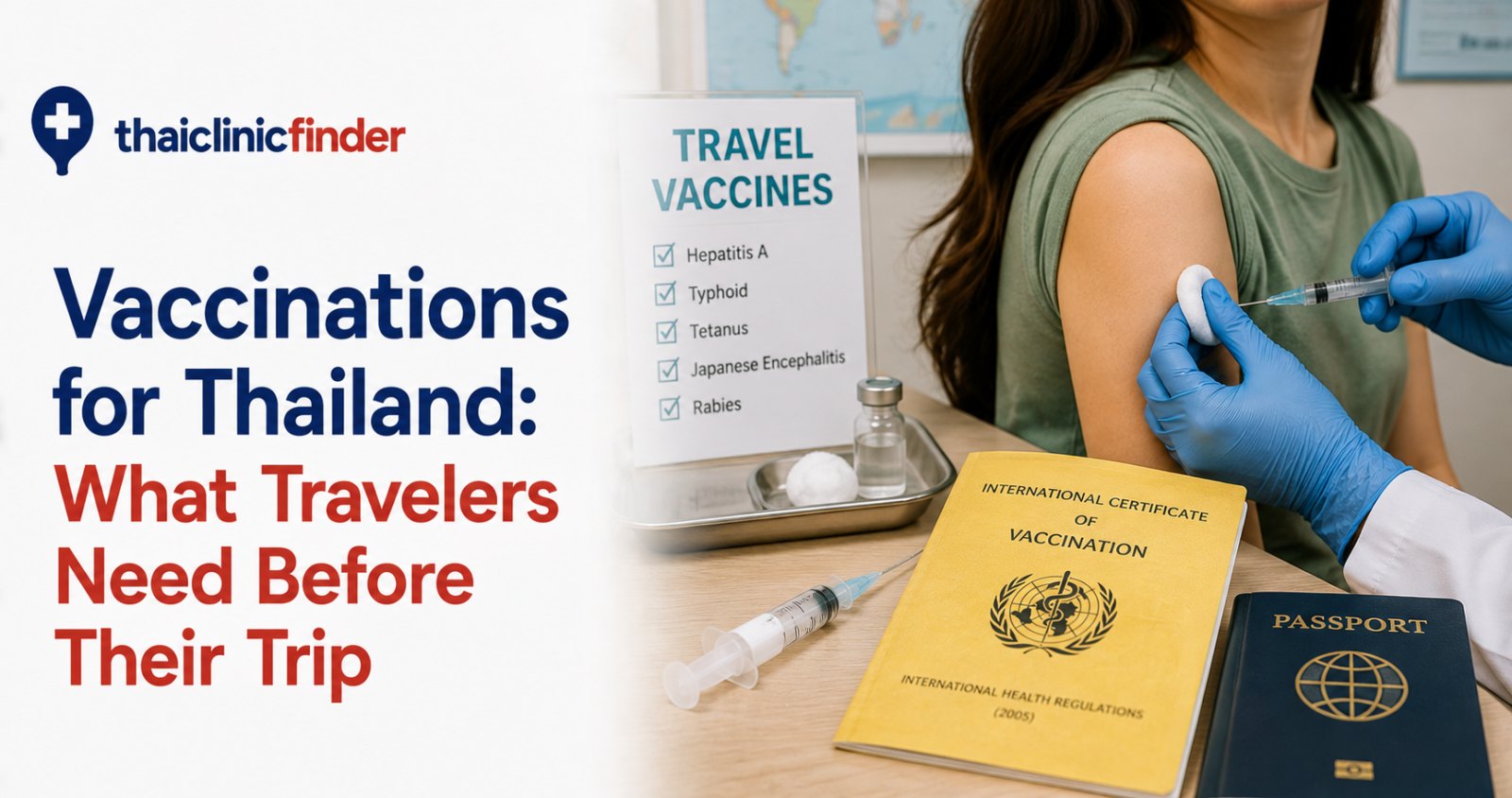
Most travelers do not need a long list of compulsory vaccinations simply to enter Thailand. For many visitors, the priorities are making sure routine vaccines are up to date and considering vaccines such as hepatitis A, hepatitis B and typhoid according to individual risk.
Other vaccines, including Japanese encephalitis and rabies, are mainly considered for particular itineraries, longer stays or activities that increase exposure.
Yellow fever is different. Thailand does not recommend yellow fever vaccination because of local yellow fever risk, but it can require proof of vaccination from travelers arriving from, or having a long airport transit in, countries where yellow fever transmission occurs.
The correct vaccine plan therefore depends on where you are coming from, how long you are staying and what you will do in Thailand.
Which vaccines do most travelers to Thailand need?
CDC currently advises travelers to Thailand to be up to date with routine vaccinations and recommends hepatitis A vaccination in Thailand for unvaccinated travelers aged one year or older.
It also recommends hepatitis B for unvaccinated travelers younger than 60, while unvaccinated travelers aged 60 or older may also choose vaccination before travel.
Typhoid vaccination is recommended for most travelers, particularly people visiting smaller cities or rural areas, staying with friends or relatives, or spending time where food and water hygiene may be less predictable.
For many ordinary tourist itineraries, the most relevant pre-travel discussion therefore includes:
- routine vaccines
- hepatitis A
- hepatitis B
- typhoid
Vaccines such as Japanese encephalitis and rabies depend more heavily on the individual itinerary.
Start by checking your routine vaccines
Travel medicine is not only about exotic diseases.
CDC advises travelers to make sure routine vaccinations are current before every trip. Depending on age and vaccination history, these can include:
- measles, mumps and rubella, or MMR
- diphtheria, tetanus and pertussis
- polio
- influenza
- varicella
- shingles for eligible adults
- COVID-19 vaccination according to current recommendations
A trip is a useful opportunity to discover whether a routine booster has been missed.
This is especially relevant for measles because international travel can expose people to outbreaks even when their destination is not usually associated with the disease.
Hepatitis A is one of the main vaccines to discuss before Thailand
CDC recommends hepatitis A vaccination for unvaccinated travelers aged one year or older going to Thailand.
Hepatitis A spreads mainly through contaminated food and water or close contact with an infected person.
That makes it relevant even for travelers who plan to stay in hotels and eat in established restaurants. Foodborne infections are not restricted to backpacking or rural travel.
CDC also recommends hepatitis A vaccination for infants aged 6 to 11 months traveling to Thailand, although that early travel dose does not count toward the routine childhood two-dose series.
If your departure is very soon, do not assume it is automatically too late to discuss vaccination. A travel-health clinician can advise according to your age, health and departure date.
Hepatitis B matters for more than long-term expats
Hepatitis B spreads through blood and certain body fluids.
Possible exposures during travel can include:
- sexual contact
- tattooing or piercing
- medical or dental treatment
- needles or injections
- accidents requiring emergency medical care
CDC recommends hepatitis B vaccination for unvaccinated travelers younger than 60 traveling to Thailand and states that unvaccinated travelers aged 60 or older may also receive it.
People moving to Thailand, spending extended periods there or expecting repeated travel in Southeast Asia have even more reason to check their hepatitis B status.
Typhoid vaccination is recommended for most travelers
Typhoid fever is caused by Salmonella Typhi and spreads through contaminated food and water.
CDC recommends typhoid vaccination for most travelers to Thailand, especially those staying with friends or relatives or visiting smaller cities or rural areas.
The vaccine does not provide complete protection.
Food and water precautions remain important even after vaccination.
That means you should still:
- wash hands regularly
- choose appropriately cooked food
- use safe drinking water
- be cautious with food that may have been stored at unsafe temperatures
Typhoid vaccination reduces risk rather than creating immunity to every possible foodborne illness.
Japanese encephalitis is not a routine vaccine for every Thailand holiday
Japanese encephalitis, or JE, is transmitted by mosquitoes and occurs in parts of Asia, including Thailand.
The separate guide to the Japanese encephalitis vaccine in Thailand explains eligibility, availability and safety in more detail. CDC recommends vaccination for travelers who:
- are moving to an area with Japanese encephalitis
- plan to spend about a month or longer in risk areas
- frequently travel to areas where JE occurs
Vaccination can also be considered for shorter trips if activities increase exposure, such as:
- visiting rural areas
- hiking
- camping
- sleeping in accommodation without effective screens, air conditioning or bed nets
CDC does not generally recommend JE vaccination for short-term travelers whose itinerary is limited to urban areas or places without a clear seasonal risk.
So a two-week trip focused on Bangkok, shopping and major resorts creates a different decision from a two-month stay involving rural farming areas and repeated outdoor exposure.
Rabies vaccination depends heavily on animal exposure and access to care
Rabies exists in Thailand, and travelers are often exposed to dogs, cats or monkeys in tourist areas.
Pre-exposure rabies vaccination is not automatically required for everyone.
CDC advises considering it according to factors such as whether the traveler will:
- work with animals
- spend substantial time around dogs or wildlife
- participate in activities increasing animal exposure
- stay in locations where prompt access to reliable post-exposure treatment may be difficult
Even if you have received pre-exposure rabies vaccination, an animal bite or scratch still requires prompt medical attention and additional post-exposure vaccination.
Vaccination simplifies post-exposure treatment but does not make a bite something you can ignore.
For what to do after an exposure, see Animal Bites and Rabies in Thailand: What to Do.
Monkeys count as a rabies exposure risk too
Travelers often associate rabies only with stray dogs.
Monkeys can also bite or scratch tourists, particularly where animals are accustomed to being fed or approached.
Avoid:
- feeding monkeys by hand
- trying to touch or hold them
- approaching mothers with young animals
- allowing monkeys to climb onto you
If bitten or scratched, wash the wound thoroughly with soap and water and obtain medical advice promptly.
Do not wait to see whether the animal appears sick.
Chikungunya vaccination may matter for long stays
CDC currently describes Thailand as having elevated chikungunya risk.
Chikungunya is a mosquito-borne viral infection that can cause fever and substantial joint pain.
CDC states that chikungunya vaccination may be considered for people traveling or moving to Thailand when they plan to stay for an extended period, such as six months or more.
This is not currently presented as a standard vaccine for every short-term visitor.
If you are relocating to Thailand or spending much of the year there, it is worth including chikungunya in a travel-medicine consultation.
What about dengue vaccination?
Dengue is one of the most important mosquito-borne infections in Thailand, but vaccination recommendations are more complicated than simply getting a travel shot before departure.
Dengue vaccination in Thailand has specific eligibility and safety considerations and is not a routine pre-travel recommendation for the average short-term visitor.
For most travelers, mosquito-bite prevention remains the main practical measure.
Use repellent, appropriate clothing and accommodation that limits mosquito exposure.
For detailed local guidance, see Dengue Fever in Thailand: Symptoms, Risk Areas and Prevention.
Yellow fever vaccine is usually about where you are arriving from
Thailand does not have a recommendation for yellow fever vaccination because of yellow fever transmission within Thailand.
However, Thailand can require a yellow fever vaccination certificate from certain incoming travelers.
CDC currently states that Thailand requires proof of yellow fever vaccination for travelers aged 9 months or older arriving from countries with risk of yellow fever virus transmission.
The rule also includes travelers who have spent more than 12 hours in airport transit or layover in a country with yellow fever risk.
Direct travelers arriving from countries such as the United States without relevant yellow fever exposure do not need the vaccine for entry.
This means your flight route can matter as much as your nationality.
A long airport connection can change the yellow fever requirement
Suppose you are flying to Bangkok from a country with no yellow fever risk but connect through a yellow fever risk country.
A short airside connection may not create the same entry requirement as a transit exceeding 12 hours.
CDC specifically notes the >12-hour transit threshold in Thailand's current entry requirements.
If your itinerary includes Africa or South America, check the current yellow fever rules carefully before departure.
Do not rely exclusively on advice written for travelers flying directly from Europe, Australia or North America.
Keep the yellow fever certificate with your travel documents
Yellow fever vaccination for international travel is documented using the International Certificate of Vaccination or Prophylaxis, commonly called the yellow card or yellow book.
WHO states that a single documented dose of an approved yellow fever vaccine is accepted as providing lifelong validity for international certification purposes under current International Health Regulations.
Thailand's Department of Disease Control also advises travelers using its yellow book to keep the certificate with their passport when traveling internationally.
If Thailand requires proof based on your route, have the original document available rather than relying only on a photograph on your phone.
There is no general yellow fever requirement for travelers arriving directly from Europe
A traveler flying directly from Spain, the United Kingdom, France, Germany or another country without yellow fever transmission does not normally need yellow fever vaccination simply because the destination is Thailand.
The same principle applies to many direct journeys from North America and East Asia.
The requirement is linked to recent presence or prolonged transit in a yellow fever risk country, not simply to holding a particular passport.
Because international health regulations can change, travelers with complex routes should confirm the current rule close to departure.
Cholera vaccination is not routinely recommended for Thailand
CDC currently states that there is no longer active cholera transmission in Thailand and does not recommend cholera vaccination for routine travelers to the country.
This is another example of why adding every available travel vaccine is unnecessary.
Vaccination decisions should follow actual risk rather than the idea that Southeast Asia automatically requires every possible vaccine.
What about malaria? There is no routine malaria vaccine for travelers
Malaria prevention for international travelers to Thailand is currently based primarily on mosquito avoidance and, for particular risk areas, prescription preventive medication.
CDC recommends malaria chemoprophylaxis only for certain areas of Thailand rather than all travelers.
Risk is concentrated mainly in rural forest and forest-fringe areas near international borders.
For most popular urban and resort itineraries, the malaria decision is very different from a trek in a remote border region.
See Malaria in Thailand: Risk Areas, Prevention and What Travelers Should Know for the current geographic guidance.
Bangkok and the islands require a different conversation from rural Thailand
A traveler spending ten days between Bangkok and a major beach destination generally has a different exposure profile from someone who will spend months in rural northern or border areas.
For a conventional urban and resort trip, the discussion often focuses on:
- routine vaccinations
- hepatitis A
- hepatitis B
- typhoid
Japanese encephalitis and pre-exposure rabies vaccination become more relevant as the trip gets longer, more rural or more difficult to access medical care from.
The destination name Thailand is therefore not detailed enough by itself to determine the perfect vaccine plan.
Backpackers should think about activities, not the backpacker label
Being a backpacker does not automatically mean you need a particular vaccine.
What matters is what the trip actually involves.
Risk can increase if you plan to:
- stay for months rather than days
- travel through rural areas
- camp or trek
- stay in basic accommodation
- have substantial animal exposure
- spend time far from reliable medical services
- visit multiple Southeast Asian countries
A traveler moving through Thailand, Laos, Cambodia and other destinations may need a different vaccine plan from someone staying entirely in central Bangkok.
Expats and long-term residents should review more than short-trip advice
Someone moving to Thailand for a year has much more cumulative exposure than a person visiting for two weeks.
Long-term residents may want to discuss:
- hepatitis A
- hepatitis B
- typhoid depending on lifestyle
- Japanese encephalitis
- rabies
- chikungunya
- routine boosters
The decision also depends on travel outside Thailand. An expat based in Bangkok may regularly visit rural Thailand or neighboring countries, changing the long-term risk profile.
Vaccination planning for residents should therefore be reviewed periodically rather than completed once before the original move.
How long before Thailand should you get vaccinated?
Ideally, arrange a travel-health consultation several weeks before departure.
Some vaccines require multiple doses or need time for the immune response to develop.
However, being a late planner does not mean you should skip the consultation entirely.
Some vaccines can still provide useful protection when started relatively close to departure, and accelerated schedules may exist for particular products or circumstances.
Bring your vaccination record if you have one so the clinician does not have to rely on memory.
Do you need boosters?
That depends on the vaccine and your previous doses.
A travel appointment should start by establishing what you have already received.
For example, someone who completed hepatitis A or hepatitis B vaccination previously may not need to restart the series simply because they are visiting Thailand.
Tetanus-containing vaccines are also part of routine immunization schedules, so the relevant question is when your last dose was and whether you are up to date under your country's schedule.
Do not assume that every vaccine listed on a travel website means another dose is automatically needed.
Can you get travel vaccines after arriving in Thailand?
Thailand has hospitals and travel-medicine services capable of providing vaccinations, particularly in Bangkok and other major cities.
However, arranging vaccines before travel is usually simpler when protection is needed from the beginning of the trip.
Getting vaccinated after arrival may also be too late for an exposure occurring during your first few days.
Post-exposure vaccines are a separate matter. Rabies vaccination after a bite, for example, should be arranged immediately rather than delayed until returning home.
Vaccines do not replace food and water precautions
Even vaccinated travelers can develop gastrointestinal illness.
Typhoid vaccine is not completely effective, and no routine travel vaccine protects against the many causes of ordinary travellers' diarrhea and food poisoning.
Continue basic precautions with:
- food handling
- drinking water
- hand hygiene
- raw or undercooked foods
For what to do if you become ill, see Diarrhea in Thailand: Causes, Treatment and When to See a Doctor and Food Poisoning in Thailand: Symptoms, Treatment and What to Do.
Vaccines do not replace mosquito protection either
Japanese encephalitis or other vaccination decisions address only specific diseases.
Thailand also has mosquito-borne illnesses for which vaccination may not be routinely available or appropriate to the average traveler.
Use mosquito precautions such as:
- effective insect repellent
- long clothing when practical
- screened or air-conditioned accommodation
- bed nets when accommodation requires them
See Mosquito Bites in Thailand: Risks and Prevention for the wider mosquito-borne disease picture.
Travelers with medical conditions need an individual plan
Vaccine recommendations can change according to:
- age
- pregnancy
- immune suppression
- severe allergies
- previous vaccine reactions
- chronic medical conditions
- regular medication
Some live vaccines are unsuitable for particular patients.
Do not use a generic Thailand vaccine checklist as a substitute for medical advice when you have a condition that affects the immune system or vaccine safety.
Pregnancy requires a more careful discussion
Pregnancy can alter both infection risk and which vaccines are appropriate.
For example, live vaccines such as yellow fever may require an individual risk-benefit assessment in circumstances where vaccination would otherwise be indicated.
Pregnant travelers should discuss the complete itinerary, not only Thailand, because mosquito-borne diseases and vaccine requirements can differ between countries on a multi-stop journey.
Children may follow different age rules
Travel vaccine recommendations and minimum ages vary by vaccine.
CDC, for example, recommends hepatitis A vaccination for infants aged 6 to 11 months traveling to Thailand, but that travel dose does not count toward the standard routine series.
Yellow fever entry requirements also use specific age thresholds.
Parents should therefore obtain pediatric travel advice rather than applying an adult vaccine checklist to a child.
What should you bring to a travel-vaccine appointment?
Take:
- your vaccination record
- exact departure date
- full itinerary
- planned activities
- details of rural stays or trekking
- information about animal contact
- regular medications
- relevant medical history
- previous serious vaccine reactions
If your route includes a yellow fever risk country, mention the flight connections and transit duration, not just your final departure country.
That detail can affect Thailand's entry requirement.
A practical vaccine checklist for Thailand
For most travelers, work through the list in this order:
- Confirm routine vaccines are current.
- Check hepatitis A status.
- Check hepatitis B status.
- Discuss typhoid according to itinerary and food exposure.
- Consider Japanese encephalitis for longer, rural or higher-exposure travel.
- Consider pre-exposure rabies vaccination if animal exposure or difficulty obtaining treatment could be significant.
- Discuss chikungunya vaccination if moving to Thailand or staying for an extended period.
- Check whether your route creates a yellow fever certificate requirement.
- Review malaria prevention separately for any border or forest itinerary.
You may need only part of this list.
What travelers usually get wrong
The most common misconception is asking, What vaccines are mandatory for Thailand? and assuming the answer will also tell you which vaccines are medically worthwhile.
Entry requirements and health recommendations are different things.
For many travelers, no vaccine certificate is required at immigration, yet hepatitis A or other vaccinations may still be recommended for health protection.
Conversely, yellow fever vaccination can become an entry requirement because of where you traveled before Thailand even though yellow fever is not a local Thai travel risk.
The simple answer before you book the appointment
For the average traveler, Thailand does not require a special vaccination certificate when arriving directly from a country without yellow fever risk.
Make sure your routine vaccines are current. CDC recommends hepatitis A for unvaccinated travelers, recommends hepatitis B for unvaccinated travelers under 60 and recommends typhoid for most travelers.
Japanese encephalitis, rabies and chikungunya are more selective decisions based on duration, location and activities.
If your itinerary includes a yellow fever risk country, check the entry rules carefully because Thailand currently requires a valid vaccination certificate for travelers aged nine months or older arriving from those areas, including certain airport transits longer than 12 hours.
A travel-health consultation based on your actual itinerary is more useful than trying to collect every vaccine associated with Southeast Asia.
Frequently Asked Questions
What vaccinations do I need for Thailand?
Travelers should be up to date with routine vaccines. CDC recommends hepatitis A for unvaccinated travelers, hepatitis B for unvaccinated travelers younger than 60, with vaccination also available for older travelers, and typhoid for most travelers. Japanese encephalitis and rabies are considered according to itinerary and exposure.
Are any vaccines mandatory for Thailand?
Most travelers arriving directly from countries without yellow fever risk do not need a vaccination certificate for entry. Thailand does require proof of yellow fever vaccination for certain travelers arriving from yellow fever risk countries.
Do I need yellow fever vaccination for Thailand?
Not because Thailand itself has yellow fever risk. However, Thailand requires a yellow fever vaccination certificate for travelers aged 9 months or older arriving from countries with yellow fever transmission risk, including airport transits longer than 12 hours in those countries.
Do I need hepatitis A vaccination for Thailand?
CDC recommends hepatitis A vaccination for unvaccinated travelers aged one year or older going to Thailand. It also recommends a travel dose for infants aged 6 to 11 months.
Do I need typhoid vaccine for Thailand?
CDC recommends typhoid vaccination for most travelers, particularly those staying with friends or relatives or visiting smaller cities and rural areas. Food and water precautions remain necessary because vaccination is not completely effective.
Do I need Japanese encephalitis vaccine for Thailand?
Usually not for a short urban holiday. CDC recommends it for people moving to risk areas, staying for about a month or more, or frequently traveling there. It can also be considered for shorter trips involving substantial rural or outdoor exposure.
Should I get a rabies vaccine before Thailand?
Pre-exposure rabies vaccination is considered according to animal exposure and how easily you could obtain prompt post-exposure treatment. It can be particularly relevant for people working with animals, spending significant time around them or traveling remotely.
How long before Thailand should I get vaccinated?
Ideally arrange a travel-health consultation several weeks before departure because some vaccines require more than one dose. If your trip is sooner, it can still be worthwhile to seek advice because some protection can be started close to departure.
Do I need cholera vaccination for Thailand?
CDC currently states that there is no active cholera transmission in Thailand and does not recommend cholera vaccination for routine travelers.
Do I need malaria tablets for Thailand?
Only for certain risk areas. CDC recommends preventive medication for travelers going to specific malaria transmission areas, mainly rural forest and border regions. Many major tourist destinations have very low or no transmission.
Sources

Writer
Niran Chaiyasit
Niran Chaiyasit is a Thai health writer with a background in public health and a focus on travel health, disease prevention and healthcare access in Thailand. His work covers topics such as common illnesses, vaccinations, mosquito-borne diseases, food safety and practical health information for travelers and expatriates.

Medical review
Justin Brooks
Justin Brooks is an American health writer with a background in health sciences and a focus on rehabilitation, musculoskeletal health and patient education. He writes about physiotherapy, injury recovery, pain management, preventive health and practical healthcare guidance for international patients and travelers.